



By Visar Zhiti
Part Eight
Memory Plates and Sacks…!
Continued from the previous issue
AFTER PRISON, ESCAPE TOWARD FREEDOM, TO THE USA
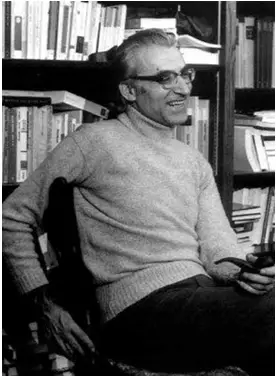
Arshi Pipa (1920–1997)
The poet, essayist, philosopher, linguist, translator, and pedagogue Arshi Pipa would be the one to realize that dream of all political prisoners: escape.
To escape, not only from prison, but also from the Albania of the “red dictatorship” and to show the world the terrible sentences, the harsh imprisonment, the suffering of a people without freedom, divided by class warfare when there were no more classes, without human rights, without faith… without…!
“Writers go abroad – those of the party – but they don’t open their mouths. Shame! A thousand times shame!” they used to say in prison.
He was from Libohovë but born in Shkodër in 1920, to a father who was a lawyer, a graduate of Istanbul. Arshi received his early education at the Saverian College, then at the Shkodër classical high school, and later studied Literature and Philosophy at the University of Florence, graduating with a thesis on “Morality and Religion in Bergson.” He returned to his homeland in 1941 and taught philosophy at state lyceums in Tirana, Shkodër, and Durrës.
In 1944, he published his first poetry book, The Luminaries.
After the war, at the Writers’ Union, on the steering council, when the magazine Bota e re (The New World) began to appear, only Pipa and Kuteli were not communists. But soon both of them and others would be arrested.
In 1947, Pipa was accused of having “directed magazines with fascist ideology and of telling students that the communist government is terrorist” and was sentenced to 20 years in prison.
His suffering began in the Durrës prison, and then continued in the Gjirokastër Castle, in Burrel and Korçë, and in the extermination camps in the Vloçisht marsh. During his sentence, they wanted him to teach philosophy and foreign languages, just as they used slaves.
He was released in 1956 and one year later, in the summer, he escaped together with his sister. He took with him the “Prison Book” – poems written secretly on thin cigarette paper. They were barely the size of a matchbox and he would publish them in Rome in 1959.
A gloomy, deathly gray that also flooded the covers, a true downfall, where the Sonnets of the Canal of that terrible prison marsh would be, in my opinion, the “Hell” of Albanian poetry.
But come now, look at that canal:
One thousand three hundred men, one misery.
Shovels and spades shake with fury
and wheelbarrows empty the marsh’s felt.
Three and a half cubic meters per person.
Be you a grandfather who has a son and grandson,
or be you sick just out of hospital,
do it or die: moaning does no good.
You see the maimed and old, loaded on their backs
with heavy pickaxes and wheelbarrows over their heads,
who fall and rise and stagger, dragging.
The policeman urges them on with his club as much as he can,
but sometimes one of them does not move.
The guard takes him away, and the guard returns with a coffin.
In prison he also wrote the poem “Rusha”, which he published in Munich in 1968. Arshi Pipa would emigrate to the United States, become a pedagogue and associate professor, lecturing in philosophy, literature, and Italian at several American universities, directing seminars on literary criticism, etc., on the great writers Dante, Boccaccio, Leopardi, Manzoni, Ungaretti, and Montale, etc., on Italian Hermeticism and French Symbolism, etc., on comparative topics such as Marxism and Existentialism in fiction and drama, etc.
After leaving lecturing, he would settle permanently in Washington, D.C., and strengthen his ties with “Vatra” (The Hearth) of Albanians and their newspaper Dielli (The Sun), showing through articles how they could organise themselves better.
In 1991, Pipa was elected President of “Vatra” without having been a member of it. He worked for one year to put “Vatra” back at the service of the nation’s important issues: democracy in Albania and the liberation of Kosovo…!
I too would go to his home to meet him in Washington on a day in August 1994. The way he looked at me, deeply. “I attach importance to having been in prison, for a writer,” he said…!
He gave me some of his books signed and handed me the manuscript of his translations from Latin, Italian, French, German, and English of great classical poets, rendered in Geg and Tosk, as suited them better, according to him.
I remember that the bookshelves on the walls were almost empty and looked to me like rows of coffins. He had donated his very rich library to Shkodër and was waiting for death with magnificent calm. Meanwhile, he continued to work.
His studies are numerous and important, placing Arshi Pipa on a world level. The professor had also published, in English, a study “Montale and Dante”, with permission from Montale himself, which would in a way presage the Nobel Prize that would be awarded to the Genoese poet. The work has been translated into Italian and Albanian as well.
I want to single out his study on the literature of Socialist Realism – a contribution to a new order in literature, according to other scholars. Likewise, his work on the unified Albanian language. Language. His voice. “It is hoarse,” he told me, “since prison, my larynx became diseased…!” I was seized with terror when I thought of the language being ill.
He died on 20 July 1997 in Washington, D.C. That year in Albania, weapons had been seized – everyone against everyone, a war without war, but with killings and flight. The democracy that had not yet been built had collapsed. Professor Arshi Pipa’s last wish was that his body be cremated and the ashes scattered over the waters of the Adriatic.
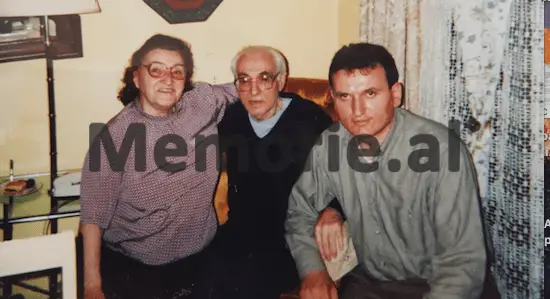
The Humanist, Sami Repishti
…and he, from the death marsh, across the ocean to the USA. Free, in knowledge, in values, in great work for great works… would also find a fellow sufferer – their sufferings would unite them to do more for the homeland. With culture… writer, historian and humanist, activist for the Albanian cause in the West, in the USA, where he lives.
There I met him, “At the New York Trial,” as the launch of my two “prisonogies”, Roads of Hell and Hell Torn Open, was called in 2013, organised by the “House of Freedom”…
In his letters, Mr. Sami Repishti always addresses me with the word “colleague” and does not forget to add the touching phrase “fellow sufferer”…!
Yes, he had been sentenced to 15 years in prison for “agitation and propaganda”, suffered them also in the marsh-hell of Vloçisht, in Shkodër prison, etc., and after prison had to work again in the canals, clearing grass, until he escaped in 1959.
He came from a patriotic Shkodër family; his father, Hafiz Ibrahim, was also a deputy. Sami, while attending the “Oso Kuka” high school in Shkodër, became involved with the communist movement, which became especially fervent after the occupation by Fascist Italy. And he went to study exactly there, in Florence, having won the competition for the Faculty of History.
During the summer holidays in his native village of Repishtë, the fascists arrested his father for having sheltered communists, tortured him, and he died in prison.
Sami, being the eldest in the house, was forced to work to support the family, while also fighting against the occupier.
With the arrival of the victors, he worked for the new regime in the Reconstruction sector and also founded the “Democratic Youth Organisation”, distributed tracts; to a British MP who visited Shkodër, he handed a memorandum to help the families of those who had fled.
…he escapes from Yugoslavia as well, goes to Italy, receives political asylum, and then immigrates to the USA, where he meets his father’s friend, Monsignor Fan Noli.
He earned a doctorate from the French Department at the City University of New York and taught at American colleges for 25 years.
Committed to human rights and Kosovo, he has over 100 studies and articles on these issues, collaborated with the White House, and organised international conferences on Kosovo together with the other escapee and fellow sufferer, Professor Arshi Pipa.
And he continues to do so…
He has published his prison stories in the book Drop of Tears – pain and breath – and later expands the narrative of his life in Under the Shadow of Rozafa, with the metaphor of walling-in and with the milk of patriotism.
UNFORTUNATE RETURNS… The File of the Qiriazi Sisters
There were also returns – they would come from exile, even from the USA, to serve the homeland, but they would end badly, in prisons or madness.
The Qiriazi sisters, enlightened teachers, came from a large patriotic family from the city of Bitola, founders of Albanian education.
Sevasti Qiriazi (1871–1949)
She received the blessing of the National Poet Naim Frashëri and began her studies in Istanbul at the renowned American school, Robert College. She was the first Albanian woman there.
She came to the homeland and worked with others to open the first girls’ school in Korçë in 1891, known as the Qiriazi Family School.
She participated in the Congress of Bitola on the Albanian alphabet and prepared school textbooks.
Parashqevi Qiriazi (1880–1970)
In the new century, the 20th, she too began studying literature at Robert College in Istanbul. Upon finishing, she returned to her homeland and began working at their girls’ school in Korçë. She is the author of the first Albanian primer with the Latin alphabet of Bitola and of its hymn, which is still sung today.
The path of the Qiriazi Sisters, with their families, would be shared.
In the year of Independence, 1912, they went to Romania and then to the USA. Parashqevi defended her Master’s degree at Oberlin College in Ohio on “The Development of Schools in the Turkish Empire and an Ideal Education System for Albania.”
She earned an academic degree. She drafted the educational program for the first government of Ismail Qemali and published in Chicago a work: The Girls’ School – Korçë (The School for Girls – Kortcha, Albania).
In Boston she published the magazine Ylli i Mëngjesit (The Morning Star) and in 1919 she went as a delegate to the Paris Peace Conference – the only woman.
Back again in the homeland, at their school, the girls’ school. The younger sister would become the director.
Their educational activity also moved to Tirana, to their properties in Kamëz, where they built schools…!
The Qiriazis as a family were arrested by the German Nazi forces in the brutal year 1943 and sent to an internment camp near Belgrade.
They survived, but the persecution in the homeland by the victors would be harsher. Looting, confiscations, oblivion, prisons, being thrown out into the street…!
They took away their school in Kamëz – because there they were going to open courses for the partisans, even though the war had ended, they remained partisans, for the class war, executions, and endless imprisonments.
Teacher Sevasti Qiriazi’s two sons were arrested: Aleksandër, who had been Chilean consul in Rome, and Gjergj, a surgeon, accused of being American agents. Gjergj, after three years, hanged himself in prison – he could not endure that endless torture…!
Mother Sevasti asked for her son’s body; they told her they had thrown it over there by the Lana River. She found it, washed it with her tears, and hid it there under leaves and grass so she could come and take it at night, but she never found it again. The soil had been ploughed by a tractor.
She could no longer endure either the homeland or life, and she died in 1949. Parashqevi also died in Tirana, in 1970, forgotten…!
“Post mortem”, amazingly, they were decorated. The wounds shine all the more.
***
The Albanian Middle Ages also had universities. In Latin: Universitas Studiorum Dyrrhachium, founded in the Kingdom of Arbëria around 1380 – the first in the Balkans and among the first in Europe.
The culture of socialism, led by the Party, by the teachings of Marxism-Leninism and comrade Enver, liked to have no other beginnings but its own – with them everything had to start.
The New Man and the new schools… the schools of hatred. Even the Albanian Army would have its creation date as that of their army of the young partisans, forgetting that the Albanian Kingdom also had an army, that Skanderbeg in the middle Ages created a wonderful army that resisted hand-to-hand against the greatest superpower in the world, the Ottoman Empire. And the Illyrians, Queen Teuta, the two Bato, etc., etc.
The party would also build the first railway, when the Austro-Hungarians had already built railways in Albania. Enver Hoxha’s party would found aviation, when during “Zog’s time” there were air routes, and with Albanian aviators, domestic flights – something that did not exist in socialism and still does not exist today.
Even in the arts, with them had to begin theatre, cinema, ballet, the socialist novel, the first woman writer, the martyrs, sculpture, the first Albanian opera, etc., etc. But it was the second half of the 20th century – one could not avoid development. One had to continue what had been started, what had been interrupted. To start those things that was needed…! / Memorie.al