

By Bashkim Trenova
Part Seventeen
NAZIBOLSHEVISM – LITERATURE AND ARTS
PREFACE
Memorie.al / Historians, political philosophers, intellectuals from various schools or different positions have devoted thousands upon thousands of pages, entire volumes, studies and articles to the comparison between Nazism and communism. Generally, in their publications and studies, the focus is on the police control of society by these dictatorships, the role of the dictatorial state hierarchy and the head of state as suppressors of free thought, the omnipresent place of official propaganda in society, the mass massacres and the network of concentration camps, the activities of the police, the NKVD in the USSR (later the KGB) and the Gestapo in the Third Reich. In his book Le Passé d’une illusion (The Past of an Illusion), François Furet notes that Nazism and communism share the same opposition to liberal democracy and what they call “capitalist bourgeoisie.” Both ideologies claim to be socialist and use the image of socialism. Communist countries called themselves “socialist.” “Nazism” is a shortening of National Socialism.
Continued from the previous issue
Chapter III
FILM
During the Weimar Republic, Germany was also known as the Mecca of European film. UFA, the oldest film production company in Germany, founded in 1917, came right after Hollywood. During this time, films were made that have entered the history of cinema, such as Fritz Lang’s Metropolis, a silent, black-and-white science fiction film from 1927. Metropolis has been acclaimed in film history as one of the masterpieces of art in this field, a film that demonstrates its powerful and multifaceted influence even today, especially in popular culture. In 2001, it became the first film on UNESCO’s International World Registry.
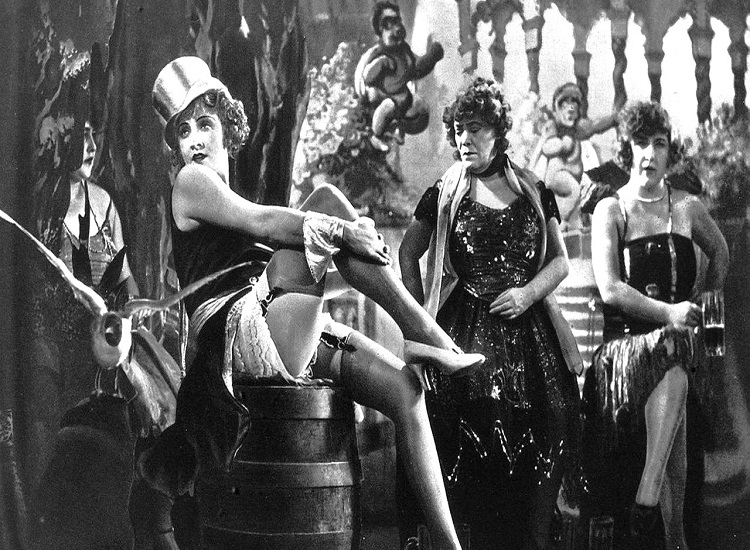
Another film from this period is Der blaue Engel (The Blue Angel) by Josef von Sternberg, featuring Marlene Dietrich. The Blue Angel is a tragicomedy and one of the first German sound films. It was made in 1929-30 and is regarded today as a classic film that is part of the world’s cinematic wealth. Hitler’s rise to power would completely change the fate of German cinema, the lives of its artists and directors. Hitler and Goebbels instrumentalised film as well.
In fact, the Nazis constantly and publicly demonstrated their hostility towards films made up to that time by German cinema, as well as non-German films that did not reflect or contradicted Nazi ideology, its ambitions and the appetites of its bearers. The SA (the Nazi paramilitary organization Sturmabteilung, later the SS) as well as Nazi student youth organized intimidating campaigns against liberal, Jewish or Marxist intellectuals before the Nazis came to power. The violent gatherings of the SA in cinemas across the country are known, aimed at preventing the screening of the film Im Westen nichts Neues (All Quiet on the Western Front), based on the novel of the same name by Erich Maria Remarque. The novel, as well as the film, is permeated by pacifist ideas. The film was removed from screens after a week of riots in cinema halls.
For the Nazis, beauty and aesthetic emotion should only be used for entirely ideological purposes. On 22 September 1933, the Reichskulturkammer (Reich Chamber of Culture) was created to place every cultural activity, including cinematography, under the tutelage of the Ministry of Propaganda. In a speech given on 15 November 1933 at the Reich Chamber of Culture on the occasion of the inauguration of the Berlin Philharmonic, Joseph Goebbels declared: “No one, be they strong or weak, has the right to use their freedom to the detriment of the national freedom of expression…! The same goes for creative artists.”
The German director Veit Harlan, in his book Le cinéma allemand selon Goebbels (German Cinema according to Goebbels) published in 1974, writes: “The director sends the projects to the minister, who gives his approval on the subject, distribution and shooting scenes, thus being, sometimes, at the origin of restructurings and profound changes. Immediately after the end of shooting, he appears before the minister in the ministry’s screening room. Often, Joseph Goebbels makes further changes (removal of a scene, request for a change to the ending, etc.)…! I had to constantly make changes, which were then changed again. In the scripts, one could see, here and there, the suspect; ‘the ministerial green pencil’, used by Goebbels. Entire pages written by Goebbels himself had to be included. ‘The green pencil’ had the force of law.”
We may recall that the Lichtspielgesetz (Film Law) of 16 February 1934 is among the first laws passed by the regime. It was preceded by the law of 23 June 1933, the Gesetz über die Vorführung ausländischer Bildstreifen (Law on the Screening of Foreign Films). On its basis, the projection of all foreign films that did not conform to Nazi doctrine, Nazi morality, that threatened the reputation of Hitler’s Reich Germany, was prohibited.
Based on the Lichtspielgesetz, the Nazi power had the right to direct uncontrollably, according to its interests, the entire film production, from the choice of subject to the most formal details. In implementation of the above law, all scripts were compulsorily checked by the Reichsfilmdramaturg (Reich Film Censorship) to assess their compliance with Nazi doctrine. After completion, the film was again subjected to a censorship committee within the Ministry of Propaganda.
The law of 16 February 1934 was promptly supplemented with many amendments that further strengthened the Nazi regime’s control over film conception and production. By an order of 3 July 1935, all films shot before January 1933 were subjected to a censorship commission. (4) The Reich Ministry of Propaganda ordered the establishment of the Reichsfilmkammer (Reich Film Chamber) composed of ten official sectors and a host of intermediary bodies as well as the Filmkreditbank (Film Credit Bank – established on 1 June 1933), which would finance a film only after official approval.
In 1936, Goebbels placed the large UFA studio under his complete and direct control. That year, it owned 109 cinemas with 119,126 seats throughout Germany, 20 of them alone in the centre of Berlin. UFA was transformed into a trust known as UFA-Filmkunst GmbH, composed of many branches, such as: Terra Filmkunst GmbH, Wien-film, Berlin-Film GmbH, Bavaria-Filmkunst GmbH, Ostmärkische Filmtheater Betriebe, Deutsche Lichtspielbau, Tobis, Prag-Film AG, La Continentale in France, etc. These companies covered all branches of the film industry.
The Nazis saw cinema as a tool of propaganda, as an integral part of the National Socialist system, as a factor that educated submission to their ideology. According to Goebbels, “cinema is one of the most modern means of acting upon the masses.” (5). Again according to him, cinema is an “instrument of national education.” Cinema was a miracle for the Nazi leaders. It touches the spectator, processes him, and moves him. It conveys, in a refined, “artistic” manner, their messages about the “role” and “duties” that belong to every citizen in the fate of the country, and diverts his attention from real, vital problems. The film attracts the spectator’s attention using a pedagogy that not only manipulates his emotions and feelings, his formation and aesthetic inclinations, but also his security or insecurity, his responsibility or irresponsibility.
Hitlerian propaganda in the field of cinematography played across a wide range – one could say across all possible, different registers. Its scope ranges from scientific “objectivity” to moral and cultural values, from historical, imaginary, documentary film to animated film, not forgetting advertising. Sometimes it penetrated as natural, “invisible”; other times it was violent, threatening or terrorising.
Regardless of the forms, the high technical or, not infrequently, artistic level, regardless of the subjects treated and the methods used, German film bears the stamp of the Nazi Party. It faithfully served the policy of mass indoctrination of the German people by promising them, as real, the rediscovery of a former lost paradise. At the same time, it served Hitler’s aggressive, expansionist policy by “naturally” injecting theories of the superior race, the Aryan race, social Darwinism. This truth is evidenced even by the films made by his followers before 1933, the year the Hitlerites came to power.
In the Nazi films that preceded those of the Third Reich, one can observe the presence of several “sacred” and guiding themes for the rulers of the regime after the Weimar Republic. The 1930 film Die Letzte Kompanie (The Last Company) conveys to the viewer the spirit of aggressive nationalism. The same year’s film Ein Burschenlied aus Heidelberg (A Boys’ Song from Heidelberg) centres on youth according to the Nazi view. The antisemitic film Liebling des Götter (The Gods’ Favourite) also dates from 1930. Another film from this time is Des Flötenkonzert von Sans-Souci (The Flute Concert of Sans-Souci), which centres on a hero of German history. Subsequently, in 1932, Der Rebell (The Rebel) was made, and in 1933 the film Morgenrot (Dawn).
Generally, the films of these years deal with the problem of strengthening national unity, respecting traditions and annihilating the subhuman. At their centre are also the mythology of ancient Greece, neoclassicism (mainly the history of Bavaria and Germany). German Nazi or pro-Nazi cinema of these years is permeated by ideas exalting nature, the Germanic hearth, and a racist, militaristic state. It is antisemitic and against the “red terror”, etc. German cinema continued its journey along these “tracks” even after the Hitlerites came to power. In 1933, under Goebbels’ control, production began on three films or a propagandistic triptych. These are SA-Mann Brand (SA Man Brand) by Franz Seitz, Hitlerjunge Quex (Hitler Youth Quex) by Hans Steinhoff, and Hans Westmar by Franz Wenzler.
The first film presents the story of truck driver Fritz Brand, who joins the Sturmabteilung, a paramilitary organisation of the Nazi Party, the predecessor of the Nazi SS. He convinces his circle of the urgent need to defend the homeland from the red danger and the necessity of supporting Hitler. The second film is dedicated to the young Heini Völker, who enlists in the ranks of the Hitler Youth, despite the opposition of his communist father. Heini Völker is killed by communist militants. The third film, Hans Westmar, is almost a parallel to Hitlerjunge Quex. All three films spread the myth of the young hero who sacrifices himself for a great cause.
Through images of brownshirt parades and street violence, they nourish the militaristic, dictatorial ideas of the regime, glorify the Nazi Party. In the film production industry, in the service of Nazi propaganda and ideology, the names of several well-known filmmakers of the time are encountered. “Several pioneers of German cinema also collaborated with Goebbels, such as: Carl Froelich, Carl Hoffmann, Peter Ostermayr, Paul Wegener, Walter Ruttmann… Great actors of the silent film era and the beginning of sound film such as… Alfred Abel, Lil Dagover, Gustav Fröhlich, Gustav Gründgens, Emil Jannings, Rudolf Klein-Rogge or Werner Krauss. Some personalities of German cinema who preached leftist ideas during the Weimar Republic became associated with the Nazi regime, such as directors Phil Jutzi and, later, Werner Hochbaum…”
In fact, an even larger number of filmmakers, directors, artists, cameramen, etc., collaborated with Nazism – open adherents, but also opportunists and careerists. The most typical case is perhaps that of Leni Riefenstahl. In February 1937, during a tour in the USA, Leni Riefenstahl declared to a journalist from the Detroit News: “For me, Hitler is the greatest man who has ever lived.” In 1993, when questioned in the context of Ray Müller’s documentary Die Macht der Bilder: Leni Riefenstahl (The Wonderful and Horrible Life of Leni Riefenstahl), she completely denied having served Nazi propaganda. She admits no mistake in her past. And, while she does not hide some kind of affinity (human…!?) with Adolf, she absolutely refuses to have been mixed up in the Nazi cauldron!
Leni Riefenstahl, former actress and later film director, was admired by Goebbels and taken under the personal protection of Hitler, who was passionate about cinema. She agreed to put her talent at the service of the Nazi regime and became the official filmmaker of the Hitlerian Reich. In 1933, Hitler asked her to film the Nuremberg Nazi Party Congress. “For this commission – to stage, evaluate and glorify the great neo-pagan mass desired by Hitler – considerable technical and human resources were placed at her disposal… 170 technicians, including 18 cameramen, 4 sound teams and 30 cameras!” The film was titled: Der Sieg des Glaubens (The Victory of Faith). Then, in 1934, she made Triumph des Willens (Triumph of the Will) and later the propagandistic documentary Olympia about the 1936 Olympic Games held in Berlin. All three films exalt her personal friend, Hitler, his model creation – the Nazi Party, as well as his narcissistic and annihilating ideas of the Aryan force and northern beauty. Olympia draws a parallel between the ideal of the ancient body and German athletes, thus illustrating one of the fundamental lines of Nazi ideology – racial purity.
Seeking to disseminate Nazi messages to the general public, the regime widely supported the production of documentary films of supposedly historical character, but which openly and flagrantly distorted facts and world history, spreading counter-“historical” truths. Such is the short film Zeugen deutscher Vorzeit (Relics of the German Past) from 1935, where archaeological finds and various drawings from antiquity are presented as identical to the swastika, the Nazi broken cross – i.e., as proof of the antiquity of Germanic civilisation, the purity and supremacy of the Germanic race, its continuity over the centuries, its holy mission to the four corners of the globe!
In fact, the swastika is a symbol found in Europe, Africa, Oceania, pre-Columbian America among the Mayans, Navajos and Kunas; it is also found in popular and systematic use in Asia, for example in India, and as far as the Far East. Other German filmmakers of the time, in various ways, treated the same idea. In this category belongs the film Ewiger Wald (The Eternal Forest), produced also in 1936 by Hans Springer and Rolf von Sonjewski-Jamrowski. Its authors undertake to present the history of humanity from its birth and continue with extraordinary honours to the broken cross on Nazi flags, the unity of the German people, the continuity and purity of the Germanic race.
Nazi ideas are also reflected and propagated by a large number of animated films, highly acclaimed for the time, produced by well-known authors. At first glance, they appear to have no connection with political or military reality, as if they are simply dedicated to nature and the life of animals in the wild, but their ideological leitmotif is clear, readable and understandable. Such is the film Vorsicht Kreuzottern (Beware of Adders) from 1943, by Eugen Schuhmacher. Wild nature is presented in this film, as in many others similar, as a terrain of merciless struggle for life where only the strongest survives. The message the film conveys on the social level is easily deciphered: harmful “animals”, “adders”, like weeds, must be annihilated; you cannot escape the laws of nature, nature itself which exists on the basis of these laws; you cannot ignore or bypass them.
The film Das Erbe (The Heritage) made by Carl C. Hartmann in 1935 spreads a similar message to Vorsicht Kreuzottern. The first scenes of the film take place in a laboratory, where a cameraman films a fight between two insects. A scientist explains to his assistant that, according to the laws of nature, the weaker must be destroyed and if man wants to improve his race, this is only possible through selection, just as in the animal or plant world, just as, for example, is practised with dogs or horses. Moving from the animal or plant world to man, the film emphasises the idea of heredity, treats selective reproduction as a necessity, the sterilisation of the sick with mental defects. This is linked to the survival of the German people.
At the end of the film, a speaker in uniform addresses the spectator, asking him to show the greatest vigilance in choosing a spouse. Besides Das Erbe, natural selection and euthanasia, also in 1935, are treated by the films Sünden der Väter (Sins of the Fathers) and Abseits vom Wege (Off the Track). In the following years, continuing in the same vein, are Opfer der Vergangenheit (Sacrifice from the Past), Erbkrank (Hereditary Illness), Alles Leben ist Kampf (All Life is Struggle) and Was du ererbst (What You Inherit), the film Ich klage an (I Accuse), made by Wolfgang Liebeneiner in 1941, etc.
Erbkrank is a short documentary film made by Herbert Gerdes. It treats the “origin” of idiocy, its “causes” and the “solutions” to the problems it creates for the German people. The central idea of the film is: The German people must bear the heavy burden of the continuous increase of the mentally ill in the country; these patients live in luxury, while a majority of “normal” Germans, who work hard, live in below-normal conditions. Erbkrank, promoted as an educational film, is in fact the most infamous film among the 5 films, such as Abseits vom Wege (Off the Track), Sünden der Väter (Sins of the Fathers), Was du ererbst (What You Inherit) and Alles Leben ist Kampf (All Life is Struggle), produced by Herbert Gerdes in the years 1935-1937.
In Alles Leben ist Kampf (All Life is Struggle), common scenes of violence in nature are shown – stags clashing, buffaloes locking horns, beetles eating each other, even flowers or trees that must overcome their neighbours to rise toward the sun, thus securing the necessary light for photosynthesis and their existence. Another film in the service of Nazi ideology is Ein Wort von zu Mann (A Word from Man to Man), made by Alfred Stöger in 1941. It treats the problem of venereal diseases in the army. The film centres on a young German girl who has made a wrong step in life and is responsible for spreading a venereal disease. On screen are reflected withering, frightening images of the sick affected by syphilis who must be annihilated.
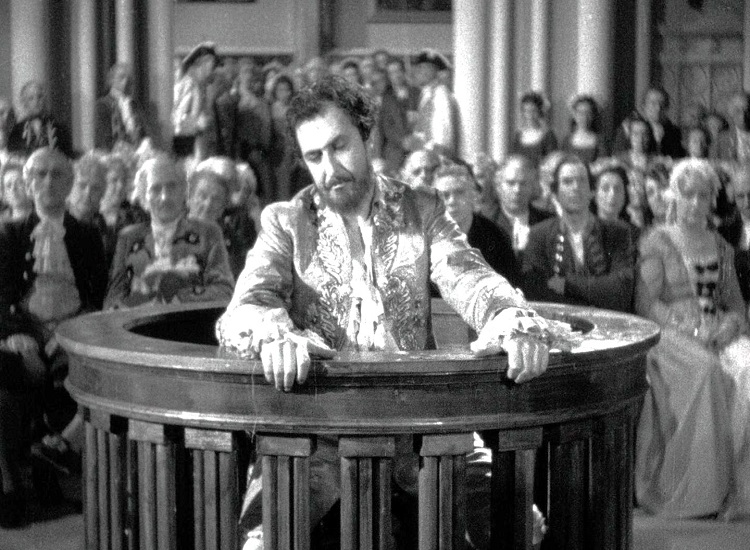
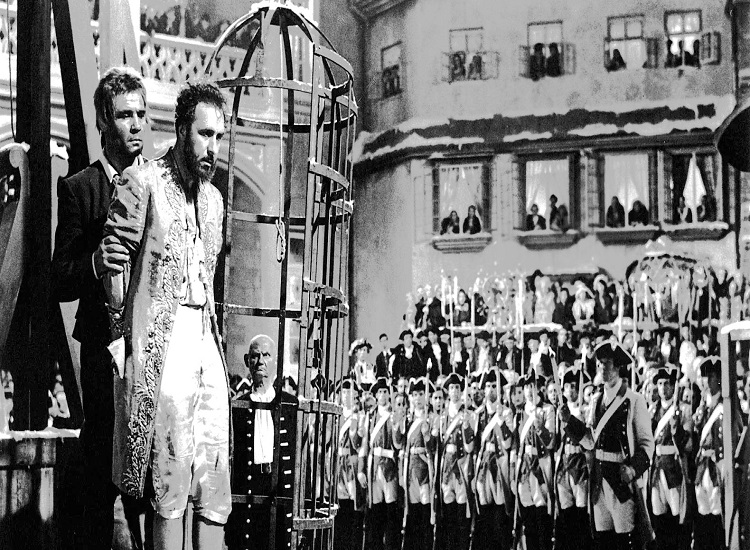
All these films were produced by the Department of Racial Policy and shown in cinema halls, in factories and during ceremonies or rallies of the Nazi Party, throughout the country. They were watched by over 20 million viewers. The Nazis thus sought to secure the support of the German people for the National Socialist policy of racial hygiene, of racial superiority. In this view, the production of anti-Semitic films also holds a special place in Nazi cinema. In the years 1939-1941, about 15 films with Jewish characters were made, for example the fiction film Jud Süß (Jew Süss) by Veit Harlan. “This is the first truly anti-Semitic film,” wrote Goebbels in his diary in 1939, after reading the script.
It was he personally who ordered its production as a feature film and followed it through to its completion. The German premiere of the film was given on 24 September 1940 at the “Ufa” Palace in Berlin in the presence of Goebbels and other high representatives of politics and cinema. Harlan’s cinematic adaptation of Jud Süß distorts historical facts, giving them an anti-Semitic direction or meaning. In the film, the Jew Joseph Süß accumulates in his person all the anti-Semitic stereotypes – such as greed, fear, deceit, sexual threats to Aryan German women, exploitation and conspiracy by world Jewry, etc. / Memorie.al