From Bashkim Trenova
Part Six
NAZIBOLSHEVISM – LITERATURE AND THE ARTS
PREFACE
Memorie.al / Historians, political philosophers, intellectuals from various schools or positions, have dedicated thousands upon thousands of pages, entire volumes, studies, and articles to the comparison between Nazism and Communism. Generally, in their publications and studies, they focus on the police control of society by these dictatorships, the role of the dictatorial state hierarchy and the head of state as suppressors of free thought, the omnipresent place of official propaganda in society, the mass massacres and the network of concentration camps, the activities of the police, the NKVD in the USSR (later the KGB) and the Gestapo in the Third Reich. In his book “Le Passé d’une illusion” (The Past of an Illusion), François Furet notes that Nazism and Communism share the same opposition to liberal democracy and what they call “capitalist bourgeoisie.” Both ideologies claim to be socialist and use the image of socialism. Communist countries called themselves “socialist.” “Nazism” is a shortening of National Socialism.
Continued from the previous issue
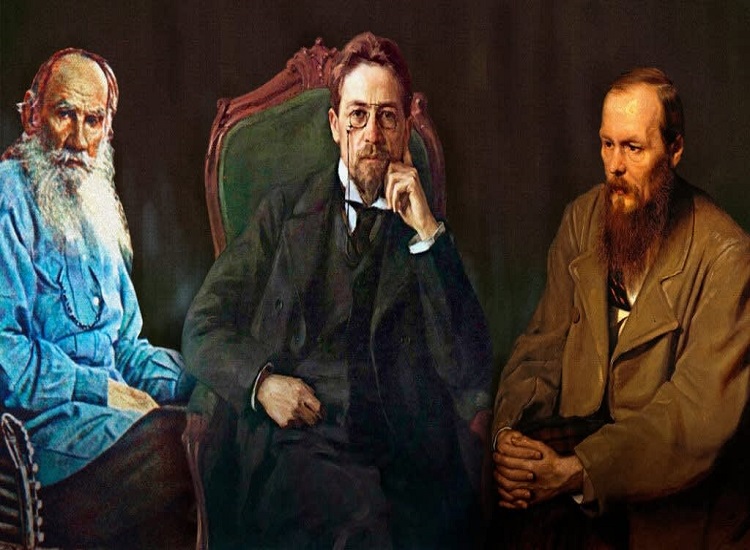
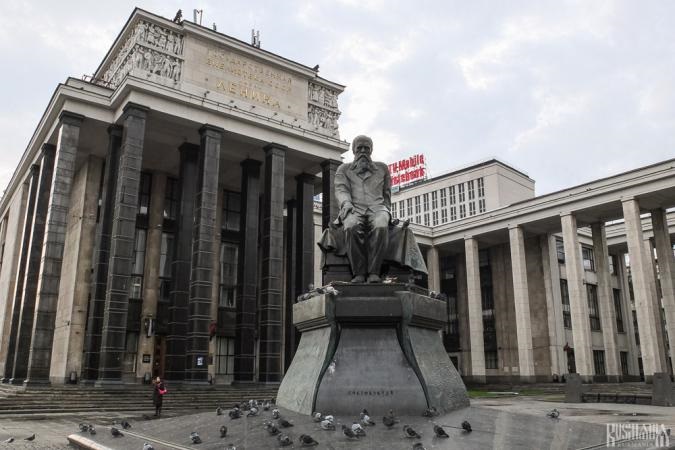
The patrons of Socialist Realism, in fact, have erected a similar cult to Dostoevsky. The “Lenin” Library in Moscow and the Leningrad Library organized exhibitions on Dostoevsky’s work and life. In 1956 and 1958, this author’s novels were reprinted in ten volumes. Feature films based on his work were made. Many of Dostoevsky’s novels were dramatized and staged. Foreign writers were invited to participate in commemorative celebrations related to this author. A “Dostoevsky” Museum was established in Moscow.
Dostoevsky has been characterized as a kind of Christian socialist and, at the same time, a monarchist. Russia, according to him, owes its existence to autarky. He adores the Tsar, Tsarist reforms, and wishes for a more intimate, better communication between the sovereign and his people. Dostoevsky is also known as an extreme nationalist, a chauvinist. He hates Europe, which for him is a “cemetery,” why not also the location of a gigantic conspiracy against Russia and against Christ. Likewise, for him, Jews are a foreign body that exploits and fools the poor Russian people.
According to him, Russia must include the Orthodox Slavic peoples, dominate the Balkans, wave its flag over Constantinople, and establish its hegemony in the world. This is entirely possible because, as he says of the Russians: “We possess the genius of all peoples, and, moreover, the Russian genius: thus we can understand you, while you cannot understand us. We have the Russian ideal of universalism, of all-reconciliation, of all-humanity.”
There seem to be sufficient reasons why the Bolsheviks, the dictatorship of the proletariat, find in Dostoevsky a kind of political, ideological, spiritual, and aesthetic ally. Regardless of the red color with which they advertise themselves, they are just as Pan-Slavist, Pan-Orthodox, and, with their internationalism, their new world, just as hegemonic and Russophile as Dostoevsky himself.
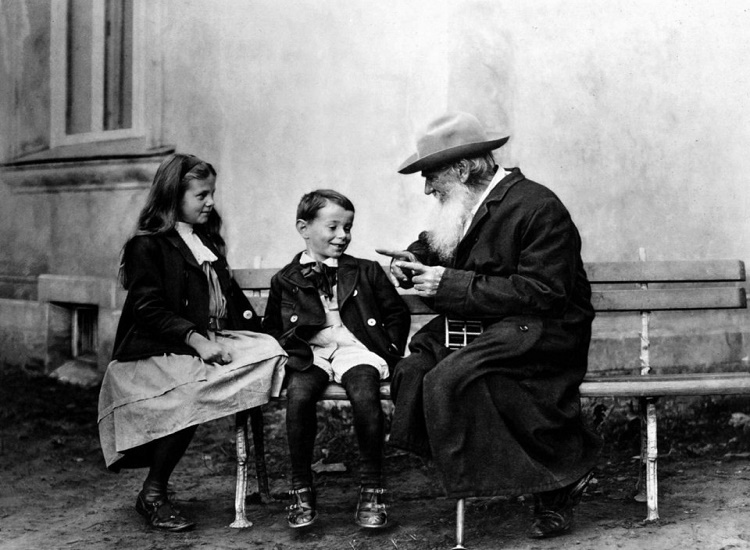
The same adoration is noticed towards Tolstoy, who is known for preaching a kind of mystical Christianity. Lenin himself wrote, between 1908 and 1911, six articles on the work of Leo Tolstoy. The first article, written on the occasion of Tolstoy’s 80th birthday, he titled “Leo Tolstoy as a Mirror of the Russian Revolution.” In this article, according to Lenin: “Tolstoy reflected a complete hatred, a well-formed desire, a wish to put an end to the past…” Always, according to him, Tolstoy did not represent the proletariat, but the patriarchal Russian village, but precisely here, he emphasized, the opposition to capitalism must also begin.
Lenin’s second article on Tolstoy was written on the occasion of his death in 1910. The third article – Leo Tolstoy and the Contemporary Labor Movement – deals with the attitude of Russian workers upon the writer’s death. The fourth article is dedicated to the role of the working class in deepening Tolstoy’s criticism of capitalism. The last two articles are criticisms made to the Russian Social Democrats, who never cease to point out the reactionary aspects of Tolstoy’s thought, without distinguishing it from his critical stance towards capitalism.
Lenin does not allow Tolstoy to be touched even by his revolutionary fellow-travelers in the Russian Social Democratic Party. The Bolshevik leader needs Tolstoy, as the titles of the articles he dedicated to him also show, to use him in the service of seizing and then maintaining power; he needs an “anti-capitalist” Tolstoy in the service of the proletarian cause, the proletarian revolution, and Great Russian pride. He thus creates a “Tolstoy” according to the Soviet model, according to the interests of the new masters of the Kremlin.
In the article published on November 16, 1919, on Tolstoy, Vladimir Ilyich Lenin writes: “Tolstoy as an artist is known by a minority, even in Russia. For his great works to become the property of all, there must be war and war against that social order which has condemned millions and tens of millions of people to live in darkness, oppressed, to do slave labor and live in poverty; there must be the socialist revolution.”
In the same article, writing about the criticism that, according to him, Tolstoy made of capitalism, he emphasizes that this criticism shows the masses “not to limit themselves to curses against capital and the power of money, but to learn at every step of their lives and in their struggle against the technical and social victories of capitalism, to learn to unite into a single army of millions of socialist fighters who will overthrow capitalism and create the new society without the people’s poverty, without the exploitation of man by man.” So behold a proletarian revolutionary Tolstoy!
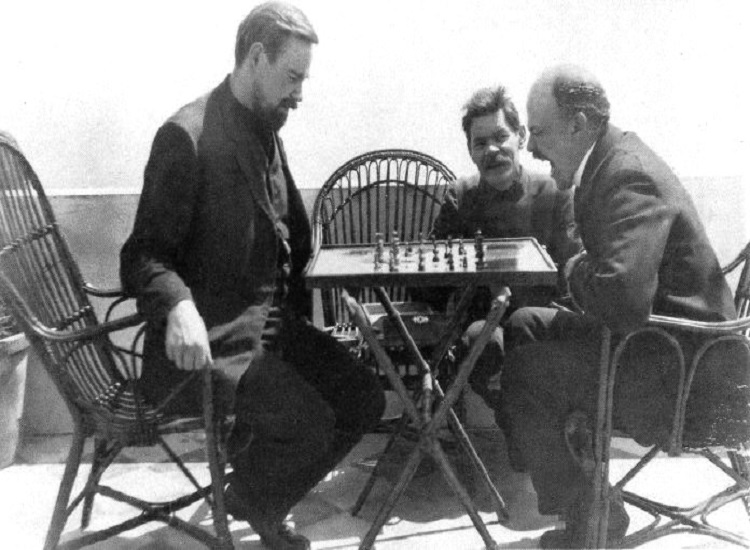
Maxim Gorky, for his part, in the sketch “V. I. Lenin,” recounts a conversation between himself and the Bolshevik leader about Tolstoy. Gorky gives this opinion of Lenin about Tolstoy: “Whom can we compare in Europe to him? And answered himself: No one. Then, rubbing his hands, he laughed contentedly. I had often noticed in him a sense of pride in Russia, in Russians, in Russian art. Sometimes this quality seemed foreign to me, even naive, but later I learned to hear the echo…”! Certainly, no one can be compared to the Russians!
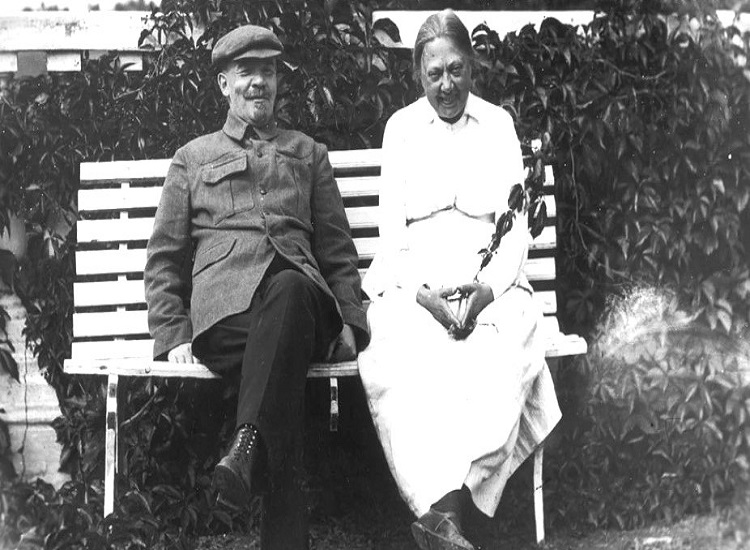
Lenin’s wife, N. K. Krupskaya, in her book “Воспоминания о Ленине” (Recollections of Lenin), wrote that he “read the proofs of the novel Anna Karenina for the hundredth time.” From the above, the adoration of the chief Bolshevik for Tolstoy and his art, which is served in the service of the revolution, is completely understandable.
Turgenev’s novel “Отцы и дети” (Fathers and Sons), also considered his masterpiece, likewise finds a very positive echo in Bolshevik Russia, being interpreted according to Bolshevik appetite. In “Fathers and Sons,” Turgenev reflects Russia immediately after the abolition of serfdom. In the novel, on one side are the dear fathers, somewhat tired, suspicious, but convinced that a good dose of liberalism solves the country’s problems, a country still living its Middle Ages. On the other side are their dark, bitter, desperate sons, who hate any reformist idea, who deny everything and believe only in “cleansing,” in destroying the order.
The Bolshevik oath to build the new world from the “ruins” of the old world, which must be overthrown by force, is well known; but with good reason, neither Turgenev, nor Tolstoy, nor Dostoevsky, etc., can be classified as precursors of Bolshevik violence and ideal. Turgenev, for example, criticized Tsarism but deeply hated those who preached terror.
The Bolsheviks similarly rush to enlist Nikolai Gogol into their ranks, which with his satire condemned oppression and serfdom. Let us quote a part from an article written by Andre Pierre and published in Le Monde on April 9, 1959, on the occasion of Gogol’s 150th birthday. “The genius of Russian prose, the honor and glory of the fatherland, the great patriot and great artist, the champion of Russo-Ukrainian friendship: these, writes Andre Pierre, are some of the titles of articles dedicated by the Moscow press on the occasion of the hundred and fiftieth anniversary of the birth of Nikolai Gogol.
Academician V. Vinogradov recalls in Pravda that the democratic critic Belinsky had valued Gogol as ‘one of the great guides of Russia on the path of progress.’ Pravda reproduces under a large portrait of the writer his famous sentence: ‘my thoughts, my name, my works will belong to Russia.’ All the criticisms, continues Le Monde, also emphasize Gogol’s topicality. He is described as ‘our great contemporary.’ In ‘Sovetskaya Rossiya’ we read that his satirical works ‘still help us today to fight against the remnants of the past in our environment.’
Vinogradov, who notes how much Lenin liked to quote the immortal characters from The Inspector General or Dead Souls, writes that Gogol gave the Soviets weapons in their fight for a better future. But is there today in the USSR a satirical writer comparable to the one who condemned the morals of the time of Nicholas I? No one has dared to claim this, just as no one has alluded to Malenkov’s call: ‘Give us Gogols!’ addressed to Soviet writers in 1952, during the 19th Congress of the Communist Party. Satire is a literary genre that attracts no one in eras of dictatorship, because it is very dangerous, and the boundaries between what the party considers salutary satire and what it condemns as pure slander of Soviet reality are much undefined.”
The Bolsheviks also served the Great Russian poet Alexander Pushkin according to their appetites. Lenin’s wife, Krupskaya, in the book “Воспоминания о Ленине” (Recollections of Lenin) writes: “Sometimes we read with envy the announcements of booksellers about Uspensky’s 28 volumes, Pushkin’s 10 volumes, etc., etc. Volodya seems to have become a great prose writer.” Especially from the 1930s onward, the Bolsheviks raised a cult to Pushkin, this representative of the local aristocracy. The reasons are not hard to understand in this case either.
It is known that Pushkin supported the Decembrist uprising of 1825, which challenged Tsar Nicholas I. The verses of his poem “Пророк” (The Prophet) are well-known: “Arise, Prophet of Russia / Put on the garment of shame / Present you with a rope around your neck / before the hated murderer.” The hated murderer was the Tsar, Nicholas I. According to Soviet criticism, Nicholas I also became the main censor of Pushkin’s work. He insisted on reading many of his verses before they were sent to the printing press.
As a result, some of his poems were never published, others were delayed, and the most controversial were burned by the poet himself, frightened of possible police control or a house search. Several verses of “Евгений Онегин” (Eugene Onegin) also ended up in the fire. Pushkin thus emerges as persecuted by the Tsarist regime and as its opponent, i.e., as a kind of precursor of the Bolsheviks!
Another reason for the Bolsheviks’ construction of the Pushkin cult can be found by reading a recent article published in the famous French magazine Charlie Hebdo. Among other things, the article states: “In Chechnya there were Russian soldiers who, between a massacre and a drinking session, recited verses of Pushkin. Are their descendants doing the same in Donbas? Pushkin is the father of the Russian language and ‘having such a language,’ writes our friend and former Charlie colleague, Iegor Gran, in Z comme zombie (Ed. P.O.L.), Russians are convinced, sure that they are an illuminating beacon in the world, also that they exercise a cultural magnetism over others, which justifies their subjugation of them.
How can we not kneel before this collection of such extraordinary writers: Tolstoy, Dostoevsky, and Chekhov. Ah! Pushkin!… Pushkin alone is clear proof of the uniqueness of Russians. Moreover, his poetry is known as untranslatable. Enjoying its delicate wonders is accessible only to Russians, which clearly shows that the good Lord has reserved a special status for them.”
The Bolsheviks manipulate the literary heritage, the truth it conveys. In fact, as Albert Camus said in a Conference in Uppsala, Sweden, after receiving the Nobel Prize: “The real object of socialist realism is precisely the lack of realism.” In an article published on November 13, 1905, in “Новая Жизнь” (New Life) No. 12, titled “Партийная организация и партийная литература” (Party Organization and Party Literature), Lenin wrote: “Literature must become an element of the general cause of the proletariat, a bolt, a small screw in the great social-democratic mechanism.
The writer must, necessarily, join the Party organizations. Publishing houses and depots, warehouses and reading rooms, libraries and various bookstores must become Party enterprises, be subordinated to its control. The organized socialist proletariat must supervise all this activity, control it fundamentally, thus putting an end to the old Russian half-Oblomovian, half-commercial principle: the writer writes when he feels like it, and the reader speaks his mind if he likes it.”
Further down in the article he adds: “Make no mistake, gentlemen! First of all, it is a matter of Party literature and placing it under Party control. Everyone is free to write and say whatever they want, without any limitation. Freedom of speech and of the press must be inviolate.” After the Bolsheviks came to power in 1917, Lenin and his Party quickly forgot their declarations about freedom of speech and the press. The ideas expressed in 1905 about controlling Party literature were extended to all artistic and cultural life of Bolshevik Russia, became mandatory, and were canonized.
In October 1917, the Bolshevik Party established the dictatorship of the proletariat, i.e., the dictatorship of the Party over the proletariat and over all society. The Bolsheviks were favored by the circumstances of the time, by concrete conditions: a country ruined by war, an empire collapsed along with all its structures, a society with no political experience, deep misery, etc. They established a monopoly on power and an ideological monopoly.
Lenin’s Party declared itself the sole bearer and expression of social consciousness. Consequently, its power, its authority, its violence against society knows no bounds. The Bolsheviks turned literature, and art in general, into a kind of transmission belt to convey and exalt the communist ideal, into a screw to tighten the pressure on them, to make them completely submissive and devout to the state of the dictatorship of the proletariat.
It is a known fact that totalitarian regimes establish close relations with art, and that tyrants are always attentive to literary creativity. They, in the role of the despot-lord of the Universe, do not fail to exercise their dictate, as everywhere else, also in this field. The Bolshevik leaders are no exception to this rule. They, as representatives of a dictatorship in power, treat literature and the arts in general as useful “allies.” In this kind of “alliance,” of course, they have the unconditional right to impose their draconian control.
Soviet culture is characterized by an intertwining of literary and political fields. The placement of art and culture on a war footing by the Bolsheviks forces the writer to accept, de facto, the state and its ideological apparatus as co-authors, which cannot pass without leaving deep traces even on the artistic level of the texts. / Memorie.al