

By Isuf B. Barjami
Part Two
Memorie.al / “Shpopullimi” – this foreign word entered the life of the Albanian population of Chameria and brought with it so much distress, pain, blood, and tears. Translated into Albanian, it means “exchange.” Surely this has nothing to do with exchanges of goods or other equivalents, but with the exchange of people. For Greek chauvinists, people are also a kind of commodity; it is enough to exchange them, to remove the Albanian population from their autochthonous lands, in order to create there the so-called Greek “ethnic homogeneity.” The Balkan Wars had doubled Greece’s territories and population, to the detriment of its neighbors. The Greek chauvinist appetites grew daily, toward the devouring of foreign lands. The expansionist concept of the “Megali Idea” (Great Idea) aimed to include within Greece’s borders the lands where the Orthodox Christians of Turkey lived.
To be continued in the next issue
Nevertheless, the solemn declarations of the Greek prime minister, who assured that he was inspired by the best intentions toward the Albanian minority. The military authorities of Filat, especially Captain Floro, the garrison commander, terrorized the Albanian Muslim population with all the most inhuman and barbaric means, beating them unjustly and mercilessly, and threatening them with death…”!
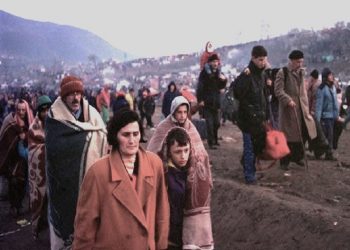
The official circles and the press of the time did not express their preoccupation with the fate of the Albanian population, which was being forced to relocate, only through documents and protests addressed to international organizations, but also with a deep sense of solidarity, taking every measure to receive and accommodate in Albania all those who did not wish to be carried off to Anatolia.
Here is what the newspaper “Dajti” wrote: “It is good for the Chams to act collectively and to be given state land and property instead of going to Anatolia and being lost altogether.” The resistance of the Albanian population of Chameria against the exchange with the Greeks of Anatolia had a great echo in the Albanian press of the time.
In a correspondence sent to the newspaper “Dajti” from Chameria, among other things, it is stated: “Not only did the Greeks realize their desire to uproot the Albanian element of Chameria, but with their usual tactics and methods, they are trying to deceive the world and the League of Nations into believing that the Chams themselves want the exchange and emigration to Anatolia.
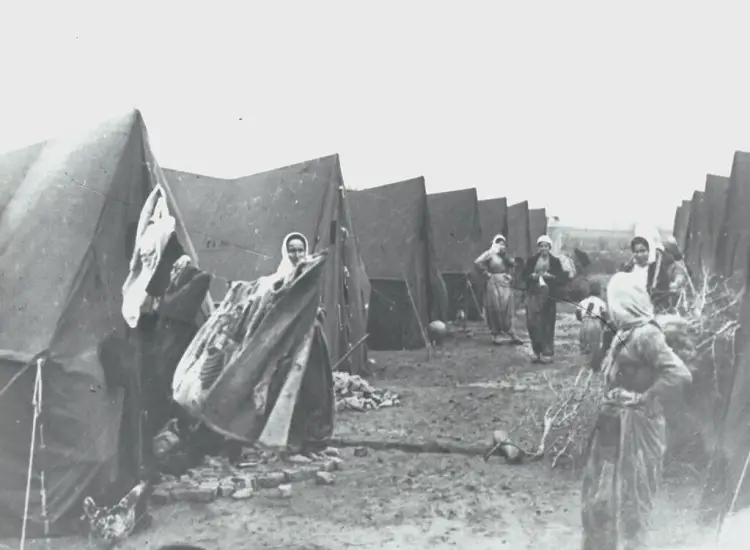
The Greeks have brought thousands of emigrants from Asia Minor, victims of their ridiculous Megali Idea, and have placed them in the homes of the Albanians of Chameria, cramming 4–5 Albanian families into a single house…! The refugees from Anatolia, in order to feed their families, robbed the Chams of all the produce of their fields and vineyards.
For about a month now, a mixed commission has arrived in Chameria to study the origin of the Albanians of Chameria. This commission will stay only in Margëlliç and Filat, because the Greek press has slandered that Albanian komitadjis would kill them. Also from there, it will examine the origin and the will of the Chams by summoning a few people from each village (who have been protested against by the local authorities and intimidated with death if they answer contrary to their orders), and based on this imposed will that these people will express, the commission will act on behalf of the entire Albanian population of Chameria.
In order to protect the lives of the members of the commission (so they claim), the Greek government has sent to Chameria a large military force under the command of the bloodthirsty *andart* (guerrilla) Kollovos, who has in turn terrorized the poor people of Chameria with his inhuman acts, such as barbaric killings, and in order to deport the Albanians of Chameria, especially those few who appear before the commission to say that they are Turks and want to go to Turkey.”
The session of the League of Nations, held at the end of October 1924, showed that the Cham tragedy continued. New contingents of people were being prepared to depart for Anatolia, while the Geneva organization not only did not stop it, but praised the Greek government’s efforts to fulfill its commitments. The determined resistance of the Cham population and the persistent work of the Albanian government became obstacles on the path that the rulers of Athens had begun. Nevertheless, the process of forced exchange continued even after 1925.
But by now it was taking on new nuances. A series of laws directly and indirectly targeted the immovable properties of the Albanians, turning lawful owners into serfs. In a memorandum that the representatives of Chameria addressed to the Greek Prime Minister, Pangalos, on February 26, 1926, denouncing arbitrariness, illegal expropriations, and the misguided implementation of the so-called “agrarian reform” in favor of the immigrants from Asia Minor, it was emphasized that: “…we and our families are condemned to die of hunger…”.
And further below, in a tone that did not conceal their revolt at all, they added that with these acts; “…we have the right to believe that your government desires nothing other than our annihilation, or to force us to abandon our hearths and our lands, which we have held for generations and which every state respects, and to be displaced, seeking elsewhere what the Greek state denies us: the security of life and property.”
Let me now share with the reader the memoirs of General Pangalos, published in the newspaper “Akropolis” of Athens, the oldest Greek newspaper. General Theodoros Pangalos (1878–1952), former head of the Greek state in 1926, was of Albanian origin. In a series of articles published in the daily “Akropolis,” he proudly defended the Albanian nation. Besides the Albanian heroes in the Greek pantheon, the history of Greece has also recorded many other figures of Albanian descent who are known for the great services they have rendered to Greece.
In that atmosphere of hatred, where it was dangerous even to be recognized as Albanian on the street, a general of our own blood steps onto the scene, who with the greatest pride defends the Albanian nation: “I have known the Bulgarians and the Albanians for a long time. My relations with them have been varied. From the time of Emperor Vasilios ‘the Bulgar-slayer’ of Byzantium up to today. Among all the Greek rulers, I have been their greatest enemy.
From the time of Esat Pasha and especially Ahmet Zogu, the most cordial friend and benefactor of Albania, that has been me again. It is easy to convince the competent officials of these facts if they take a look at the files of the Ministry of Foreign Affairs, and as we will see below from the development of events at that time, which almost ended in an alliance between Greece and Albania.
In my infancy, I spoke only Albanian, since my grandmother, who raised me, did not know Greek. She was the daughter of the most distinguished aristocrat of Magaridha, Ndon Bilbili, in whose house his close friend, the Marshal of Rumelia, Karaiskakis, died. In my veins, therefore, flows Albanian blood, and I am proud of this. Admiral Kountouriotis, the three Nikolades (grandfather, son, and grandson), Admiral Sakellariou, hero of the submarine ‘L. Kaconi,’ Laskos, and many other distinguished Greeks, are of Albanian descent, and the great services they have rendered to Greece are well known.”
Paparigopoulos (the great Greek historian) writes: “…Among all the nationalities that are in Greece, the mixture with Albanian blood produced the most excellent race. The Hydriots, the Spetsiots, Miaoulis, Sachtouris, and thousands of warriors from 1821 to the present day confirm Paparigopoulos’s opinion. I am therefore not an enemy of Albania; on the contrary, I sympathize with the Albanian people, who in their great majority are not responsible for treachery against Greece.”
Immediately after I came to power in June 1926, I found myself facing a real deterioration in relations with Albania, due to the problem of Chameria. The representative of Albania, while presenting his credentials at the political office, informed me that the Greek authorities had expelled and, in violation of the treaties, had deported the Albanian population of that region, sending them to the coast for transport to Asia Minor, and that his protests were met with the response that these Turko-Albanians were covered by the agreement for the exchange with the Greek population in Turkey.
I requested the relevant documents and became convinced that the Ministry’s interpretation was unfounded, since the Treaty of Lausanne clearly stated that the Muslims of Epirus were considered a minority and were not included in the exchange, like the Turks of Thrace, etc. For fuller clarification of the matter, I telephoned our minister in London, the late Kaklamanos, who had represented Greece in the drafting of the treaty. He answered without hesitation that the Muslims of Epirus were not included in the exchange and that the Ministry’s opinion was incorrect.
I immediately summoned the competent director general, who told me these astonishing words: “In principle they are right, but for reasons of necessity and purpose, I ordered the relocation of the Albanians in order to empty the villages and settle our refugees from Turkey in them; it is not worth wasting time over five or six thousand Albanians, Mr. President”!
I could barely restrain myself from kicking out the one-legged diplomat. At the same time, according to police reports, a real drama was unfolding in Epirus, as the villagers, with tears, were being torn from their ancestral hearths where they had been born and had lived for centuries, and were being loaded onto ships to be sent to Asia Minor.
I gave orders for them to be unloaded and allowed to return freely to their villages. The Albanians, like every old and backward race, have their vices, but they also have some noble virtues. The above event was the main reason for the establishment of cordial relations (between the two states), which developed almost to the point of establishing a future federation, as we shall see.
The President of the Republic, Ahmet Zogu, with a cordial letter, expressed his gratitude to me, which I will never forget. And so, until the days of his dethronement, whenever a new Albanian representative came to Greece, he would come to my house with his regards and bring me the King’s greetings, addressing me in Albanian and saying: ‘Big brother.’
And this was at a time when I was only a simple citizen as a demobilized general. This is what is called the Albanian ‘Besa,’ that is, faith and gratitude for trust. If we take a look at the map of the Balkans, we immediately understand the great importance of Albania. Due to recent events, political and military circles in Greece have only now come to understand the importance of Albania as a base for attack and defense.
Greek military men in past times knew this, as is clearly shown by the fierce and bloody wars that took place in the harbors and mountain passes of Albania, especially in the last centuries of the Byzantine Empire. For Greece, a friendly and allied Albania constitutes a colossal fortress and a strong threat to any attacker from the north. The keen intelligence of Venizelos had understood this fact when he said that at all costs the issue of Epirus should be settled amicably and the most cordial relations should be established with Albania.
I firmly believe in the correctness of this opinion. I sought at all costs and sacrifices to put this into practice when I was Head of State. After these events, friendly relations were established, and I sent to Tirana as Greece’s representative General Alexandros Kondoulis, my compatriot, who knew not only the Albanian of Southern Albania spoken in our region, but also the idioms of the Labs and Gegs.
It is an indisputable fact, for many reasons, that if a wise and consistent policy had been applied to the Albanian issue, it would have been possible that, instead of enmity, Albania would have been the best, the most valuable, and the only faithful friend of Greece in the Balkans. As a race, Albanians are neither Tartaro-Mongols nor Slavs, but Illyrians, descendants of the Pelasgians. They are historically proven to be a sister race to the ancient races that descended from the north and constituted the first inhabitants of Hellas. They have nothing in common with the Italians, Serbs, or Bulgarians, whereas with the Greek people they are closely linked in blood, heritage, and customs.”
The Treaty of Lausanne of 1923 gave the ruling circles of Athens the pretext to violently expel the Chams from their ancestral lands; these were considerable numbers of the Albanian population. In the following years, only the tactics were changed; the strategy remained that of the complete uprooting of the Albanian population of Chameria, which General Zervas realized with fire and iron in 1944. / Memorie.al