By Isuf B. Barjami
Part One
Memorie.al / “Shpopullim” – this foreign word entered the life of the Albanian population of Chameria and brought with it so much unrest, pain, blood, and tears. Translated into Albanian, it means “exchange.” Surely this has nothing to do with the exchange of goods or other equivalents, but rather with the exchange of people. For Greek chauvinists, people are also a type of commodity; it is enough to exchange them, to remove the Albanian population from their autochthonous lands, in order to create there the Greek “ethnic homogeneity.” The Balkan Wars had doubled Greece’s territories and population, to the detriment of its neighbors. The Greek chauvinist appetites grew day by day, aimed at devouring foreign lands. The expansionist concept of the “Megali Idea,” which aimed to include within its borders the lands where the Orthodox Christians of Turkey lived.
This adventure led it to Asia Minor, which, instead of bringing the glory they coveted, brought them a humiliating defeat. The political discrediting and military catastrophe it suffered there were accompanied by many exchanges of hundreds of thousands of people. On January 30, 1923, the special Turko-Greek agreement on the exchange of the Greeks of Anatolia with the “Turks” of Greece was signed in Lausanne. According to the agreement, starting from May 1, 1923: “…the compulsory exchange of ‘Turkish’ nationals of the Orthodox faith must be carried out.
The Greeks settled in Turkish lands, as well as Greek nationals of the Muslim faith settled in Greek lands.” Those exchanged had to leave their place of origin and were to acquire that of the country they were going to, without the right of return. This exchange did not include “the Greek inhabitants of Constantinople and the Turks of Western Thrace.”
The Albanian people were not supposed to be included in the sphere of the exchange, because apart from religion, they had nothing in common with either the Turks or the Greeks. Even in the Mixed Commission, tasked with implementing the exchange, it was decided that “the population of Chameria should be excluded.” This fact is also acknowledged by the government officials of Athens themselves.
The Greek representative, Kalamanos, declared at the Lausanne Conference that: “His Government has no intention whatsoever to act upon the exchange of Muslims of Albanian origin. The Albanians live in a well-defined region, Epirus. Even if they are of one faith, they are in no way of one nationality.”
Such “assurances” had also been given by the Greek chargé d’affaires in Tirana, Kichotakis. Indeed, even Venizelos himself said: “I have telegraphed my Government to caution them regarding the situation of Greek nationals, Muslims of the Albanian race, who must not be confused with the Turks as far as the convention on the exchange of populations is concerned.” The practical reality stands differently. Words and deeds are very far apart.
Before the ink of the signatures had dried, the Greek government officials violated the agreements. Under the label “Turks,” they proceeded to remove thousands of Albanians from their ancestral lands in Chameria. As for the Albanians of the Christian faith, they thought to assimilate them quite easily, even by luring them with the properties of the Muslims who would be expelled. In this, the Orthodox Clergy also played a diabolical role, trying to sow division and enmity between the Muslim element and the Christian one.
The situation became excessively tense when Greek chauvinist circles organized the murder of the Italian general Tellini and members of the International Commission for the final determination of the border, intending to blame Albania. A few days later, the Italians occupied Corfu. On March 31, 1923, the Conference of Ambassadors declared the Greek government guilty of the crime and held it responsible.
Athens temporarily withdrew its representative from Tirana. Affairs took a turn with serious consequences for the population of Chameria. The Greek authorities intensified the war for the displacement of the Chams to Anatolia. Musa Demi, Ymer Capari, Xhevat Merushi, who sought the intervention of the Mixed Commission to stop the expulsion, were imprisoned.
Bands of professional thieves, backed by local authorities, terrorized the population into declaring themselves “Turks.” They skillfully used the most destructive methods to displace people: kidnapping them at night from their homes, demanding considerable sums of money for their release afterwards, etc. Thus, Man Ismaili was kidnapped and released after paying 200 gold napoleons, the brother of Murat Gjika paid 300, Agako Pronja paid 600, etc. After the thieves did everything at night, the next day the forces of order would go through the villages and inflict new wounds on the population by accusing them of “harboring” thieves.
The innocent population, experiencing tortures of various kinds, did not kneel. They sent their representatives several times to protest to the government against the violence and injustices. Through various channels, they regularly informed the Albanian government about the entire situation in Chameria. Dozens of telegrams were sent to the League of Nations, denouncing the injustices and requesting its intervention.
This led to the dispatch, in October 1924, of a commission to Chameria, chaired by Albanian, Turkish, and Greek representatives, to ascertain the nationality and will of the people. It was requested that a delegation composed of Tahir Metja, Kadri Sadushi, Bido Dule, Nelo Hamiti, etc., convey the voice of Chameria to the commission. The duties of the delegates were clearly defined in a meeting held in the field of Grigohor.
The representatives of the population of Chameria, disregarding the consequences, not only presented to the Commission its Albanian affiliation and its insistence against any attempt at exchange, but also the oppression, injustices, and denial of every right perpetrated against them by the Greek authorities. They brought shocking facts to the Commission. For example, to the question: “How is it explained that various persons have declared themselves as Turks?!”
To this question, Kadri Sadushi replied: “- Nothing other than fear and insecurity. One of them is even my brother, Shefiku. Ask him if he knows even a single word of Turkish.” “- Is your life in such danger then?!!” “- It’s hard for you to imagine,” Kadri replied, “- but when I leave here, there is no certainty that I will make it home alive!”
This delegation went even further, presenting to the Commission that in Chameria, not only those of the Muslim faith were Albanian, but also the Christians. Meanwhile, an old man named Mina Dhima, from the village of Ledhës, was passing by on the road. “- Here he is, a Christian,” says Tahir Metja, “- ask him what nationality he is.” When asked by the Greek representative, the old man Mina replied shortly: “- I am Albanian, I don’t know Greek.”
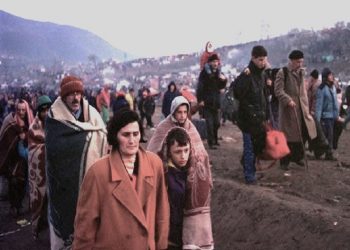
After the Commission was convinced of the completely Albanian character of the population, it suspended the exchange, but the Greek authorities continued their work. The village of Petrovica was completely emptied; Gardhiqi went from 400 houses to 80, Karbunari from 300 to 120, Parga from 300 to 40, Shëndielli from 200 inhabitants to none, etc. During the years 1912-1925 alone, more than 20,000 inhabitants were displaced from Chameria.
The Greek government tasked the deputy of Trankë, Bakallbash, with handling the exchange and the settlement of Greek emigrants coming from Asia Minor. Emigrants flooded into Chameria. The locals were crowded 4-5 families into one house, and in their place, others—foreigners—were housed. Against these acts, the Cham population raised its voice in protest.
In a letter addressed to the League of Nations, Hasan Kapoli, Sherif Rexhepi, and 23 other signatories, energetically protested “against any attempt to infiltrate Asia, being recognized as Albanians even by the Greeks themselves.” Such a protest was also made by Huso Iljasi, on behalf of the population of Parga.
Finding themselves in this difficult situation, the Albanian people erupted in mass rallies and protests against the arbitrariness of the Greek authorities to the detriment of the Cham population. Echoing a rally held by the students of Tirana, the newspaper “Dajti” called upon the democratic government: “…to show itself as active as possible in the defense of the Cham population, and this not only in the name of solidarity with blood brothers, but also in the interest of laying the most solid foundations for the development of relations between the two countries.”
In the summer of 1924, the exchange process took on a massive character. Under these conditions, the Albanian government undertook a series of serious steps, making the protection of the Albanian population of Chameria one of the primary objectives of its diplomatic activity. It demanded that the issue be brought up for reconsideration in the Council of the League of Nations. In the letter addressed to the Secretary-General, giving a correct interpretation of the Lausanne Agreement of 1923, it wrote:
“The Albanian government believes that the principle of origin which the mixed commission has adopted can be applied only to a certain extent, and only for those Albanians who live sporadically in Macedonia, whereas it cannot be taken into account at all for a region like Chameria, where the population is compact.
It believes that even the very fact that this population is asked to express its desire is in contradiction with the spirit of the Lausanne Agreement, which states that the Albanian element will be excluded from the exchange…! The Albanian government is of the opinion that it is impossible to take seriously a desire expressed by a population that is under the terror of the violent measures of the Hellenic authorities…”.
The Cham issue occupied a central place in the diplomatic activity of Fan Noli’s government, undertaking a series of steps to sensitize international opinion through the League of Nations. Denouncing the violence used by the Greek authorities for the displacement of Albanians; Noli never lacked effort in creating a new climate between the two countries. He viewed the minority issue not as an obstacle, but as a bridge of connection.
In an interview that Noli had given to the Greek newspaper “Politika,” wishing to create a new atmosphere, particularly between Albania and Greece, he emphasized that: “National minorities, both here and there, should be not as an obstruction, but as a link and as a bridge for agreement between us.”
Sulejman Delvina, seeing that diplomatic efforts to stop the exchange of the Cham population were fruitless, wrote to the Ministry of the Interior: “We kindly request that you urgently give orders from that ministry, to be sent to the southern border authorities, not to hinder the entry and settlement in Albania of those Albanians coming from Greece to escape the exchange of populations.”
When, under the absurd pretext of “investigation to determine origin,” the expulsion of the Cham population was taking on wide proportions, the Albanian government demanded that the issue be brought up again for review in the Council of the League. In the telegram sent to the Secretary-General, on August 11, 1924, it was stated that:
“…The Albanian ethnic physiognomy of the region of Chameria has been determined indisputably, because the population is autochthonous, it speaks only Albanian, Turkish culture is completely unknown there, and no other foreign element is encountered in this region…”. Under these conditions, any investigation is superfluous and contrary to everything previously established.
Nevertheless, on the eve of the opening of the Assembly in Geneva, the Greek authorities had included nearly 10,000 Chams in the exchange. The Albanian delegation at the 5th Assembly of the League of Nations made the protection of the rights of this population one of its primary objectives. At the head of the delegation, Fan Noli staked all his prestige. He forcefully denounced the illegal actions of the Greek government and the mixed commission that did its bidding. Through his analysis of the procedure, he concluded that he was “leaving the door open for all sorts of persecutions by the Greek authorities.”
In the speech he delivered on September 29, 1924, at the session of the Council of the League of Nations, among other things, he said: “The majority of the Muslim Albanians of Greece have been included in the exchange because it is a patent truth that the Muslims of Epirus are nothing other than Albanians…”. In response to an article published in the Greek newspaper “L’Mesager d’Athènes,” complaining that the Greek minority in Albania was mistreated, the newspaper “Bashkimi” wrote:
“…The Greek authorities, on the contrary, systematically terrorize the Albanians of Chameria, especially since the beginning of the Greco-Turkish exchange of populations; the situation of the Albanians of Chameria has become unbearable due to the bad treatment and persecutions of the Greek authorities. No Albanian school has been opened in Chameria…!
Whereas the Albanian government has in its budget a fund of 100,000 gold francs for the schools of the minority. The Greek-speakers of Southern Albania fully enjoy their political rights. In the last elections, the Greek government even deprived the Chams of the right to vote. Ever since they have been under Greek rule, the Chams feel themselves to be an element condemned to be forever oppressed and enslaved…”. / Memorie.al