By VEPROR HASANI
Part Three
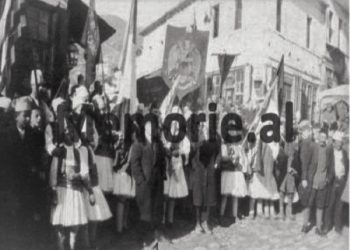
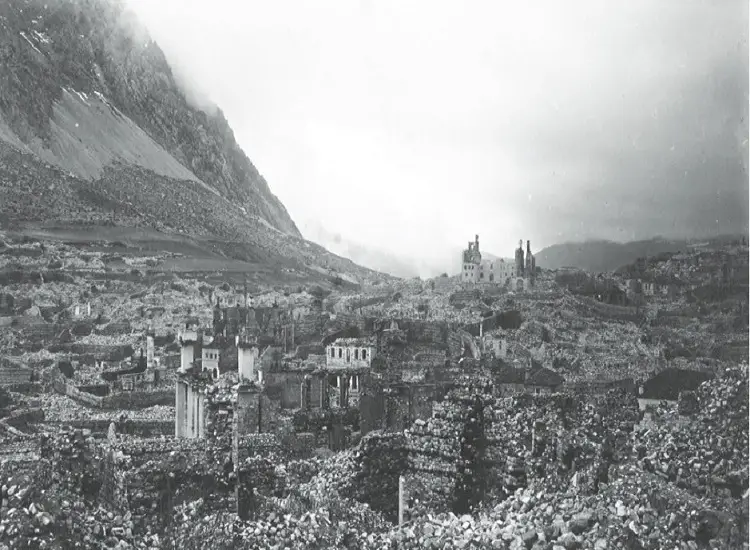
Memorie.al / On the morning of December 5, 1912, according to the Gregorian calendar (or December 18, according to the Julian calendar), a terrifying piece of news spread: Greek armies had entered Devolli and were advancing toward Korça. They were burning, killing, and destroying everything in their path. The Greek divisions were led by a colonel named Dhamiano. The Muslim inhabitants of the Devolli villages were gripped by panic; the full weight of the horror was about to fall upon them. They decided to abandon their homes and head toward Korça, hoping they might find better protection there. Nothing was certain, but they had no other choice. They waited for darkness to fall. The accounts of that night, leading into the dawn of December 6/19, are among the most harrowing. Those who took to the roads were many, unable to carry anything with them.
Continued from the previous issue
The Albanian gendarmerie was organizing, but the “Holy Battalions” of the Metropolis were not disbanding. The Despot (Bishop) repeatedly asked for more time. He and his men had a dark plan to carry out. The Greek army had made a pretense of leaving Korça, but not everyone had departed. Many soldiers and officers were hidden within the Metropolis, others were stationed in ravines, and another group found shelter at the Greek hospital in Korça.
Two doctors, a pharmacist, a caretaker named Papadakis, and 30 paramedics remained there under the pretext that many Greek soldiers and officers were gravely wounded and could not be abandoned. The director of the Telegraph, Kyriako Diamandidhi, also did not leave Korça. He was the man tasked with making the phone call to signal the start of the bloodshed prepared by Despot Germanos.
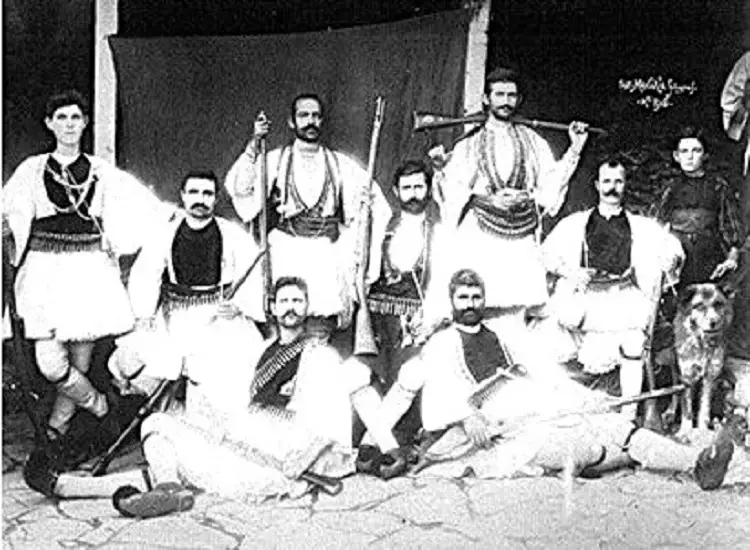
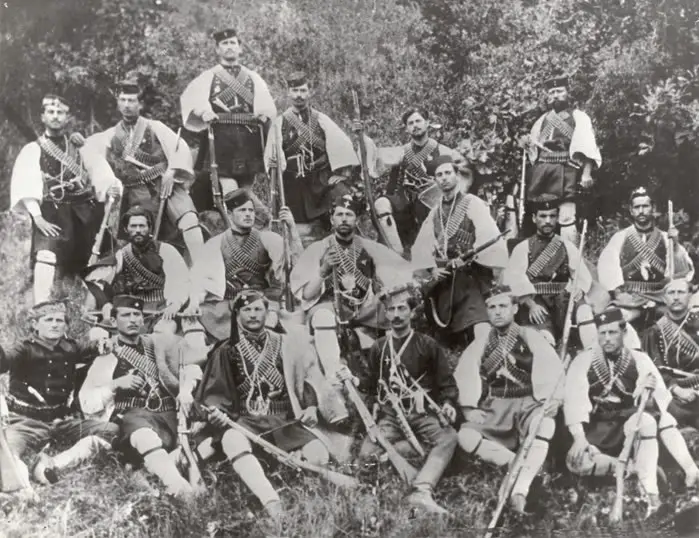
The soldiers of the “Holy Battalions” stood ready and armed. On February 14/27, the Despot of Korça took Gjergj Sulo (often called Jorgji Sulo) from Orman Çiflig as his personal bodyguard. Sulo had been an andart (Greek irregular) and was known as a man of reckless bravery. Edith Durham, in her book The Burden of the Balkans, provides this information: “By order of the Great Powers, the regular Greek army was forced to evacuate the occupied districts. They left Korça but left behind a so-called ‘hospital for the wounded who could not be moved,’ which they connected by telephone to the Greek border. A large part of the army remained at various points away from inhabited centers, changing or masking their uniforms so the Greek government could deny they were soldiers.”
Secret information began reaching the offices of the Albanian government in Korça: the Metropolis was preparing an uprising. Consequently, the government sent 1,500 armed men to Morava to keep the Korça territory under surveillance. They also demanded the removal of the telegraphist Kyriako Diamandidhi, who fled through the night toward Bilisht.
The dispersal of the “Holy Battalions” and the surrender of weapons were demanded again, but the Despot once more pleaded for a few more days. How could he surrender arms so suddenly when he was on the very brink of the uprising? The Metropolis accelerated the execution of the plan.
“Despot Germanos summoned Captain Gjergj Sulo to his office, made him swear an oath to keep secret everything he heard from the ‘holy mouth,’ and said these words: ‘Captain Sulo! The fatherland is being lost, Orthodoxy is being ruined, religion is being mocked, and Korça is in a pitiful state now that it has fallen into the hands of the Albanians.’” Sulo then swore he would leave no man un-roused against the Albanian government.
“Rise, dear and blessed Sulo,” Despot Germanos told him, “do not sit idle; rouse the entire people against this government, which seeks to destroy our Orthodoxy.” (Petro Harizi, The Chronographic History of Korça). Two other brave men arrived at the Metropolis: Dhimitër Kallfa and Lluka Petro from the village of Bellovodë. The former took responsibility for rousing the lowland villages, the latter the villages of Qarri.
Petro Mangaleci, assisted by Kallfa, would train the soldiers of the “Holy Battalions.” Jorgji Sulo’s men were to cut the Korça-Pogradec telephone line, while Lluka Petro’s men would cut the Korça-Kolonjë line. Jorgji Busho was to bring about 1,000 armed andarts from Bilisht. It was intended that the Korça government would surrender within minutes. The flag of Northern Epirus would be raised over the Metropolis, and the union of Korça with Greece would be presented to Europe as a fait accompli.
It did not take long. The telegraphist Kyriako Diamandidhi returned to Korça through the night and delivered a letter to the director of the Greek hospital, D. Anagnostopoulos, which stated: “On the dawn of April 19/April 1 into April 20/April 2, the andarts of Bilisht will attack to capture Korça.” The start of the uprising awaited only the final order.
April 20/May 2, 1914. At 04:00 AM, Jorgji Sulo left some of his men under the command of Andrea Samaras to stand guard near the Orthodox cemetery at the entrance of Korça. Then, with the rest of his men, he headed up toward the Church of Shëndëlli (St. Elias). When he reached the top, he realized the Albanian government guards had noticed nothing.
They remained silent in their outposts. They had taken positions near where the “Themistokli Gërmenji” park is located today and in the upper part of Korça, near Dr. Polena’s house (Korça only extended that far at the time). Sulo then ordered two or three men to go down and ring the bells. It was the signal for the start of the uprising.
A moment later, Captain Sulo attacked the government guards and managed to break through without much difficulty. The bells rang out. It was the final moment. Upon hearing their resonance, the soldiers of the “Holy Battalions” were to don military uniforms and join Jorgji Sulo’s forces. Gaqo Busho, a former deputy of Serfidje in the Ottoman Parliament, was to position himself in the city’s vineyards to block Captain Kajo’s path, as everyone knew he would surely come.
Dr. Harisiadhi, with 400 men, was to take a position above Korça to prevent the residents of Mborje from coming to the city’s aid. The hidden Greek army was also to be alerted. Edith Durham writes in The Burden of the Balkans: “Meanwhile, the ‘wounded’ Greeks in Korça telephoned for medical aid. The Greek Bishop began the execution of his plot. The ‘medical aid’ arrived in the form of armed bands and weapons… thus Korça were taken by surprise. Yet, the city stood bravely…”
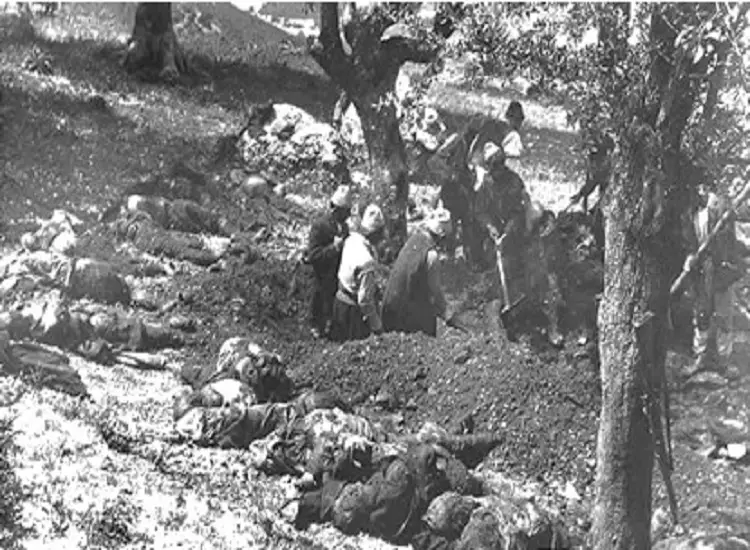
Everything had been planned in detail. Other armed men were to storm the homes of those who had openly opposed Greece. The targets were Muslims and several Vlach families. They were to be executed. Not even women known for their patriotism would be spared. Even children would be killed, so long as the “Northern Epirote” uprising ended in victory. No compromise would be made. Terror had seized Korça.
After bypassing the government guards, Sulo rushed toward the gendarmerie building where the Dutch officers were stationed. If he captured that building, victory would be certain. The flag of Northern Epirus would wave over the Metropolis. But the Dutch officers, hearing the gunshots, took up arms and confronted the aggressors, fighting a life-or-death battle. Sulo had no intention of retreating either; he fired continuously and pressed forward.
When he reached Lakçe’s pharmacy, he fired again, wounding two gendarmes. A moment later, he also wounded Major Snellen van Vollenhoven. However, that was to be the end of Sulo’s glory. At the same time, Snellen van Vollenhoven had also fired. Sulo was wounded; his vision blurred, and he fell, covered in blood that would not stop.
The soldiers of the “Holy Battalions,” who until that moment had supported him unreservedly, were stunned. How could this be? How could a captain be killed before the battle had even properly begun?
The government volunteers (gendarmes) had regained their footing. The Dutch officers -Commander of the Defense of Korça, Major Johan E. Snellen van Vollenhoven (wounded in the hand), Captain Jetze Doorman, Gendarmerie Captain Leopold de Gilard, Captain of the Dutch mission Reimers in Pogradec – along with American Consul Major Harold Sherwood Spencer, Themistokli Gërmenji, Abdyl Ypi, Hysen Nikolica, Major Mustafa Elmazi, Captain Sadik Rexhepi, Dr. Osman Feriti, Lieutenant Ismail Hakiu, Ferit Frashëri, the commander of the band Hysen Pirgu, and others, had placed themselves at the head of the government forces and the people coming from the villages to defend Korça.
How could they not defend Korça? Here is what the newspaper Koha (Time) reports regarding the villagers: “Now Greece has sent some murderous officers who have begun raiding Muslim villages. They torture the poor villagers by placing hot irons on their fingers, driving splinters under their fingernails, pouring boiling oil on their chests, forcing them to surrender whatever weapons they have, and robbing them of as much money as possible. The poor Muslim villages have not seen the end of their misfortunes; it was not enough that they were completely ruined, but even today, they are still being tortured and roasted alive!”
The terror against these residents had begun on the first day of the Greeks’ arrival and continued until the day they finally left Korça. The number of people defending Korça was growing larger. The andarts remained only as many as they were. It could not have been otherwise.
The newspaper Koha brings this truth: “The clique of thieves, traitors, sell-outs, the dishonorable, and murderers, formed by Efrim Dardha, Pando Katili, Petro Mangaleci, and the reigning company, are today so loathsome that everyone turns their backs on them with disgust!” (Koha newspaper, June 24, 1915). No one could come to their aid. The opposing sides stood face to face.
“Now Korça was divided into two camps – one in Kasaba and the other in Varosh – and the battle grew hotter and fiercer by the hour,” writes Petro Harizi in his book, The Chronographic History of Korça. Bloodshed between brothers was imminent. The city was heading toward fratricide. Someone had to avert this madness. Abdyl Bey Ypi, Themistokli Gërmenji, and others made their way toward the Metropolis.
They asked the Despot for a ceasefire. For the Despot, it did not matter if everyone was killed or not. Greece needed them today, and they had to die today; however, he could not say no to the request for a ceasefire. His army was left without a leader. Captain Jorgji Sulo, wounded by Major Snellen van Vollenhoven, could not move.
The andarts of Devolli, who had given their word to the former deputy of the Ottoman Parliament, Jorgji (Gaqo) Busho, Josif Adhamidhi, and the Metropolitan of Kastoria, Joachim, were nowhere to be seen. Nor did Lluka Petro’s claims from Bellovoda – that he would rouse all the villages of Qarri – prove true.
Meanwhile, with every passing minute, the number of people coming to the defense of Korça grew larger. If the situation did not calm down, they might take Varosh and storm the Metropolis. The Despot had to gamble with his own head. / Memorie.al