



From Dashnor Kaloçi
Memorie.al / The Special Operative Group that was created immediately after the arrest of the former Minister of Internal Affairs, Kadri Hazbiu, and his deputy, Feçor Shehu, in mid-October 1982, headed by the Deputy Minister of Internal Affairs, Zylyftar Ramizi (who also held the function of Director of State Security) and with Enver Zeneli and Hasan Ulqinaku as his subordinates, among other measures, such as the study and analysis of a large number of archival files belonging to a long period (1945-1982), also called upon and requested some of the former high officials of the leadership of the PPSH (Albanian Party of Labour) and former senior leading cadres of the Ministry of Internal Affairs, State Security officers, etc., to submit in writing what they knew or suspected regarding the “hostile activity” of Kadri Hazbiu, Feçor Shehu, or other persons with whom they had been connected by work or not, during the period they had served in that ministry, or in the Internal Affairs Branches in districts, in the Political Detection sector, near our diplomatic representations accredited in various countries of the world, etc.
Among the former high officials of the PPSH and leading cadres and State Security officers, etc., who responded to this call, providing their written testimonies to the Special Operative Group, were: Liri Belishova (former member of the Political Bureau and secretary of the Central Committee of the PPSH for propaganda, art, and culture), Nesti Kerenxhi (former Major-General, Director of State Security and Minister of Internal Affairs), Xhule Çiraku (former Lieutenant-General, Director of the Second Directorate of State Security and Deputy Minister of Internal Affairs), Rexhep Kolli (former Lieutenant-General, Director of State Security and Deputy Minister of Internal Affairs), Zija Kambo (former Major-General and Commander of the Republic Guard), Zoi Themeli (former Lieutenant-General, Director of State Security and Deputy Minister of Internal Affairs), Myftar Tare (former Colonel and Deputy Minister for Political Detection, arrested in 1949 and released), Nevzat Haznedari (former Major-General and Head of the Investigation Department at the Ministry of Internal Affairs), Veli Llakaj (former Corps Commander and Chief of the General Staff of the Army at the Ministry of Defence), Hekuran Pobrati (former Colonel and senior State Security officer), Feti Smokthina (former Colonel and Commander of the Republic Guard), Zylfi Saliu (former Colonel, senior State Security officer, head of Internal Affairs Branches in several districts, and deputy of the People’s Assembly), Lelo Sinaj (former senior officer and Director of State Security), Halil Zeneli (former Colonel of State Security and head of Internal Affairs Branches in several districts), Ilo Manushi (senior officer and Director of the Cadre Directorate of the Ministry of Internal Affairs), Mark Dodani (former Lieutenant-Colonel, senior State Security officer and deputy head of the Sarandë Internal Affairs Branch), Xhemal Bejto Fasllia (former judge and senior State Security officer in the Ministry of Internal Affairs), Ibrahim Kubati (former agronomist graduated in Bulgaria, director of hunting reserves in several districts of the country where the high leadership of the PPSH went hunting, political prisoner), Ali Kubati (former officer of Political Detection in several countries of the world and deputy chairman of the Executive Committee of Tirana, political prisoner), Nexhip Pajo (former officer of the escort group for Hysni Kapo), etc.
From the aforementioned letters or reports sent to the address of the Special Operative Group at the Ministry of Internal Affairs, or personally to Minister Hekuran Isai, in the years 1982-1983 (which were later used against Kadri Hazbiu and Feçor Shehu during the investigative process and in the indictments at trial), in previous issues we have published the letters of Liri Belishova, Hekuran Pobrati, Xhule Çiraku, Mark Dodani, Ibrahim Kubati, Nexhip Pajo, Nevzat Haznedari, Sotiraq Zavalani and Janko Konomi, whereas in this article we are publishing the letter of the former State Security Operative Worker, Rustem Çurri, sent to the Special Operative Group on October 26, 1982.
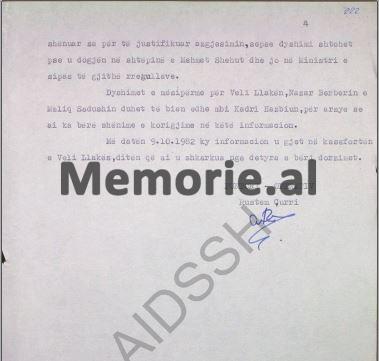
As we will see from the document in question, in his report-information, he (Rustem Çurri) informed his superiors about a meeting he had the day before with officer Zija Lagji, instructor in the department of documents of special importance of the Operative Directorate of the Ministry of People’s Defence, who, together with his colleague Nexhdet Kondo (proto-archivist of that department), informed him about the problem of a safe and the documents contained therein, during the handover of duty from Mehmet Shehu, as Minister of Defence, to Kadri Hazbiu in 1979. For more on this, etc., the document in question (part of the archival fund of the Authority for Information on the Documents of the former State Security) informs us, published in full and together with the respective facsimiles by Memorie.al.
THE SECRET DOCUMENT COMPILED BY THE OPERATIVE WORKER, RUSTEM ÇURRI, REGARDING THE DEPOSITIONS OF THE OFFICERS OF THE MINISTRY OF DEFENCE, ZIJA LAGJI AND NEXHDET KONDO, ON THE PROBLEM OF THE SAFE THAT MEHMET SHEHU HAD LEFT TO KADRI HAZBIU
S E C R E T
Copy No. 1
Tirana, October 26, 1982
OPERATIVE NOTE
Today, on October 25, 1982, officer Zija Lagji, A.P., with the duty of instructor in the department of documents of special importance of the Operative Directorate of the Ministry of People’s Defence, and Nexhdet Kondo, with the duty of proto-archivist of this department, came and signaled to us (me and Mit’hat Potka) the following:
The enemy Mehmet Shehu, when he handed over his safe to the enemy Kadri Hazbiu, who replaced him in January 1980 as Minister of People’s Defence, did not hand over the real key to this safe (the key to the drawer on the upper level of the safe), but gave him another key that did not open it.
This came to light because one day, in April 1982, Kadri Hazbiu went to the highly secret office where special documents are kept, together with Veli Llaka, comrade Kiço Mustaqi – then director of the Operative Directorate – to open the safe (its upper level), with Zija Lagji also present.
But the safe did not open with the key that Kadri Hazbiu had; then he (Kadriu) began to curse Mehmet Shehu, saying: “Do you understand what he intended to do with this act, that we, as we are in a difficult situation, when we came to open the safe and take the documents, we would not succeed in this aim, and then we would be called enemies?!”
With that, Kadri Hazbiu and the others left the office of documents of special importance, saying that they would inform the Supreme Commander, comrade Enver Hoxha, about this.
The next morning, Kadri Hazbiu, Veli Llaka, and comrade Kiço Mustaqi came again to the office where this safe is located, and he (Kadriu) had brought with him another key, which had been sent to him by Haxhi Kroi, because he (Haxhi Kroi) had the other keys of the enemy Mehmet Shehu.
As soon as the key was inserted into the safe (the upper level of the safe), it opened, and at this time, Kadri Hazbiu said that a record should be kept and that the four of us who were present should sign it.
At this time, Kadri Hazbiu, angry and displeased that Mehmet Shehu had not left him the real key to this safe, said that he would go and report this to the main Party leader.
After the safe was opened, inside it was found a metal cassette with two keys on top, which was sealed with wax, and Kadri Hazbiu said that he would now inform the Supreme Commander on how we should proceed to open it.
And on this same date, Kadri Hazbiu and the rest of us, also taking with us the director of engineering preparation, Ramiz Fiçori, to take measures in case the safe was mined, went to the command post of the General Staff in Linzë, and the cassette safe was opened.
The enemy Kadri Hazbiu took with him the documents found inside, and from Linzë as we were, we came to Kadri Hazbiu’s office. The materials of the cassette were taken into his car by Kadri Hazbiu himself.
In the former minister’s office, these documents were put back into the cassette and, after being sealed with two seals (one with Kadri Hazbiu’s and one with comrade Kiço Mustaqi’s), this cassette was placed in the safe that Kadri Hazbiu had in his office. For more on this, Veli Llakaj and comrade Kiço Mustaqi should know.
Regarding the above, the two above-mentioned comrades raise these suspicions:
Was the Supreme Commander truly informed about what documents these were that the enemy Mehmet Shehu had placed in the cassette, which as far as is known, were not administered according to the rules, and why did Kadri Hazbiu keep them in his safe?! Even today it is not known what became of these materials, how many days he kept them, whether he sent them higher up or not, etc.?
On April 27, 1982, by Eli Kokushta, the personal secretary of the Minister of People’s Defence, Kadri Hazbiu, an information report was typed for comrade Enver Hoxha, “On some suspicions about the hostile activity of Mehmet Shehu”, which discusses:
How Mehmet Shehu worked on the operative plans, the place, time, and persons who worked on and were acquainted with it?
On the burning of some operative plan documents in Mehmet Shehu’s house, in the presence of Veli Llaka, Nazar Berberi, Maliq Sadushi, and Mehmet Shehu himself.
It mentions Mehmet Shehu’s statement that in this small safe (small cassette), we have a document that you do not need to know about, but if I (Mehmet Shehu) die, you have the document here in the safe. This cassette was located in Veli Llaka’s large safe.
Regarding this, the following suspicions arise:
How long was the operative plan kept in Durrës and later in his house (Mehmet Shehu) in Tirana?
At the General Staff, the special plan was also worked on, part of military actions by Veli Llaka, Maliq Sadushi, and Nazar Berberi, while the part on the political situation, i.e., when this plan would be implemented, the main circumstances, was worked on by Mehmet Shehu himself.
Regarding the special plan, the suspicion arises: is it true that this plan did reach comrade Enver, or not?! Was this plan destroyed in Mehmet Shehu’s house, or not?! Is there any document that proves its destruction, because it is said that some printed materials and maps were destroyed in Mehmet Shehu’s house.
For this, the former deputy ministers mentioned above must answer what materials these were that were burned in Mehmet Shehu’s house, because there are suspicions here, and the possibility of their compromise with him (Mehmet Shehu) is not excluded, that the special plan and the summary block may have been given to someone else (foreign intelligence), while their burning was recorded just to justify the destruction, because suspicion increases: why were they burned in Mehmet Shehu’s house and not in the ministry, according to all the rules?!
The above suspicions about Veli Llaka, Nazar Berberi, and Maliq Sadushi should also fall on Kadri Hazbiu, because he made changes and corrections to this information.
On October 9, 1982, this information was found in Veli Llaka’s safe, the day he was dismissed from duty and made his handovers. Memorie.al
OPERATIVE WORKER
Rustem Çurri