
• Rreth Nesh
  • Kontakt
  • Albanian
  • English
Friday, May 15, 2026
Memorie.al
No Result
View All Result
  • Home
  • Dossier
  • Interview
  • Personage
  • Documentary
  • Photo Gallery
  • Art & Culture
  • Sport
  • Historical calendar
  • Others
  • Home
  • Dossier
  • Interview
  • Personage
  • Documentary
  • Photo Gallery
  • Art & Culture
  • Sport
  • Historical calendar
  • Others
No Result
View All Result
Memorie.al
No Result
View All Result
Home Art & Culture

“In this way, Kadare has managed to create a narrative that transcends the specific tragedy of Albania and…”/ Unknown writing in the ‘New York Times’ by Leonie Caldecott, 1987

“Në këtë mënyrë, Kadareja ia ka dalë mbanë të krijojë një rrëfenjë që kapërcen tragjedinë specifike të Shqipërisë dhe…”/ Shkrimi i panjohur në ‘New York Times’ nga Leonie Caldecott, në 1987-ën   
Kadare dhe pëlhura e imtë e fatit
Njeriu që mbajti kombin me kokën nga Perëndimi

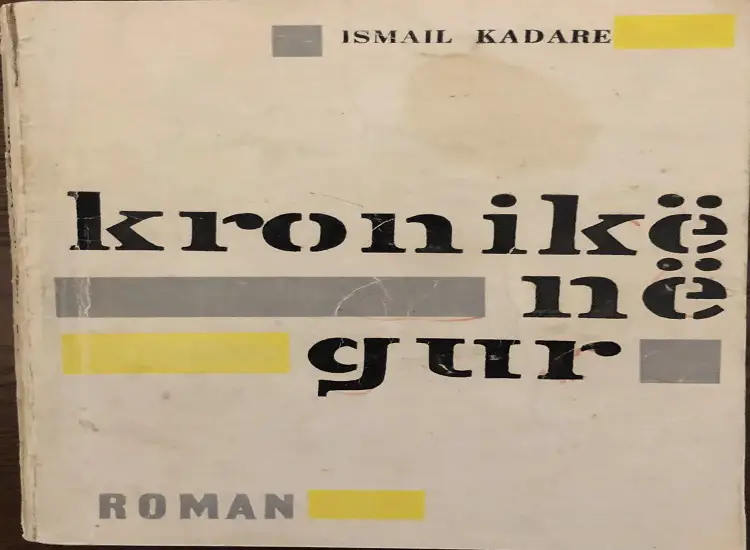
Memorie.al / Undeniably, Ismail Kadare’s work, Chronicle in Stone, has been universally appreciated across all periods. This fact is proven when one sees how this work was received in the United States of America, around 30 years ago. The American daily newspaper dedicates attention to the release of this work, along with some of Kadare’s other works in America. Although very well-known in Europe, the Albanian writer arrives with many mysteries for readers on the other continent. Leonie Caldecott, a journalist who also wrote for British media and was the author of a famous book at the time, penned the article about Kadare’s translated work. The assessments for this book are the result of a detailed understanding of the work, but with little knowledge of Ismail Kadare, the only Albanian writer known in the West.

The Article by Journalist Leonie Caldecott

At the center of Chronicle in Stone is a scenario in which the narrator, a young Albanian boy, during a peripeteia of the Second World War engulfing his city, is taken by his grandfather to visit the house of an inventor. The inventor had claimed to have designed a powerful airplane that operated on the principle of “perpetuum mobile.”

As a resident of a city that had recently begun to face aerial bombardment, the marvelous invention was not only a practical protection but also an “honor” to the people disgraced by the war machine that had been unleashed against them. However, the boy realized that the crumbling, elephant-model contraption represented a hopeless failure.

Gjithashtu mund të lexoni

“The Monster” was published and then banned, during the Stalinist period there were writers like Bulgakov, Maldestam, Anna Akmatova, who…”/ Unknown interview with Kadare in “La Stampa”, May 2010

“Thanas Dino was not one of those who could ‘get stuck’ in his fate, to simply turn into a dummy chronicler, but he…”/ The story of the Gjirokaster journalist who was criticized by Enver Hoxha in 1972

This perception is based partly on realism and partly on fantasy, which was based on bad times. Every military power is a seemingly continuous threat, such as an Italian bomber that had recently crashed into the old, stone city.

This clash, which the wise and learned elders believed in, is exchanged for the metallic security of modern technology, stripped of all the sorrows of this compelling novel. Ismail Kadare’s insertions into his narrative, in scenes such as this and others, are sure keys to relationships.

The boy’s participation in the world of the magical city and the events that surround him bring to mind the close connection with his grandfather, who acts as a conduit for local gossip, which remains one of the many normal and stable elements in his grandson’s life.

This summarizes everything in the depiction of the strange characters that move in and out of life, such as the yellow-skinned boy who haunts the city’s wells and reservoirs after dark, searching for the body of a girl he loves and who he is convinced was killed by her family after their secret – a passionate embrace during an air raid – was revealed.

The character, through the consciousness of a child with a short adolescence, allows Kadare to blur the line between fact and fantasy, without sacrificing the essential realism of the novel for a moment. The hostile behavior in which the boy perceives his environment, for example, he views water, simultaneously “as a friend and enemy of the stone city,” where “it was not easy to be a child.”

This is precisely essential to the writer’s way of conveying the truth about the situation. Through a level of misunderstanding of things by the child, the events that affect his life – many prejudices from adults – guarantee a foresight that transmits this person’s suffering, more spiritually than any other hope he might entertain. From the beginning of the novel, he and his best friends’ recoil at the sight of the slaughter of animal beings.

Towards the end, the idea of blood has dominated the city more in relation to the hangings, murders, and slaughter of comrades, cousins, and neighbors, which are described with a uniform gaze, inevitably appreciated. As in the scene at the inventor’s house, the children’s state of mind has moved from joy, through boredom, to indifference.

In this way, Kadare has managed to create a narrative that transcends the specific tragedy of Albania. The coming of age of his unnamed narrator stands as a beginning for generations as a whole within the dulled effects of violence.

At the same time, the child is in some sense simply reliving the history of these people, who, from past centuries until now, have experienced conditions arising from countless invasions by armies, from the Italians, the Greeks, and earlier, the Turks.

Even the habits of control conveyed by the Albanian communist partisans bear the same distinguishing marks, in which human sympathy has been sacrificed to ideology rather than justice.

Ismail Kadare’s work (translated into English), which has included poetry and eight other novels, has yet to gain attention in the U.S., while it has been enjoyed in Europe. His narratives have been compared to those of Gabriel García Márquez.

He certainly incites the same ironic suspicion in the understanding of life first, magically, by a child, which is much greater and more realistic than that of adults.

The success of Chronicle in Stone is that it has not found it necessary to deviate from the unification of the aesthetic enjoyment of time, space, and action, realized in this interweaving of realism with fantasy. Memorie.al

Published on January 24, 1988, in the ‘New York Times’  

The title is editorial
ShareTweetPinSendShareSend
Previous Post

"After I insulted the secretary, [saying] 'may you go to hell (esfel) along with the entire Party,' they put the handcuffs on me and took me to the Branch in Berat, where Filat Muço and others, for five months..."/ The rare testimony of the former Spaç convict.

Next Post

“When they asked Mihallaq Ziçishti to let me play with 'Partizani', he told them: 'As long as the pistol (or: gun) that Enver Hoxha gave me is working, you, Vaso...'” / The rare testimony of the Korça football legend

Artikuj të ngjashëm

“The Monster” was published and then banned, during the Stalinist period there were writers like Bulgakov, Maldestam, Anna Akmatova, who…”/ Unknown interview with Kadare in “La Stampa”, May 2010
Art & Culture

“The Monster” was published and then banned, during the Stalinist period there were writers like Bulgakov, Maldestam, Anna Akmatova, who…”/ Unknown interview with Kadare in “La Stampa”, May 2010

May 5, 2026
“In all my travels across the country, from South to North, I had never encountered a bookseller like Alizoti; he had read every single book and….” / The rare testimony of the former editor of “Hosteni”
Art & Culture

“Thanas Dino was not one of those who could ‘get stuck’ in his fate, to simply turn into a dummy chronicler, but he…”/ The story of the Gjirokaster journalist who was criticized by Enver Hoxha in 1972

April 26, 2026
“How do you think, ‘blessed ones’, that with the political decisions of a perverse communist like Enver Hoxha, you will change the Albanian national identity…”?! / Reflections of the famous publicist
Art & Culture

“Writing correctly in Gheg today is not simply a matter of desire; it is an act of intellectual resistance, as those ‘100 people’ who keep it alive are…”/ Reflections of the renowned journalist

April 25, 2026
“The boring and impatient R.P. gives Kadare almost unbelievable news; ‘Lasgushi, this summer, had a love story…”/ The unknown event of the two colossuses of Albanian letters
Art & Culture

“During the conversation, Lasgushi only mentioned Ismail Kadare, of course in a positive way, as well as world-famous names: Lermontov, Heine and Leopard, saying that…”/ The rare testimony of the famous actor and director

April 19, 2026
“Free elections and a Government that originates from Parliament and is based on it, this solution is formally the most normal, but serious press freedom is needed…”/ Reflections of the famous publicist, in 1936
Art & Culture

“Free elections and a Government that originates from Parliament and is based on it, this solution is formally the most normal, but serious press freedom is needed…”/ Reflections of the famous publicist, in 1936

April 5, 2026
“The Silent Laocoon: Ismail Kadare’s Suffering, Disguise, and Secret Dissent in the Communist Regime, is the Highest Form of Resistance, as…”/ Reflections of the Renowned Scholar and Publisher
Art & Culture

“The Silent Laocoon: Ismail Kadare’s Suffering, Disguise, and Secret Dissent in the Communist Regime, is the Highest Form of Resistance, as…”/ Reflections of the Renowned Scholar and Publisher

April 1, 2026
Next Post
“In Korçë, I started with boxing, then with athletics, but when I went to Tirana, in the enterprises’ championship, with the Automobile Park team, ‘usta’ Zihni Gjinali called me…”/ The rare testimony of the football legend

“When they asked Mihallaq Ziçishti to let me play with 'Partizani', he told them: 'As long as the pistol (or: gun) that Enver Hoxha gave me is working, you, Vaso...'” / The rare testimony of the Korça football legend

“Historia është versioni i ngjarjeve të kaluara për të cilat njerëzit kanë vendosur të bien dakord”
Napoleon Bonaparti

Publikimi ose shpërndarja e përmbajtjes së artikujve nga burime të tjera është e ndaluar reptësisht pa pëlqimin paraprak me shkrim nga Portali MEMORIE. Për të marrë dhe publikuar materialet e Portalit MEMORIE, dërgoni kërkesën tuaj tek [email protected]
NIPT: L92013011M

Na ndiqni

  • Rreth Nesh
  • Privacy

© Memorie.al 2024 • Ndalohet riprodhimi i paautorizuar i përmbajtjes së kësaj faqeje.

No Result
View All Result
  • Albanian
  • English
  • Home
  • Dossier
  • Interview
  • Personage
  • Documentary
  • Photo Gallery
  • Art & Culture
  • Sport
  • Historical calendar
  • Others