By Luan Rama
Memorie.al – It is astonishing to think today that on the shores of the Adriatic, Durrës and Apollonia were, in antiquity, places where the persecuted from Rome – both from the Republican era and the Imperial period – sought refuge. These were politicians, but sometimes also religious figures, people of the Church, as in the time of the beginnings of Christianity and the Roman Republic’s persecution of the early Christians in Rome, which is known in Illyrian history also through the killing of several Roman Christians in Durrës (Durrachium), along with Saint Asti, the first bishop of Durrachium, who were killed because they were followers of Jesus Christ.
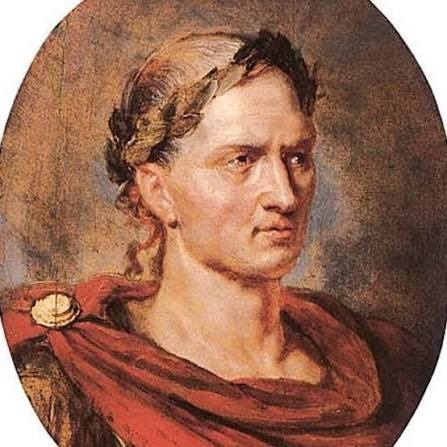
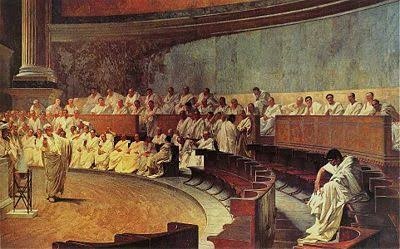
But undoubtedly, one of the most famous asylum-seekers of this ancient period was Cicero (Marcus Tullius Cicero, 106–43 BCE), one of the most prominent personalities of his time, a senator and great orator, who – alongside Caesar, Pompey, and Cassius – was among the four most distinguished figures of the Roman Republic. But why did Cicero seek refuge on the Albanian shores, and what happened to him?
Cicero was a great humanist figure and among the first ancient authors to use the word “humanitas.” It was he who spoke with such force in public tribunals or in his books about the values of a society built on the Greek “demos” – that is, the Greek model of democracy – and about the most fundamental values of man, such as “justice” (Iustitia), “moderation” and tolerance (Temperantia), or civic “courage” (Fortitudo). When Brutus was with his troops in Durrachium…
In 63 BCE, he learned that in Rome, Cicero had been declared consul, and delighted, he sent him a letter on May 15, in which he wrote: “I had finished my letter when I learned that you were to be elected consul. Then I must think of the idea of a legitimate Republic, a ‘rem publicam iustam’ supported by its own forces.”
Even though this news was not true, but rather a rumor circulating in political circles, it showed that Cicero had great fame and that many commanders of the Roman legions were ready to support him. His speeches against the corruption of politicians and the demagogy of the populist Catiline made him one of the most popular figures, so much so that even the most powerful consuls like Caesar feared Cicero’s speeches. Not for nothing was he called “Pater patriae” (“Father of the Fatherland”). Indeed, the all-powerful consul Caesar began to view him with suspicion and as a strong opponent, since with the courage that characterized him, Cicero knew how to win over the nobles and military chiefs.
Several times in the Senate, Cicero had openly opposed Caesar’s policy. To win him over, Caesar had previously proposed sending him as “legate” – that is, ambassador – as a representative of the Republic, but Cicero had not accepted it. He could not compromise because he did not have a great thirst for power. This was also the reason why his situation in 58 BCE worsened, and his continued stay in Rome became dangerous. Caesar had begun to isolate him. When Cicero left Rome to go to his house on the outskirts of the capital, he found it ransacked and empty. The time of persecution had begun. At that time, he lived there with his wife, Terentia.
Foreseeing that Caesar’s men might capture and kill him in some well, he decided to leave immediately. Thus, alone, secretly separating from his beloved wife, he took the familiar road south, the Via Appia, and headed toward Brindisi, where he took refuge in the house of his friend Laenius Flaccus, waiting for a ship to take him to Sicily. But along the way, learning that he was not welcome there by the Roman governor, he stopped and turned back toward the shores of Illyria, toward Durrachium. It was April 29, 58 BCE, and he had to make a dangerous journey across the sea.
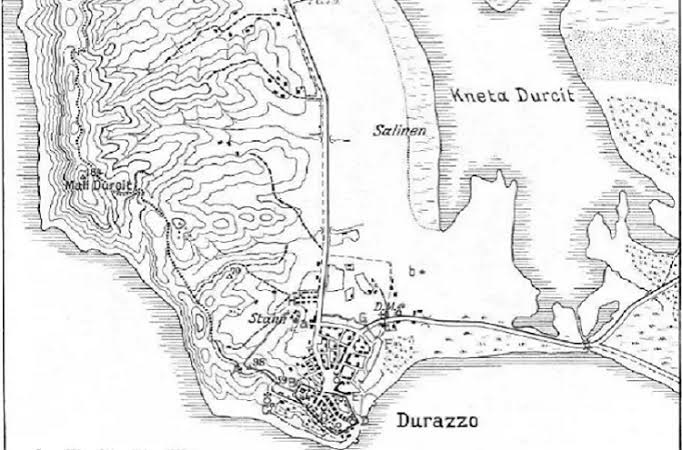
Durrachium at that time was one of the ports held by the Roman army. On the way, at sea, he wrote a letter to his wife, telling her of the great pain of leaving her, fleeing into unknown paths. As he was approaching Epirus, he learned that Claudius had forbidden him to stay in Buthrotum (Butrint). Then the only solution was to go first to Durrachium, which at that time was considered one of the most famous commercial ports or as Catullus called it, “The Tavern of the Adriatic.”
Indeed, Durrachium was the city that had more prostitutes than all the other Mediterranean ports combined. Of course, the question was whether he should stay in Durrachium or go further inland toward Thessaloniki, where he had trusted people, including Cyzicus and the Roman governor Plaucius. Meanwhile in Rome, the wars between various political and military clans were becoming increasingly fierce.
Some demanded that Cicero return, others that he be captured and punished. On July 9 of that year, Pompey organized a Senate meeting at the Capitol, in the Temple of Jupiter, openly bestowing on Cicero the title “Savior of the Fatherland,” which clearly showed the division and antagonism between Caesar and Pompey that would soon lead to war between them.
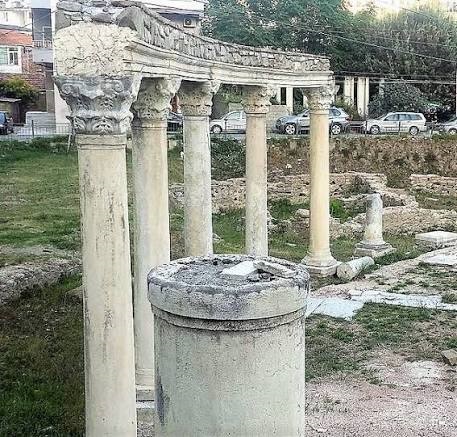
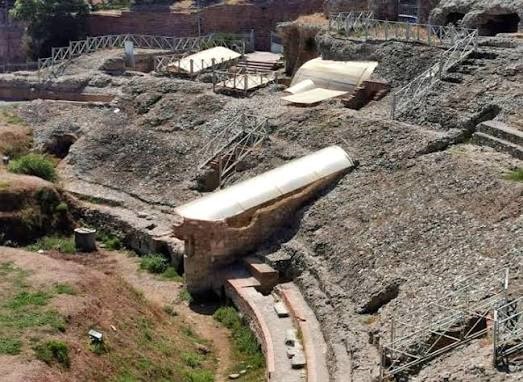
Cicero decided to leave Thessaloniki, where he felt insecure for his life, and to return again to Durrachium – this warm city with its great amphitheater, its baths, beautiful mosaics, and full of vitality: citizens, slaves, legionaries, merchants from many parts of the Mediterranean. Cicero’s arrival was undoubtedly a great event in the city.
Everyone wanted to hear him speak about laws, the state, civic duties, etc., even though he now showed himself reserved. On November 25, he wrote a letter to his friend Atticus in Rome, expressing that he was very sad and that “the inhabitants of Durrachium are very devoted to me.”
On that same day, he sent another letter to his wife Terentia and his daughter Tullia, writing that he was sorry they were suffering because of him, “but we must not fall into despair…!” “I came to Durrachium,” he wrote, “because it is a free city, since here people are devoted to me. But if I feel unwell in such a beaten place, I will go elsewhere.” A day later, he received three letters that his wife had sent weeks earlier. “Aristocritus brought me three letters, which I almost washed with the tears I shed,” he wrote.
“Night and day I have before my eyes your image in mourning…! If I am in Durrachium, it is because here I can be informed more quickly about what happens there. Here I am safe, since this city previously had me as its protector.” Cicero continued to write letters on December 10, and then in mid-December or mid-January of 57 BCE. “I have a letter from my brother Quintus,” he wrote to his wife, “who informs me of the Senate’s decision (regarding the request for his return to Rome), but I will wait for the laws to be proposed to the people. If there is opposition, I would rather renounce my life than return to my homeland. While you, hurry to come.” In mid-January, he wrote to Consul Metellus, asking for support for his return and thanking him for his words in the Senate, where he had strongly supported him.
In early February of 57, he wrote in his memoirs that he was preparing to return. It was a return from an exile that had been uncertain for his life. Even though the Senate had expressed itself in favor of his return, it still took several months for the matter to be legally decided. And the law was proclaimed in the first days of August. Meanwhile, the Senate had begun to support Pompey. On August 4 of that year, he finally boarded the ship. In the port of Durrachium, he was seen off with fanfares, cheers, and great honors from the city’s governor and high military officials. Everyone hailed the upholder of law and liberty. A day later, Cicero arrived in Brindisi. In all the cities he passed through on his return journey to Rome, he was received with great triumph and enthusiasm. On September 4, he entered Rome triumphantly… But his villa on the Palatine had been destroyed by his political opponents. Likewise, the villas in Tusculum and Formia were completely abandoned.
Many years later, Cicero would return to Durrachium again, where he stayed for a short time, as he was preparing to travel far from Rome, heading toward Butrint, Preveza, and then toward Thrace and the Near East. During this time, he also wrote his impressions of Apollonia of Illyria, which he considered a “Magna urbs et gravis” (“A great and solemn city”).
After his return from Asia Minor, where he had been appointed proconsul in Cilicia in 51 BCE, and after several battles he commanded – assisted also by his brother Quintus – in addition to his political life as a senator and famous orator, over several years he devoted himself to writing his books: De Republica (On the Republic), De Oratore (On the Orator), De Legibus (On the Laws), De Officiis (On Duties) – which was the greatest legacy he left to humanity.
During this time, somewhat withdrawn, he wrote and gave advice to others: “I advise you to do as I do. Do not appear too much, even though many things may be said about you. Since our voices are not heard in the Senate and the Forum, we know the lesson of the wise men of old. Therefore, we must serve our homeland with our writings, focusing on matters of ethics and constitutional law.”
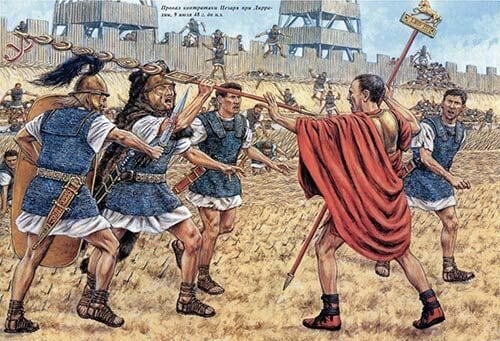
But when the crisis between Caesar and Pompey grew ever greater, Cicero chose Pompey. He even went and joined Pompey in Epirus, during which time he saw again Butrint, Oricum, Apollonia, and Durrachium, where the long battle between the legions of Caesar and Pompey would take place – a war that ended with Caesar’s victory at Pharsalus in Macedonia. After this battle, Cicero returned to Rome and once again began his civic struggle in the political arena.
The Ravens of Apollo
In 44 BCE, many things had changed in Rome’s political life. Although he fought until the end of his life to protect the internal political balance of the Republic from the great quarrels that were developing between Brutus, Cassius, Mark Antony, and the other consuls, he could not avoid the anger of his political opponents. As he wrote in his work Philippics, “Mark Antony is a madman, a corrupt man, and even worse than Caesar. Antony seeks to start a new bloodbath.”
The assassination of Caesar on March 15 of that year was the climax of chaos in Rome. Octavian, Caesar’s nephew and heir, who at that time was studying at the military academy in Apollonia, hurried back to Rome. Cicero asked him to join him in the fight against Mark Antony, but Octavian did not dare. That very year, seeing Cicero as a dangerous opponent, Mark Antony and his loyal follower Lepidus sent soldiers to capture him.
By then, Cicero’s name was on the lists of those to be executed. When the soldiers went to arrest him, accounts say that they found him fleeing swiftly through a forest to reach the sea and find a ship there – perhaps to take him to the Illyrian shores, to Durrachium, where he still had friends. In fact, before fleeing, Cicero had gone to his villa in Gaeta, which was empty. Chroniclers say that that night, ravens flew over the villa.
Indeed, one raven had entered and gone to his bed, pecking at him, but the tired old man was sleeping. Apparently the ravens were Apollo’s messengers, seeking to come to Cicero’s aid, to wake him so he could flee as quickly as possible. The next day, his friends took him and they were leaving. Meanwhile, the soldiers had arrived at the empty villa and had asked about him.
One of the residents – specifically Philologus, to whom Cicero had given lessons years earlier – showed them the road by which Cicero had fled. And so, rushing toward the shores, they saw Cicero waiting for the ship. Finally, they caught him and immediately cut off his head, which they sent to the powerful Mark Antony in Rome. It was December 7, 43 BCE, and Herennius cut off his head and hands.
Brutus, who had left Durrachium, had moved toward northern Italy, then marched through the lands of the Gauls, and later descended toward Rome. He had been declared imperator, but Cicero was already dead. His head and hands were displayed by Mark Antony’s men on the “rostrum,” the public tribune of Rome. They also captured his son and his brother Quintus, whom they also killed.
Later, Plutarch wrote the book Life of Cicero, in which he made known the life and political and humanistic activity of one of the giants produced by ancient Rome – Cicero, the author of the celebrated works of Roman antiquity. Of course, in his work De Fato (On Fate), he had not foreseen his own fate, nor that his head and hands would be cut off and then displayed in the Forum before the citizens of Rome. Geniuses often suffered a tragic fate…! / Memorie.al