
From Uvil Zajmi
Memorie.al / Invited to a retrospective exhibition organized by the family of the “People’s Painter”, Fatmir Haxhiu, on an anniversary of his, where there were also many friends of the artist, an evening that was touching, full of emotion, memories, accompanied by paintings, drawings, everything that Haxhiu left behind, a valuable legacy. Among the guests were also two esteemed ladies, next to whom I happened to be. After we introduced ourselves, I learned that they had been teachers at the “Qemal Stafa” high school, where my father, the painter Nexhmedin Zajmi, had been one of its first lecturers. Meanwhile, as those present followed the paintings one after another, attention stopped when the canvas “Labe Mothers”, measuring 1920×150, in oil, realized by the painter Haxhiu in 1986, appeared. Based on the note left by the painter himself, Fatmir Haxhiu, it was his desire, his idea, to present the great help that the brave Albanian mothers and women have given in the continuous wars for the freedom and independence of the country.
A generalizing composition with broken terrain and snowy landscape, to also show the difficulties of nature, as well as the women’s clothing, characteristic of the Labëria region. “This painting has a rare history,” – continued the narrator, the painter’s son. I judged it as an accompanying expression of a painting, a work of art, a story that had prompted, provoked, and inspired the author. But suddenly, Artani, very emotional, took out a letter, asked for silence, and began reading. All of us focused, to hear what that letter contained, curious whether it had any connection to the painting or not. And indeed, a story like that of the work “Labe Mothers” by the painter Fatmir Haxhiu is hard to come across. A true event, surprising, is shocking, to the limits of the unbelievable when you hear it, to learn of its fate.
THE LETTER
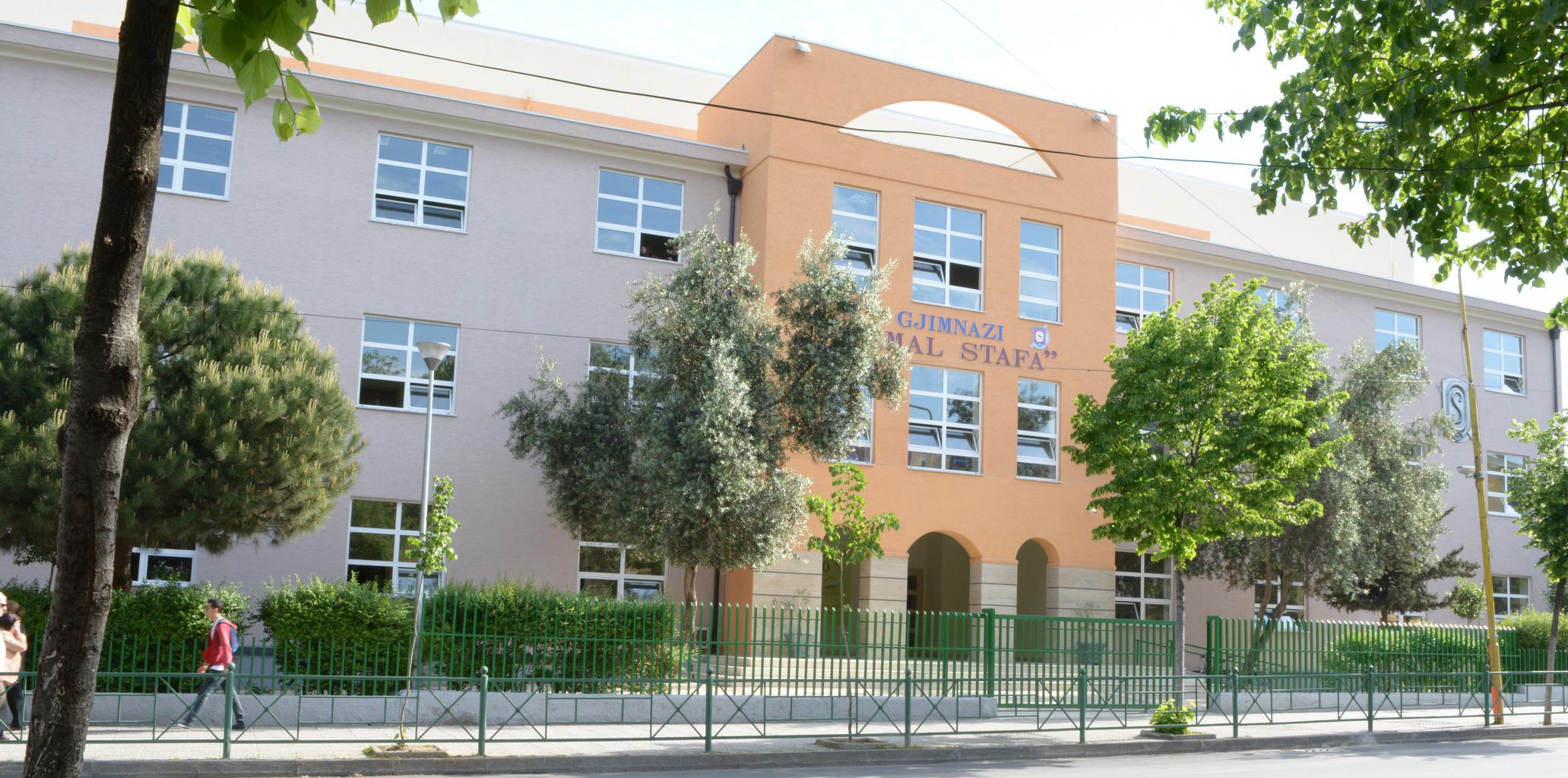
“After the events of 1997, at the ‘Qemal Stafa’ high school in Tirana, we decided to make efforts to change the ‘climate’, as a result of the heavy atmosphere created throughout the country. We built the flower garden in front of the school, planted many trees that are now several years old, activating many students to collect material for the history of the high school and to start work on re-establishing the school museum. The high school was opened in 1925, a high school with many values and tradition, where personalities of the time taught and students who have contributed in many fields, both at home and abroad, studied. I was the coordinating teacher, who besides teaching covered the student government and all the activities in the school. We decided to celebrate the 70th anniversary of the high school, and we had assigned tasks for placing stands in the school hallways, photos of honored teachers who have taught at the high school and of former students, personalities over the years.
Together with the high school director of those years, Mr. Gjegj Zaharia, we went to the Ministry of Education to clarify the names of teachers honored with the titles ‘People’s Teacher’ and ‘Meritorious Teacher’, given after the 1990s. When we finished work and were about to leave, we found ourselves in front of an unbelievable sight. Two workers were transporting construction materials with an improvised trestle, which was nothing other than the original painting ‘Labe Mothers’ by the master Fatmir Haxhiu. The painting had been part of the national exhibition of 1986. We couldn’t believe our eyes and we became alarmed. I immediately went to get two students to save and transport the painting, together with another painting that had suffered the same fate.
We kept the painting at the school for sixteen years, and on the 8th anniversary of the high school in 2010, we placed the painting in a dignified frame. We never told the honored Professor Fatmir Haxhiu how the painting had arrived at the school. In 2000, invited to the 75th anniversary of the high school, he was surprised when he saw it, explaining to us the purpose that had driven the painter to create it. He promised that he would make a reproduction as a gift for the high school, to later take the original. But at that time, he was very engaged in the creation of the monumental painting ‘The Battle of Kosovo Field’ for the Historical Museum of Kosovo. Unfortunately, in March 2001, suddenly while at the peak of his work, he passed away. Today I am happy that it is the property of the Haxhiu family as a work of art and not as a trestle.”
For a moment Artani stopped, looked around the hall, to continue: “From a former teacher at the ‘Qemal Stafa’ high school, Tirana, March 3, 2016”. Certainly, all of us present were surprised. The atmosphere created was truly unbelievable, unexpected for what the letter contained; the narrative and the event made people fall silent, there was a moment of pause. Without wasting time, Artani addressed a woman, publicly introducing her. I turned my head and saw that it was precisely that teacher, the protagonist, the author of that letter, of that action, the woman I had next to me, and to whom I had been introduced at the beginning. As a guest, she did not expect that the letter she had sent to the family would be made public there. Somewhat confused, as Artani finished reading, while everyone’s eyes, attention, gaze were focused on her. To then continue with the paintings, other drawings, works, creations of the painter realized and left behind after his passing. Placed aesthetically on the gallery stands. A cocktail afterwards at the closing, with conversations, comments.
GJERGJ ZAHARIA: “PAINTER HAXHIU PASSED AWAY WITHOUT KNOWING THE HISTORY OF HIS PAINTING”
Former director of the “Qemal Stafa” high school, precisely at the time in question regarding the painting’s history, now years later, recalling that event, remembers: “It was a surprise when, completely by chance, I saw and my attention was caught by a blue color in a corner of the mortar trestle” – he says. Then the moment when the painter Haxhiu saw the work and his request.
Zaharia, how do you remember the establishment of the museum?
In the hallway of the high school, I had placed several stands with photos of prominent personalities, of figurative art, cinematography, music, education, science, literature, writers, athletes, and people with contributions from all fields of life, former teachers, and students of that high school. Also heroes, martyrs. The idea was for the new generations to get to know them. It would be hard to find a nicer museum at that time, I believe even today in a secondary school, a high school, I think there is none. Students, teachers change, leave, others come, those people, photos remain. You see those figures in the hallway; it’s as if you communicate, live with them.
How did you come across the painting “Labe Mother”?
I went to the Ministry of Education constantly, being the director of a renowned high school, and from the fact that I had it nearby, also to secure some help for the school. I had been impressed by a painting located on the first-floor corridor, two high school girls with black aprons sitting on a bench. I liked it very much, I wanted to take it and place it at the school, typical for that environment. But how? I would have to beg the administrator, but it was difficult. They were doing inventory, and the ministry couldn’t give you, for your school, a painting that had value. Anyway, my mind was working on that.
What did you do afterwards for the painting?
The ministry’s restoration began. The paintings, photos were removed from the walls, left in corridors, without special care or attention. I thought the time had come to find and take that painting. Fixated on that painting, I went to the ministry casting my eyes to see it. In that mess, I see two workers, with a trestle collecting, throwing away debris and preparing mortar. Suddenly, my eye caught, amidst the mortar and dust, something like sky-blue paint color. Not sure what it could be, as it wouldn’t even cross your mind; indeed, if my eye hadn’t caught the blue color, everything would have been lost; I wouldn’t have shown any interest. The workers had put two sticks under the trestle to hold it. I stopped them and said; “leave this trestle here for a bit, I need it”. Dressed in a suit and tie, the rule for officials, they thought I was someone important and without a word, they left it there. How many times have I thought afterwards, if they had known me, perhaps they wouldn’t have listened to me? They left, to return after a while, since they themselves didn’t know what that trestle really was.
After they left the trestle, what did you do with the painting?
That day, with me at the ministry was also Shpresa. A heroic teacher, extremely rare and special. Shpresa Bejo (Todri). The granddaughter of Dhaskal Todri, a woman, a personality with whom I organized activities, competitions. She had an unlimited love for the students, with unprecedented devotion to serve. Decisive, such was her nature as an educator. With an extraordinary contribution to what she did at that school. Being very agile, with the passion to lead school students to the architecture branch, she, with the students, organized every Saturday, as a day off, lectures at the Gallery of Figurative Arts. A systematic engagement, and when we held competitions, the first winners came from our high school, since they had priority, thanks to the courses developed that offered them more opportunities to be better prepared. Everything due to Shpresa’s work who accompanied them. I call Shpresa, tell her to bring some students urgently here to the ministry. She notified them and they came, but they found it difficult to take the trestles and take them to school. Being there, I ordered them. Two trestles with mortar, but still without anyone knowing what was hidden under those canvases. We took them to school and I didn’t deal with them further. I tell Shpresa; “you take care of it, do what you want.” Thinking that after the mortar was removed, if it was worth keeping them for the school, since we discovered that the trestles were paintings, but without knowing anything more.
How much risk was there of that painting being damaged in that state?
Shpresa knew well how to proceed, meaning with the mortar, the paint, the colors could also come off, so it required care, it was a specialist’s job. Having friendships, acquaintances with the employees of the National Gallery of Arts, she took them there, after having communicated with the restoration people. “There are two paintings that workers had turned into trestles, they are covered with mortar, what should I do?” She had informed them.
Were you curious to know whose paintings they were?
I didn’t have much interest in the names, but I needed the painting, I cared about it for the school. Of course, if it was by a well-known author, it had multiple values. Meanwhile, Shpresa cleaned the paintings as much as she could without damaging them, with the care of a person, as she was, then she sent them to the Gallery for more professional work. The surprise was that there, when Sopi saw them, who worked in the restoration sector, he was stunned; “this is my painting,” – he said, surprised.
After you found out who the authors were, what did you do?
I learned late whose paintings they were, when after some time, Shpresa comes and tells me that those identified, one is by the artist Fatmir Haxhiu, the other by the painter Edi Sopi, whom I knew because I had him in the neighborhood, near the Medrese, and who had finished painting. I was dumbfounded. “How is that possible” – I tell her. Those at the Gallery didn’t talk to Haxhiu’s family. When she brought it to the school, I was amazed, the painting was very beautiful. The restoration had been done to perfection. The original painting was restored; you couldn’t believe that a short time before it had been a mortar trestle. “Labe Mothers”, I remembered the film and “this we will keep for the director’s office” – I tell Shpresa and I placed it there.
Were you fixated on a painting owned by the ministry?
I was not an amateur admirer of painting, nor an enthusiast, but the painting of those girls, I would not have taken it for its artistic aspect, but for what interested me more, for the seriousness of the school, simple, in the sense of school discipline. It could have been by an unknown painter, but I was fixated on it. Even thematically, I needed it for the high school, because a certain kind of liberalism had started in schools, students, teachers, who came in miniskirts and I was against those clothes.
Was there any interest from the ministry for the lost paintings?
Absolutely, no one from the ministry remembered the two paintings, one of which was sitting in my office. We didn’t remind them, we didn’t tell them, we didn’t show them, nothing, on the contrary. Realistically, their interest was zero. They came to my office, for inspections, meetings; they didn’t even know that painting existed and that it belonged to the ministry. As for Sopi’s, I don’t know what happened. Meanwhile, at various activities, artistic, sports, school anniversaries, we would invite former students who were alive, their family members, children, parents; Shpresa was a master at such organizing. One day, at one such activity, Fatmir Haxhiu also came. We invited him, without the idea, and thinking that we had his painting in the school. It is the year 2001.
What was the painter’s first contact with the environment?
We didn’t tell him, nor did he know anything, nor did it even cross my mind. I knew him as Fatmir, an artist, but without making the artist-painting connection at that moment. Without giving it importance, as something ordinary in the daily routine, he sat in an armchair, in the director’s office, with the painting on the wall, but at first he didn’t see it. Even as a painter, perhaps he didn’t think that a work of his was located in a school director’s office and he here in this office together with his painting. Even more so with that theme, meaning war, the heroism of women. Casting his eyes around, he sees it, recognized it, had a reaction: “This is the painting” – he tells me. There I remembered; “yes” – I answer – “Professor Fatmir, you are the author of this work. A very beautiful painting,” – I continue, now focused on the conversation. The painting completed the office. When various people came, even from embassies, it caught their attention, they showed interest, and they looked at it with much admiration. I expressed this to Fatmir as well. There was a moment when, very carefully, he asked me if he could take it? “Not take it, but I will make you another painting, identical to this one so that even you cannot tell the difference. But this one has other value, because it’s original. You don’t care if it’s original or a copy, it’s enough that when you look at it, you have it here, you won’t know the difference, but my hand will make it,” he told us.
What surprised you the most?
I didn’t know the love, the connection a painter has with his work, when he unexpectedly finds himself in front of it. I am outside that painter-painting relationship. If I had thought of it before, I would not have put it in the office, because realistically the painting risked being taken from me, which we had brought back to its original state with such difficulty and with which I had already fallen in love, as a part of the office, of the school. You regret removing it; your eye has become accustomed to it.
Did you make an agreement with the great artist?
“Yes – I tell him – this, yes, it can be done immediately, I have no objection, but you make the copy first, so that I don’t remove this one, the wall looks empty. Not only me, but the entire pedagogical staff are used to this painting, and when people come in and out, where is the painting, they will think the director has taken it home. They won’t say it to me, but they will gossip about me in the corridors. They don’t know that you came. I can’t gather the staff and tell them, the painter came and took it. You make that one; the important thing is that you have the original here.” And so we parted.
And then what happened, was the promised ‘exchange’ realized?
No, because after a few days, he suddenly passed away. I was surprised, saddened, grieved that I didn’t fulfill that wish, it remained a burden on me. But I could never have thought it, since he was active and in good health. After his death, Shpresa got in touch with the family, the children, mainly Artani, the son. We organized an activity with the students, and in a ceremonial manner, we handed over the original to them. Meanwhile, very correctly, they had prepared and brought us another painting, as a wish of the Haxhiu family.
Zaharia, in closing, could you also tell us about an exhibition, a bit special, that you had?
With the artist Bujar Kapexhiu, we realized at the school three nice, large stands of caricatures. I placed them on the first floor. With the theme mainly of the clothing of teachers and students. One of them was a caricature of students looking at the teacher’s red underwear. Phenomena of this nature caused a stir, delivering the message; “don’t come to school with non-aesthetic clothing.” Those caricatures spoke more than anything else. You would see, as soon as you entered the school hallway, a masterpiece by Kapexhiu./ Memorie.al