
The First Bicycle in Albania, 1907 in Shkodër, Brought by the Swedish Consul
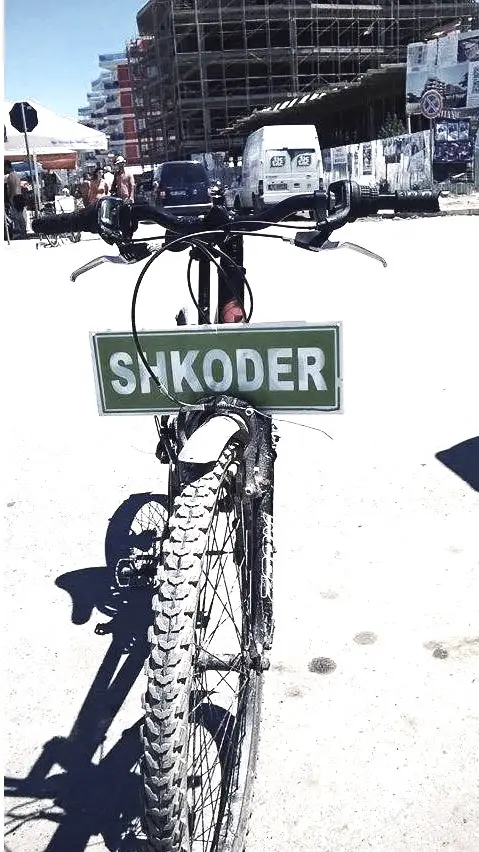
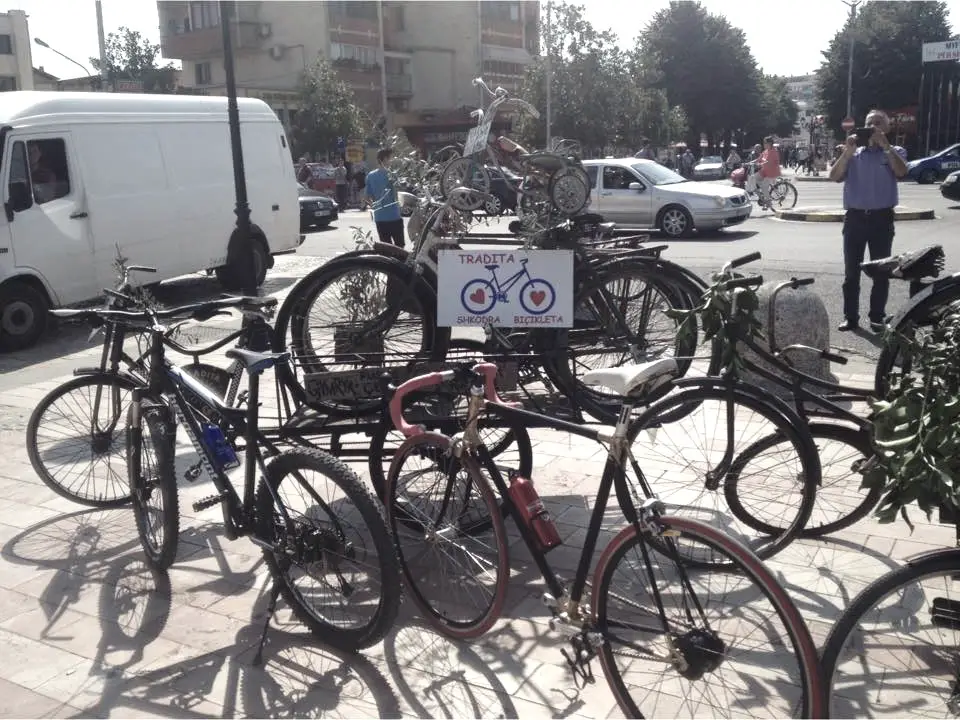
By Memorie.al / Perhaps not all of you reading this article know that in Europe, there is a city that moves on two wheels: it is Shkodër, a northern city in Albania. It is so ancient that it dates back twenty-five centuries. It served as the capital of the Illyrian Kingdom, but since its birth and development, I would say it has also been the capital of natural wonders: it has plains, hills, and mountains, and three rivers – the Drin, Buna, and Kir – which surround it like a halo. The fortress, built with cyclopean stones and dominating the entire landscape from the Adriatic coast to the Alps, has at its “foundation” an impressive legend of a mother walled alive so that the castle would never crumble! Perhaps these natural resources, over the centuries, also increased the greed of invaders. But in this writing, we will not deal with the historical or geographical aspects, nor any other field of note; we will present to you a rare phenomenon, perhaps even in the Balkans, as Shkodër is a city that moves on two wheels.
It is now understandable to the reader – a city that moves by bicycle, also thanks to the fact that the area where it is populated is flat, 12 km long and about 6 km wide, making it quite practical for pedaling. So much so that many chroniclers, writers, and journalists have called it “The City of Bicycles,” a model of ecological transport, especially now when cities are no longer wandered by clouds that bring rain, but by clouds of smog that suffocate. More than a century has passed since a foreigner was first seen moving through the streets of Shkodër – sometimes cobbled and sometimes dusty – with a vehicle that no local, who had never been abroad, had ever seen. The calendar fixed the year as 1907.
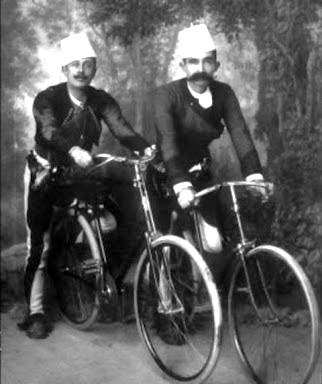
He was the “Consul of Honor” of Sweden; therefore, anyone who heard of it flocked to the main road where he traveled to see with their own eyes that vehicle that moved on two wheels without being pulled by animals. With that, curiosity was satisfied, but the greed to own such a means of travel was not. Those who were wealthier and had traveled outside of Albania did not hesitate to bring back bicycles of various brands, mostly Italian. But in the historical framework, we must also mention a photograph of two men with bicycles from the “Marubi” phototheque, dated 1897, wearing Albanian national costumes. However, their identities are not documented to give that date more chronological certainty!
Initially, in our city, the bicycle was called “Velisipet,” but also “two-wheeler.” Shkodër – this city that believed in three religions: Muslim, Catholic, and Orthodox; Shkodër – this pioneer of almost all fields of art and culture in Albania, also had the other side of the coin: women were marginalized from social life, and fanaticism did its work. Therefore, one day, as if following a call to arms, the citizens flocked again to the main road, where… a woman on a bicycle was passing by! And she was not Albanian, but a woman from the Austrian consulate. Even though the bicycle had not yet gained full “citizenship,” it was being understood as if it had been created specifically for this city, so much so that the local police, as early as 1915, were equipped and began to pedal on bicycles.
With the increase in the number of bicycles, a group of Shkodran citizens decided to establish the sport of cycling as early as 1920. The first cycling circuit – which is also the third oldest in Europe after France and Italy – was organized precisely in our city. Therefore, Shkodër has continuously set the tone for this sport, so much so that not only adults, but there is no child who does not know how to ride a bicycle. Given that until the first decades of the 20th century, Shkodran houses were one or two stories high – and rarely three stories – and that most of them had courtyards and stables, the possibility of keeping and leaving bicycles was extraordinary.
They increased from year to year, but as always, until the liberation of Albania from the Nazi-Fascists on November 29, 1944, the bicycle was the privilege of men and boys. It reached a point where there was even “competition” over who had the most beautiful bicycle. The development of Shkodër and the creation of an industrial zone outside the city’s “yellow line” (city limits) made the bicycle an indispensable tool for work, not only for men but also for girls and women. Consequently, in the city stadium annex and in the peripheral fields, one could constantly see dozens of women learning to pedal on a bicycle.
There was a time when commuting from home to the workplace could not be handled by 2-3 urban buses, and when no one – except high-ranking local and central officials – had the opportunity to travel by car. The bicycle was the only solution, even though the increasing demands could not be met by their importation (initially from Eastern countries and later from China). Doctors and teachers, masters and apprentices, engineers and artists, clerks and military personnel, etc., all went to work by bicycle. By the end of the 1950s, when Shkodër had approximately 60,000 inhabitants, there are complete records showing that there were over 10,000 bicycles in the city.
It was a time when even bicycles were registered, and every citizen, for a symbolic fee, received a white metal plate the size of an average mobile phone, which had the number stamped on it and which they were obliged to place under the bicycle saddle. There were people obsessed with numbers, so much so that in Shkodër, it was known that the violinist Kolë Vjerdha always had number 1; that Nazmi Mandia and Kel Temali were among the first to pedal on bicycles; that some kept their “Bianchi” as if it had left the factory that day despite using it for years; that Faik Quku, a well-known instrumentalist of the Shkodran “aheng” (traditional music), and Fadil Kruja and Ragip Curri were among the first to introduce the tandem bicycle to Shkodër; that Mark Mirashi bought a “Mifa” as soon as he received his diploma as a surgeon and retired with it, and so on. Shkodër had more bicycle repair shops and departments than any other Albanian city, as the need for them – even in conditions where not all roads were paved – was great.
Well-known in Shkodër are the master bicycle mechanics, such as: Qazim Damnori, the Kallugjeri brothers, Sadetin Ulqinaku, Enver Kosova, and many others. A decade later, the new artistic works enterprise, with nearly 3,000 female workers, had over 1,000 bicycles in the square in front of the offices and workshops every day, where Shkodran girls and women arrived and left from work.
After the overthrow of the previous system in 1991 and until today, we cannot say that the statistics are the same, even though the city has seen significant demographic growth. This is because the industrial zone, which once counted tens of thousands of workers, was suffocated and many enterprises were closed. And if until yesterday the city moved completely on two wheels, today – perhaps in the same proportions – it moves on four wheels, on cars of various brands, so much so that especially on the main roads, one can only find a parking space at midnight.
But regardless, no other Albanian city has been able to take the crown of the bicycle champion from Shkodër. Thousands of them still circulate through its arteries. The author of this article, so in love with development and the new, has neither made a “compromise” nor tried to get a driver’s license, as I say today with humor: I have no intention of changing my “Benz,” which is a German-brand bicycle, even for a 2013 “Benz”! One is impressed by the fact that Jozef Zualleart, one of the most up-to-date experts on bicycle pedaling in Europe, in a 2011 study, distinguishes Shkodër as a record-breaking city in Albania – and even in Southeastern and Central Europe – with a high pedaling percentage of 29%.
It ranks among European cities known for high pedaling culture, such as Bolzano, Ferrara, Freiburg, and cities in the Low Countries and Scandinavian countries. The creation in Shkodër of a non-profit organization called ‘GO2’ (Go on 2 feet and on 2 wheels) with a focus on sustainable urban mobility – among the first of its kind in Albania – and the support it has found from local officials and residents, suggests that bicycle pedaling will gain ground and continue to enrich its early experience with contemporary elements. Shkodër’s movement on two wheels has also inspired the poet Mehmet Gucia, the first and most successful practitioner of Japanese haiku in this city.
He has a manuscript of a volume with 100 haikus dedicated to the bicycle in Shkodër. And to quench the curiosity of the readers of this article, we are bringing two haikus, one of which is dedicated to the most modern poet of the last century, Migjeni, who, while he was a teacher in Vrakë, traveled the road from Shkodër to this village and back – several kilometers – every day by bicycle: “Facing the north wind / The bicycle does not stop / It is Migjeni” and: “I look from Rozafa / At the road where the Buna waves: / A river of bicycles!”
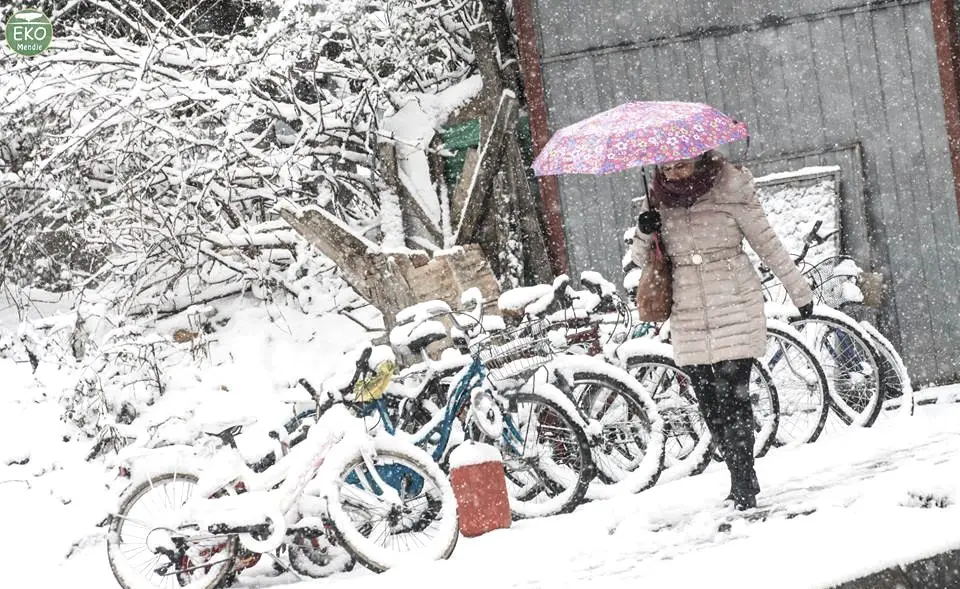
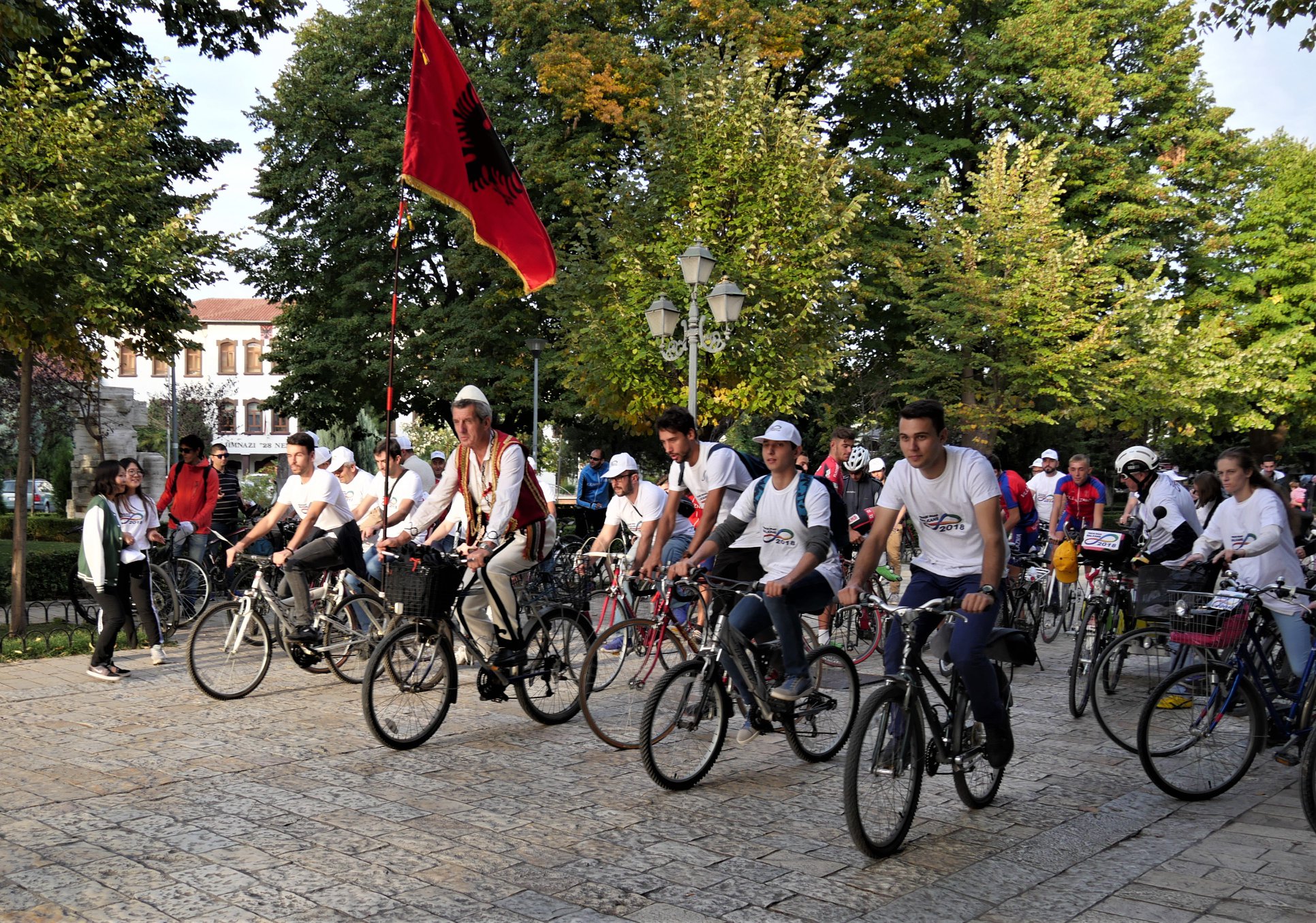
Today, more and more, near institutions and enterprises, beside markets, stadiums, and sports fields, you see not dozens, but hundreds of parked bicycles; on rainless days, entire families or social groups take excursions to Shiroka, Zues, and Ura e Mesit, several kilometers away from the city center.
The love for pedaling on a bicycle is rooted in children from a young age, so much so that anyone who is a family man will have a basket in front of the bicycle where he puts children aged 2-5 and strolls with them street by street. Today in Shkodër, there are several shops where various types of bicycles are sold, as well as spare parts for them. There is a social movement to increase the number of bicycle users, reaching a point where it attracted public attention, and the first international symposium on sustainable mobility was organized in the Shkodër Prefecture in October 2012.
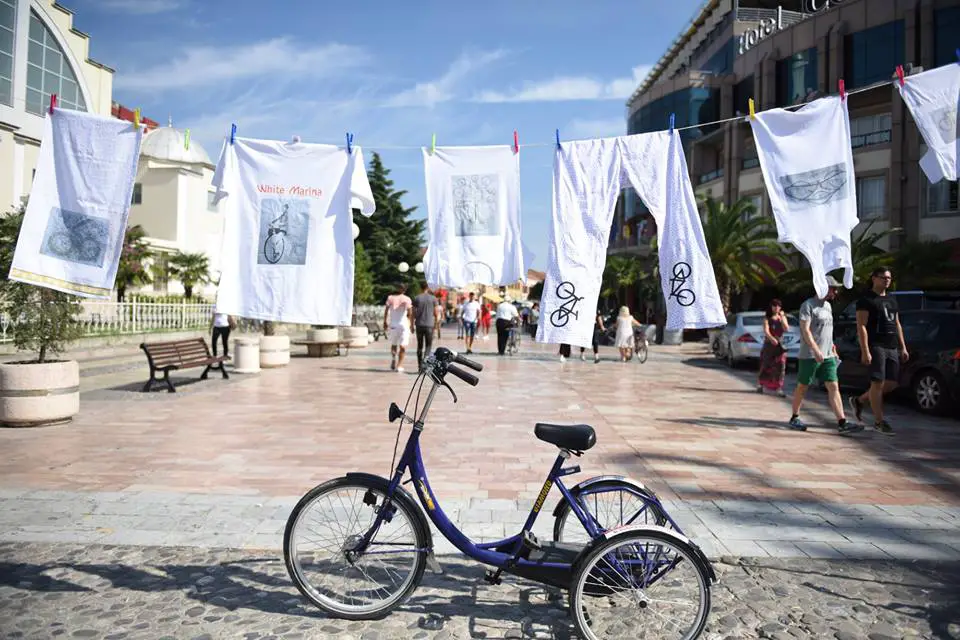
But this movement takes on a new dimension and meaning when everyone – from the Mayor to the president of a firm, from the deputy to the high school director, from the clerk to the military officer – goes to the office by bicycle, not just to appear in a photo. Why not, in a main square, erect a monument to the bicycle, as it has been a companion of life for a century now, and not be satisfied with placing its skeleton in a city roundabout. Memorie.al