Memorie.al / Albania is judged as one of the most dangerous zones in Europe. A new war could start there if the political and military interests of other countries in Albania continue to clash with one another. Due to its geographical position, this small country holds the keys to the Adriatic and has for centuries been the cause of quarrels between various nations. From a strategic point of view, its coast would be of priceless value to Italy in case of war. Italy has for several years been pouring large sums of money into Albania, aiming to help organize the army, build roads, bridges, and fortifications. In the Balkans it is believed that Italy’s effort to militarily strengthen Albania is part of Mussolini’s imperialist program to thrust deep into the Balkans, to reconquer the famous Roman road Via Egnatia, which runs from Albania and Yugoslavia towards Salonika and Istanbul.
A Pawn of the Powers
Every move by Italy in Albania is viewed with suspicion and anxiety by France, by the Little Entente (Czechoslovakia, Romania, Yugoslavia), and especially by Yugoslavia. In recent years, the financial aid and military direction given to Albania by Italy has frayed nerves in the Balkans and has spurred Yugoslavia to make feverish military preparations to counter the Italian incursion anticipated in the Balkans.
Thus little Albania has become a pawn in the game of two opposing blocs in European diplomacy, one headed by Italy and the other by France. It has benefited to some extent from these conflicting interests and has managed to strengthen its national unity, first with the help of Yugoslavia and then with the help of Italy.
Whatever the hidden motives of these countries may have been, Albania has skillfully and courageously preserved its independence, although it was forced to make sacrifices, concessions, and many acceptances in return for the material aid it obtained since the end of the war. Even if the roads and bridges built with Italian financial aid were intended for Italian military schemes, they now serve useful economic purposes for Albania, creating connections between the different parts of this small mountainous country.
Occupied During World War I
During World War I, Albania was the scene of many occupations. The Greek, Serbian, French, Austrian, and Italian armies fought each other in Albania, and this small land was divided into several pieces under foreign influence, while the people were subjected to unspeakable misery and restrictions. Ahmet Zogu, the present king, was kept in Vienna during the war period.
Albania’s independence, achieved in 1912, was interrupted. At the Paris Peace Conference, its demands were initially completely denied. The Albanian delegates, led by Mehmet Konica, brother of the then Albanian ambassador to the United States (Faik Konica), placed their hope in President Wilson and begged the American delegation that the United States, as a disinterested power, should take command in Albania. Yugoslavia, Greece, and Italy were eager to secure their “spheres of influence.”
In 1919, an agreement was reached by Clemenceau, Lloyd George, and Nitti (respectively the French, British, and Italian prime ministers), in the absence of the American representative, which gave Italy command over Albania and gave Yugoslavia lands in northern Albania. The Albanians opposed this agreement, which would strip them of their independence and truncate their country.
Wilson’s Opposition
President Wilson strongly opposed this agreement, stating that it had been reached in the absence of the American representative and that it aimed “to divide the Albanians, against their ardent desire, among three different foreign powers.” Albania’s independence was saved when the American government made it known that “the Albanian questions should not be included in the talks between Italy and Yugoslavia, and the President must reaffirm that he cannot accept plans that give Yugoslavia lands in northern Albania as compensation for what she seeks elsewhere.”
And that “Italy and Yugoslavia are left together to settle their issues, if they can, through separate negotiations, with the condition that they must not reach an agreement by taking advantage of Albania.” Albania was admitted as a full member of the League of Nations in December 1920, after an insistent plea in the name of Albanian independence made by Lord Robert Cecil (at the Peace Conference in 1919 he was the British representative in the talks for the creation of the League of Nations) against opposition from several Balkan states.
A year later, the ambassadors of Great Britain, France, Italy, and Japan, “recognizing that the violation of these borders and of Albania’s independence could constitute a danger to Italy’s strategic security,” reached an agreement according to which “at any time, if Albania finds it impossible to maintain its territorial integrity, it is free to ask the Council of the League of Nations for external aid”; and that “the governments of the British Empire, France, Italy, and Japan decide in such cases to instruct their representatives on the Council of the League of Nations to advise that the restoration of Albania’s territorial borders be entrusted to Italy.”
Although now a member of the League of Nations, Albania was not consulted about this agreement. It opposed it by declaring that it would not recognize its validity. To this day, Italy considers the Ambassadors’ Agreement as a binding inter-state instrument, which recognizes special interests for it in Albania, although this agreement is viewed with suspicion and fear by Albania’s neighbors in the Balkans. Thus, the agreement has served from the beginning as a cause of friction and has made Albania a sensitive zone as it is today.
In 1920, the Italians occupied Vlora in southern Albania. Albanian leaders, determined to free their country from foreign occupation, forced the Italian army to withdraw. Then they began to organize the state and establish order in the country. Ahmet Zogu was one of the distinguished new leaders, and the government, in which he was Minister of the Interior and later Prime Minister, was distinguished by his name. In 1924, Zogu’s regime was overthrown by a revolt led by the Albanian bishop Fan Noli. Ahmet Zogu and some of his colleagues hastily left for Belgrade, for shelter and aid.
The insurrectionary government of Fan Noli lasted from June to December 1924, when Zogu, whom it had sentenced to death, returned victoriously to Tirana at the head of a small army he had organized in Yugoslavia. Within a month of his return, Zogu was elected President of the Albanian Republic for seven years. His government began to reorganize and improve the country, although outbursts of discontent continued to occur from time to time.
The Yugoslavs, having befriended Ahmet Zogu and helped him regain power, expected him to take a strong line leaning toward Yugoslavia or against Italy. Realizing the great danger for his country if he followed this policy, President Zogu tried to steer a middle course, to keep Albania’s side.
The Tirana Agreement
Suddenly, in 1926, a serious uprising occurred in northern Albania. Ahmet Zogu was convinced it had been instigated by the Yugoslavs. Both Italy and Yugoslavia had presented him with a treaty of friendship and security. That uprising prompted him to make a quick decision in favor of the Italian side, and on November 27, 1926, he signed a five-year treaty of friendship and security between Albania and Italy.
This document, known as the “Tirana Agreement,” declared that Italy and Albania, “with the aim of strengthening their bilateral relations of friendship and security, agree that any disturbance directed against the present political, legal, and territorial situation of Albania is contrary to their mutual interests.”
The signing of the “Tirana Agreement” threw Albania’s neighbors into a state of despair and alarm. A year later, immediately after the signing of the Franco-Yugoslav Treaty, a cooperation treaty was concluded between Italy and Albania for a period of 20 years. A loan of 50 million gold francs was given to Albania by Italy, through a financial group known as ‘SVEA’. The National Bank of Albania was established under the supervision of this group. A large program of public works was begun and financed by this loan.
Economic organizers, engineers, construction specialists, and Italian military trainers came to Albania. Roads, bridges, and public buildings were built. Every move in the Balkans is analyzed with a microscope. The Yugoslavs watched the Italians’ efforts in Albania with suspicion. They judged the Italo-Albanian treaties, the loan, and the introduction of Italian organizers and trainers as part of a political and military scheme to secure a strong base in the Adriatic with the aim of thrusting deep into the Balkans. Belgrade regarded such a program as a direct challenge to Yugoslavia. The situation was dangerous.
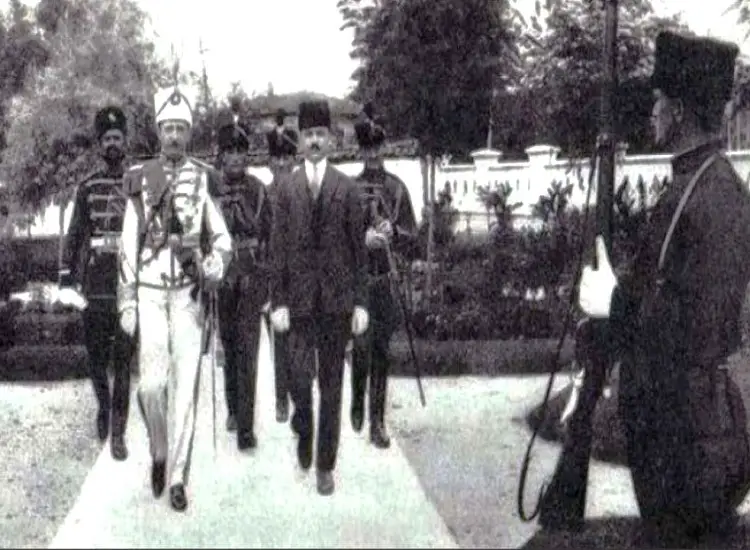
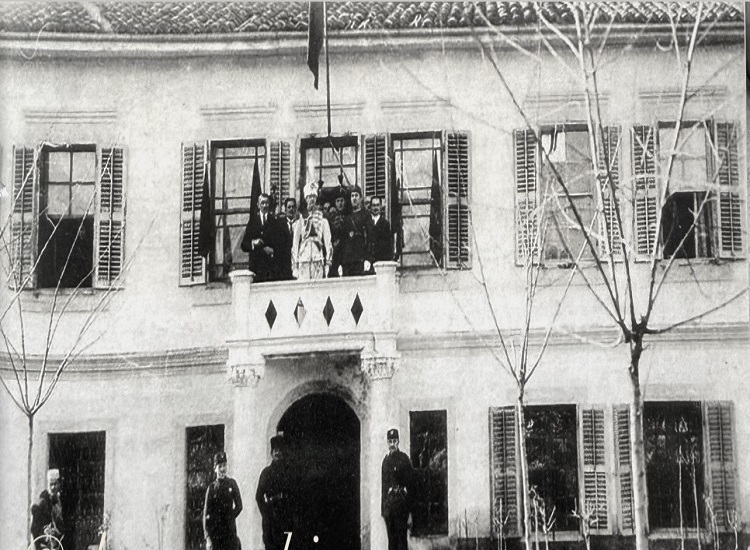
On September 1, 1928, President Zogu was proclaimed King of the Albanians by a Constituent Assembly, and the Republic was turned into a Kingdom. Italian General Alberto Pariani helped organize and train the Albanian army. The gendarmerie was organized and directed by British General Sir Jocelyn Percy. The courts of justice were reorganized. New schools were opened. A faster pace entered this small country where in the past “things could only be done if you had enough tobacco and patience.” When the five-year period of the Pact of Friendship and Security ended, King Zog refused to renew it, despite known pressure from Mussolini.
King Zog stressed that the treaty was no longer necessary and that he did not require foreign powers to protect him. He also pointed out that his cooperation treaty with Italy, which would remain in force for several more years, covered all points of friendly cooperation between the two countries. **Critical financial situation.** At the same time, Albania’s economic and financial conditions had reached a critical point. Italy offered again to give aid to Albania, granting ten annual loans of 10 million gold francs each. Albania’s neighbors became even more alarmed, believing that the Italian aid would be nothing but for military purposes.
The annual loans were to be spent under the supervision of a mixed Italo-Albanian commission. Albania accepted, and the first two loans were given, though not in full. The third loan, of this year, has been withheld, on the grounds that Albania is not fulfilling the conditions of the agreement for “friendly cooperation.” When Italy a year ago suggested to King Zog that a customs union between Italy and Albania would be acceptable to Italy and would give priority to Albania, King Zog rejected the idea, realizing that such an agreement would not only provoke his Balkan neighbors but could create a stir throughout Europe.
Later, Italy became concerned by a change in Albania’s Constitution, which caused the closure of several foreign and religious schools. The Albanian government explained that this measure was now necessary in order to strengthen national unity through a common school system and to stop foreign propaganda against the nation. The Italians did not accept such administrative direction in their schools and consequently closed them and returned their teachers to Italy. The wisdom of the new Albanian law regarding the school system was debatable given the present lack of Albanian teachers.
No More Aid from Italy
The Italian government, being well aware of Albania’s desperate financial conditions, adopted a policy of watchful waiting and meanwhile stopped further financial aid. Italy’s imports from Albania began to decrease. The Italians denied that they wanted new concessions in Albania, or that they wanted control of the army, gendarmerie, and other branches of government. They said that all they wanted was friendship, friendly cooperation, and cultural influence.
King Zog refused to reopen the foreign schools but made a gesture of goodwill by ordering that the Italian language be made compulsory in secondary schools. This did not fully satisfy the Italians, and they continued to delay the promised annual loan. Then King Zog ordered a major contraction of the 1934 budget. He halved military expenditures. He also cut state salaries and royal household expenses to one quarter of their previous amounts. All these measures helped increase King Zog’s popularity among Albanians, but Rome still remained uneasy.
The Present Problem
Albania, knowing well that its only hope for renewal lies in peaceful development, is trying to keep itself out of political entanglements that endanger friendly relations with its Balkan neighbors. Italy, Yugoslavia, and Greece have repeatedly stated that they are against any violation of Albania’s independence. Meanwhile, the clever diplomatic battle between Prime Minister Mussolini and King Zog continues. So far, King Zog seems to have been the winner, for the reason that Albania’s power lies in its weakness.
Recently, it has concluded a favorable commercial treaty with Greece and is negotiating a new commercial treaty with Yugoslavia. These are unmistakable signs of closer cooperation between Albania and its Balkan neighbors. If Albania succeeds in establishing friendly relations with its Balkan neighbors without antagonizing Mussolini, the small country on the Adriatic, called “the forgotten land of Europe,” will be able to develop its agricultural and economic resources in peace and prosperity. / Memorie.al
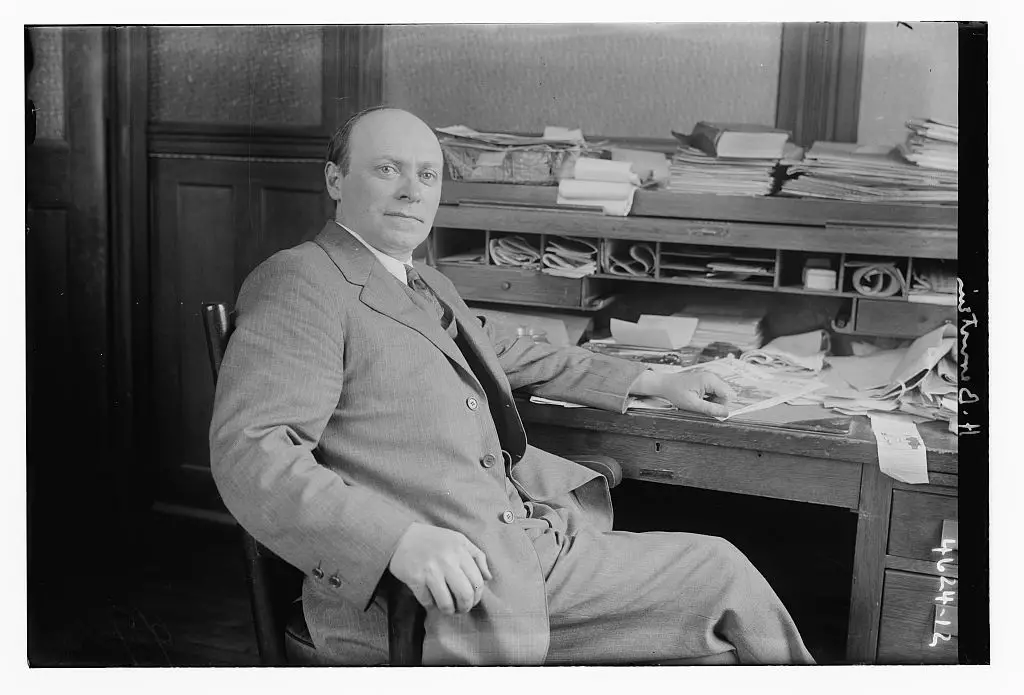
Former U.S. Ambassador to Albania
The New York Times, January 28, 1934
Accompanying note: Herman Bernstein (1876-1935) was U.S. Ambassador to Albania from February 1930 to September 1933. He was also a journalist, writer, translator, publisher, and diplomat of Jewish origin. Albert Einstein was his friend and collaborator. Herman Bernstein was a prominent activist for Jewish rights and editor of two Jewish newspapers.