Memorie.al / A testimony on Albania during the period 1945-1948is found in the historical book “Rule without Conquest. Albania 1945-1948” by Luan Doda, published by the Institute for Southeast European Studies. The author, since around the ’80s, lives in Brussels, while the publication has been evaluated as a scientific work that confronts facts and documents. Below we have excerpted a fragment that presents Enver’s diplomatic relations at this time with other countries, and especially with the superpowers:
Albania at the Tables of the Great Powers
Unofficial Soviet-British agreement: The internationalist Stalin did not abandon the Tsars’ idea of Russian domination in Europe. In December 1941, in the proposals Stalin made to the British Foreign Minister Eden regarding post-war border adjustments, he had taken care that Albania should remain a separate state, i.e., not belong to Italy, nor partly to Greece – which he could not have taken away from them.
On the other hand, according to the principles of the Atlantic Charter, signed as early as August 1941 by US President Franklin Roosevelt and British Prime Minister Winston Churchill, Albania, like any other country, had the right to its own independence. However, Albania’s integrity was put into question by British diplomacy, which, having as allies the Greek and Yugoslav governments in exile in London, according to a long memorandum by Pierson Dixon addressed to the Foreign Office entitled:
“Albania: The Present Attitude of His Majesty’s Government,” acknowledged the covetousness of both parties, in the south and in the north, seeing the possibility of independence for a truncated Albania only within a Balkan confederation – for the creation of which, in January-February 1942, Britain was encouraging the two countries’ governments, and about which in February 1942, Eden expressed optimism in the House of Commons. In April, he also approved Dixon’s memorandum.
With the belief that after World War II the Soviet Union would be the only great power on the continent (France and Italy would emerge weakened), in May 1944 Moscow reached an agreement in principle with England on the division of spheres of influence in Europe.
The agreement provided for three zones, one of which remained neutral. In the Soviet Union’s zone, among other things, the Slavic countries of the Balkans (Yugoslavia and Bulgaria) as well as Greece were included. Albania was not mentioned, but in the geographical context it was implied to be within that zone.
The “Percentages” Agreement!
On 9 October 1944, Churchill met with Stalin in the Kremlin; the Foreign Ministers Eden and Molotov were present, as well as the British Ambassador to Moscow, Clark Kerr, and two interpreters. The British Prime Minister recounts that; “when the moment came for business,” he said to Stalin that, in order to protect each side’s interests in the Balkans and thus “to avoid clashes over trifles, how would it seem to you to have ninety percent predominance in Romania, for us to have ninety percent advantage in Greece, and to be fifty-fifty in Yugoslavia?”
While the translation was being made, he noted on a half-sheet of paper which he passed to Stalin: Churchill writes that Stalin; “made a large tick on the paper and returned it.” Expressing the opinion that their behavior seemed cynical, having decided, for a moment, the future of millions of people, Churchill proposed that the paper which had remained on the table be burned.
Stalin replied: “No, keep it.” The next day Churchill instructed Eden: “Last evening we did not mention Albania, but I personally think we should press the Soviets for a 50-50 agreement. It is natural that Eden would have raised the issue, whether from the mutual understanding that existed at that time for reciprocal concessions, or from similarity with Yugoslavia – the Albanian problem must have remained 50-50.”
Whatever interpretations were given to the fluid “percentage” deal, starting with those by the British Prime Minister himself, not much time would pass before it lost any kind of value, because Moscow, regardless of formal steps, undertook all kinds of maneuvers to give the communist system 100% predominance wherever the Red Army set foot. Afterwards, England and the United States took measures and wiped out the Soviet 10% in Greece.
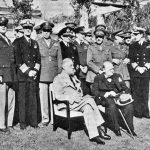
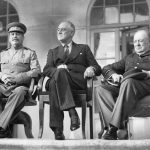
The Yalta (Crimea) Conference: The heads of the three Great Allied Powers – US President Roosevelt, President of the Council of People’s Commissars of the USSR Stalin, and British Prime Minister Churchill – accompanied by their Foreign Ministers, military chiefs, and respective ambassadors, met at Yalta in Crimea on 4-11 February 1945, to decide on the terms of Germany’s surrender and to coordinate efforts to give the post-war world peace and security.
In his diary, Churchill writes: “Yalta: Projects for world peace.” However, not a few scholars assess Yalta as projects for the division of the world. The first plenary meeting took place on 5 February. Twenty-three people participated, including three interpreters. Among the decisions taken at Yalta was the determination of criteria for establishing the United Nations Organization and for participating in it. For this, it was decided to hold a conference in San Francisco, USA, on 25 April 1945.
Since there were many countries that had not signed the United Nations Declaration, as well as others that had not declared war on Germany, a discussion was opened to create the possibility of inviting them to San Francisco. Churchill’s proposal was accepted, that all states that would declare war on Germany and Japan by 1 March should be invited to the conference.
Due to strained relations with the Albanian communist government, the Anglo-Americans did not notify it to take the proper formal step: declaring war on Germany. But even Moscow, which had a Military Mission in Tirana, did not inform the Albanian Prime Minister so that the Tirana government could declare war on Germany – though not formally, because at that time there were two divisions of the Albanian National Liberation Army that, together with Tito’s Army, were pursuing the German forces fleeing from Yugoslavia.
The question naturally arises: why would Stalin have sacrificed a vote in his favor in the UN, that of communist Albania, at a time when he sought and obtained the approval of the Western allies that two of the 16 Soviet republics, Ukraine and White Russia, should be invited to the San Francisco Conference as sovereign states!
We believe that the Kremlin did not doubt the loyalty of the Communist Party of Albania, because by then it had fallen into Tito’s hands. Our assumption is that international recognition of Albania was not desired, because it could bring complications for the realization of a Moscow project entitled: “Post-war Construction of the Balkans (Yugoslavia, Bulgaria, Macedonia, and Albania).” Albania was mentioned at Yalta, but not in the official sessions in which the Big Three spoke many times about its neighbors and other nearby countries. Here below we follow Arthur Conte.
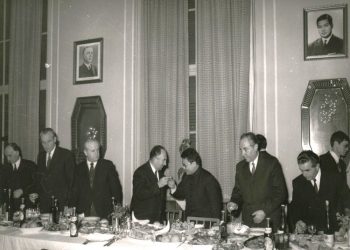
At the dinner hosted by Churchill, the first toast was: “to a hundred years of peace.” Stalin added that it was only the duty of the Great Powers to preserve it. According to him, it would be ridiculous that in the UN being built, Albania should be equal to the Soviet Union, that the Great Powers were not obliged to shed blood to liberate them. “I agree – he said – with the United States and Great Britain to protect the rights of small powers, but I will never accept that any decision or action of the Great Powers should be subjected to the decision of the small ones.”
Roosevelt agreed that the Great Powers bore the greatest responsibility and that peace should be championed by the three powers represented at that table, but he raised his glass “to respect for the rights of small nations.” “Yugoslavia, Albania, and other countries like these – Stalin said in that toast – have no right to sit at this table. Do you want Albania to have the same status as the United States? What did Albania do in this war to deserve such a place? The three of us must decide how to keep peace in the world – a peace that will be preserved only if we three maintain it.”
Starting from 7 February, the newspaper “Bashkimi” published various news from around the world about the international echo of the Yalta Conference. The published articles also spoke of the decisions taken there, without in any case mentioning the declaration of war on Germany and Japan.
Stefan Peters, a member of the American Military Mission in Tirana, writes that; “Enver Hoxha was extremely worried that Stalin might give Albania to the British, and this was the reason that forced him to go personally, for the first and last time, to the American Office of Strategic Services (OSS) in Tirana on 11 February, in a clear attempt to find out whether the Albanian question had been dealt with at the Yalta Conference.”
After another meeting with Hoxha on 19 February, Peters wrote to his headquarters about the complaints of the Albanian government that it lacked information from the Yalta Conference on Albania’s future, and that the members of the government felt they were being treated unfairly and that their country was being blocked from the rest of the world.
On 25 February, “Bashkimi” published on its front page the news that Turkey and Egypt had declared war on Germany and Japan. During the 17-day period when various countries publicly declared war on Germany, the Albanian government did not move. Thus Albania lost the chance to obtain the status of “allied country.”
In the last ten days of March, the government officials in Tirana organized large popular demonstrations in the country’s cities, demanding recognition of the government and Albania’s invitation to the San Francisco Conference. On 29 March 1945, just weeks before the Yalta Conference began, in which 50 states participated, Enver Hoxha addressed a request to Prime Minister Churchill, Marshal Stalin, and President Roosevelt, reminding them that he still had not received “any invitation” to participate in that conference.
As if to cause an ironic smile, especially from Stalin, he continued: “Among the states that have fought side by side with the allied states to defeat Hitlerite Germany, Albania occupies an important place because of the unrelenting war it has waged against the common enemy.”
On 11 April, the United States replied with three arguments: The conference was not for peace, but for international organization; invitations had been sent to recognized governments; the criteria for invitations had long been approved and it was impossible to reopen discussions on procedures already closed. The British government communicated to Hoxha that its reply was the same as that of the USA. We do not know anything about any reply from Moscow.
Even in January 1946, at a press conference, Hoxha would express surprise: “why was the country not invited… to San Francisco”?! / Memorie.al