By Assoc. Prof. Klejd Këlliçi
– THE HISTORY OF THE EXHUMATION OF THE REMAINS OF NAIM AND ABDYL FRASHËRI FROM TURKEY AND THEIR BURIAL IN ALBANIA –
Memorie.al / The effort to obtain the remains of Naim Frashëri from Turkey, although it came from consular authorities – who in all likelihood would have taken care of them in the years between 1927 and 1935 – originated directly from the Royal Court. The motivation with which they are requested states: “The royal government has taken a decision in favour of this proposal, fulfilling its duty towards the memory of the Great Patriot, and will gain the sympathy of the colonies existing outside Albania. Likewise, the grave in the homeland will be an example of good work for future generations.” The remains of the great patriot bring to light not only the state’s effort to control the remains and reburials as an act of commemoration and care for the body, but also the construction of a certain discursive and hegemonic regime over national collective memory. They serve as a link between the form of government, the monarchy, and Albanian collective memory, where the Monarchy and above all the monarch, Ahmet Zogu, plays the role of mediator between the past and the present of Albanians.
The Albanian community in this case is not only those living in the country but also those living abroad, towards whom the Monarchy seeks to propose itself as the ultimate form of regime, one that realises the collective dream of independence and continuity of the state and, above all, of the country’s stability. At the same time, through Naim’s remains, it approaches future generations, who must understand, through the proof of the body’s repatriation, the now hegemonic role it has in making and maintaining collective memory. This hegemonic role, however, is not played by the state, but by King Zog himself, since the efforts to obtain the remains of the Frashëri brothers are described as a personal enterprise of the Monarch, who seeks to monopolise or attribute to his living body any element that links him to the past and projects him into the now-monarchical future. The very care for Naim’s remains is an indicator of the power and authority of the now-consolidated monarchical regime and serves as a catalyst to also seek the bodies of the other two brothers, Abdyl and Sami, albeit without success.
Obstacles to obtaining them come from family members who do not wish to be separated from their ancestors and, moreover, declare that they have now tied their lives to the place where the remains of their ancestors are located. Sami Frashëri’s daughter does not under any circumstances accept the transfer of her father’s remains, and likewise she prevents the exhumation of Abdyl, even though his son, Mit’hat Frashëri, lives in Albania. The obstruction of the removal of Sami Frashëri’s remains is closely linked to his multifaceted intellectual activity, which was not satisfied only with defending the Albanian cause but also became important for the modern Turkish language. It can be conjectured that the justification for transferring Sami’s remains was confined to the family sphere, precisely so as not to reveal this important fact at a time when the new Turkish state sought to establish identity premises and limit them to the already well-defined ethno-political territory of Anatolia. On the other hand, Mit’hat Frashëri’s letter, which charges his relative with obstructing Abdyl’s exhumation, may be linked to the idea of preventing the use of his father’s body for propaganda purposes.
Albanian research on famous remains ended with the acquisition only of Naim and did not go further, also because their return was to coincide with the 25th anniversary of independence (28 November 1937). The sovereign’s connection with Naim’s remains becomes even more personal, as the Monarch formally expresses his desire to cover the expenses of bringing them to the country. This personal relationship that the Monarch seeks to establish with Naim’s dead body is not accidental, as it aims to visibly seek and determine the connection and discovery of national roots as a result of political stability and the salvation of the country, for which Zogu claims all possible merit. The government’s press office ensures that this relationship is displayed as fully as possible. Naim’s remains are placed in the Tekke of the Bektashi Headquarters in Tirana. The burial place coincides with the Bektashi religious tradition, to which Naim belonged. This religious order had tied its existence to efforts to give independence to Albanians, and this also found expression in Frashëri’s literary work.
Naim’s remains were intended to rest temporarily near the Bektashi Headquarters until the realisation of a national pantheon for patriots – extraordinary bodies that the Monarch had vowed to find.
At the reburial ceremony, the Minister of Education, Faik Shatku, commemorates Naim’s work through that of Zogu and vice versa. It is Zogu himself who makes possible the realisation of Naim’s work; or rather, what Naim did for the language, the Monarch did for the state. Naim Frashëri, according to Shatku, was the first to experience the feeling of patriotism, but it was Ahmet Zogu who consolidated the state and thus materialised the Renaissance man’s work. Zogu is considered the completer of Naim’s work, the “new Skanderbeg”, the double guarantor of Albanians who establishes and guarantees the secular cult of Naim Frashëri, becoming a mediator between him and the body of Albanians.
The resting of his remains in the homeland is not only a rite marking the proper reconciliation of the body, but a supplementary proof of militancy in the efforts to strengthen the Albanian state – efforts that can only pass through the Monarch, who through the guarantee over Naim’s remains assures Albanians of their living existence. This relationship is thus projected onto the remains of other patriots who might become part of the idea of raising a National Pantheon. This monument would not be realised, because two years after the Independence commemoration, the King would have to leave the country due to the Italian invasion. The Italian invaders sought to give a milder, almost cooperative form to their presence in Albania. Nominally, the country was independent, although immediately after the invasion, Albania and Italy were united through the offering of the Crown of the Kingdom to Victor Emmanuel III. The political justification of the invasion was built through two narratives: that of liberation from obscurantism and backwardness, and the unification of Albania’s fate with Italy as a way to project Albanian irredentism and claims over Kosovo and Chameria into reality.
Despite the invasion, various elements of national identity or the projection of Greater Albania, this battle was played out on the plane of national symbology. Even Naim’s remains could not escape this attention; they were now to be subjected to a narrative different from Zogu’s. To legitimise the new political order, the Italian authorities and mainly Regent Jacomoni turned their gaze towards Naim Frashëri’s remains. This was also an effort to secure discursive and practical hegemony over how the nation would be imagined in union with Italy. On 9 April 1940, one year after the Italian invasion, public authorities announced the holding of a ceremony in the premises of the Bektashi Headquarters, the object of which was the placement of Naim Frashëri’s remains in a monumental grave.
The ceremonial fell within the framework of the celebrations of 12 April, the acceptance of the Royal Crown of Albania by King Victor Emmanuel III. The reburial ceremony would take place under the direct care of the Regent, Francesco Jacomoni, more or less imitating the form of personal care that Zogu had shown for Naim’s remains. The remaking of the grave and the reconfiguration of Naim Frashëri’s remains followed the same civilising logic used to justify the union of Italy and Albania. For this reason, the main issue discussed concerning the Renaissance man’s remains was that of dignity. The authorities aimed to build a more majestic funerary monument than Zogu’s. In this way, the new regime sought to re-elaborate Naim’s figure in a new political context, which would be symbolised by the monumentalisation of a new grave. If Zogu had built a grave for Naim, the Italian authorities built a mausoleum, respecting both the new regime’s preconception of the grandeur of works and symbols, and the Bektashi religious tradition.
This case also marked the regime’s effort to insert Naim’s figure and his remains into the framework of Fascist commemorative practices. More than the legitimacy sought through the appropriation of the remains, the aim was to insert Naim’s figure into a shared, inevitable narrative of Italo-Albanian fate. According to the newspaper “TOMORI”, the official ceremony of removing and placing the remains in the mausoleum, besides religious and civil authorities, was accompanied by typical Fascist manifestations, involving children enrolled in the Balilla organisation. The participants included the highest authorities of the country, from Viceroy Jacomoni to the leader of the Albanian Fascist Party, Tefik Mborja, and the Minister of Education, Ernest Koliqi. The official ceremonial envisaged the ideal reflection of the Fascist imaginary on the new Albanian society. Honour guards at the monument were two Balilla children, followed by other para-military and military formations, Italian and Albanian, such as the Albanian Lictor Youth or the Fascist Avant-gardists, giving the ceremony a solemn and military tone.
According to the daily “TOMORI”, once the remains had been taken and transferred to Albania, no one had taken care of them, implying that the operation of their return had received neither the attention nor the consideration it deserved from the Zogist regime…! Consequently, Naim’s grave was deemed old and unsuitable for the time. The undoing and redoing of the grave thus marks a break between two eras and two diametrically opposed regimes. This reflection would later become the leitmotif of the continuous exhumations of Naim’s body, where the dignity of rest seeks to minimise the act of taking the body from abroad and thus shift attention to intensive and constant care as an element that continually proves that only the regime that commemorates the body also retains the monopoly over its use. The article in “TOMORI” linked the remaking of Naim’s grave to the end of the nation’s suffering with the arrival of the Fascist regime. Previous efforts, all Albanian political history from independence onward, are deemed futile and painful, and thus the patriot’s reburial serves as a way to symbolise the completion and making of Albania through union with Italy.
The creation of the Albanian state is considered deficient and development impossible. According to the new Fascist narrative, the ideal carried by the unquiet remains of the patriot finds fulfilment precisely with Albania under Italy, since the perspective of the country’s development is now “… the dream of which (Naim’s) is fully verified.” Shortly after Jacomoni’s speech, the Bektashi Head Father would hold the religious ceremony of blessing, which he would conclude with “the divine blessing of His Majesty the King-Emperor and upon the Duce, Italy and Albania”. Attention to sacred and religious aspects was not only about the strategic importance the new regime gave to religious aspects and balances in the country, but also about the transmission of traditional religious elements to the modern state – what Gentile calls the sacralisation of politics. If the Zogist regime had previously thought of building a National Pantheon, the Fascist one would only commemorate Albanian national figures within restrictive religious frameworks, and in this case, even though Naim was proclaimed an apostle of the nation, he was simultaneously subjected to the practice of religious worship.
This can also be asserted because, unlike the Zogist period, the Italian occupation took care to have better relations with religious subjects, granting them more autonomy than they had during the Kingdom. It is difficult to say whether the commemoration of Naim Frashëri’s reburial would have served as a symbol of the occupying authorities’ care to preserve Albanian identity, also because the political trajectory of the Italian occupation would soon enter into crisis with the Italo-Greek War and then with Italy’s capitulation in 1943. The suspension of the war years thus diminished the need for commemoration. Albania’s formal separation from Italy in 1943 was followed by efforts of de-fascistisation and reappropriation of the national element. This became especially evident after the war ended and the new communist regime was established. If in the first phases of consolidation the reconfiguration of memory was limited to the war, the need to establish the sacredness of the new socialist society did not escape the recovery and appropriation of original elements of Albanian nationalist discourse, of which the patriots were a part.
After the year 2000, the multiple burials of Naim were reflected in several daily newspapers. Among them stands out the third reburial ceremony, carried out in 1950 by the communist authorities. Naim’s body was moved from the Bektashi Headquarters premises to the side of the Prime Ministry building. The location was not accidental. The very naming of the central axis in Tirana – “Martyrs of the Nation” – brought to light an important element of the communist identity of the post-war years: that of imagining being an integral and, indeed, ultimate part of Albania’s history. This could be evidenced precisely by the name given to the city’s central axis and it’s marking with the bodies of the most distinguished martyrs, those located beside the Central Committee. Naim’s remains could not escape the attention of the new communist regime, whose first and essential step was the remaking of national symbols, and consequently also of the remains of patriots and heroes.
Soon after taking power, most of the monuments erected by previous regimes were destroyed under the weight of the new revolutionary zeal. The independence monument built in 1937 in Tirana’s main square was demolished, to be replaced by a statue of Stalin. In all likelihood, the destruction of Naim’s mausoleum and the transfer of his remains near the Prime Ministry also belonged to this iconoclastic streak, which would be replaced by the new communist iconography, to which other national symbols could not fail to be associated. Thus Naim’s remains enter another phase of remaking: that of fabricating a new communist authenticity that demanded a direct link with the past. In the same year, 1950, the authorities of the time also erected a monument to the Renaissance patriot, which was to be inaugurated on 28 November 1950, Independence Day. In a way, this also marked the cleansing of the patriot’s body from the Fascist heritage of the mausoleum, and at the same time removed the monopoly over the body from the Bektashi community, achieving a double goal: detaching the body from the religious context and from a heritage such as the Fascist one, which was rarely mentioned – the moment of occupation excepted.
In the commemorative ceremonies of 1978, on the occasion of the repatriation of Abdyl Frashëri’s body, mention is made of the undignified reception of Naim’s remains by the authorities during the Monarchy. The intermezzo of the second burial finds no place, and here we might conjecture not only ignorance but perhaps also concealment of the fact, since the communist narrative itself excluded any implication of national symbols that might compromise the logic of the people’s residence, which the regime began with the 1939 invasion. Naim’s remains became part of the sacred and demonstrative ritual of the new truth of communism in Albania, which – as scholar Van Ree says, referring to Stalinism – the latter did not aim to replicate the element of transcendence typical of religious regimes, but rather a proof of faith in the present and the bright future. Throughout the 1960s, the Albanian government tried to negotiate with the Turkish government the repatriation of the remains of the two Frashëri brothers, Abdyl and Sami, but was prevented by both the Turkish authorities and the Albanian diaspora there.
But Abdyl is at the same time the father of Mit’hat Frashëri, the chairman of *Balli Kombëtar* in exile, which automatically transfers “ownership” of the “body” to elements of the Albanian diaspora in Turkey that were opposed to the regime.
The regime’s first attempt to obtain them dates back to 1950, but without satisfactory results. Members of the anti-communist Albanian diaspora in Turkey, as if to affirm the blood link that comes through the founder of *Balli Kombëtar*, Mit’hat Frashëri, took care to preserve Abdyl’s memory. They also took care to restore Abdyl’s grave. While Abdyl Frashëri is undoubtedly part of Albanian historical memory, Sami Frashëri is considered by the Turkish state as a personality of Turkish culture and identity, which makes obtaining his body almost impossible. And if the recovery of Sami’s remains is firmly opposed by the Turkish authorities, those of Abdyl become a terrain for the continuation of the war between Ballists and communists, on the double field of national memory and the ideological clash imposed by the Cold War. Ownership of the remains, according to the logic of the Albanian authorities, belongs to the country of origin, whose memory is possessed by the Albanian state.
Those who oppose the recovery of the remains are not defined as political enemies but as fugitives, and in communist logic, flight was equivalent to treason against the homeland. Flight imposes on the members of Balli not only the qualification as enemies but also the delicate status of suspension between surrender to the foreigner through non-recognition of the regime, and the diminution of citizenship due to abandoning the country of origin. In this way “the fugitives” have also lost their claim over the body, whose fate is negotiated by both states.
These efforts also bring into play Albanian-Turkish relations, since the instructions given to the Albanian representative authorities in Ankara must emphasise the fact that the handover of the Renaissance man’s body will be seen as a sign of friendship between the two states.
Added to the effort over the Frashëri brothers’ remains is another variable that could definitively undermine the Albanian state’s ability to retrieve the bodies. In the early 1970s, the Yugoslav government, which after the protests of the late 1960s recognised Albanian autonomy, sought the remains, especially Abdyl’s, to place them near the Bajrakli Mosque – the site now known as the “Complex of the Albanian League of Prizren”. Thus political claims over Abdyl’s remains are not limited to the narrow plane of ideological conflict, but are raised on the more complex plane of a double narrative over the genealogy of the national renaissance, one that must be produced among Albanians within the Yugoslav multi-national framework and the Albanian state.
Moving the remains to Yugoslavia would thus be considered a great loss, not only on the plane of memory, but also in the cultural and national competition between Yugoslavia and Albania over the Albanians of Kosovo. The year 1978 and the commemoration of the League of Prizren are linked to the success of retrieving bodies from abroad and the multiple competitions with political and state opponents for the monopoly of all-Albanian memory. When obtaining Sami’s remains appears impossible, the latter is “sacrificed”, and thus only Abdyl is sought, because the approach of the League’s commemoration makes it necessary to integrate it with the exceptional body of its founder.
The Ministry of Foreign Affairs suggests to Albanian representatives that they use every possible means, including bribery of Turkish authorities, to recover the remains. As if to give shape to the Albanian request, the Turkish authorities are also reminded of the remains of Hasan Riza Pasha, which are located in Shkodër and will be kept until the Turkish state repatriates them. After many negotiations, only in 1978, on the eve of the centenary commemorations of the League, does the Turkish state accept the request for Abdyl Frashëri’s remains?
This acceptance is considered a great victory, one that would be enjoyed neither by the Titoists nor by the enemy diaspora in Turkey.
In the correspondence between the consulate in Istanbul and the Ministry of Foreign Affairs, it is reported that the Albanian diaspora in Turkey, especially representatives of Balli Kombëtar, might attempt to seize Abdyl Frashëri’s remains from the cemetery. To avoid this event, a series of measures must be taken, lasting until the moment the remains return to the homeland. The official authorities consider giving bribes to guarantee the recovery of the remains and also mobilise other Albanians to guard them. Thus Abdyl’s body becomes not only a terrain of ideological conflict, but also of competition over the Albanian diaspora in Turkey, which the Albanian authorities divide into two groups: the patriotic and the treacherous. The very recognition of the Albanian state’s “ownership” of the remains further reinforces this division, so much so that the consular authorities themselves mobilise a part of the patriotic diaspora to constantly supervise Abdyl’s burial site, which is guarded by Albanian volunteers throughout the time legal formalities are being completed.
The guarding of the remains throughout the exhumation formalities is also a show of strength by the Albanian authorities against the Balli Kombëtar members in exile. It is seen as a continuation of a liturgy of war characterising the communication between the Ministry of Foreign Affairs and the functionaries of the Albanian consulate in Istanbul. Besides Abdyl’s remains, the Albanian authorities also take to the consulate the marble remnants, the distinguishing marks of the grave, which are “war” trophies. Taking them eliminates any trace linking the body to the anti-communist diaspora, removing even the possibility for the anti-communist diaspora to use the empty grave, even symbolically. Thus the retrieval of the remains definitively severs the emotional bond between the father’s body and the son, Mit’hat – who is considered a traitor to the nation and homeland, and thus as dishonouring the father’s figure. Abdyl’s remains will be escorted to Albania, with the itinerary passing through Greece. As in Istanbul, during the journey through Greece, the Albanian authorities organise the constant guarding of the body, as if to show that not only rest but also its ultimate security could be achieved only within territorial borders.
The arrival of the body in the country gives the regime the opportunity to organise a series of mass demonstrations that mark the renewal of a unifying Albanian geography, manifested through the movement of the remains. Thus, initially the coffin with Abdyl’s remains rests in Korçë, Ersekë and Përmet, to be later placed in the Frashëri family’s home village. For nearly three months, the remains rest in the Frashëri family museum house. The programme envisages that throughout this period, mass demonstrations are held, and the house becomes a pilgrimage centre for local residents, schools, and work centres. Throughout this time, it is also advised to invite elderly people dressed in folk costumes, as if to create the genealogical link between present and past. Although the final destination of Abdyl Frashëri’s remains would be Tirana, the Council of Ministers’ decision suggests that the public should be told that they have been placed in the homeland, at the request of and under the care of the local authorities, thus reinforcing the link between the local and the national. The commemorative suspension to which the remains are subjected temporarily isolates them in the local, since the arrival of the remains is scheduled to be communicated in the press only one day before they reach Tirana.
Thus it appears as a sort of unexpected miracle, mediated and made possible by the state, as if to keep the entire community in emotional tension, even though the latter is mobilised by the authorities to participate massively in the ceremony. The remains of the Frashëri brothers inadvertently become the unifying symbol of every regime, including the communist one. Their relocation to the centre, not to the birthplace, is not unintentional. Just as Naim’s remains were taken from Istanbul and buried in Tirana, Abdyl’s too would have to be buried there. Above all, it was important for the brothers to be placed in the same place. This dates back to the 1970s, when a monument to Naim Frashëri was planned, but its location near the Prime Ministry was deemed unsuitable. The criteria followed require the place to be easily accessible, to become a pilgrimage site for the population.
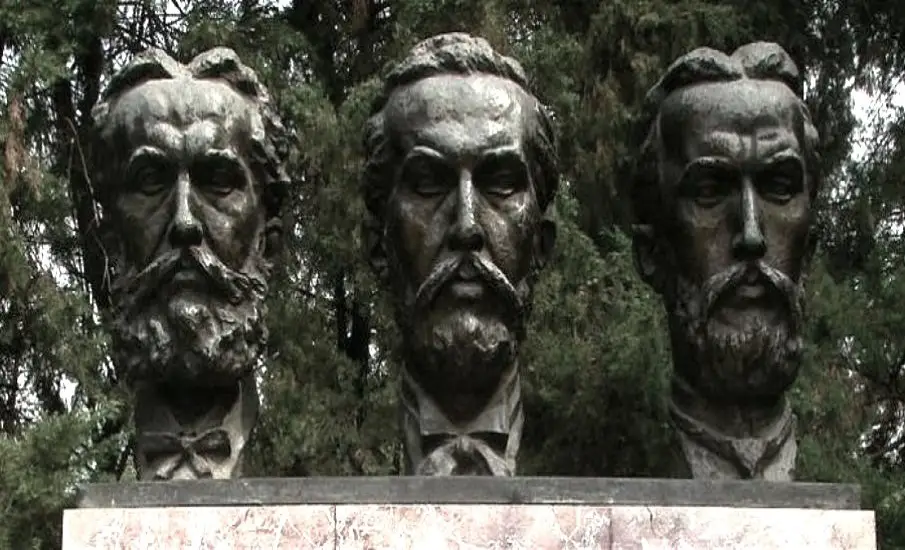
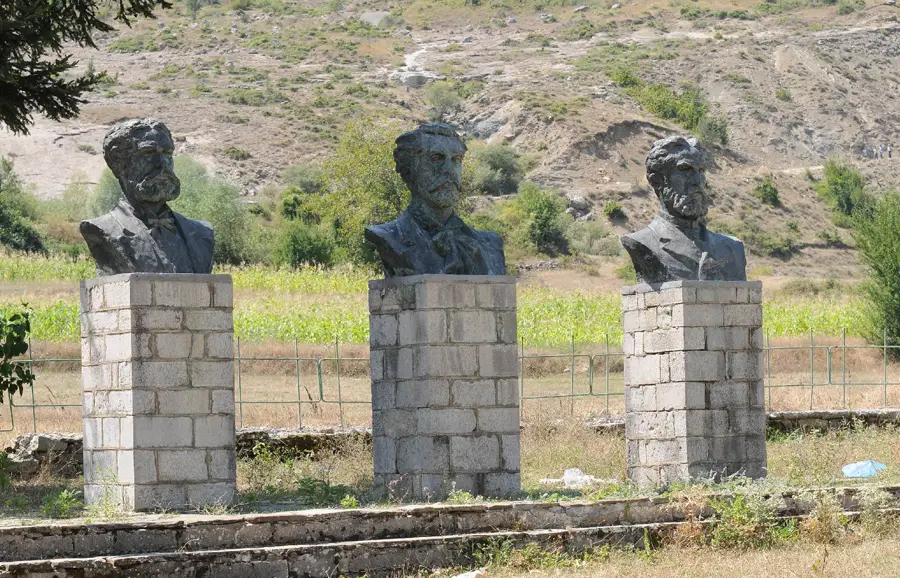
Placement in Tirana’s Great Park fulfills these criteria: pilgrimage and monumentality. The burial site must not be a simple funerary monument. The very ceremonial of bringing Abdyl’s body is inserted into the logic of the regime’s state ceremonial. After his remains arrive in Tirana, and Naim’s have been exhumed, they are positioned in Skanderbeg Square, in front of the statue of the national hero. The ceremony envisages mass participation of the population, who will honour with clenched fists. To enable the connection between present and past, besides the national anthem, it is envisaged that the song “For the Motherland” be played, replacing the funeral march. After the ceremony, the coffins move in a procession that traverses the entire “Martyrs of the Nation” Boulevard, passing through two nerve centres of power – the Prime Ministry and the Central Committee – before moving to the newly built memorial in Tirana’s Great Park./Memorie.al
This material is excerpted from the author Klejd Këlliçi’s book, “One burial for each regime: the political use of the dead body in Albania” (Berk: Tirana, 2023)