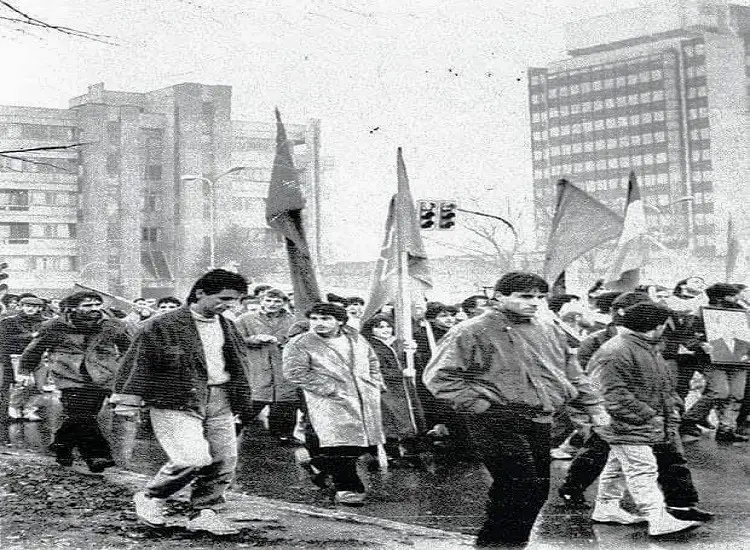
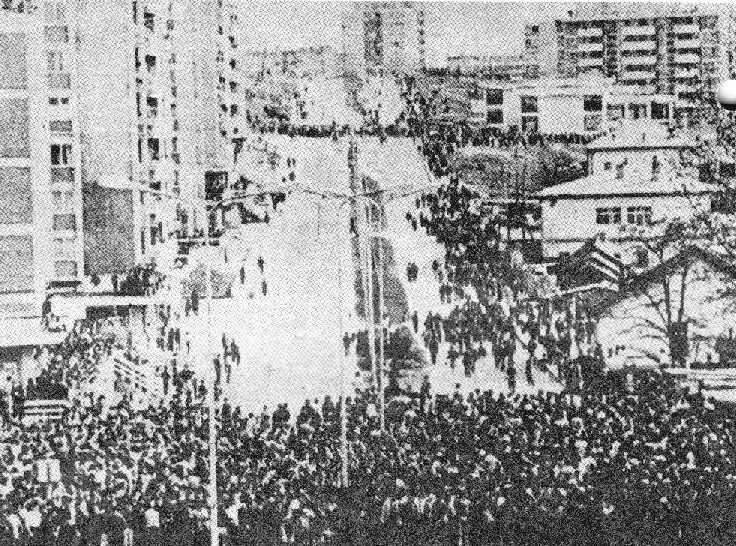
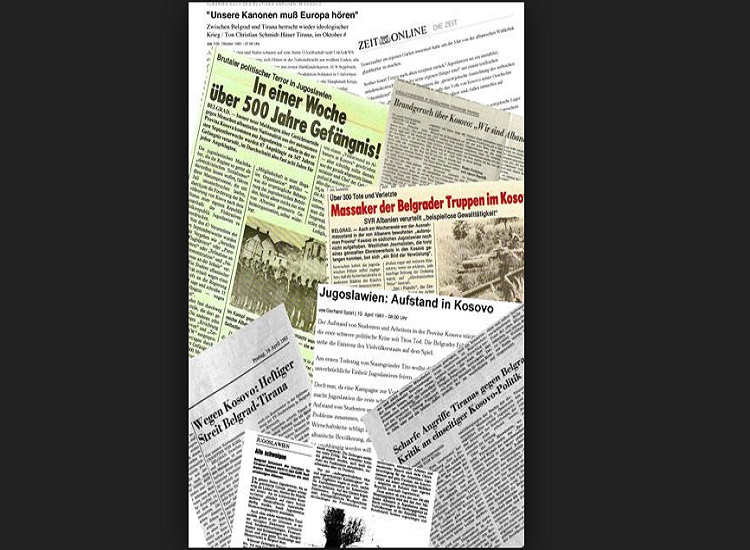
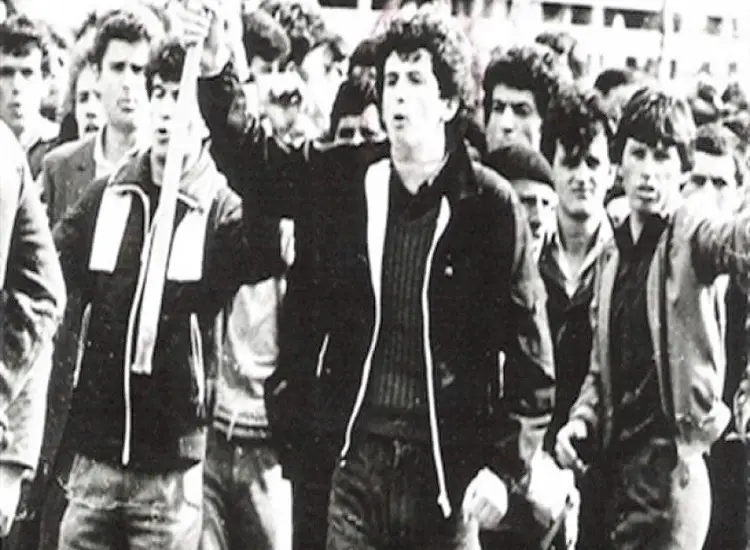
Memorie.al / After the student demonstrations of the University of Pristina in March 1981 and thereafter, in April, spreading throughout the entire province and across all layers of the population, when they saw that Albania did not adopt a neutral stance but instead aligned itself with the demands of the demonstrators – among which (and the most important) was that Kosovo be granted republic status within the Yugoslav Federation – the radical wing in Belgrade set in motion the “ace” for getting out of difficult situations: Interior Minister Franjo Herljević. A Rankovićian in his political tradition as well as in his professional identity and psychology, he implemented a type of solution to the situation by “throwing the hot potato.” The internal tension created with the Kosovo Albanians and the concern of a large part of international opinion that the Belgrade authorities had significantly exceeded the right to suppress the protesters, he transferred to Tirana.
His service people, but disguised as diplomats, on 23 May 1981 – i.e., at a still rather suitable moment to defuse with soft means the two-month clash between his state and the mass of Albanian protesters – at 9:17 p.m., detonated two pieces (lumps) of dynamite on the kitchen terrace of the Yugoslav embassy in Tirana. The action was carried out without the knowledge of Ambassador Branko Komatina, because in the Secretariat of Foreign Affairs of Yugoslavia (the Foreign Ministry), even though the staff was predominantly Serbian, they were not so strongly in favor of resolving the conflict through strained, short‑term methods that would very quickly backfire.
Komatina, unaware and convinced that the explosion had been carried out by people planted by the Tirana government, or at least by individuals or some ultra‑nationalist group ideologically opposed to communism but who – on the Kosovo issue – if not united, at least without any head‑to‑head agreement, were acting in coordination with Enver Hoxha’s Bolshevik power, protested energetically to the Albanian Ministry of Foreign Affairs.
He called the explosive device a “bomb” – a wording according to the recommendation he had received from headquarters. “Bomb at the Yugoslav embassy in Tirana” was a coveted headline for the front pages of continental newspapers, as indeed happened. The “bomb” news spread very quickly. Belgrade was a city where the European media kept their eyes and ears open. Branko Komatina insisted on the “bomb” version, but he did not refuse, however, that alongside experts coming from his country, there should also be experts appointed by Tirana.
The latter determined that the blast had caused a 1 cm scratch on the asphalt of the roof, as well as the fall of a small piece of kitchen plaster. The kitchen was within the courtyard, a full 14 meters away from the embassy’s surrounding wall. The latter was two meters high. Since two police guards stood on both sides of the Yugoslav embassy building and they had seen no movement in the street, it was understood that the explosion had been created from inside. After this, Tirana organized an aggressive propaganda attack to make it visible to international opinion that a car bomb had been detonated at the Yugoslav diplomatic representation.
It was the Reuters news agency that on 29 May picked it up from the Albanian capital and spread it across Europe and the world. After having obtained the news from its correspondent in Vienna, reporting that Deputy Foreign Minister Reiz Malile had summoned Ambassador Branko Komatina the day before and declared to him that it was not his state that had placed the explosive; on the 30th the “New York Times” also published it.
Thus in June the effect of the Herljević‑type “bomb” had returned to zero. Nevertheless, the radical group in Belgrade moved to implement other harassment‑style measures, but the boomerang effect of the 23 May event began to turn into a syndrome. It was the anxiety of the use of explosives in embassies: since the Yugoslav‑Serbs had done this to the Albanians, why should the latter not repay in kind?
The Yugoslav militia booth in front of the Albanian embassy in Belgrade
Meanwhile, on 1 November in Tirana, the 8th Congress of the Party of Labour of Albania began its work, and in the presidium, unlike all the communist leadership dressed in light colors, sat Mehmet Shehu, grim‑faced in a completely black suit. On 6 November, a telegram sent from our embassy in Belgrade arrived at the Ministry of Foreign Affairs. The coded radio message bore number 2986.
It informed that authorities at a significant level – meaning the Secretariat of Foreign Affairs – “with orders from above,” had told them that: “in front of our representation building a permanent booth will be placed for the militia, which will stand guard 24 hours a day.” It explained that this proposal “they have justified with the phrase: ‘to prevent any possible act against the embassy.’”
The radio message, after noting that the high‑level Yugoslav authority had asked them to be given a reply as to whether they agreed to this, specified that when he had presented the above problem, he had said verbatim: “…We do not wish that small events become a cause for aggravating relations between the two countries, which we are interested in developing normally.”
The coded radio message from the Belgrade embassy further reasoned: “Until now the Yugoslavs have not placed a guard in front of our representation, and they are asking for such a thing for the first time. Of course, their explained motives are not everything; they want to have our embassy under constant surveillance and openly, to prevent Albanians from coming to the embassy.”
Then: “It is not excluded that behind this matter the Yugoslavs may also hide some other preconception, to organize some provocative act themselves against the embassy, if from our side the placement of the booth under the conditions they set is not accepted.” Meanwhile, two days later, on 8 November, on the anniversary of its founding, the PPSH concluded the work of its 8th Congress. By now it was no longer a secret to any of the delegates that Mehmet Shehu was not in good shape. Enver Hoxha had targeted him. The state of these relations was also closely followed by the Yugoslav embassy in Tirana. At this time, Ambassador Branko Komatina had been recalled home, and in his place Counselor Spasoje Tuniq had been appointed Chargé d’Affaires a.i.
In the first week of December 1981, without waiting for Tirana’s approval – a stance that was delaying – the militia guard booth was placed in front of the Albanian embassy building in Belgrade. Until that moment, this diplomatic representation had never had a guard. The appearance of the militia guard was one of the boomerang effects of the provocative self‑explosion game at the Yugoslav embassy in Tirana on 23 May. In the second week of December, the Yugoslav Secretariat of Foreign Affairs repeated its request once more that the Albanian side supports the security guarantee measure they had undertaken, and on this occasion, according to a rule they applied to all foreign embassies, the embassy should cover the electricity costs for heating and lighting for the guard policeman.
The Albanian ambassador in Belgrade, Sokrat Plaka, received from his leadership at the Ministry that they agreed to cover these costs, but they demanded that this also happen with the Albanian policeman at the entrance of the Yugoslav embassy in Tirana. Until then, the payments for heating and lighting that booth had been made by the local authorities.
Three urgent phone calls from the Yugoslav embassy in Tirana
On 15 December 1981, at 9:02 p.m., the 24‑hour duty officer at the Ministry of Foreign Affairs, Refat Kasimati, was called by the Yugoslav embassy. The person spoke Albanian, said that their Chargé d’Affaires a.i. (the adinter) requested an immediate meeting “with comrade Justin Papajorgji, regarding some things that have happened around our embassy.” His voice was uneasy, and Refat Kasimati understood that something had indeed happened in the immediate vicinity of the Yugoslav diplomatic representation. The game that this embassy had carried out with the self‑explosion on their kitchen terrace was still fresh in memory. He replied: “I will look into it and let you know.”
He immediately informed Justin Papajorgji, who was the Director of the Balkan Directorate. He called the Ministry of Internal Affairs and asked whether from their guards or any other information they had obtained any indication that any disturbance had appeared around the Yugoslav embassy. They replied that complete calm prevailed there. Under such circumstances, to receive the top Yugoslav diplomat in Tirana at that hour of the night, while the embassy had not explained what concrete reason its chief was requesting a meeting at night, Justin Papajorgji judged that for the time being they should wait a while. Perhaps they were faced with a new provocation.
Spasoje had been Branko Komatina’s political counselor and after the 23 May event he had not been very understanding.
The Yugoslav employee who spoke Albanian called again at 9:55 p.m. He said: “We have requested a meeting with comrade Justin Papajorgji and have received no answer.”
Refat Kasimati: “We are looking for him, but he is not at home.”
The Yugoslav from the embassy: “The matter is urgent and must be expedited.”
Kasimati: “Once we find him, we will let you know, so please do not worry!”
The Albanian‑speaker of the Yugoslav embassy called again at 10:25 p.m. He repeated what he had asked the previous two times. Refat Kasimati replied: “We still have not found comrade Justin Papajorgji; he is still out of the house.”
The Yugoslav paused as if at the threshold of the question: “How is it possible that such an important director in the Albanian Foreign Ministry cannot be found for almost an hour and a half?!” – “Do not worry,” repeated Kasimati calmly, “we will find him for sure and give you an answer.”
Then the Yugoslav gave in and finally began to clarify the reason why they needed that urgent night meeting: “Write down as follows,” he said. And he continued: “The reason for the request is that on one of the roller blinds of our embassy’s window; a piece of metal has been placed that is something that could be explosive. Since it is placed on the outside of the window, its removal must be done at your expense.” It was a bomb story.
Refat Kasimati immediately informed Justin Papajorgji, who had now arrived at the Ministry and was waiting for further developments of the unexpected event coming from the Yugoslav embassy. It bore all the signs of being a provocation similar to that of 23 May. This time, Papajorgji’s superiors told him that as the head of the Balkan Directorate – that is, of a political directorate – it was better to remain formally outside this event, thus to be “still not returned home.” The meeting with Spasoje Tuniq was to be conducted by a non‑political director, Jovan Antoni, who at the Foreign Ministry was the Chief of State Protocol.
Meanwhile, Antoni had arrived at the ministry building, and the Albanian‑speakers of the Yugoslav embassy were answered that the Chargé d’Affaires a.i. (the adinter) was ready to be received immediately. Spasoje Tuniq met with Jovan Antoni at 11:00 p.m.
The Yugoslav diplomat: “Today at 6:40 p.m., the employees staying in the embassy chancellery heard a noise from outside on the window grilles on the embassy street side. At first they thought the noise might have been caused by the shifting of the grille, as they had been newly installed these days; nevertheless, they went outside and found that on the plastic grille of the windowpane a metal object had been placed, round in size about a five‑cent piece.
Of course, it must be sharp on the inside, since it is stuck to the grille. We photographed it but do not know what it could be. Possibly it should be examined by experts.” He then continued: “It can be seen by you, because it might even be explosive. We are neighboring countries, and it is not good for such things to happen.” Likewise, Spasoje Tuniq insisted: “I repeat once more, that if possible your experts should come as soon as possible. We are ready to receive them.”
Jovan Antoni replied: “As soon as you made the first notification regarding this matter, we contacted the competent bodies, which told us that the Yugoslav embassy is well secured with guards and nothing has been seen from the outside. But since you request it, we are coming to the site with experts to examine the matter.” Tuniq agreed to the sending of experts, who was carried out after midnight, and the object the size of a five‑cent piece was neither explosive nor a recording device. It was simply a common metal scrap.
The dawn of 16 December 1981 had broken. Without any incident with the Yugoslav embassy, which – to get back at the demonstrations of the Kosovo Albanian population demanding republic status for their province within the federation and also to take revenge for Albania’s defense of those protests – had done everything to ensure there was no tranquility in Tirana.
The non‑occurring “explosion”
Twenty‑four hours later, on the afternoon of 17 December, the special meeting of the Political Bureau of the PPSH began to examine the serious political errors of Mehmet Shehu. In the late evening of that meeting, the prime minister killed himself. Enver Hoxha would later denounce him, among other things, also as a Yugoslav agent. Perhaps his spirit, which would be so gravely accused, still not departed from his body, had noisily scratched the grille of the Yugo‑Serbian embassy two nights earlier.
To its people, it seemed as if it were the threshold of a real explosion this time, carried out by the Albanian prime minister. A few months earlier, immediately after the demonstrations, on Enver Hoxha’s orders, Mehmet Shehu had, in the greatest secrecy, directed the preparation of an operation called “Explosion,” according to which, if the Yugoslav army attacked Albania, the counter‑offensive actions of our army also included advancing as far as Pristina – i.e., the liberation of Kosovo.
Enver Hoxha had highly appreciated this work, but one day, as September was beginning, he ordered the destruction of all materials for this project, instructing that only one copy of the war map and some supplementary notes be preserved. To two very high‑ranking officers of the Albanian army, who were to carry out, in great secrecy, the destruction with an official report of the planned operation “Explosion,” Mehmet Shehu, with visible concern and nervousness, had said: “Go ahead, spit on my grave, if the day will not come when you need this plan again!”
Reiz Malile’s note
On 24 December 1981, Deputy Foreign Minister Reiz Malile noted at the bottom of a radio message that had arrived from the Albanian embassy in Belgrade, which raised once again how they should act regarding the Yugoslav militia booth and covering the electricity costs for heating and lighting – that the request of the Yugoslav Secretariat of Foreign Affairs should be accepted according to their conditions, and that for the time being no problem should be raised regarding this matter. / Memorie.al