
From Isuf B. Bajrami
Part Two
Memorie.al/ Treated as an objective necessity, upon the realization of which the success of the struggle for liberation from Ottoman rule and for the preservation of the territorial integrity of the homeland would depend, the idea of political and militant unity of the Albanian people was elaborated by our distinguished Enlightenment figures throughout the entire National Renaissance, was placed at the center of this era, and became an inseparable part of the political platform of the Albanian National Movement. The path of the Albanian people towards national unification and the formation of an independent state undoubtedly had its own characteristics, compared to other countries of the Balkans and Europe, conditioned by historical, socio-economic, and internal and external political circumstances.
Continued from the previous issue
The national unification of the Albanian people could not be understood without territorial unity, one of the most necessary components for the existence of the nation, without the foundation upon which Albanians would build their independent state and secure for their nation a full and unique development.
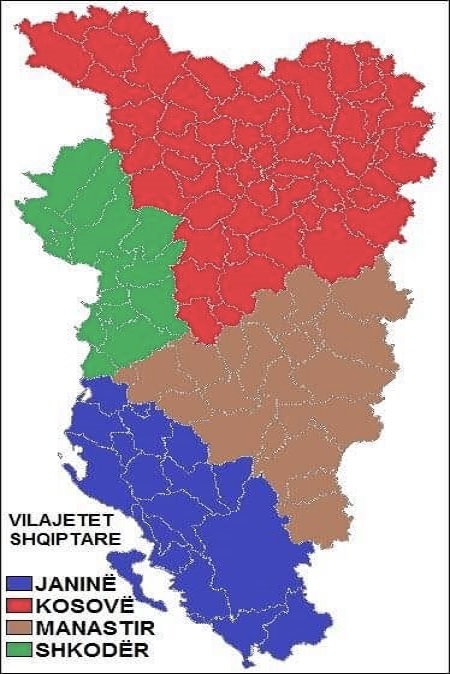
This unification would be achieved by overcoming the division of Albanian lands into four vilayets, established by the Sublime Porte, as well as the regional differences between Gegëria and Toskëria and other smaller regions, inherited from the depths of centuries and kept alive by the invaders and by local pashas and chieftains (bajraktars) to hinder the political unity of the Albanians, to fragment and subjugate them.
In this administrative division, the Renaissance figures saw the continuation of the ancient principle of the conquerors, “divide and rule!” – a principle for which, as Pashko Vasa expressed, “the time has now passed, because the current of the 19th century drives peoples towards unification” (Pashko Vasa, cited work, p. 96).
The struggle for the unification of Albanian lands was intertwined in the political thought of the Renaissance figures with the development of a correct concept regarding these territories. In arguing for the national belonging of the Albanian lands, they relied primarily on ethnic data, on the fact that Albanians constituted the majority of the population in these lands and lived there compactly. Abdyl Frashëri, although he defended the entirety of Albania with comprehensive historical, ethnic, linguistic, economic, and military-strategic arguments, placed the emphasis on the Albanian language, which was the common trait and one of the most important features of the nation.
“The language of the inhabitants of Albania,” wrote Abdyli, “is Albanian, and its inhabitants have been Albanians since ancient times” (Basiret, Istanbul, no. 2416, April 7/19, 1878). This concept of the Renaissance figures for Albania, as the common homeland of the Albanians, of a population that spoke the same language, regardless of religious differences and the administrative division into four vilayets, was a correct, scientific concept, which was placed at the foundation of the formation of national states in the Balkans and throughout Europe. This principle was also defended by Friedrich Engels, when he wrote that “the true natural borders are those determined by language and common sympathy” (Karl Marx – Friedrich Engels, Works, vol. 13, 1959, p. 281).
For the Albanian National Renaissance, as well as for our historiography today, the aims attributed to it by some contemporary scholars of the type of Dimitrije Bogdanović are completely foreign. Bogdanović, by giving the thesis on the Illyrian origin of the Albanians a completely falsified and subjective interpretation, tries to convince public opinion that, according to this thesis, all territories once inhabited by Illyrians, where in the 19th century other peoples lived, are considered Albanian. He sees in the view on the Illyrian origin of the Albanians the—in his imagination—attempt to turn the Balkans, and even Europe, centuries back, to the period of the Slavic migrations in the 6th century (D. Bogdanović, Knjiga o Kosovu, Belgrade, 1985, p. 16).
As scholars, the Renaissance figures also referred to history, presenting data on the historical rights of the Albanians over their ancestral lands, to defend their inviolability, but with these rights extending only to those territories where they lived in the 19th century, as descendants of the Illyrians, as an autochthonous people and not as a people established as a consequence of “later migrations of Albanian tribes and the displacement of Slavic populations,” as is asserted in the old and contemporary Yugoslav historiography. Not because of any national exclusivity, but for the sake of the conditions in which history placed them, the Albanians, as Abdyl Frashëri also expressed, had never harbored conquering aspirations towards other peoples (Basiret, Istanbul, no. 2416, April 7/19, 1878).
Although they were aware that Albania’s future was guaranteed by the formation of an independent state, in the face of the danger of dismemberment, “of the disappearance of the national and political existence of the country” (Abdyl Frashëri, Letter from Ioannina, Basiret, Istanbul, no. 2416, April 7/19, 1878), which hung over the Albanians like the “sword of Damocles,” the patriotic Renaissance figures singled out the unification of Albanian lands as an extremely urgent and imperative duty, and demanded from the Sublime Porte “that the country called Albania be united into one whole and form a single vilayet” (Acts of the Renaissance…, doc. 52).
They saw this as a minimal, temporary demand, as a tactical stance imposed by the policy of the Sublime Porte and the Great Powers who opposed Albania’s autonomy. The conviction of the leaders of our national movement to use the unification of Albanian lands into one vilayet as a step, as a transitional phase, to then proceed to its proclamation as an autonomous Albanian state unit, also exerted its influence on this matter.
Precisely because it led to such consequences, the unification of Albanian lands into a single vilayet is found both in the political thought and practical activity of thinkers with radical views, such as Pashko Vasa, Abdyl Frashëri, Sami Frashëri, as well as in the very acts of the Renaissance.
Abdyl Frashëri, who is known as the most determined fighter for autonomy, and even for the complete secession of Albania from the Ottoman Empire, in the memorandum he sent to the Sultan on October 13, 1880, when, as he expressed it, “The fleets of the Six Great Powers, like tearing birds of prey, attacked a small town like Ulcinj,” was forced to limit himself to such a very urgent, necessary, and one of the most important measures, such as “the unification of Albania into a single vilayet, under the name ‘the vilayet of Albania’.”
The leader of the national movement valued this as one of the means that would cut off the path to the greed of neighboring states—greed that was also fueled by “the division of Albania into four vilayets,” where, alongside the Albanians, who constituted the majority of their population, there were also Slavic and Greek minorities—as “a measure that would protect and secure the integrity of Albania within the framework of the Ottoman Empire.”
In the extremely complicated international conditions of the time, Abdyli considered the situation of Albania so critical and the threat to the integrity of its lands and the very existence of the Albanians as a nation so real, that in this memorandum he was forced to make concessions to his own radical concepts for the resolution of the Albanian question. “Let no special privilege or administrative form be given to Albania,” Abdyli wrote to the Sultan, “Let it be administered according to the laws by which the other imperial vilayets are administered. It is enough that the four vilayets be united into a single vilayet” (Promemoria of Abdyl Frashëri, presented to the Sultan on October 13, 1880. Bashbakanllik Archives, Istanbul, Yildiz Esas Evraki, Section 14, Document no. 2239). Abdyli presented this demand to the Sultan as an aspiration of the entire Albanian people.
The idea of uniting Albanian lands into a single vilayet runs through the memorandums and petitions sent to the Great Powers and the Sublime Porte at the end of the 19th and the beginning of the 20th centuries, until the Declaration of Independence. It appears in two forms: first, as a separate demand, especially raised during periods of harsher intervention by the Great Powers and the Balkan monarchies; and second, as part of the autonomist platform of the Albanian National Movement in numerous memorandums and petitions, especially in those of the great uprisings of 1910–1912.
In both cases, the unification of Albanian lands would serve, as Sami Frashëri put it, “the main goal of the Albanians: the preservation of the territorial integrity of Albania, of the Albanian language and nationality, and the formation of an autonomous national state” (Sami Frashëri, *Albania: What It Was…*, p. 59).
The existence of the Albanians as a single nation and their right to have their own independent state could not be called into question by their division into three religious faiths—the Muslim faith, to which the majority of the population belonged, the Catholic faith, and the Orthodox faith. However, in the conditions of the time, when the Sublime Porte and the Greek Patriarchate of Constantinople denied the Albanians their nationality, putting an equal sign between religion and nationality, calling Muslim Albanians “Turks,” Catholics “Latins,” and Orthodox “Greeks,” the different religions exerted a negative influence on the Albanian National Movement.
In such circumstances, the national unification of the Albanian people and their organization into an independent state could not be achieved without that determined struggle that the patriotic Renaissance figures waged against the clerical reaction of all three faiths, which gave the Albanian Renaissance a special characteristic, making it stand out from the national movements of neighboring states.
Unlike other Balkan countries, where the bourgeoisie, because the population belonged to the same religious faith, used the church as an ideological weapon in the struggle for national liberation and then to fulfill its own conquering ambitions, in Albania the clergy was a negative factor, as Fan Noli put it, “a political tool” in the hands of foreigners, working to divide and assimilate the Albanians, thus hindering their national unification.
It was a special merit of the Renaissance figures that they correctly assessed this reactionary role of the clergy, that they understood that in order to achieve the unification of Albanians—so necessary for their national liberation—religious divisions had to be overcome and the masses had to be detached from the divisive influence of the clerics of all three faiths. In unity regardless of religion and region, they saw the sole basis of the struggle for the liberation of Albania.
Such a struggle could not be waged from the positions of atheism, because the majority of the Renaissance figures were themselves believers, and in the conditions of the country’s economic and cultural backwardness, when religion had taken root in people’s consciousness, our people, as the most advanced patriots rightly emphasized, had not reached such a degree as to renounce religion and drive the priests and imams out of the country (Shqipëria, Magaga [Egypt], no. 4–5, May 1907, regarding the Orthodox).
Nevertheless, through their resistance against clerical reaction, the Enlightenment figures placed the Albanian National Renaissance on a more advanced platform, on the principle of nationality, of “Albanianness (shqiptaria) as the religion of the Albanians”—a principle that runs through an entire political and artistic literature of our Renaissance and was a non-religious, political notion aimed at uniting Albanians regardless of their religious affiliation (Stefanaq Pollo; “On Some Fundamental Distinctive Features of the Albanian National Movement,” in Historical Studies, Tirana, 1970, no. 3, p. 121).
To the reactionary ideology of Pan-Islamism, Pan-Orthodoxy, etc., which had found support even in some feudal (çiflig) and Turkish-minded or Greek-minded bourgeois circles and which identified religion with nationality, the Renaissance figures opposed their rationalism, the concept of the Albanian nation as a special category that was one and indivisible, although belonging to three religious faiths.
“An Albanian is an Albanian before being a Muslim or a Christian” (Sami Frashëri; Albania…, p. 39)—wrote Sami Frashëri. The Renaissance thinkers adhered to the view that nationality and religion is not the same thing, that they represent two different social categories and cannot replace one another.
They fought against the caliphate propaganda of the Ottoman sultans and the Pan-Hellenist propaganda of the Greek Patriarchate, which elevated “religious faith to the principle of nationality and replaced race (meaning nationality) with dogma, rite with homeland”—which was completely unacceptable. “It is neither Islam nor Christianity,” the Renaissance figures reasoned, “that form peoples and nations, but language, customs, traditions, and other characteristics that distinguish nationalities from one another” (Pashko Vasa, cited work, p. 56. See also: I foni tes Alvanias, October 13, 1879, and January 19, 1880).
Against the Pan-Hellenist propaganda that identified Christianity with Hellenization and called Orthodox Albanians Greeks because they shared the same faith, the Renaissance figures saw the claims of certain political circles over the Albanian population and their lands. / Memorie.al