
By Dodë Mëlyshi
Memorie.al/ It must have been the beginning of December 1984. On a wild, snowy winter night, two men and one woman – some closer to 45, some a bit less – and together with them an elderly woman not in very good health, who had passed seventy, found themselves late at night around 10:00 PM at a crossroads of four roads, amidst the mountains of Kaçinar in Mirdita. They had two immediate obligations: to light a fire, seconds before anything else, in the middle of the forest, to save their lives from the brutal cold, and to urgently find a way to return to their homes, which were located in Kodër Rrëshen, near the town of Rrëshen. An unthinkable distance, impossible to cover on foot (at least 20 km) even in summer with good weather, let alone on a pitch‑black winter night!
And the fire was not easy to kindle on such a snowy night. Fortunately, the snow was not very thick, and the climate was somewhat dry, which helped them find a nook or a cave, gather some leaves and branches, some dry pieces of wood, and thus fulfill the first task: the fire was lit by the side of the road…! The story that follows is among the saddest, most absurd, most shameful and most senseless stories that a human mouth can tell, except for those involving death.
The two men and two women who found themselves in the late hours of the night in the middle of the winter of 1984 in the mountains of Kaçinar, in an almost hopeless search to make a flame, were my father and mother, together with my grandmother, and my father’s first cousin. The reason they found themselves in this unbelievable situation was as simple as it was sad!
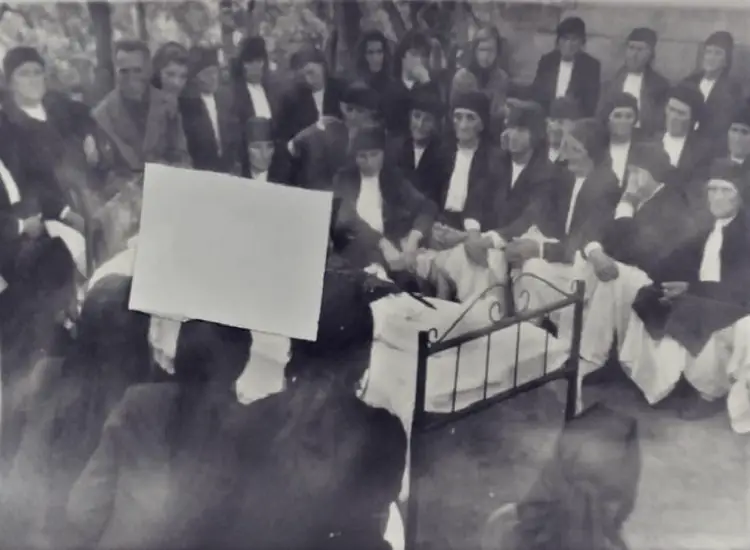
On the morning of that day, a death telegram had arrived at our house, announcing that an elderly woman, a daughter of the house (i.e., a married woman from the family), had passed away in the village of Simon in Kaçinar. And they had been summoned to the funeral. This old woman was not exactly from our direct family line, but since she had neither sister nor brother, she considered our house as her main parental home, and her descendants knew us as the ‘uncles’ (maternal uncles) of the line.
They got ready and set off on top of a lorry along the stony roads of Kaçinar, and must have arrived at the house of the nephews where the funeral ceremony was being held, sometime around dusk. My grandmother, a noble daughter of the Lekgjeçaj family, the most intelligent, strong‑willed and generous woman one could ever know – contrary to what I said above, even though she was not in very good health (in fact, two or three years later she herself would pass away, may she rest in peace) – insisted on going to the funeral as well, to bid a final farewell to a highly respected daughter of her husband’s house.
Late in the evening, apparently inside the house of our many nephews, a debate had broken out, or better said: a fierce quarrel! Someone had put forward the idea that: the Mëlyshaj with bad biographies had been a great mistake to invite to the funeral, so they should be excluded from this ceremony immediately. The strongest ‘partisan’ of this idea, in the name of ‘class struggle’, was one of their women, a party secretary. And the men of the house – as if by an irony of fate, sons and nephews of one of the wisest and most renowned men that Mirdita had ever known (but that’s not worth mentioning) – had bowed to the will of the “comrade secretary”…! And they were not very much to blame, because when the name “The Party” was invoked, opposition in Mirdita at that time was difficult, if not impossible!
And so, the Mëlyshaj, the uncles, were asked to forgive the “methodological error” of having sent the telegram, and in the name of ‘class struggle’ they were asked to leave the house. In the middle of winter, late at night, with an elderly woman with them!
What miracles God has seen!
Unbelievable! Especially when you consider the geographical difficulties, the distances, the weather conditions!
Father, mother and grandmother got up and left. They were joined by my father’s cousin, a man of perpetual nobility, even though in the ‘pathological hierarchy’ of the comrade secretary he had not been classified as having a bad biography.
It is said that a fierce debate continued in that house. Someone among the nephews, driven by a last grain of pride and dignity, shouted out loud: “No one, not even the Party or the mass organizations, will throw the uncles out in winter, for my part!”
Moreover, he had run after my father, apologizing and begging him to return to his house, saying he would take full responsibility!
But the ‘dispute’ had already taken its toll. Even if death itself rose from the coffin, there would be no turning back!
To go outside was easier said than done – but where to go, late at night among the mountains in the snow…?!
How to get back home and how to bring the elderly, frail grandmother back safely!
“We were at the point where a man is tested…” – my father told me later.
After a stretch of road, at a crossroads (the roads, imagine them more or less as tractor tracks, amidst bushes and forests), they managed to light a fire. Meanwhile, my father made one final attempt not to spend the whole night outside.
The villages of the cooperatives were often equipped with some interconnecting telephones. These were telephone without numbers, operated with a small crank, and they connected to the cooperative’s center.
Somewhere, 20 or 30 minutes on foot from where they had lit the fire, there was such a so‑called duty booth. Perhaps also a nearby brigade center, or the building of an elementary school as well. These booths always had near them manual alarm sirens made of iron discs mounted on a tripod, so that if the American imperialist forces, or the Soviet revisionist forces, or the world capitalist forces attacked us, we, with a crank telephone and an alarm siren, would prepare and defend ourselves. I have the impression that Dritëroi, when he recited “I rise (and take my rifle) when I hear the alarm signal,” was inspired by these mechanisms, the alarm sirens.
In that duty booth and that crank telephone laid the last hope of this group of people that night. At the center of the Kaçinar cooperative (I think it is Arrëzi), very close to the corresponding duty telephone, was the house of a valued colleague and workmate.
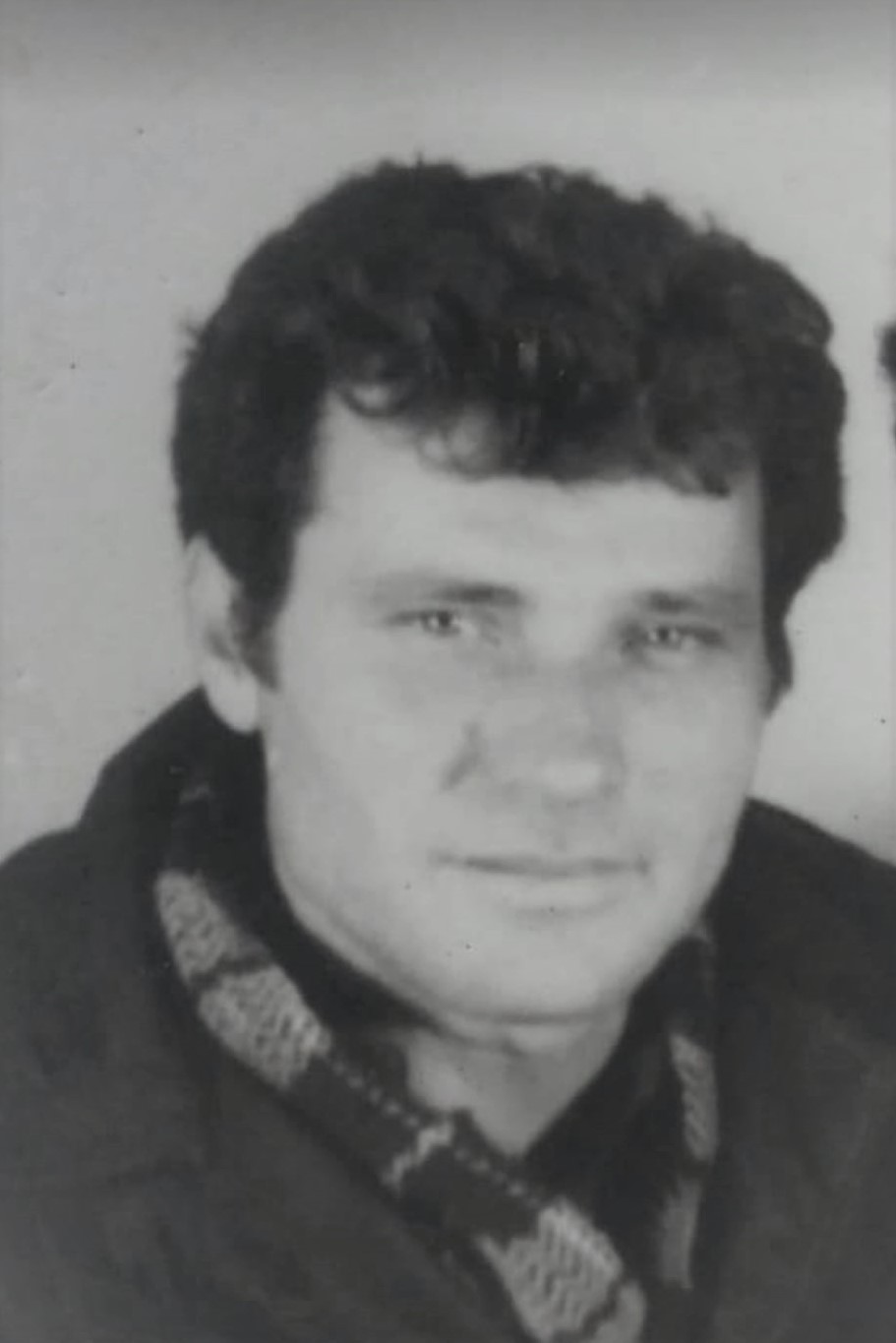
His name was Marka Shkurti.
I have no idea why we Mirdita people, in most cases when we call the name Mark together with the surname, add the suffix “a” to it. That’s how we say it, and that’s how I write it!
My father calls the duty booth at the cooperative center and asks for the favor: to go to Marka Shkurti’s house and tell him that Bardhok Biba is at such and such a place (or rather on such and such a mountain slope) and needs to be picked up and taken home. But he is not alone; he is with people, so a trailer is also needed. Marku drove a ‘Zetor’ (the name “Zetor” also has its own history, just like “Sata” and “Skoda”) “Universal”, an Eastern‑brand vehicle, probably Czech or Bulgarian. The ‘Zetor’ was almost new, so it did not yet have a cabin. The duty man on the other end of the phone replies that Marku (fortunately) is at home and is rushing over.
A great problem was being solved in that dark, hopeless winter night in Mirdita.
“We saw the lights of the ‘Zetor’ from afar, Marku coming as fast as he could. He arrived out of breath and stopped next to the fire. He spoke to my mother, while taking a cape off his shoulders and throwing it over her body: ‘Don’t worry, mother of Bardhok, I will take you home in the blink of an eye!’” – My father would recount, whenever I asked him about this absurd story. And every time he mentioned that moment, his chin would tremble from the emotion! The motivation behind the event was devastating.
“He took the cape off his own body, threw it over my grandmother’s shoulders, and comforted her with words as well…” my father told me – and this thing is stamped in my memory as the most noble and emotional gesture I could ever experience. May that hand that did it be blessed!
The road from Simon of Kaçinar to Rrëshen was not a matter of minutes; it lasted an hour and a half! And it was difficult. Anyone who has tried to hold onto a piece of iron at temperatures below zero for more than a minute understands very well what that means. And these people had to hold onto those trailer irons for an hour and a half. Fortunately, the snow was at least light and not thick.
“The cold of that night did not leave me for a whole month afterwards,” my mother would affirm, years later. In any case, they arrived home safe and alive.
When I asked my father many years later whether Marku risked anything by this initiative, he answered: “In my life, I have been obliged to ask many favors from friends and well‑wishers, and without their help I would have undoubtedly ended up in a political prison. But I always kept two factors in mind: that the person doing me the favor would not be at great risk, and how capable he was for such a task. The dictatorship was unpredictable; no one had absolute guarantee of not being endangered – not even the prime minister, Mehmet Shehu. So Marku had some favorable circumstances, but Marka Shkurti was such a brave and noble young man that he did not take even potential risk into account in such a case!”
That morning, we children, as we went to school in Rrëshen, to protect ourselves more from the mud, stepped in the tracks of the new tires of a “Universal” tractor that, at two o’clock after midnight, had brought our people home. We were too young to ask, but old enough to understand. We understood that a bad and shameful story had happened!
At its center was “dignity”!
Of those who had none at all, and of those who had it in abundance. And our poor parents, who worked without rest, long hours, in hard and tiring jobs to raise and educate us – as if that were not enough, precisely because they had dignity in abundance, this event would mark their mood for a very long time afterwards.
My grandmother, despite all the misfortunes and sufferings she had gone through in life, starting from the murders that the communist state had committed against her husband and her brother, would live long enough to experience yet another such unpunished masquerade!
Among all the definitions of “enemy of the class”: de‑classed, bad biography, kulak, ‘i prekun’ (the touched/contaminated), etc., the most inappropriate was the term “kulak”. Kulaks, borrowed from the Russians, were supposed to be large landowners. Where were there kulaks in Mirdita? The best Mirdita peasant barely had two plots of land and two proud goats, more than his neighbor?!
The most fitting term, however, was ‘i prekun’ – the touched, the contaminated. Exactly like from cholera, exactly like from a plague. That was the mentality of the worldview with which the “new man” was being prepared.
Lively racism, practiced by the state, except that it was racism within the same race!
Anyone who has read Albert Camus’s novel *The Plague* can understand the emotional impact, and how the ‘touched’ in Albania, like those touched by cholera in the novel, experienced this absurd and senseless class struggle! Then it was not simply a matter of class. The absurdity was greater, because even within the same family, a class division was made! Two brothers, for example, belonged to two different classes, by party order. Madness, total insanity…!
The state would make one a ‘Hero’ willingly or unwillingly, and his brother an ‘enemy’, deservedly or undeservedly! The dictatorship decided: one Mëlysh was declared a ‘Hero’ because it suited it, and fifty others ‘kulaks’ – again because it suited it. One Gjomark a ‘Hero’ by order, and fifty others ‘enemies’ – again by order, like it or not, deserved or undeserved!
Heroes and enemies like chess pieces!
And Mirdita was in black hell.
The story above shows that not only were the two pillars on which the poor Mirdita man had historically supported his existence and distinctiveness – “Besa (pledge of honor) and hospitality” – totally destroyed, but also human nature itself was totally destroyed, disfigured into a merciless savagery, devoid of any elementary human and civil value, emptied of every human sentiment…!
Nevertheless, the tractor tire tracks that morning in December, as we went to school, miraculously resembled in our childish minds the tracks of a white horse, borrowed from some ancient distant legend, that brought to our homes not only people alive and well, but also the light of an unquenchable hope…!
The noble gesture of Marka Shkurti is an ultimate value, like a ray of light, a ray of hope, a counter‑image in the darkness of the Mirdita night of the early 1980s!
As if to teach and prove that the Mirdita reality would find its healing within its own body!
(Note: Whenever I use the term “comrade party secretary”, I also keep in mind the other fact that in that party, besides dark, ignorant and criminal segments, there also adhered an army of honest people who simply saw their work as a job. And not only did they not harm anyone, but with all their abilities they softened and amortized, to some extent, the negative impact of a system that was born and planned as flawed from its very creation! Respect for them!). /Memorie.al