By Bashkim TRENOVA
Part Twenty
– NAZIBOLSHEVISM – LITERATURE AND THE ARTS –
PREFACE
Memorie.al / Historians, political philosophers, intellectuals from various schools or different positions have dedicated thousands upon thousands of pages, entire volumes, studies, and articles to the comparison between Nazism and Communism. Generally, in their publications and studies, they focus on the police control of society by these dictatorships, the role of the dictatorial state hierarchy, the head of state as suppressors of free thought, the omnipresence of official propaganda in society, the mass massacres and the network of concentration camps, the activities of the police, the NKVD in the USSR (later the KGB), and the Gestapo in the Third Reich. In his book “Le Passé d’une illusion” (The Past of an Illusion), François Furet notes that Nazism and Communism share the same opposition to liberal democracy and what they call “capitalist bourgeoisie.” Both ideologies claim to be socialist and use the image of socialism. Communist countries called themselves “socialist.” “Nazism” is an abbreviation of National Socialism.
Continued from the previous issue
FILM
The Party also criticizes works that present the living conditions of Soviet workers in an unfavorable light. Thus, the film ‘Большая жизнь’ (‘Great Life’), made in 1939 by Leonid Lukov with a script by Pavel Nilin, also became an object of criticism. The film deals with the reconstruction of Donbas. The young engineer Petukhov, with the support of experienced miners, develops a new method of coal extraction. But not everyone believes in the success of the new method. More than others, the chairman of the mine committee, Usinin, a man who fears any responsibility, are doubtful.
He is also supported by internal enemies who plot to destroy the mine during the experimentation of the new method. The mine veterans, Kuzma and Viktor, believe in the success of the new method and convince Petukhov to stay at the mine and continue his work. The young engineer introduces a new method for exploiting coal mines with renewed energy. On the day of the experiment, the miners, working according to the new method, significantly exceed the norms. After setting a new record, the workers of the miners’ brigade emerge from the mine as heroes.
As can be seen, everything is in complete accordance with the scheme of Socialist Realism. The authorities, however, do not spare criticism. This is because the film shows workers placed in dirty and almost destroyed barracks. This reality of the time does not match the schemes of Socialist Realism. Morally and physically tired, humiliated and frightened, faced with life and death, creators in many cases practice self-censorship to save themselves and the film.
Some take risks and choose the “Aesopian language” to tell the truth, but metaphors and coded language are not always understandable to the viewer. On the other hand, they are caught with excessive zeal by censorship. Many filmmakers of the time, caught between the impossibility of reflecting reality on screen, the non-ideologized daily life, choose to serve the model of Socialist Realism without conviction. Others choose to turn to eras not connected to the present, distance themselves from current events, and find refuge far away in history.
In the following years, the control over film production and distribution becomes even stronger, doubled, tripled. Even after passing through all levels, after shooting and editing, the final product could easily be thrown into the trash bin, simply because it might not please just one viewer, Stalin. “Before being seen by Stalin, the film ‘Soviet Georgia’ (Stalin was of Georgian nationality) was viewed thirty times by its makers and all suspicious footage was erased.”
On August 7, 1940, the film ‘Закон жизни’ (‘The Law of Life’), directed by A. Stolper and B. Ivanov, was released. The film had received preliminary approval from the Deputy Chairman of the Council of People’s Commissars and the Chairman of the Cinema Committee. An unsigned article, i.e., commissioned “from above” and of directive value, published in ‘Правда’ (Pravda) on June 18, 1940, condemns the morality of the film, labeling it as “false”, “slanderous” towards Soviet student youth. The magazine ‘Кино’ (Kino), which had previously praised the film for its “sincerity” and “sharpness,” was forced to back down by publishing, simultaneously with ‘Pravda’, the same unsigned article. The decision to ban the film was taken personally by Stalin.
On September 9, 1940, the film’s screenwriter, Avdenko, was summoned by Zhdanov, secretary of the Central Committee of the Soviet Communist Party, to a special meeting of the Political Bureau where, in addition to Stalin, Malenkov, a member of the Political Bureau, A. Andreyev, a member of the Central Committee of the Soviet Communist Party, Poskrebyshev, Stalin’s secretary, Pospelov, Alexandrov, Polikarpov, three heads of Agitprop, Fadeyev, chairman of the Soviet Writers’ Union, a total of 22 people: writers, directors, etc., were present.
Stalin severely criticized Avdenko. He first dwelt on the notion of правдивость, “truthfulness”, and обьективность, “objectivity”, then emphasizing that literature cannot be photographic, that it must be “tendentious” and serve a specific class, but without falling into caricature.
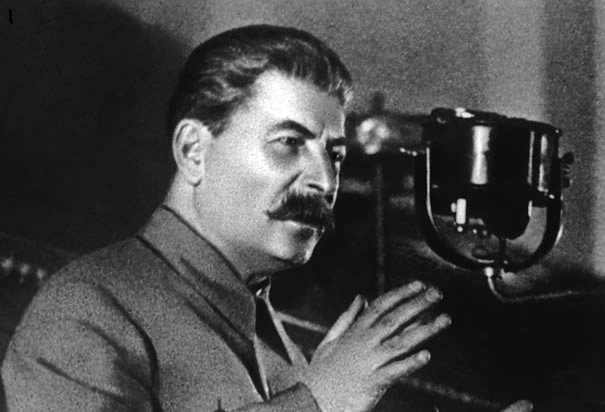
The Kremlin leader appears not only in providing some theoretical and ideological theses and conclusions about film in general, but also as a specialist in its practical realization. He is in the role of the undisputed patron, who orders the theme, the subject of a specific film, chooses the screenwriter and director, and gives approval or disapproval for parts of the script or for its entirety.
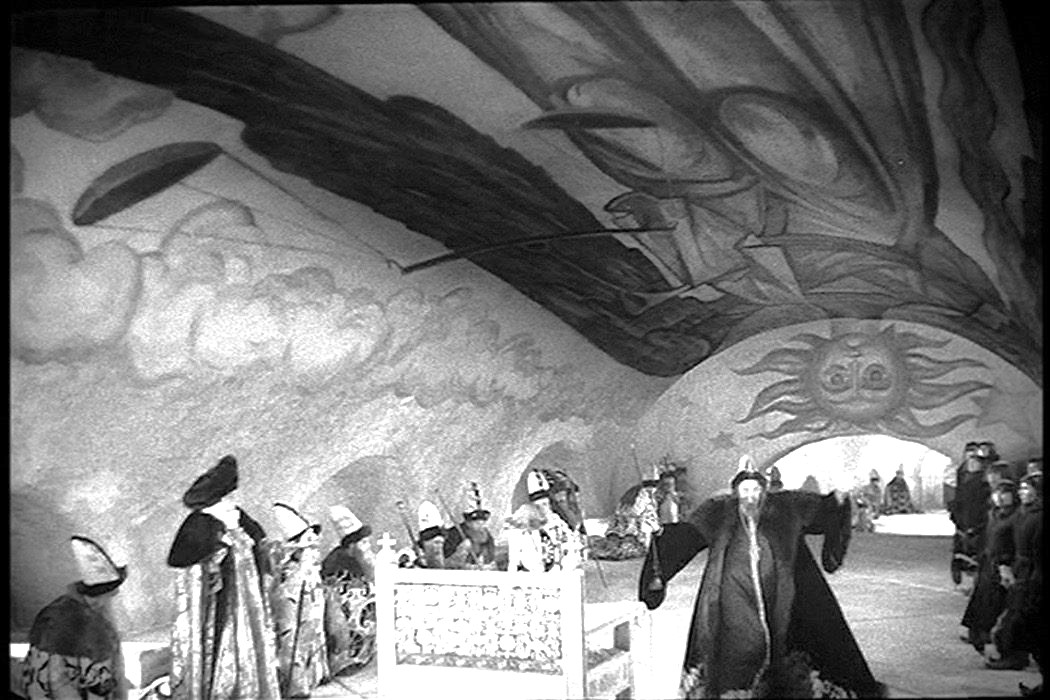
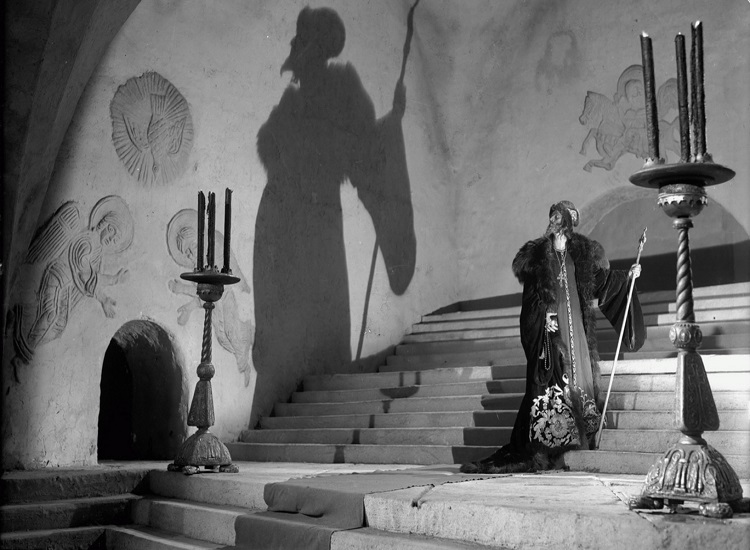
It is Stalin who gives the idea regarding the necessity of a film about the first Russian tsar ‘Иван Грозный’ (‘Ivan the Terrible’). It is also he who practically chooses the screenwriter and director of this film. The script written by Eisenstein was approved by Stalin himself. The first part of “Ivan the Terrible” was released in January 1945. Over the course of a year, the film was watched by 900,000 viewers. The director and his team were honored with the first-degree Stalin Prize. The second part was received completely differently; it was censored because Stalin deemed it as criticism of power. According to the Kremlin leader, the film drew parallels with his regime.
In August-September 1946, what Russians have called “Ждановщина” (“Zhdanovshchina”), i.e., a further tightening of the screws also for cinematic production, began in the Soviet Union. Censorship was organized at three levels and in three different mechanisms, but in the same uniform. At the highest level of the pyramid is the Central Committee of the Communist Party of the Soviet Union (Bolsheviks), then the Ministry of Cinema, and then the Artistic Council under this Ministry. As permanent bodies, they supervise production plans, check the film’s musical scores, read scripts, and evaluate the completed film. Each level presents its findings to the higher level, and the “journey” continues thus up to the Central Committee.
In September 1946, the Central Committee of the Communist Party of the Soviet Union (Bolsheviks) criticized the second part of “Ivan the Terrible”, among other things, emphasizing that “Director S. Eisenstein, in the second part of the film ‘Ivan the Terrible’, has shown his ignorance in presenting historical facts, presenting the progressive army of Ivan the Terrible’s guard as a degenerate gang, like the American Ku Klux Klan, and Ivan the Terrible, a man of strong character and will, as a sort of Hamlet.”
The same resolution dwells more, down to technical details, on the second part of the film ‘Большая жизнь’ (Great Life), made by Leonid Lukov with a script by Pavel Nilin. Part I of the film, made in 1941, was particularly successful. It was watched by 18.6 million viewers and was awarded the “Stalin Prize, Second Degree”. Regarding the second part of the film, made in 1946, the resolution states:
“The content of the film does not match its title. Moreover, the title of the film ‘Great Life’ sounds like a mockery of Soviet reality. The film reflects more the period of Donbas reconstruction after the end of the Civil War, and not the modern Donbas with its advanced technology and culture, created during the years of the Stalinist five-year plans. The film’s authors create for the viewer the false impression that the reconstruction of mines and coal extraction in Donbas, after its liberation from the German occupiers, is carried out not on the basis of advanced modern technology and the mechanization of work processes, but through the use of brute physical force, long-outdated technology and conservative working methods…. The initiative of the mine reconstruction workers not only lacks state support, but is undertaken by miners against government mechanisms.
This portrayal of the relations between state bodies and the collective of workers is completely false and wrong…! The secretary of the party organization in the mine being reconstructed appears in a deliberately absurd position…! The film ‘Great Life’ gives a false and distorted picture of the Soviet people. The workers and engineers of the Donbas reconstruction appear to be backward and uneducated people, with very weak moral standards… a Soviet people with a morality that absolutely does not resemble that of our society…”. The resolution banned the screening of Part II of ‘Большая жизнь’ (Great Life).
The same will be done with the film ‘Простые люди’ (‘Simple People’) by Leonid Trauberg and Grigory Kozintsev. This 1945 film is the only one of its kind that deals with the relocation of Russian factories to the East after the Nazi aggression against the Soviet Union. In 1946, the film was harshly criticized, censored, and banned from distribution to cinema halls. According to the Central Committee of the Communist Party of the Soviet Union, the film’s script placed workers and factory personnel, and not members of the Communist Party, in the foreground. It was deemed “harmful” and “wrong”.
The film ‘Поезд идет на Восток’ (‘The Train Goes East’) is a lyrical comedy by Yuli Raizman, made in 1948, in the new wave of Stalinist repression. ‘The Train Goes East’ was first shown to Stalin. The Kremlin leader did not like the main character because, according to him, he did not look straight ahead, but down at his feet. After watching a part of the film, Stalin had this dialogue with Raizman:
– “Which station are we at?”, asked Stalin.
– “This is Novosibirsk, Comrade Stalin,” replied Raizman.
– “Yes. This is where I should get off,” said Stalin, getting up and leaving the hall.” The film was never shown on cinema screens in the Soviet Union.
‘Молодая гвардия’ (‘The Young Guard’) is another Soviet film production of the 1940s. This film by Sergei Gerasimov is an adaptation of the novel of the same title by Alexander Fadeyev. It was the most profitable film of 1948, with about 48,600,000 tickets sold. In 1949, Gerasimov and others from the film team were awarded the “Stalin” prize. Nevertheless, even this film did not escape official criticism, according to which the authors had overdone the spontaneity of resistance, sidelining the role of the Party. The responsibility fell, of course, on the one who also had the main role in its realization, i.e., Sergei Gerasimov.
By the end of the 1940s, Soviet cinema was in deep crisis. In all films, the ideological axis is foremost, i.e., the deification of the ruling party, its leader, the advantages of the system or the model of Soviet socialism, and the “bright future”. The main characters of the film often speak in slogans. There are no complex characters in whom positive and negative traits are intertwined, as is normal in life. There are only two lines: absolute good and absolute evil. Good is always on the side of communism, of the Party, and evil is always against them.
The Stalinist period of the 1940s has been called by Soviets “Малокартинская эпоха”, i.e., the era of film shortage. This is because cinematic production during these years, and even beyond, as a result of suffocating, crushing censorship, was quite weak and lost its appeal.
A more general testimony regarding the role of censorship on Soviet film is given by the Conflicts Committee emerging from the Fifth Congress of Soviet Filmmakers in May 1986. This committee would rehabilitate 250 films banned since 1920. Regarding the level of production, facts show that if in 1947, 23 films were still produced in the country, in 1951 only 9, while in 1952, 18 were produced, again far from the 1947 level, which itself does not represent a record level. We may recall that earlier, in 1930, 97 films were produced, 39 films in 1935, and 14 in 1950.
Soviet film did not escape the blows of the authorities even after Stalin’s death. ‘Застава Ильича’ (‘Ilyich’s Outpost’) by Marlen Khutsiev tells of a young man who compares his aspirations with those of his father, killed in the war at the age he is now. This film was publicly attacked by Khrushchev and, under pressure from Soviet authorities, only after being reworked, also changing the title to ‘Мне двадцать лет’ (‘I am Twenty Years Old’), was it rehabilitated in the year Khrushchev left power.
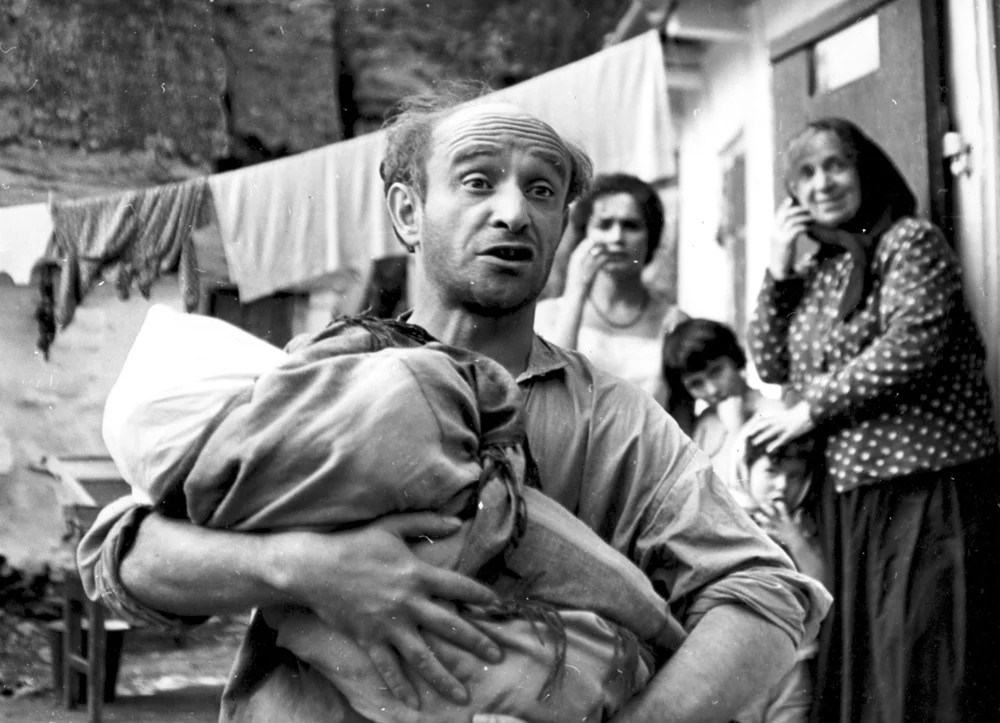
Even ‘Комиссар’ (‘The Commissar’) of 1967, as well as its author, Alexander Askoldov, did not escape the blows of the Soviet regime. The film is based on historical data. It was banned. Askoldov was expelled from the Communist Party and did not make a second film in his entire life. ‘The Commissar’, a humanist and tolerant film, was condemned as pro-Zionist and reappeared only after 20 years, in 1987, during Gorbachev’s perestroika. “My story, that of the Commissar,” Askoldov would write years later, “lies between two dates: 1967-1987.
My life is a connecting line between the two. A graduate of the Moscow Film School, I wanted to show the mistreatment, the real genocide that the newborn revolution inflicted on the Jews of Ukraine more than 15 years before Hitler. How crazy I was! I felt well that the script was troubling, but I trusted my compatriots, as being most capable of self-criticism, which they themselves did not claim. I did not wish to provoke or to astonish, but I had my moral credit. I felt, without wanting to fantasize, that I was going in the opposite direction to all the teachings of the time.
The finished ‘Commissar’ had only one screening, just one, based on which the author was incriminated with all the sins of Russia. I protested. They came and asked for the film reels. Then they told my wife they had been burned. I wrote to Suslov. He was the grey eminence of the socialist doctrine. ‘The destruction of a work of art,’ my letter said, ‘is a barbaric act without any sense and recalls the burning of books in Nuremberg by a hated regime’…! I survived.”
In the same year, 1967, the film ‘История Анны Клячной’ (‘The Story of Anna Klyachnaya’) by Andrei Konchalovsky was banned. Subsequently, in 1971, the films ‘Долгие проводы’ (‘Long Farewell’) by Kira Muratova and ‘Проверка на дорогах’ (‘Checkpoint on the Road’) by Aleksei German were banned. Then, in 1979, it would be the film ‘Тема’ (‘The Theme’) by Gleb Panfilov, for which Soviet censorship would reserve the same fate. Despite some highly accomplished productions, the 1980s would start as an even more asphyxiating decade for Soviet cinema.
As a result of strong ideological pressures, some authors like Alexander Ptushko or Gennady Kazansky dedicated themselves to children’s cinema. Elem Klimov also worked along these lines. In 1964, he debuted as a director with the film ‘Добро пожаловать, или Посторонним вход воспрещён’ (‘Welcome, or No Trespassing’), a satire set in a pioneer summer camp. Among the sequences of this film is one showing a pioneer rhythmically blowing a trumpet, and then the director appears on a podium, ceremonially surrounded by pioneer brigades.
The director’s speech conveys state ideology, the spirit of unconditional submission and military discipline from the early years of life. “Children,” says the director, “you are the masters of the colony.” Then he adds the following phrase: “And what do we expect from you in return?” The children answer in chorus: “Dis-ci-pline.” / Memorie.al