
By Bashkim Trenova
Part Eighteen
– NAZIBOLSHEVISM – LITERATURE AND THE ARTS –
FOREWORD
Memorie.al / Historians, political philosophers, intellectuals from various schools or positions have dedicated thousands upon thousands of pages, entire volumes, studies and articles to the comparison between Nazism and Communism. Generally, in their publications and studies, they focus on the police control of society by these dictatorships, the role of the dictatorial state hierarchy and the head of state as suppressors of free thought, the omnipresent place of official propaganda in society, the mass massacres and the network of concentration camps, the activity of the police – the NKVD in the USSR (later the KGB) and the Gestapo in the Third Reich. In his book *Le Passé d’une illusion* (The Past of an Illusion), François Furet notes that Nazism and Communism share the same opposition to liberal democracy and what they call “capitalist bourgeoisie.” Both ideologies claim to be socialist and use the image of socialism. Communist countries called themselves “socialist.” “Nazism” is an abbreviation of National Socialism.
Continued from the previous issue
Chapter III
FILM
From its very beginnings, Nazi film dealt with the “Jewish danger.” Fritz Hippler’s Der ewige Jude (The Eternal Jew) is another anti-Semitic film, after Harlan’s. It is ranked as the most aggressive representative of its genre. The film was shown in the country’s cinemas in November 1940, i.e., about a year after the start of World War II. It was made by Fritz Hippler with the support of the Reich Propaganda Department. Hitler and Goebbels strongly influenced its form and content. This film was intended to prepare the German public for the “final solution of the Jewish question.” The objective was to arouse in the people a hostile feeling toward Jews as a harmful “race.”
Der ewige Jude is a brutal, horrific film. A large number of scenes were shot in the Warsaw and Lodz ghettos. The film repeats the anti-Semitic stereotypes of Nazi propaganda and compares the Jewish people to rats. It distorts the life of Jews in the ghetto, presenting it as a normal reality having nothing to do with that ghetto. Its maker insists on the “barbarism” of the religious and social customs of the Jewish people. The film also includes Hitler’s speech of January 30, 1939, in which the threat to annihilate the Jews is formulated.
“On this commemorative day, perhaps not only for us Germans,” Hitler says in this speech, “there is something I would like to tell you: in my life I have been a prophet very often, and very often they have laughed at me. In the era of my struggle for power, the Jewish people were the first to receive my prophecies with laughter. I prophesied that one day I would take the leadership of the state in Germany and, consequently, the leadership of the entire people, and that then, among many other problems, I would solve the Jewish problem. I believe that the loud laughter of Judaism in Germany back then has by now been choked in its throat. Today I wish to be a prophet once more: if international finance Judaism, in Europe and beyond, succeeds in pushing the peoples once again into a world war, then the result will not be the Bolshevization of the Earth and thereby the victory of Judaism, but the annihilation of the Jewish race in Europe.”
Der ewige Jude, together with Jud Süß and Die Rothschilds (made by Erich Waschneck), are anti-Semitic films in which Jews are no longer presented as comic characters, as was common in German cinema of the time, but as dangerous, as “sub-humans,” as “anti-races.” Hitler’s cinema, when dealing with problems such as mental health, debility, those who walk on all fours, etc., explaining these by the law of heredity, emphasizes that a large percentage of the carriers of these diseases are Jews.
In this vein, another anti-Semitic film – Venus vor Gericht (Venus on Trial), made in 1941 by Hans H. Zerlett – also belongs to the propagandistic film in the ideological line of Nazism. The film sets events in the 1920s and aims to deal with “degenerate art,” according to the Nazi view. Scenes take place in a warehouse of artworks whose owner is Benjamin Hecht, a Jew. He tries to sell a bust of the period to a minister, treating it as an antiquity that should be placed in a museum! The Jewish merchant had connections with this minister because the latter was also interested as a buyer of pornographic files. To embellish the scenes, original works of “degenerate art” that had been removed from museums by the Nazis in 1937 were used – sculptures by Ernst Ludwig and Erich Heckel, paintings by Wassily Kandinsky and Paul Kleinschmidt, as well as other works of art.
All layers of society are objects of Nazi indoctrination, but special attention is paid to German youth. In Germany, schools were forced to include in their curricula the screening, every month, of a 20-minute political propaganda film. One of the films shown in schools in 1937 is Alles Leben ist Kampf (All Life is Struggle). Students had to analyze the film and were graded for it as in all other subjects. To encourage youth attendance in cinema halls as well, the so-called Jugendfilmstunde (Youth Film Hour) was organized, where a member of the National Socialist Party was always present. On special occasions, Goebbels himself was present. At the end of the screening, every film was discussed. Young people were encouraged to continue the discussion at home, in the evening with their parents.
The theme of youth was broadly addressed in German cinema, especially during the years 1936-1942. The Nazi regime’s “care” for youth is the “care” for indoctrinating future Wehrmacht soldiers with the regime’s ideology from adolescence onward. The same thing, the same “care,” is also noticeable toward German women. To understand this, it is enough to glance at the treatment of her role in the cinema of 1933-1945. In the films of the time, she is a woman faithful to her husband who has gone to the front. She sacrifices herself to be a good “mother,” ensuring the continuity of the Aryan race; she is the guardian of that race. From 1940 onward, a not-always-traditional treatment of women in cinema can also be observed.
She now also appears in the role of the strong woman – the woman doctor, scientist, detective, the working woman – but with one condition: in a given circumstance, if required for the fate of the country, she must always self-sacrifice. According to contemporary statistics, German women constituted the overwhelming majority of viewers in cinema halls. As for the role and influence of cinema on the masses, the fact can also be mentioned that in 1943, German cinema had one billion admissions, or 8 times more than in our days. Germany was the largest film producer in Europe during 1939-1945. Its film industry produced over 80 feature films per year, thus ranking second in the world after Hollywood in the USA. It was generously financed by the Nazi state even in the most difficult conditions of its existence.
War, the comprehensive preparation of youth, women, all layers and categories of the German people for an armed confrontation of international proportions, the very reflection of this conflict in the spirit of a quick and indisputable victory of the Reich over its enemies – on this theme all German cinema is based, especially in the first years of Nazi power. The forms, treatment and findings are extremely varied; the essence remains the same: the spiritual and active preparation of the Germans, their full mobilization for Hitler’s tragic adventures.
In Wer war es (Who Was It) and Feind am Werk (Enemy at Work), two fiction films from 1938 and 1940 made by Carl Rosti, the German people are called upon to be vigilant. These films show on screen Germans who, by boasting or under the influence of alcohol, talk too much. The film conveys the idea that uncontrolled talkativeness will be severely punished by law “as it deserves, as a criminal.” The film calls on the people to keep silent (Mund halten – Shut up!) or, in case of doubt, to inform the Gestapo immediately.
In this range, we distinguish a large number of films of teaching or pedagogical character, aimed at all branches of the Wehrmacht: aviation, navy, artillery, and infantry. These films convey knowledge on how to distinguish an enemy aircraft, an enemy device of any type or weapon, warships, etc. One category of films disseminates knowledge about gas masks and their use, about the manner and practice of building ordinary shelters or those made of ice blocks, as is the practice for Eskimos. Other films give advice on how to cope with floods, how to withstand the cold, how to give first aid or how to perform artificial respiration. Deutsche Panzer (German Tanks) by Walter Ruttmann, a 1940 production, sings hymns to completely automate German armored vehicles, presenting them as a mythological, non-human, superhuman, invincible creation.
Deutsche Panzer is a symbol of Hitler’s Germany, of the Wehrmacht, of the Aryan race. In 1941, the situation on the war fronts was not as the Hitlerites had trumpeted or as they would have wished. In these circumstances, Goebbels defined the service of the German film industry thus: “Its objective now is to remove from the German people the idea of a near, easy victory and, on the other hand, to call the German citizen to total war.” This stamp is borne by the so-called Fredericus-Filme – biographical films of the Prussian kings Frederick William I, Frederick William II, Frederick William III, and Bismarck, Der Alte und der junge König (The Old King and the Young King).
These films turn to history to hide reality, and to some extent also to justify it. Through them, the Nazis seek to echo the prestige of the Prussian kings, naturally presenting Hitler as their successor in ambitions and in the paths followed for a Greater Germany. They exalt patriotism, duty, self-sacrifice. Through them, the idea of Germany’s greatness, the idea of National Socialism as the guarantor and heir of this glorious history, is intended to pass and be recognized as popular. Also in this vein is Veit Harlan’s film Grosser König (The Great King), made in 1942. The films Grosser König is permeated by lines that make one think about the contemporaneity of events at the front, such as: “to doubt victory is high treason,” or “he who withdraws from war, withdraws from life”!
The situation on the war fronts, especially after the Battle of Stalingrad in 1942, gives a different profile to German film. Its task is now to “feed” the morale of the population and the Wehrmacht troops, to show that they are still strong. Meanwhile, as German cities are massively bombed by the Allies, cinema stars are even sent to the front to entertain the soldiers. When the Third Reich was living its last months, in 1944, Veit Harlan made the film Kolberg. Taking historical events as a starting point, he aims to give hope anew to the German people and revive the fighting spirit. The film Kolberg deals with the unsuccessful but heroic resistance of the city of the same name, which during the Napoleonic Wars prevented a complete victory of the French.
For the shooting and production of Kolberg, the Nazis made available great technical and financial means. Goebbels ordered that a large number of soldiers be withdrawn from the Russian front to play as extras. About 180,000 soldiers took part in some scenes. Entire neighborhoods of Kolberg were built as sets near Berlin to be bombarded, according to the script, by Napoleon’s artillery, and then burned. The Persante River was diverted from its course to provoke a flood of Kolberg. The film, as an apology for sacrifice, closes with the phrase: “the best always arises from pain.” It was parachuted to the soldiers defending the fortress at La Rochelle in France, to inspire them to resist while waiting for reinforcements to arrive!
Franco-German relations, in a historical framework, were dealt with by Nazi cinema at least from the first years of World War II. The war began in the East, with the Nazi aggression against Poland in 1939, but on their maps the Nazis had simultaneously arrowed both France and England in the West. The Nazi plans included not only the Sudetenland in the East but also Alsace in the West. Nazi cinema also played its role in preparing German public opinion to accept and serve the revanchist, aggressive policies of the Hitlerites in power, to justify the transition from maps to the terrain. In this regard, we might recall the film Das Deutsche Elsass (German Alsace) of 1941, made by Walter Leckebusch.
The film Das Deutsche Elsass insists on the geographical, linguistic, architectural and cultural unity of the region with the state of Baden-Württemberg. It seeks to prove how France has always sought to destroy this unity. The film returns to the defeat of Verdun, or the battle fought between February 21 and December 18, 1916, in the regions of Verdun and Lorraine. The footage shows monuments dedicated to French soldiers, whereas according to the film’s authors, only ruins and abandonment bear witness to the sacrifices of German soldiers. The entry of the Nazi army into the region in 1940 is presented as a return to normalcy. Das Deutsche Elsass continues with images showing how prosperity has been restored to the region “devastated” by the French. This, thanks to the joint efforts of the local population and the Arbeitsdienst (Labor Service).
Historical film was also used to feed Anglophobic feelings, hostility toward Great Britain, as one of the two countries that, together with France, declared war on Hitler’s Germany immediately after the aggression it undertook on Polish territory on September 1, 1939. Great Britain was a serious obstacle to the Nazi march that aimed to establish Hitler’s rule on the continent and beyond. Nazi propaganda and its instrument, cinema, manipulate history, presenting its periods and events in a distorted, malicious light.
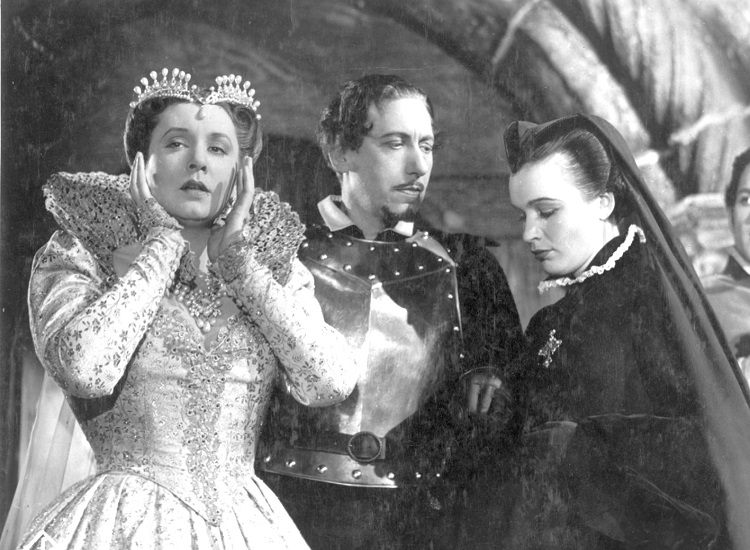
Such is the film Das Herz der Königin (The Queen’s Heart) by Carl Frölich, made in 1940, not long after the start of the war. The film gives a selective presentation of the history and life of the Queen of Scotland, Mary Stuart. According to its authors, the Queen of Scotland, pure of heart, is presented as persecuted by traitors, by corrupt, degenerate, debauched Englishmen. She is condemned to death by beheading by her enemy Elizabeth I of England.
Among the Anglophobe films produced by the Nazi German film industry, we can also mention Ohm Krüger (Uncle Krüger) of 1940, made by Hans Steinhoff, Karl Anton and Herbert Maisch. The film undertakes to bear witness to the massacres committed by the British during the Boer War of 1899-1902, the British concentration camps, and the hypocrisy of the British queen of the years 1837-1901, Victoria.
The film closes with the words of the Boer leader, Paul Krüger: “That is how England, with the cruelest means, has subjugated our small people. Nevertheless, the day of revenge will come. I do not know when, but so much blood cannot be shed in vain, so many tears have not been shed in vain. We were only a small, powerless people. Great and powerful peoples will rise up against British tyranny. They will break England. God will be with them. Then the road will open towards a better world.” The allusion is open; Nazism and the great German people, the Germanic race, are the saviors of the time! They will establish a new order in the world. God is with them!
Among other anti-British films is Carl Peters, which also deals with the colonial world before World War I. Carl Peters was made by Herbert Selpin and came out on screen in 1941. It deals with the life of Carl Peters, tried as anti-English. The story begins in London in 1892. In the Intelligence Service they debate whether to arrest Peters, whose mission is to weaken the British position in Africa and to reinforce there the presence of the German Empire by colonizing spaces on that continent and declaring them a German protectorate. In his efforts, he is supported even by Kaiser Wilhelm himself. / Memorie.al