
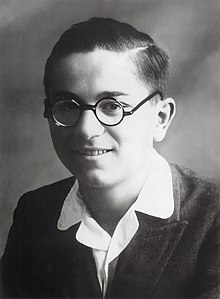
Memorie.al / The killing of Qemal Stafa (1920–1942), the 22-year-old youth, on May 5, 1942, among other things, encouraged patriots to compose songs in his honor, according to tradition. The song; “Afër një spitali” (Near a hospital), composed by the poet Gaqo Trola from Vuno, is well known, and, being a popular song, it spread quickly. This song has been called the first song dedicated to the Anti-Fascist War. (See: Vaso Tole, Irena Shabani “Panorama”, dated 24.4.2003, etc.). In 1942, to our surprise, there were even 9-year-old children who supposedly felt great pain over the killing of Qemal Stafa!!! “Sofokli Thomai, today 80 years old, was nine years old when he, along with his friends in Tirana, experienced the pain of the killing of ‘People’s Hero’ Qemal Stafa…” (See: “Telegraf”, dated 5.8.2013)
Ridiculous examples attempting to narrate history with the “pains of 9-year-old children for Qemal Stafa,” which they neither knew, nor had heard of, nor understood what had happened…?! I want to present a historical fact. Bardhyl Pogoni, an intellectual of “Balli Kombëtar” (National Front), and later a university professor in the USA, wrote and published a song, a poem that was inspired by the fall of Qemal Stafa. So, there were two patriots, Gaqo Trola and Bardhyl Pogoni, who at the same time felt and appreciated the fall of Qemal Stafa and expressed their grief in their songs.
Gaqo Trola’s song, as a popular song, spread quickly, while Bardhyl Pogoni’s poem was little known at the time and later, as is known, was denied and forgotten, because it had been written by an “enemy of the people”! From a historical perspective, how is it explained that an intellectual of “Balli Kombëtar” would hymn a communist? Today it is accepted that, until October 1, 1943, the two anti-fascist forces; “Balli Kombëtar” and the Communist Party, regardless of their programs, did not have deep contradictions, but on the contrary, acted in mutual understanding and cooperation.
On October 1, 1943, the Central Committee of the Communist Party sent a letter to all District Committees, which spoke about measures for strengthening the power of the National Liberation Councils, and for a hostile stance against “Balli Kombëtar.” This letter sanctioned the policy of the Communist Party, which did not accept any other alternative; thus, the only power had to be that of the National Liberation Councils, or more precisely, the Communist Party. (See: Enver Hoxha, Vepra Vol. 1, p. 426)
Bardhyl Pogoni’s poem, written immediately after the fall of the communist Qemal Stafa, is a meaningful example that there was no enmity between the two political forces until October 1, 1943. The poem was first published in the organ of “Balli Kombëtar,” “Kushtrimi i Lirisë” (The Call of Freedom), August 1942, and republished in the anthology “Mosha e Lirisë” (The Age of Freedom), (Tirana 1999, pp. 74-75).
But Bardhyl Pogoni is not the only one who praised the anti-fascist acts of communists. in December 1942, Dhimitër Kol Bala (1885 – 1945), Gaqo Trola’s fellow villager, who was executed by the communists, in a brilliant poem about the Battle of Gjorm, speaks not only about Hysni Lepenica but also about the communist Hysni Kapo Abazaj. (See: Enver Lepenica, “Himne, këngë dhe marshe patriotike të Ballit Kombëtar” (Hymns, Songs, and Patriotic Marches of the National Front), (Tirana 2017, p. 210).
Such was the atmosphere in Albania, until October 1, 1943, when, as the people say, “the Yugoslavs spit and opened the path to fratricide in Albania.” We do not find any communist who sang about the fall of a martyr of “Balli Kombëtar,” which indicates the anti-national policy of that party. The distinguished folklorist Fatos Mero Rrapaj says that; “Gaqo Trola’s song also had the verses: ‘Ngreu Qemal, se të kërkon Bazi i Canes’ (Get up Qemal, for Bazi i Canes is looking for you),” which were later, as is understood, removed by the communists.
But Qemal Stafa himself was not an Enverist communist; on the contrary, with the culture he possessed, he knew how to appreciate Mid’hat Frashëri and other patriots who were anti-communists. For example, we are talking about a letter that Qemal Stafa, from Italy, wrote with honor and veneration to the patriot Lef Nosi (1877-1945, executed by the communists), a letter that Qemal’s nephew, Veli Stafa, made public. (See: “Tirana Observer”, dated 5.5.2013)
Veliu writes that; Qemal Stafa sent the letter from Florence, where he was studying at the Faculty of Law, in 1941. The letter reveals with what respect the 20-year-old Qemal Stafa addressed the signatory of National Independence, explaining to the 66-year-old Lef Nosi about the latter’s request for Qemal to find materials related to Albania’s medieval history among the Florentine booksellers.
The letter begins with the appreciative words: “Honored Lef Nosi. Firstly, I wish to express the spiritual joy that your acquaintance has caused me, a joy that I am sure you will not consider as a display of an ordinary convenience, but as a reality…”! The letter concludes: “Always at your disposal, for whatever you may need. Please accept the expression of my deepest respect. Qemal Stafa, Via Nicolini, 5 Casellai.”
Correspondence between two intellectuals who, despite the age difference, were linked by science and love for the homeland, but both met a tragic end: Qemal was killed by the fascists; Lef was executed by the communists, Qemal’s comrades.
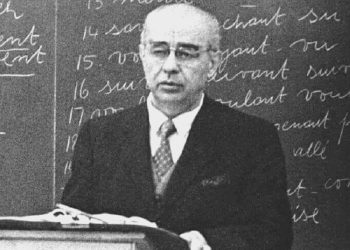
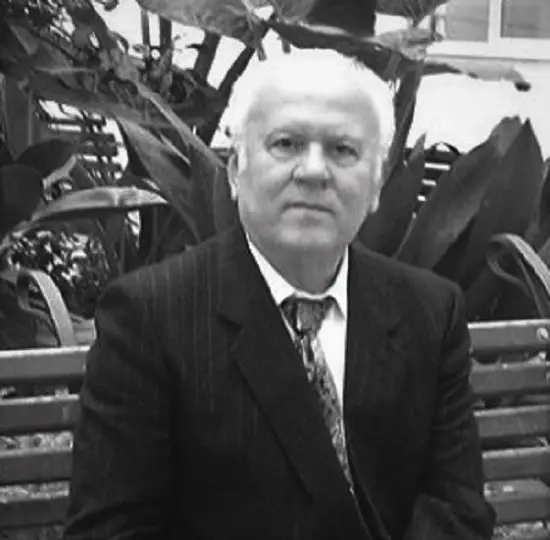
Who was Bardhyl Pogoni, who composed a hymn to the communist Qemal Stafa?
Bardhyl Pogoni was born in Tirana in 1925. He finished secondary school there and took an active part in the Anti-Fascist Movement. His father, Pertef Pogoni, had been Deputy Minister of Education during the time of Mirash Ivanaj. The pro-fascist Albanian authorities had issued an arrest warrant for Bardhyl, but his father had removed him from Albania to save him from imprisonment.
He stayed for a time in Austria and after returning to the homeland, he joined the anti-fascist forces of “Balli Kombëtar”. He later joined those Ballist units that went to fight for the freedom of Kosovo. Bardhyl Pogoni permanently left Albania at the end of 1945 and settled in the refugee camp in Italy, where Mid’hat Frashëri and many other Albanian political personalities were present. He studied French literature at the University of Bologna.
In 1950, he migrated to the United States and began working at the Albanian section of Radio “Free Europe”. In 1959, he started working at the Military School of Languages in the city of Bloomington, Indiana. He completed his higher education at this university and in 1967; he defended his doctoral dissertation (Ph.D.) in the field of linguistics. In 1967, he was appointed professor at Western Kentucky University, where he stayed until 1972.
From 1974 until 1978, Bardhyl Pogoni was accepted as a professor of English language in Tripoli, Libya, and from 1978 until 1985, he directed the Institute of Albanological Studies in Naples, Italy. Throughout his university career, Bardhyl Pogoni published various writings about the Albanian language. He kept many good memories of Mid’hat Frashëri and in 1949, he had published the poem “Fytyrë e Kombit” (Face of the Nation) in Italy, dedicated to Mid’hat Frashëri:
I left and will not return.
His eyelids closed in loneliness,
And remained the voiceless Face,
With lips that no longer speak
With hands that no longer tremble.
You left, Servant of the Nation,
And will not return!
In 1976, Professor Bardhyl Pogoni published the collection of poems in English entitled; “Contemporary Albanian Poems”, which included: Migjeni, Lasgush Poradeci, Arshi Pipa, Martin Camaj, and Ismail Kadare, accompanied by his comments on the lives and activities of the poets, a publication financed by Ekrem Bardha.
His cultural activity and work are spread far and wide, but Bardhyl was not careful with his cultural work. Bardhyl Pogoni was a true intellectual, but he did not work diligently. He died on October 24, 1985, at the age of 60. He was married to an American woman, Barbara Pogoni, and they had one son, Sam. (See more: Gjekë Gjonlekaj “Tirana Observer”, dated 30.11.2012)
TO THE MARTYR QEMAL STAFA
By a bullet they killed you, who struck you?
Oh, torn soul; your brother,
Brother in blood, in hearth and land,
But… a brother sold body and soul.
You fell to the ground like a thunderbolt,
With your eyes you saw nothing else,
But flame and fire, but light of ashes,
But a nation drowned, in slavery…!
And you fell face down, with a full heart,
We saw no tears in your eyes,
But we saw sparks, we saw fire,
That did not extinguish until the grave.
Qemal, Qemal, oh brave one, oh young man,
A rare death like cinder was given to you,
A fire that ignites, a fire that dies,
It shook your heart right through the middle.
…
Flag darkened and stretched in blood,
With hands tied in chains,
We hold it high from the black earth
Where blood ignites for freedom.
The dawn is silent above the grave and stone,
Where a heart fell, a flag,
Where the bones of a hero ignite,
Who died with the flame of despair?
The flag rises high and lowers,
But never bows to the enemy.
Just like you, just like us,
We hold our heads above the earth.
The dawn is silent above the grave and stone,
Where a heart fell, a flag”!
“Kushtrimi i Lirisë” (The Call of Freedom).
The poem was first published in the organ of ‘Balli Kombëtar’, “Kushtrimi i Lirisë”, August 1942, republished in the anthology “Mosha e Lirisë”, Tirana 1999, pp. 74-75. We also publish the popular verse dedicated to the fall of Qemal Stafa, by Gaqo Trola from Vuno, that is, from the village of Dhimitër Bala, who sang about the Battle of Gjorm. Other variants of this song are also found.
Gaqo Trola
INSIDE TIRANA
“Inside Tirana,
Near a hospital,
Qemal Stafa was killed,
On a day in May.
Yesterday the card came to me
From the mountain unit
Get up, – the mother tells him, –
The partisan wants you.
– I have received three wounds
Italian bullets
My blood must be avenged,
Do not forgive them the blood.
They took him from behind,
The devil’s spies,
He fought with his pistol,
Until his soul departed.
Health to the people,
Stand like a lion,
– Mother farewell! –
Qemal tells her.”
Published by the Academy of Sciences of Albania “Partisan Songs, the Spiritual Heritage of the Anti-Fascist National Liberation War” (Tirana 2014, p. 250) Collected, prepared, and provided with an introductory study by academic Vasil TOLE. Memorie.al