
By ROMEO GURAKUQI
– REPORT ON THE TIVAR MASSACRE – THE SERBS KILLED 4,626 ALBANIANS –
Memorie.al / The paper I am presenting to you is brought specifically in the wake of two articles published in “Gazeta Shqiptare” in recent days, as a reminder of the lines of that article and as a response to the overarching alibi raised in that article, that no independent investigation has been conducted regarding the Tivar Massacre. Below is only a part of my independent investigation into the event, which I have carried out uninfluenced by any political pressure, but solely by professional conscience and the will to illuminate the truth. This treatise is an effort to provide some general considerations on the results of a year-long archival research, on what is actually considered the Tivar Massacre but is in reality a complex process of the reintegration of Kosovo, the western part of Macedonia, and Malësia into the Second Yugoslavia, and the elimination of the human potentials of resistance to this process, which is closely linked to the installation in power of the Yugoslav-Albanian communist clique after November 29, 1944.
The Tivar Massacre is merely one of the events of the genocidal process that was carried out in many corners of Yugoslavia, in Dalmatia and in Vojvodina, but, unfortunately also in Albania, on the road from Kukës to Shkodër and towards Ulcinj, under the watchful eye of the silent weapons of the partisans of the UNÇSH (National Liberation Army of Albania). The paper is mainly based on the archival files of the “Foreign Office”, “War Office”, “and SOE files” and on the files of the Albanian dictatorial State Security, intercepted by British intelligence services in 1945-1947 and now opened to the general public in the United Kingdom. The paper will also present a file from the Archive of Kosovo, belonging to Yugoslav documentation.
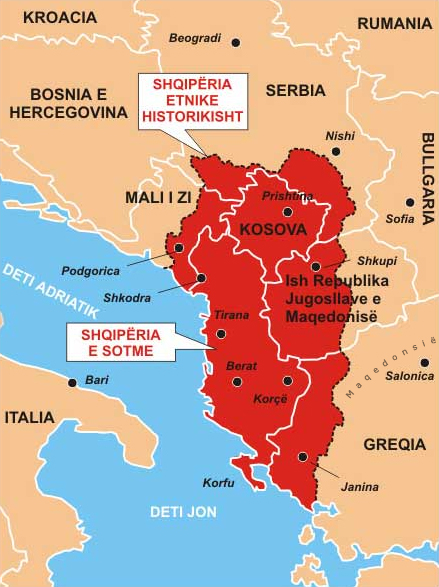
What was understood at that time by ‘Kosovo’?
The term ‘Kosovo’ at that time was applied in three ways:
According to the first way, by ‘Kosovo’ was understood the entire territory annexed by the disintegration of Yugoslavia to Albania and slightly more than this, outside this annexed part, in the northern and eastern part that was aspired to by Albanian nationalism. According to the second way, all of this part of the annexed territories north of the Shar Mountain (Sar Planina) and south of Mokra Planina (i.e., all territories annexed to Albania, with the exception of some (a) fragments in the northwest, taken from Montenegro, and (b) in some areas in the northwest of Macedonia, in the southern part of the annexed territory). According to the third way, we have the Kosovo Plain (Fushë Kosovën), which is the eastern half of Kosovo in the second sense (the western half is the Plain of Metohija, or as it is otherwise called by Albanians, the Plain of Dukagjin).
The space referred to as KOSMET is equal to Kosovo in the third sense, plus the Plain of Dukagjin, and corresponds entirely to Kosovo in the second sense. (PRO.WO.204.9428, From, Captain Vandeleur Robinson to Miss Barker, 20 March 1944, Reference: Force 133’s B8/GSP/668 of 5th March.) But let us return to the interior of the Second World War, to understand the political processes at the end of the war and the reintegration of Kosovo into Yugoslavia. With the help of Hitlerite Germany, during the period 1939-1943, Italy realized its ambitions in the Balkans, to the detriment of Yugoslavia. At the beginning of this period, Albanian irredentism in Kosovo was incited to prepare for the unification of this territory with Albania. Such unification was carried out through the treaty of June 15, 1941, with Bulgaria.
Immediately followed the Serbian and Montenegrin reaction: During the summer of 1941, attacks were carried out from the Montenegrin border in the area of Guci; during the winter of 1941, attacks were carried out along the Serbian border in the region of Mitrovica, Novi Pazar and Sjenica. These attacks were repelled through the coordination of actions by Italian and Albanian forces. For their participation in the actions, some leaders of the Albanian highland tribes received the “Silver Medal” from Mussolini himself. After this, the Italians created the “Albanian Guard of Kosovo” under the command of Prenk Previsi, with Kosovar recruits, and the “Committee for the Defense of Kosovo”, under the collective presidency in rotation of Ferhat Draga, Bedri Pejani and Iliaz Agushi.
Before the armistice with Italy, the latter was deputy prime minister of Albania (Iliaz Agushi was killed in December 1943) and simultaneously the rotating president of the Committee. We should also specify that Ferhat Draga and Bedri Pejani had been deputies in the Yugoslav parliament in the preceding period. (PRO. WO. 204. 9428, From Captain Vandeleur Robinson to Miss Barker, 20 March 1944, Reference: Force 133’s B8/GSP/6?68 of 5th March. Enclosure, Draft “Kosovë”). Ferhat Draga was the most active member of the Committee for the Defense of Kosovo in the summer of 1943. For this, he would subsequently become Governor of Kosovo (i.e., Kosovo in its broadest sense, which included all the territories annexed from Yugoslavia, with the exception of the territories added to the old prefectures of Shkodër and Dibër). (PRO. WO. 204. 9428, From, Captain Vandeleur Robinson to Miss Barker, 20 March 1944, Reference: Force 133’s B8/ GSP/ 668 of 5th March.)
The Albanian Guard of Kosovo was responsible for the defense of the new borders and the exercise of police activity within this new space included in Albania under Italian occupation. The Kosovars took advantage of this opportunity to take revenge during this period against Serbian colonists, who were forced to leave for protection, to Serbia, or to Montenegro, where they even joined either the partisan forces or the Chetnik forces. In January 1943, Chetnik forces led by Gjurishiq and Mihailović again invaded Kosovo, destroying entire villages and massacring the population in Bihor and Rožaje. According to statistics, 4,626 Albanians were killed or wounded and 200 women and girls were abducted. In this case, the Italians, who at this moment were supporting Gjurishiq and Mihailović, did not intervene.
This fact undoubtedly influenced the rise of anti-Italian sentiment in Albania. (PRO. FO. 371. 48090/8181/237/90, Mr. Ralph Skrine Stevenson to Mr. Eden, Belgrade, 27th April 1945). On September 16, 1943, a regiment of the Kosovo Guard took part in fighting against the Montenegrins, who had attacked Gjakova. (PRO.WO.204.9428, From Captain Vandeleur Robinson to Miss Barker, 20 March 1944, Reference: Force 133’s B8/GSP/668 of 5th March. Enclosure, Draft “Kosovë”.) After the armistice of Italy, the “Second League of Prizren” was created in Kosovo, on September 18, 1943. This organization also created a Constitutional Assembly, whose semi-autonomous position was ratified by the Council of Regents of Albania, on March 14, 1944. The main purpose of this organization was to protect and liberate the territories of Kosovo from the Serbs.
This organization managed to control the entire administration within the zone and had four militia battalions under the command of Major Bajazit Boletini. The Germans took advantage of this opportunity and managed to create in March 1944 the SS Division “Skanderbeg” with 7,000 Albanians from Kosovo, led and trained by German officers. At the same time, a conference of Albanian leaders, held respectively in Maqellarë and Rugovë, decided to create a military committee for Kosovo and the Plain of Dukagjin and undertook massive recruitment throughout the territory. This had considerable success. Border guards were reinforced, Albanian police units were formed and they began to serve as police garrisons in Serbia (this refers to the territory controlled by the Germans), but also in France and the Netherlands.
When in the summer of 1944 the positions of the Germans in the Balkans deteriorated, Dr. Xhafer Deva became the Chairman of the “Second League of Prizren” and the High Commissioner of the Province of Kosovo. In the face of this powerful opposition, the partisan movement in Kosovo never reached significant proportions. Because the German-speaking countries, and above all Austria, had long been supporters of the creation of a natural Albania, and due to the fact that under Nazi Germany such an aspiration became a reality, it must be said that in Kosovo, support for the partisans, with Slavic-communist inspiration, was almost non-existent. Here, the majority of the Albanian population preferred to maintain the wartime border, which had included them under the Albanian mother state.
KOSMET itself, the national liberation organization of Kosovo, has not had any support among the Albanian population of Kosovo, sufficient to enable this Albanian-Yugoslav partisan organization to undertake actions within the territory of the aforementioned province. Thus, this organization has acted more outside the territory of Kosovo (in Tetovo), (the region of Presheva) and in northeastern Albania. The main reason why KOSMET was unpopular in Kosovo is related to the close cooperation of this organization with Marshal Tito. Furthermore, KOSMET, as an organization, had been recognized by General Colonel Enver Hoxha, to be placed under Tito’s orders, with the area of Kosovo as its sphere of influence (PRO.HS.7.70, S.O.E. History, File number 37/B, Allied Military Mission in Albania, 1942-1945, page 16).
What should be specified is that, at least starting from the beginning of 1944, Kosovo became a field of battles and confrontations of the most opposite military and political interests, which included, the Albanian national forces, the Serbian Chetnik forces, the Yugoslav partisan forces, leftist Bulgarian units, etc. In the circumstances of the consolidation of Albanian power in Kosovo, the Yugoslav National Liberation Movement, which aspired to take power after the Second World War, began at this time its preparations for undermining the bases of the unification of Kosovo with Albania. From the year 1941, efforts were made to absorb some kind of support among the Albanians, and in this same year two delegates from Tito, Ali Dushanoviq and Miladin Popoviq, participated in the founding meeting of the Communist Party of Albania (PKSH).
The Position of the National Liberation Front
After the creation of the PKSH in 1941, this organization sought the help and support of the Communist Party of Yugoslavia (PKJ). The Serbian communists afterwards sent two officers to Albania, Ali Dushanoviq and Miladin Popovic. These two officers were arrested by the Italians at the beginning of 1942 and were interned in an internment camp in Albania. Afterwards they were liberated by the Albanian communist leader Mustafa Gjinishi. The selection of Ali Dushanoviq, a man quite sharp and shrewd, was calculated, since he was originally from Peja. These persons were the points of contact for the connection between the Yugoslav partisans and the PKSH and were precisely these who tried to create a partisan movement in Kosovo and in the Plain of Dukagjin.
Based on a directive from Moscow, all communist parties were to suppress nationalist movements within themselves in the mutual interest of the Balkan nations and the formation of national liberation movements against the fascist Axis powers. In Albania, such a movement was announced with the Conference of Peza on September 16, 1942, and after this, the connections with the Yugoslav, Montenegrin, Macedonian and Greek communist parties were developed. As for the National Liberation Movement in Kosovo, there, at the end of 1943, KOSMET (Kosovo-Metohija) was also created, which I spoke of above, and which answered to Marshal Tito. KOSMET consisted in its membership, half of Serbs and half of Albanians, among whom stood out Mehmet Hoxha and Fadil Hoxha.
KOSMET was forced to define itself in its activity within the political sphere, with the main aim of lowering anti-Serb sentiments among the Kosovars. Efforts were also made to build a partisan political organization in Kosovo and a few National Liberation Committees. The National Liberation Front of Albania had insisted on an independent character for this organization. The purpose of this aim, following the initial communist directives, was to suppress the anti-Serb sentiments in Kosovo. In January 1944, in Kolgecaj of Tropoja, Malësia of Gjakova, a Congress of KOSMET was held, in which 52 delegates participated, including delegates of Serbian and Montenegrin nationality and two former deputies of the Yugoslav parliament.
The designation ‘KOSMET’ is a mixture of the words Kosovo and Metohi, which are the two localities of the KOSOVO entity, respectively the eastern and the western part. In the January conference, which was led by Mehmet Hoxha, a council was elected composed as follows: President, Mehmet Hoxha; Vice-Presidents, Rifat Berisha and Padel Yovichevich (Montenegrin); members, Ali Shukriu, Milan Zeqhar (Serb), Daud Ardyshi, Fadil Hoxha, Xhevdet Doda, Zeqir Jarexha. They decided to fight on the side of the Allies of the Anti-Fascist Coalition, on the basis of the Atlantic Charter, and to send their representative to the LNÇ (National Liberation Movement) and to Marshal Tito.
KOSMET was supposed to be an organization that represented Yugoslav and Albanian interests. The area of its extension of activity included the regions of Kosovo, Metohija, Puka, Nikaj, Mertur, Krasniqe. (PRO.WO.204.9428, From Captain Vandeleur Robinson to Miss Barker, 20 March 1944, Reference: Force 133’s B8/GSP/668 of 5th March). Despite the meager military activity in Kosovo, the Kosovar partisan units fought early on together with the Yugoslav National Liberation Army in Macedonia and Serbia, under the command of the headquarters of these areas. Already in 1942, two Kosovar battalions had been formed on the hills west of Tetovo, which fought within the unit called the First Macedonian Brigade, until it was transformed into the First Kosovar Brigade, composed of 800 troops, in June 1944.
In its beginnings, this brigade was composed of Serbs who had fled, but in June 1944 it was calculated that 30% of this brigade was composed of Albanian partisans. Another Kosovar brigade with 400 troops was formed in Skopska Crna Gora at the beginning of 1944, in the area east of the Niš-Skopje railway. Part of the staff of KOSMET was positioned in Serbian territory, south of Radan, protected by a battalion composed of 100 Kosovars. Until the summer of 1944, KOSMET did not participate in any activity of a military character, while in August 1944, KOSMET, in the space between Peja and Gjakova, joined with the First Kosovar Brigade from Macedonia. However, the partisan forces in Kosovo remained weak and did not manage to offer any resistance worth mentioning.
The most important resistance movement was that built by Gani Kryeziu, a large landowner from the area of Gjakova. The relations between KOSMET and Gani Kryeziu had been correct and occasional military operations were carried out together, but because of his refusal to join KOSMET, he was threatened by the partisan forces of this organization and later, at the end of 1944, his life would be terribly endangered by the cooperation of the UNÇSH and UNÇJ, about which development will be discussed further in this exposition. Furthermore, the efforts of the UNÇJ to send troops into Kosovo were not successful.
This, because the resistance offered to them by the Kosovar border guards was very strong and in the month of May 1944, the second corps of the UNÇJ, in an attempt to enter Kosovo through Montenegro and in July 1944, the Serbian forces led by General-Lieutenant Popoviq, advancing from the north of Gjilan, were repelled by the Kosovar government forces (meaning the forces of the Albanian government of the period of German occupation).
Because of this almost complete defeat in Kosovo and the brutality of the Kosovars towards the Serbian colonists, the majority of the Yugoslav partisans created a completely pessimistic picture regarding the possibility of victory through appeasement over the Kosovars. In general, the opinion of the majority of the Yugoslav partisans, who had much to do with the Albanians of Kosovo during the war years, among whom General Vukmanovic Tempo stands out, had often declared that they were incorrigible bandits, who should be impaled with harsh methods when the country was liberated. (PRO.FO.371. 48090/8181/237/90, Mr. Ralph Skrine Stevenson to Mr. Eden, Belgrade, 27 th April 1945).
This is perhaps the starting point of the policies later followed by the Yugoslav communists towards Kosovo and the Albanian population in this part of the Balkans. During the year 1944, a series of attacks were carried out in the territory of Kosovo occupied by the Germans, which culminated in the cooperation between Marshal Tito and the FNC (National Liberation Front) of Albania. The attacks during the first period of 1944 can be listed as follows:
1) Between the dates of 11 and 20 February 1944, the Serbian Chetniks and the troops of Nediq occupied the Albanian villages north of Peja. 2) On May 29, 1944, units of the 2nd corps of Marshal Tito carried out a series of attacks from the area of Berane in the direction of Morina, Plava and Rožaje. 3) At the end of June 1944, the Serbian general staff, working in cooperation with Marshal Tito, began the invasion of Kosovo in the area of Gjilan./ Memorie.al