Study by Prof. Dr. Luan Malltezi
Memorie.al / In Albanian journalism, there are no scientific-anthropological treatments of political leaders, their qualities, traits, and formation.
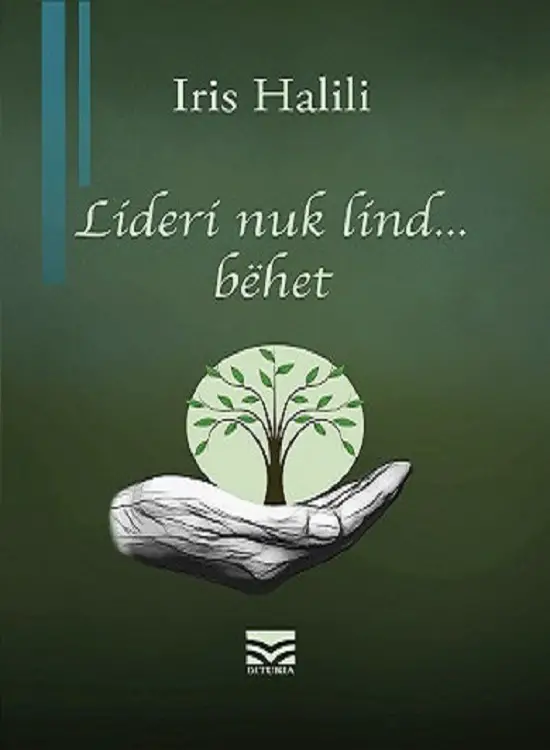
A first study in this direction is provided by the Albanian-American researcher Mrs. Iris Halili with her book *“The Leader Is Not Born… Made”*, rated as the best publication of the year 2020 on the online portal “Bukinist.al”.
Mrs. Halili graduated with a gold medal in Albanian Language and Literature and defended her “Master of Science” title in European studies. She worked as a lecturer of Foreign Literature at the Faculty of History and Philology (1995-2006) and served as Head of Cabinet for the President of the Republic, Mr. Alfred Moisiu.
Since 2009, she has lived in Miami, Florida, USA. There she completed studies at Grand Canyon University in the Doctoral program in Education in Leadership and defended her “Master’s” degree.
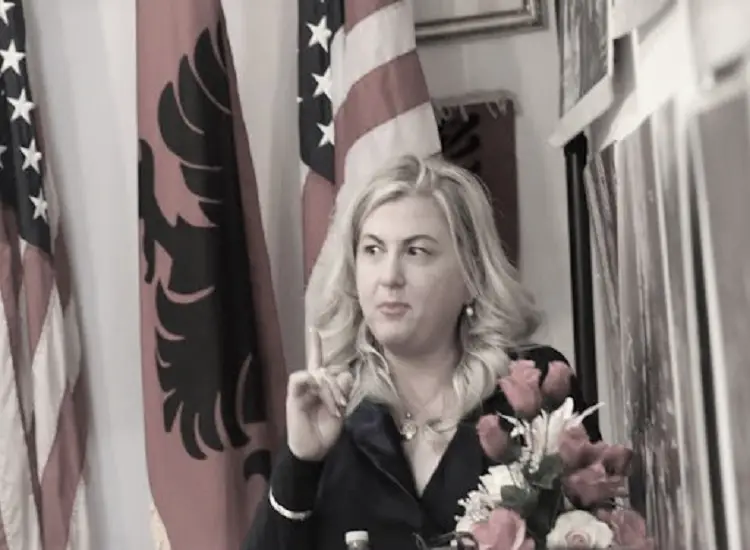
On September 19, 2021, the book was successfully promoted at the central headquarters of the Pan-Albanian Federation “Vatra” in New York.
On November 7, 2021, the newspaper “Dielli” announced the establishment of the newest branch of “Vatra” in Miami. The Chair of the Founding Commission was Mrs. Halili.
In her article published on this occasion in the newspaper “Dielli”, the lady informed her Albanian compatriots in the USA that to successfully realize this trust, “she has gathered around her personalities from the fields of economics, business, literature, activists with integrity, and Albanian personalities in Florida”.
The book “The Leader Is Not Born… Made” is a compilation of several years of studies on the qualities, traits, and formation of leadership, based on recent studies by American anthropologists on the topic of leadership. In an interview given to *“Psychology”* magazine, Mrs. Halili stated that she undertook this study because “the Albanian environment lacked such a topic”.
In her study, the author addresses issues such as: Is the leader born or made? Anyone can become a good leader! Leadership and the immense power of followers! Ethical leadership! Charisma in leadership! The nationalist leader! The narcissistic leader! Women’s leadership as servant leadership! Mother Teresa! Toxic (negative) leadership! The role of a country’s culture in leadership; a few words on the Albanian reality! Art and leadership!
According to American anthropologists, a leader has many qualities; one important quality is charisma. Charisma, according to them, is an “inborn quality” of the leader. The author relies on the study of the American anthropologist James MacGregor Burns, winner of the Pulitzer Prize (1978) for his book “Leadership”.
“Charisma, according to him, is the leadership ability to inspire followers.” According to the German sociologist Max Weber, charisma gives the individual “inspirational, superhuman, and supernatural power.” According to others, charisma “is formed up to the age of 6.”
Mrs. Halili relies on the studies of American anthropologist Ann Ruth Willner on the charismatic leader. According to her, “followers attribute almost supernatural traits to the charismatic leader.”
American anthropologists distinguish between “charismatic leaders” and “legal leaders”; the former are personalities who cause great social movements, such as Martin Luther King, Mahatma Gandhi…
Mrs. Halili addresses several leadership qualities such as vision, communication, courage, sincerity, transparency, simplicity, etc. – qualities that are “acquired in leadership.”
According to the American anthropologist Peter Drucker, leadership is an inborn instinct of the human genius; according to him, “there is no good leader with bad followers, and vice versa.” “To be a leader,” writes Mrs. Halili, “you must have followers. A leader without followers does not exist.” Alongside the leader, followers are also important; they must “be active” and be informed about the leader through mass media. “In the time we live in,” writes Mrs. Halili, “everyone receives information from multiple sources… this diversity of information creates alternative information for followers.”
Of interest to the reader is the chapter “Character in Leadership.” “Whenever we want to bring an example of a heroic act,” writes the author, “our mind goes to myths, to the heroes of mythology.” All mythical heroes, she continues, are united by “strength of character.” Anthropologists view character “as a developing process” together with emotion, intellect, and morality. Every person, writes Mrs. Halili, “is accepted or rejected in the social environment by the character they possess.” Among all leadership traits, “character remains primary.” A leader with character, writes Halili, dedicates the victory to his followers. “The leader’s sincerity begins with thought; speaking them openly is the result of a strong character; the drive that pushes a leader to make ethical decisions,” continues the author, “is his morality and character.” A leader with character builds a society with character. The author dwells on “the leader without character.” Such a leader writes Mrs. Halili, “resembles the typical character of socialist realist literature – a character described but not built with high physical values.” Such “characterless” leaders have the sole goal of strengthening their own power; when they feel the power shaking, they become arrogant, authoritarian, and dictatorial. Healthy societies remove and discard such leaders. A leader’s character is tested in times of crisis. Followers, writes Mrs. Halili, should abandon such leaders when they notice signs of their lack of character. Studies point out that “99 percent of leadership failures are failures of character.”
The author dwells on the “narcissistic” leader. “Although narcissism is treated as a trait with negative consequences in leadership,” writes Mrs. Halili, “narcissism is a force that drives them toward power.” Narcissistic leaders have “incomparable” abilities to inspire followers. Anthropologist Maccoby distinguishes between productive and unproductive narcissists. The productive aspects of the narcissistic personality help the narcissistic leader achieve victory. According to Maccoby, “in times of crisis, the narcissistic leader can… instill optimism in followers and lead them toward change.” According to anthropologist Sankowsky, narcissism creates a mystical, trustworthy profile among followers.
“If we take look at the most dominant leaders of Albania,” writes Mrs. Halili, “we see that in many points they exhibit different characters, but in one point they are all together, and that is narcissism! This means they inherit a dominant trait of the society they represent.”
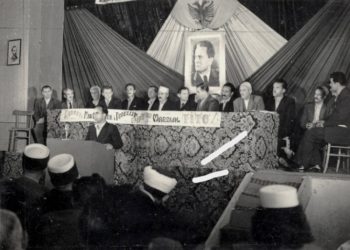
“The leader is a product of the society he represents,” writes Mrs. Halili; “this is one of the basic lessons in leadership theories.” The fact that a society always produces a certain type of leader shows that the society itself possesses that trait. The author considers Enver Hoxha as a narcissistic leader.
According to her, the narcissistic leader seeks admiration from followers; narcissistic leaders “suffer from a lack of empathy.” According to anthropologist Dimaggio, “the narcissistic leader believes he has the right to treat followers as if they were objects.” Narcissistic leaders have no emotional connection with followers. Narcissistic leaders have the ability to produce narcissistic societies. Narcissistic leaders “only want victory.” In Hoxha’s time, writes the author, “victory was spoken of everywhere”; the entire propaganda machine was set up “to glorify successes.” Mrs. Halili also relies on the studies of anthropologist Blair, according to whom “narcissism is closely linked to paranoia.” The goal of the narcissistic leader is power. According to anthropologist Sankowsky, the narcissistic leader deceives followers to maintain personal power.
The author addresses the role of women in leadership. She places at the beginning of the study the saying of the renowned anthropologist Pete Hoekstra: “True leadership is achieved when leaders understand that they are in service to the people they lead.”
Women’s leadership is a fact in modern societies. Theoreticians of the leadership school believe that women’s leadership presents “the traits of transformational leadership in the development of society.” Prominent American anthropologists emphasize in their studies that women “have a higher level of intelligence compared to men.”
The role of women in society is observed as far back as antiquity; at Olympus, writes Mrs. Halili, there were many female goddesses; in the consciousness of ancient man, women had leadership abilities. Such a role has been played by women in the family. Women, writes Mrs. Halili, “inherit many archetypes that make them successful leaders.”
The first theorist to speak of “servant leadership” was the American leadership school anthropologist Robert Greenleaf in 1970. The terms “leader” and “service” Mrs. Halili found in the Bible, in Jesus. According to Jesus, “anyone who claims to be a leader… must first be a servant.”
Women have been valued in Albanian tribes. According to Godart, women in Muslim and Catholic tribes in Albania were seen as sacred beings; she could travel throughout the country, day and night, without fear of insult or danger; in inter-tribal wars, she was not touched by the enemy’s gun. According to the Canon, a perpetrator at risk of vengeance who found himself near a woman was never killed.
Mrs. Halili dwells on the figure of Mother Teresa; she gives the reader the highest praises given to Mother Teresa by authorities of the American leadership school.
Mrs. Halili was part of the Albanian delegation on October 18, 2004, in St. Peter’s Square in Rome, at the Majestic Ceremony organized by Pope John Paul II for the beginning of the beatification of Mother Teresa.
“To be honest,” she writes, “no moment of that event left me more impressed than the knowledge I gained several years later that ranked Mother Teresa as one of the four greatest leaders of humanity, alongside Gandhi, Martin Luther King, and Mandela.”
Many people, writes Mrs. Halili, mistakenly think that Mother Teresa was simply a nun whose mission was to help the poor… For researchers, she writes, Mother Teresa’s religious role is negligible compared to the human mission she conveyed.
Mother Teresa, she writes, aimed “to educate people with love for one another… Mother Teresa is recorded in leadership literature as the leader who built the model of love, defining love as the only weapon that brings peace and prosperity.” Mother Teresa believed that “the greatest evil was not in the system… but the lack of education with humane feelings.” According to “servant” leadership scholars, their success is based on the pleasure of serving others.
Of interest in this publication are the opinions of leadership specialists on “toxic (negative) leadership.” In her book *“Bad Leadership”*, Barbara Kellerman, director of the Center for Leadership Publications at Harvard University, defines seven types of toxic leaders: incompetent leader, rigid leader, intemperate leader, corrupt leader, dictatorial leader, etc. The author writes that negative leaders turn into toxic leaders when they do not keep the promises made to their followers; instead of correcting themselves, they become arrogant, authoritarian, and dictatorial. Negative leaders, she continues, have the ability to feed a collective blindness in their electorate.
“The situation today in Albania,” she writes, “is a consequence of this phenomenon. Albanian society feels tired of negative leadership, of promises that have turned into giant corruption.” According to her, it is up to voters to overturn this situation, and “this is done with courage and trust in individuals and groups that promise progress.”
Important to the fate of leadership, writes Mrs. Halili, are historical circumstances; these give the leader the opportunity to make the fairest decisions. The Latin expression *“Finis Coronat Opus”* (The end crowns the work), writes Mrs. Halili, is what determines the value of the leader.
An interesting chapter is “The Primary Role of a Country’s Culture in Leadership.”
“A country’s culture,” writes the author “determines the type of leadership.” The anthropologist who reached this conclusion is the Dutchman Geert Hofstede. Thanks to this researcher, writes Mrs. Halili, “We are able to understand why the leadership of one country is different from the leadership of another.”
According to this anthropologist, in “collectivist societies” the clan has weight, not the individual. In such a society, “the individual finds success when he aligns his interests with those of the clan.” Albania, writes Mrs. Halili, belongs to the group of societies with a collectivist culture where the clan holds power. In such countries, “free thought is cause for exclusion, while representation through the clan ensures success.”
Although the book “The Leader Is Not Born… Made” is theoretical in nature, Mrs. Halili has criticisms for Albanian leaders after the 1990s.
“The leaders of the post-communist era,” she writes, “should have faced the norms of democracy and bypassed the model of autocracy or dictatorship with which they had grown up and been educated according to the only model they had. In a difficult transformative process, they continue to face this challenge of character. Meanwhile, they also continue to struggle with the other challenge to which they should have unconditionally resisted: greed.”
The author also expresses her opinion on the communist regime in Albania.
“Today,” she writes, “there is open discussion as to whether the achievements of Enver Hoxha’s dictatorship should be denied or not… First,” she writes, “the question is raised whether communism was or was not a success for Albania. Even the most orthodox communist does not believe that communism in Albania brought the proper development to the country… Albanians isolated in thought and movement, condemned to lack of free speech, scattered through prisons and internment, without property rights, without voting rights… I do not believe they have nostalgia for that regime to return. The communist leadership left the generations an extremely poor country… With the fall of communism, every Albanian, communist or déclassé, came before the mirror and found themselves naked before the world. This simple description shows how negative the communist leadership was. We are not mentioning here the crimes of that regime, for those alone would suffice to define it as a completely… inhuman leadership. The legacy left by Enver Hoxha’s regime was a complete failure. That leadership was fatal for the country.”/Memorie.al