Part Twenty-One
Memorie.al / The CIA have shown the great role that the Soviet Union played in communist Albania. In several “Top Secret” documents, declassified years ago, it is shown that the USSR built several important military bases, especially in the South of the country. There, the submarines that Moscow had on the island of Sazan and the Bay of Vlora are shown in detail, as well as air bases, such as that of Rinas, Kuçova, etc. Afterwards, a panorama of political developments is given, where the dismissal of Defense Minister Beqir Balluku in the summer of 1974 from all functions in the army and party is mentioned. Likewise, a special place in the documents that the CIA has declassified are also those that speak about Albanian political emigrants in Yugoslavia, who are included in the Committee of Prizren, initially headed by Apostol Tanefi and under the pressures of the UDB, which recruits them with coercive measures, such as return to Albania, etc.
Continued from the previous issue
July 1977
Support for Tirana
Moscow seems to seek to exploit the polemics with Albania and China to its advantage, while it is trying to re-establish diplomatic relations with Beijing. In an unprecedented move on Saturday, the Soviet daily “Pravda” wrote in favor of the arguments of “Zëri i Popullit,” calling the Chinese theory of the “three worlds” reactionary and anti-Marxist. Radio Moscow supported Pravda’s commentary with a commentary of its own. With the aim of advancing Moscow’s old propaganda about Beijing’s self-isolation, “Pravda” also signaled that Albania had finally decided to no longer follow Beijing.
The attack by “Zëri i Popullit” was well received by the Soviet leadership since most of the Albanian arguments against the theory of the “three worlds” fit with what the Soviets have long said about the main principles of China’s foreign policy. The American ambassador in Moscow believes that the Soviets are already carrying out their private moves through diplomatic channels, to see if Albania is open to a reunification with Moscow. But given the inflexible ideological stance of the Albanians, it is not very likely that Tirana will accept such approaches, at least for the moment.
Nik Sokoli and Cafo Bej Ulqini
Nik Sokoli comes from Merturi in the region of Dukagjin. He is a courageous man, with a good reputation, and a member of the clan of Mark Tunxhi, who according to reports leads an anti-communist resistance group in the mountainous north of Albania. Sokoli is believed to be an intermediary between Tunxhi and the Yugoslav authorities. According to reports, Sokoli is a supporter of Titoist communism, but the news should not be considered certain. Cafo Bej Ulqini was born in Ulcinj and is a well-known Muslim leader in the regions of Ulcinj and Bar.
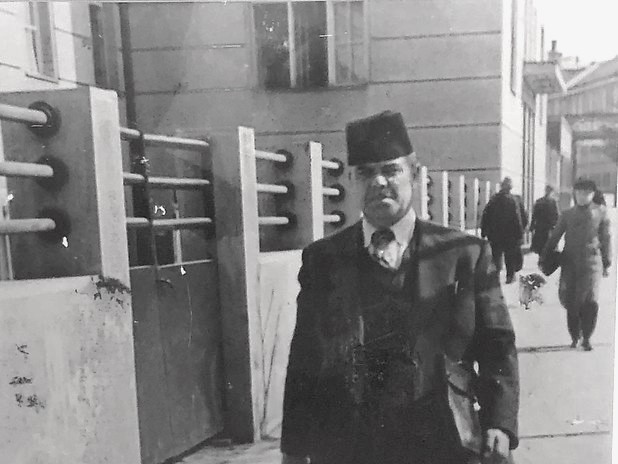
He has influence throughout Kosovo and leads several Muslim religious associations. From 1941 to 1944, Ulqini was a deputy in the Albanian parliament, while during the time of the German occupation he served as a member of the Royal Council. After the departure of the German army, Cafo beg Ulqini was pursued by the communists and left for Montenegro in 1944, where he was sheltered by loyal supporters, until Tito’s break with the Soviet countries. He is considered a loyal Albanian and consequently is an antagonist to Gani Bej Kryeziu. There are no signals indicating that the committees led by Sokoli and Ulqini have connections to the Independent National Bloc.
Organization of the Post, Telegraph-Telephone
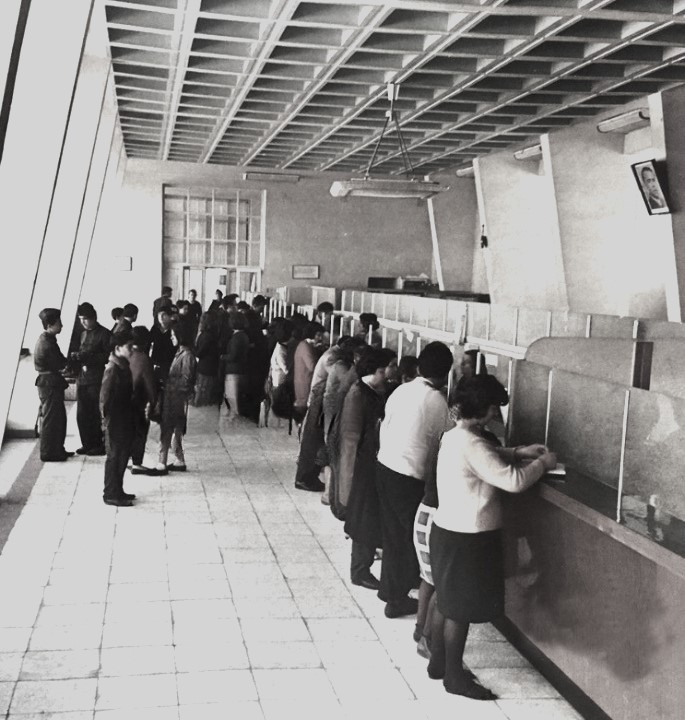
Every regional center in Albania has its own PTT post office, which depends on the central PTT office in Tirana. In Tirana there are three postal points for each of its administrative zones, which usually consist of the section for ordinary letters, registered letters, foreign letters, the section for parcels and cash-on-delivery payments. The offices also have telegraph and telephone booth sections. The internal distribution of written mail is done by postmen, who wear gray uniforms of a military style.
The postman carries the letters in a shoulder bag and sometimes uses a Soviet bicycle. In small localities, mail is also distributed by the area’s policemen. In Tirana and other large centers, mail is distributed every day, while in localities once a week. Since there is only one railway, mail is also sent by train from Tirana to Durrës, Elbasan. Sometimes postmen also use horses, as happens in villages where paved roads are lacking. Delays in mail deliveries are caused by wrong addresses and weather conditions.
For example, a letter from Tirana to Kukës should normally take six to seven days, while a letter from Tirana to the village of Letaj in Kukës, during the winter snow season, may take three months. In the capital and main cities there are mailboxes where citizens drop the letters they have to send, from which the mail is collected every 24 hours. Postage stamps for letters are sold at post offices and cost 2.50 lekë. There are also services for sending parcels and postal orders for money transfers. For sending letters, no many formalities are required except the name of the sender and recipient on the envelope.
But for mail abroad, a letter or parcel must be delivered directly to the postal employee, but the sender does not need to identify himself. According to our information, it is not believed that there is special censorship for correspondence, since the people are clear that anything suspicious can compromise them and bring them trouble with the authorities. The State Security can check suspicious letters and can censor them by not sending them to the address. Telegrams sent within Albania are passed to the addressee within 24 hours, while telegrams considered important are sent without delay at any hour of the day or night.
March 1949
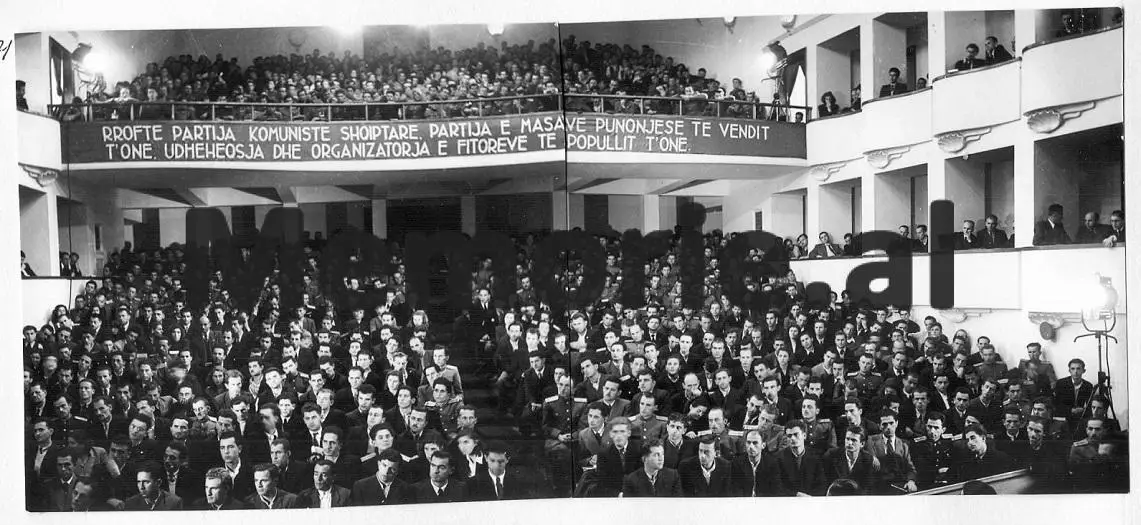
Tuk Jakova’s Speech at the Congress
At the First Congress of the Communist Party held in Tirana in November 1949, the director of organizing and recruitment activities, Tuk Jakova, spoke about the Political Bureau. Part of his speech was a sincere assessment of the progress of the party’s work in Albania: “During the National Liberation War, some branches were distinguished in our party, but after liberation the party opened its doors to expand membership. But this policy allowed into the party not only convinced and loyal persons, but also careerist and unhealthy elements such as former members of the National Front or collaborators, who have masked themselves by infiltrating among the ranks of the liberation army.
As we said above, in November 1944 our party had 2,800 members, plus a large number of sympathizers. From November 1944 to November 1945, the party recruited another 7,758 members. During 1946, 2,031 members were recruited and 3,760 candidates. While in 1947 about 9,000 other members. These figures clearly show how after liberation the doors of the party were completely opened. During the years 1947 and 1948, the total number of members declined, but despite the achievement of numerical objectives, it must be emphasized that the number of women recruited is small, slightly more than 900.
The lack of clear policies, of a party constitution, as well as the lack of control over subordinate organizations, has made recruitment not reach the required standards. The emphasis has been placed more on the quantity than on the quality of recruitments, therefore in some cases recruitment has been deficient. In the district of Tirana during this period, about 20 percent of those recruited turned out to be religious fanatics and superstitious who fasted during Ramadan. Fanatical elements have also been present in the district committees, such as for example in Shkodra, Shijak and Himara, where persons with ideas diametrically opposed to those of the party and consequently with a line close to reactionary forces have been accepted into the party.
There have also been cases of membership by obligation or without the knowledge of the persons, as well as of persons who have not regularly participated in party meetings, before or after membership. But the increase in the number of members during the recent years has nevertheless helped in the growth of the authority of the party organizations, both in the central areas of work and production and in the regions. From the end of 1945, we had local organizations in all the southern communes of Gjirokastra and Korça, while in central and northern Albania, the party was still weak.
In 1945, five local party centers were created in the production region of Kuçova, as well as one each in the factories of Elbasan, Korça, Shkodra. As a result of the recruitments of these years, the improvement in the social composition of the party is distinguishable. About 22 percent of the members are workers, 54 percent are poor peasants, while the rest consists of students, artisans, etc. Today the party has 29,137 members and 16,254 candidates for membership, which in total are 45,382 persons that is about 4 percent of the entire population of Albania.”
August 1951
Concentration Camps, “Flamuri” Newspaper, Rome
During the spring of 1948, there were about 1,200 prisoners in the internment camp in Vloçisht of Korça. Often the place is called the “Camp of Death.” Almost all the prisoners are there for political reasons and must work in inhuman conditions in the opening of the canal of Lake Dunaçev. A large number of prisoners have died, including Father Josif Pipa Mihali, the head of the Catholic Church of Korça; the lawyer Baba Qazimi, Colonel Sulejman Vuçiterni and many intellectuals or merchants interned.
A former prisoner of the Vloçisht camp says that in 1948 more than 130 people died there. He says: “The camp commander was Tasi Marko, who was such a master of brutality that he was later promoted and transferred to the camp of Pojan. Later he became a police lieutenant.” There are also forced labor camps in Beden of Kavaja, in Kamëz of Tirana and in Tepelena.
“Atdheu” Newspaper, Rome, “Slave Labor in the Maliq Swamp”
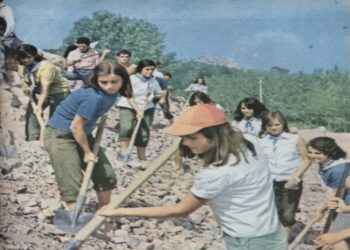
The work for the reclamation of the lands of the Maliq swamp began in 1946 and has continued since then. The workforce consists of a small number of employees who are paid 70 lekë a day, some volunteer workers and a large number of slaves who are political prisoners, mainly relatives of people who have fled the country. For the work project in Maliq, work camps with internees have been set up in Maliq (1946-1947), Vloçisht (1948), Rembec (1948-1949), and the camp of Pojan in 1950.
February 1953
“Flamuri i Lirisë” Newspaper
The concentration camp of Kamza in the northeast of Tirana has been moved to the district of Elbasan, near the cooperative of Cërrik. About 500 prisoners of this camp, as well as in the Kamza farm, are kept in the camp without minimum living conditions such as food and clothing. The camp is located in the middle of a field and consists of two wooden barracks without protection from the cold and rain. Water enters through the roofs of the shacks, which are made of old and rotten wood. At least 80 percent of the prisoners are affected by tuberculosis and pneumonia. Mortality is highest among children.
The food is very bad. Workers receive about 600-700 grams of bread a day, mixed with various grains such as rye, barley, etc. The prisoners’ workday is exhausting and they are forced to work even on Sundays to fulfill the norms. Daily norms are calculated to be fulfilled in 8 hours, but prisoners often have to work up to 14 hours to fulfill their obligations. Women must work the same as men, while harsh punishments are given for not fulfilling the norms. Sometimes women are given the “easier” task, that of collecting firewood.
But this is just as difficult since they must travel 3-4 kilometers away and return with the wood on their backs. If someone refuses the task, the camp leaders punish them with solitary confinement and deprivation of food and water for 12, 36, or 42 hours. A part of the collected wood is used by the camp prisoners, but most of it goes to the officers’ and police rooms. The camp director is Lieutenant Zeman Saliaj from Gjirokastra, who is followed by Lieutenant Ahmeti from Tepelena, who works in the information office, Marko Hoçishti and the illiterate sergeant, Dule Hyseni.
On August 30, 1952, the following persons escaped from this camp toward Yugoslavia, who gave the descriptive details about the camp: 20-year-old Halit Mulla Qamili, from Cangonja of Korça; Sami Licolli, 32 years old, from Kuçi i Zi, Korça; Azem Berdo Laze, 19 years old, from Dukati of Vlora; and Harry Beneli from West Germany, a prisoner of war, interned since 1944 in the Kamza camp./ Memorie.al
Continued in the next issue