


By Luan Rama
– The anger of the poet Xhevahir Spahiu over the dismissal from work of the great composer and the story of his return to work –
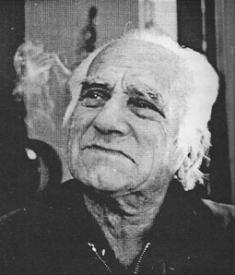
Memorie.al/ Among the many stories and memories of life, some of them do not need much effort to be brought back to mind. A single word, a photograph, a song, or even a few lines read by chance is enough, and one feels the need to tell and share them with others, especially when they are connected to great names of history, art and culture. The director Mevlan Shanaj is a noble example, especially when it comes to writing about fellow artists. He does it with a passion that deserves admiration. Indeed, he has even written a book dedicated to many of the artists he has known or with whom work has connected him. And with what kindness he has written that book! It is titled “Secrets Off Screen.” One of the characters selected by the director Mevlan Shanaj for this book is also the composer Kujtim Laro.
The account about him is full of sensitivity and respect. These days I reread a fragment from the part dedicated to the composer, which the director himself had reposted on his Facebook page, and immediately a story of mine with the artist, the musician, the man, the rare friend came back to my mind. A story that, in fact, set out from the poet Xhevahir Spahiu. In honor of the composer who has left us his soul poured into his own mesmerizing and immortal music, but also in respect of the poet Xhevahir Spahiu and the director Mevlan Shanaj, I am publishing this story, as I think it no longer belongs only to me.
I had not been long in the position of Minister of Defense. They were busy days. The responsibilities of a high state duty did not leave much space to deal with other things. First in order were the preparations for the meeting of the Council of Ambassadors in NATO, a forum in which I would participate a few days later, together with the Minister of Foreign Affairs, Arta Dade, who, as head of the delegation, had managed to include in the work calendar also the meeting with Lord Robertson, Secretary General of NATO. There we would inform about the achievements of the Albanian government in the framework of the process of NATO membership. It was June of the year 2002. Albania of that time had NATO membership as one of its major priorities.
It was a process that required not only political and diplomatic commitment, but also deep reforms in all structures of the state, especially in the Armed Forces. From Brussels, our ambassador to NATO, Ilir Boçka, had sent us the questions of the ambassadors. A whole book of questions. Each of them required reasoned answers, down to the most peripheral details. Therefore I was entirely focused, as the meeting was of great importance. Seriousness and special attention were required. Precisely on one of those days, while I was in a meeting with the working group, with which I would go to Brussels the next day or a day later, Flutura, the minister’s secretary, whom I found appointed to that duty by the preceding ministers and whom all those who followed me also kept, an exemplary and correct lady, with an imposing dedication, notified me that the poet Xhevahir Spahiu had come and was asking to meet me no matter what.
– “I am not leaving here without meeting the minister, even if there is uproar”! – the poet had replied to the secretary’s effort to convince him that I was busy in an important meeting. Xhevo, as the close ones call the poet of loves and great storms, could not be prevented by any agenda. Not even that of the preparations for NATO. I had to interrupt the meeting, asking forgiveness of those present. – “Let him come,” – I tell Flutura. – “For poets like Xhevo the doors are always open.” I had known him since I was a student. His poetry had been the topic of my diploma defense. Therefore, without waiting for him to enter the office, I get up and go toward the door to wait for him, as Xhevahir Spahiu deserved. But he did not leave me even that possibility. He entered in all haste, like a storm that gives no warning.
I understood immediately that something great had disturbed him. He was truly angry and had no intention of hiding his anger. This could be read on his face, in his wavy hair and in his eyes filled with rumbles. – “Hey, are you in your right mind or not”?! – he burst out, without even waiting to sit down. – “How come, you have dismissed Kujtim Laro from work?! Do you know who Kujtim Laro is? What is a minister, or what are all the ministers together with the prime minister, before an artist like Kujtim Laro”?!
– “Come, Xhevo, come sit down and let us talk calmly. Let us also drink a coffee, as it is a problem that will be solved,” – I tell him, to calm him down and to give him the opportunity to explain himself to me more clearly.
I, of course, knew what the name of Kujtim Laro represented for our music and culture. His music had made him not only very well known, but also very dear to me. I knew a lot about him. I knew almost all his songs. I also knew which films he had given extraordinary artistic dimensions with his magical music. To bring to mind only a few of the more than thirty-odd films, I mention: “Poppies on the Walls,” “The Alleys That Sought the Sun,” “At the Beginning of Summer,” “The Path of Letters,” “Freedom or Death,” “The Second November,” “The Stars of the Long Nights,” “The Bride and the Curfew,” and others.
In a certain way, his creativity had become part of my memory, as it had become part of the memory of many Albanians. So, I knew him through his work, but I had never met him closely. I also knew that for many years he had been the artistic leader of the Army Ensemble, the highest artistic authority of that professional troupe, which had given extraordinary contributions to the artistic and concert life of the country. But I did not know that they had dismissed him from work. Therefore, under the weight of Xhevo’s storm, I call the Chief of the General Staff, General Pëllumb Qazimi. The general, besides being an extraordinary colleague and collaborator, was also a military man with much authority, which made everyone love and respect him.
I wanted to learn from him what had happened and how the problem that had brought Xhevahir Spahiu to my office, with all that anger, really stood. The general did not delay in coming. – “Come, general, come! Come and dispel Xhevo’s anger, as I alone cannot manage it! There must be a general from Skrapar to tame this anger of a Skrapar man, poured into my office like lightning from the mountain of Tomor.” While I was thinking that, by addressing the general also as a Skrapar man, I would have it easier to create more closeness between them, I noticed that in Xhevo’s expression, nothing had changed! The mountain of anger was still there, in front.
– “In fact, Mr. Minister, the dismissal from work of Kujtim Laro has been a mistake,” – General Pëllumb Qazimi began the explanation.
– “Due to the fulfillment of the obligations that stem from the entire process of NATO membership, we are forced to reform and restructure all the Armed Forces. This process includes also the military schools, the Academy, the Military Hospital, the Artistic Ensemble of the Army and the ‘Partizani’ Club, which are also part of the structure of the Armed Forces. In this context,” – the general continued, – “the Army Ensemble has also been dissolved,” – clarifying to me that the composer had been dismissed from work a short time before I was appointed minister.
– “But why, general, did you find Kujtim Laro to make a sacrifice of the reform”?! – Xhevo flashed. – “It is not the general’s responsibility, dear Xhevo,” – I intervened. – “But do not worry, it is a problem that we will solve.” Then, addressing the general, I told him that we had to find every possibility to correct the mistake made. After Gaqo Avrazi, one of the first founding artists of the Ensemble, the name of Kujtim Laro was synonymous with that troupe itself. I do not at all want to undervalue the names and work of others. In that Ensemble have served and given extraordinary contributions artists, conductors, creators and performers among the most distinguished of the country. Each has left his own mark. Therefore, the honor for Kujtim Laro was, at the same time, also honor for the Ensemble itself, for its history, tradition and artistic identity.
– “Xhevo, the general will solve the problem for which you have come and Kujtim Laro will return to work.” Even though it seemed to me that the waves of the poet’s anger were receding, the clouds were still over him. The surge had not completely gone away. – “Good, but I have another problem,” – Xhevo continued, this time with a somewhat calmer tone. – “Fire the second cannon too, let us hear it,” – I told him, with my eyes fixed on the poet’s wavy forehead. Because what he has in his soul, you can read on Xhevo’s forehead. The forehead is the screen of his soul. The altogether expressive grimaces are poetry of another kind, where the same soul that is in his poems is found.
– “You must give Pano Taçi the veteran’s certificate of the War, because they have unjustly refused it to him. He has been among the first debatikas of the War”! Pano, the poet of erotic lyricism, I also had as a friend. I have some of his books with dedications. Indeed, not with just any dedications, but with verses that flowed from his Essenian soul, as rebel as it was sensitive. To the account of Pano and the story of his veteran’s booklet, I will return another time. What I want to underline here is the sensitivity and dedication of Xhevahir Spahiu toward people of art. Another beautiful side of his character. And only after he was convinced that his concerns would be solved, Xhevo opened the way for us, together with General Qazimi, to talk also about Malindi, about his Skrapar and my Martanesh.
There we also recalled a conversation of mine with Et’hem Bakiasi, whom I had met in the first days, when I had just started work at “Zëri i Popullit.” He had asked me: – “Are you also from Skrapar”? – “No,” I told him. – “Well, you must be from Vlora”?… – “No, no, I am from Martanesh,” I answered. After he was silent for a moment, as much as it seemed to me that my answer found him unprepared, because perhaps he expected that I too would be either from Skrapar or from Vlora, good Ethemi continued: – “Well then, we have the mountains the same, we have the teqes the same and we have made the war the same.” In the conversation, Xhevo did not waste time. He called Kujtim Laro on the phone, to tell him that he had solved the problem and that he would return to work. You should have seen what light spread over his face from the joy that he was giving his friend good news! It was the pure joy of the man who had not come to seek something for himself, but to protect a friend and an artist whom he deeply esteemed.
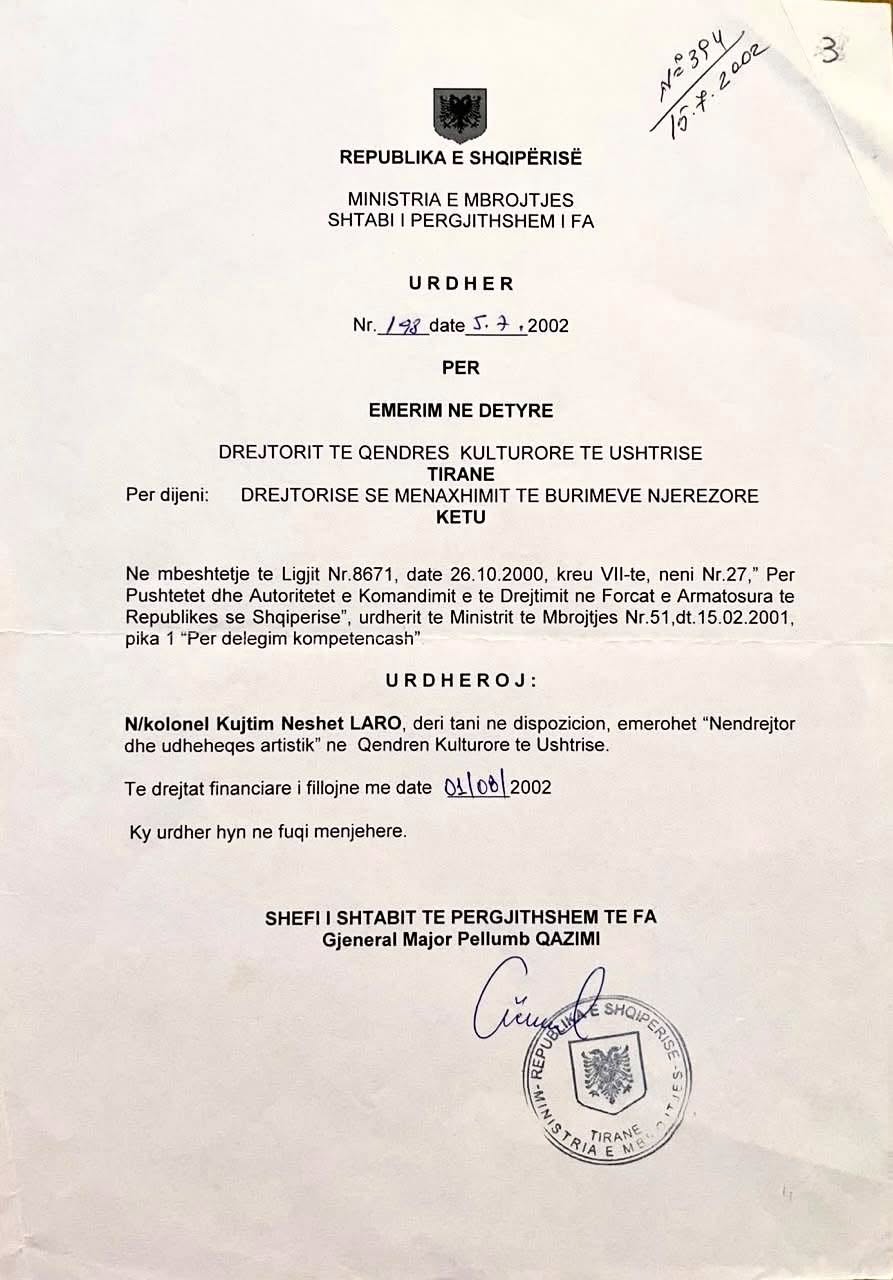
He blossomed and lit up entirely. – Now yes, – he said, – I can drink my coffee with you in peace and, if you have, also a glass of Skrapar raki. Thus the composer Kujtim Laro returned to work. As a memory of that moment, I keep in my files also the order signed by the Chief of the General Staff of the Armed Forces, Major General Pëllumb Qazimi, for the appointment to work of Lieutenant Colonel Kujtim Laro. With his return to work, not only Xhevo rejoiced. Not only Kujtim and his family rejoiced. Many others also rejoiced artists and military men. Their joy had much less to do with the workplace and the modest salary that Kujtim received, than with his dignity as an artist and with the correction of an injustice that had been done to him, through a hasty administrative action. It was a matter of dignity, respect and appreciation for everything he represented.
While I also gained a friend. And what a friend! An artist with the name of Kujtim Laro, who would not want to have him as a friend? A few days after he had started work, I called him and invited him for a coffee. To be freer with each other, I decided not to wait for him in the minister’s office, but to meet in one of the many cafes of Tirana. I felt honored that he had accepted to come and meet me and drink coffee with me.
– “You have no reason to thank me,” – I told him, without letting him utter even a single word of thanks. – “On the contrary, I should thank you for accepting to return. Your name and work honor us all. A mistake had been made with you and it is very good that, thanks to Xhevo’s ‘intervention,’ we managed to correct it. – Therefore, thank Xhevahiri,” – I told him laughing.
We talked for a long time. Naturally, the conversation focused more on music. I insisted on learning as many details as possible about his creative process, about the way his compositions were born and came to life, about the music so beautiful of many of our films, but also about the songs written on the poems of Xhevahir Spahiu, in particular. Kujtim Laro was not one of those who spoke about himself. Indeed, whenever I tried to direct the conversation toward his creativity and values, he shifted it with insistence to the government’s responsibilities for drafting a well-defined strategy of cultural policies. He insisted that much more should be done for the preservation of cultural tradition as a whole and of the musical one in particular.
He was worried about the future of music, which he saw perhaps as the most threatened by the all kinds of penetration of foreign models. I had before me a great composer, who, instead of speaking about his own works, about fame or about the appreciation he deserved, was worried about the fate of Albanian music. I felt that his worry sprang from his soul. In every word he said, I touched the great truths of a man who had given to the people and the country his sensitivity and inspiration, poured into songs and symphonies, into film music and choreographic tableaus. Measured, but convincing in his insistence, while he spoke, it seemed to me as if he was singing with a full voice, where the timbre of a Lab man stood out, who had taken Vlora with him in his entire being.
We spoke for a long time. Naturally, I was not sated listening to him, absorbed among words that seemed to me to blend with his melodies. He also spoke to me about the importance that culture had for the Armed Forces. – “We will be members of NATO,” – he told me. – “But also the armies of the NATO countries have their musical troops, they have symphony orchestras, famous ensembles and choirs. – A modern army is not built only with defense capacities, equipment and technology, but also with culture, tradition and spiritual formation,” – he emphasized with the conviction of the man who felt that the right was on his side. While we talked, I felt that before me I had not only a great composer, but a man who had crossed the border of his own creativity. Kujtim Laro saw culture not simply as an ornament of life, but as an essential part of it.
For him, a modern army had to have not only the force of arms, but also the force of culture. As I listened to him speak so calmly and full of soul, I understood that the greatness of an artist lies not only in what he creates, but also in the worry he feels for what comes after him, for the values that must be preserved and for what we must not lose. A minister can return to an artist his workplace, but only a great artist can remind a minister what value power has and where it must stop. Power has the right and the duty to reform, to change and to modernize. But it must also know what it must not touch. Because institutions change, people come and go, while the work of a true artist continues to live. As the music of Kujtim Laro continues to live among us. / Memorie.al