

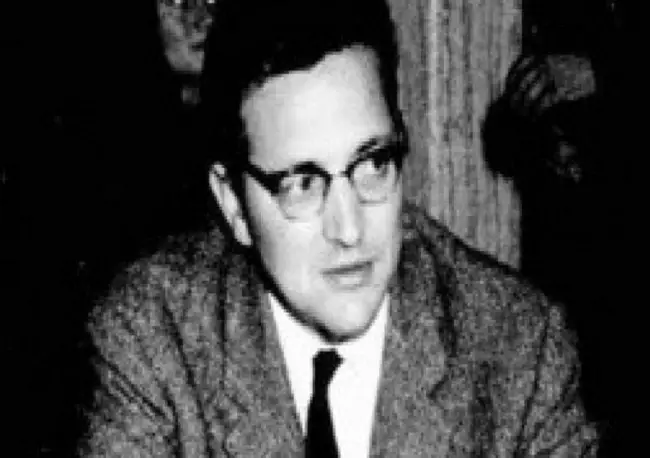
By Ismail Kadare
Memorie.al / The first sensation a reader experiences upon entering the literary world of Martin Camaj is that of altitude. Without excluding the euphemistic function of the expression – the one that pertains to all great writers of a literature – in Camaj’s case the expression takes on a literal meaning. In most of his works, in the settings described, in their climate, in the characters, the air – even the healthy or hazy intoxications that come from it – are those of the Alps. According to Ernest Koliqi, an admirer and at the same time mentor of the writer, this geographical luxury is linked to the writer’s origins. The heights of the highlands – more precisely Dukagjin, where he was born – had finally found, in their son, their own means of expression.
This is a noble thought, of the kind that is as easily understood as it is in need of completion. It is true that the landscapes and climate in Camaj’s work often recall those of northern countries – even extreme ones, like Iceland – but they approach, curiously, the climate of Greek theater, through the same invisible thread that, as the Frenchman Jean-Pierre Faye has noted, linked pre-Classical Albanian culture with antiquity.
The inner journeys of artistic sensibility often remain undiscovered by us. But this does not prevent them from intersecting on another map, just as happens with the Icelandic sagas, the old Balkan customs, and ancient art.
There is likelihood that, more than in these, the deep cause of this isolation is to be found in the writer’s solitude. Martin Camaj was, without doubt, the most solitary Albanian writer of the second half of the twentieth century.
By sheltering his events and characters at an altitude that ensured their independence, he perhaps thought he would protect his art from the influence of the Albanian chaos – the very chaos he believed he had said farewell to. Having left his homeland too young, a homeland that was becoming more foreign to him by the day because of communism, he thought he had somehow found what he had lost in Kosovo, but this could only have been an illusion.
He changed territory again, even leaving the dramatic Balkan Peninsula for another peninsula, less dramatic – that of the Apennines – until he departed from there as well. Had he been a musician or a painter, the detachment might have been easier, but his art was bound to the Albanian language – that heavy, verse-bound language – which he neither could nor perhaps wanted to change. In the lands of the Arbëreshë, where, like Koliqi, he often went, he truly found a glimmer of the Albanian world, but there was likelihood that, though undisturbed by doctrine, that pale glimmer was, more than a substitute, simply sadness.
He understood that since the poet Zef Skiroi, though born in these lands, had nevertheless called them “a foreign land,” they would be all the more so for him. Another Zef – the one from Serembe – a century or so earlier, had explained the secret:
“Arbëria beyond the sea reminds us / That we are strangers in this land.”
It was always her – Albania – that in different epochs radiated the same disturbance. Settled finally in Lenggries, Bavaria, at the foot of the Germanic Alps that reminded him of the highlands of Dukagjin, he felt that they, in the end, were nothing but scenery. He felt definitively that, like the ancient Philoctetes with his incurable wound, he too would never overcome the absence of his homeland.
And then, seeing that he could not escape it any longer, he did what he surely thought would never happen: he listened to news coming from there – precisely from the chaos he had so insistently fled. He listened to what was happening to that people, with its noises, with its bells falling silent, with the men who had bowed their heads, with the graceful women, and finally with the Albanian language and its writers and their mournful fate.
A circle – one of those that seem to be formed by higher harmonies – was finally closing, to clarify the writer’s complicated relationship with freedom and with his own country. Freedom and Albania were separated. Together they still seemed impossible.
Martin Camaj, as rarely happens to writers, endeavored to overcome precisely the impossible. It was this epilogue that, in testamentary form, was expressed in his words, addressed to all Albanians – and naturally to his colleagues – shortly before he bade farewell to this world: “Though we have been separated for half a century, I am yours and you are mine.” Albanian literature has been compared several times to a strict and cold edifice – half castle, half monastery.
Its beginnings as monastic literature have perhaps encouraged such a perception. Small, tragically shrunk – for reasons and circumstances that are known – with a long, centuries-old prohibition, with a bilingual period, Latin and Albanian, with an unwanted alphabet, even demonized in official ceremonies by neighbors, it arrived in the twentieth century where, contrary to hope, a new season awaited it: censorship and self-censorship, for which no one was to blame but Albania itself.
Though such – narrow, always insufficient, spartan and without external grandeur, like all spiritual values created through hardship – it nevertheless radiated a heavy shadow. Meanwhile, by a great paradox, instead of being hospitable to the writers who would fill its gaps, it did the opposite. Its gates remained more closed than open. From them great characters had been forcibly expelled, whose departure made its halls and chambers seem even emptier.
Before these gates, one day, stood Martin Camaj. He had not been expelled beyond the walls, like Fishta, Konica, Koliqi, but this did not make his problem any less complicated. He had simply been a subject of that country called Albania, but never inside the literary tower. There is a likelihood that for a long time, in his subconscious, the unattainable was simmering: to one day be part of that tribe, or that imaginary order.
Inside the tower, besides the great shadows, there were living writers, similar to them but unwanted, like Lasgush Poradeci or Mitrush Kuteli.
Just as they were incomprehensible to the epoch in which they found themselves, so would they be afterward, when the epoch changed. Scholars would find it easier to assert that, since no literature could be created in such a cruel epoch, they had abandoned literary creation. Meanwhile, precisely in that difficult time, some of the most precious pearls of all epochs had been created – like Poradeci’s poems “Gremina” and “Flaka,” or Kuteli’s “E madhe është gjëma e mëkatit,” and perhaps other values that would be discovered later.
Numerous questions would arise: what would happen to these pearls? Would they be denied, because they annoyed clichés and narrow minds, or would they deceptively pass into another time? Even more difficult would be the questions about the generation of writers who had been born or raised in the so-called wrong epoch. Because of it, and after its fall, would they also be called wrong and fall together with the epoch, or would their fate be decided by other laws and by another verdict?
Martin Camaj never allowed himself, taking advantage of the freedom that exile gave him, to write against his compatriots in Albania. It was true that at the time he remembered them and worried about them, they never remembered him, but this never drove him to bear a grudge for their neglect or long forgetfulness. He was sensitive to their condition, to the false optimism and the carefully hidden anxiety, amid the equally false celebration.
In solitude, rarely understood by people, Camaj continued his work, endeavoring to preserve its alpine luminosity, whether in his poetry or in his prose. It was his unchanging pact with art, with the heights of the highlands from which he had come, and where one day he hoped to return. “I don’t want to be like bad weather,” he announced in one of his poems, thus proclaiming noble clarity over political passions, and especially over grudges, without which it was difficult to achieve the Albanian world.
“Poetry is seen as a formula for the triumph of the tragic,” wrote the German scholar E. Glaser about his poetic work. He himself would clarify: “From literature I have had everything, even the will to live.” From the first collection “Një fyell në male” of 1953, in Prishtina, to “Palimpsesti,” published in 1991 in Munich and New York, shortly before his death, stretch forty years of uninterrupted poetic creativity.
To his poetry – though of a direction that wrongly seemed foreign in Albanian letters, European modernism, mainly hermeticism – despite scholastic prejudices, the Albanian costume fits naturally. Great art is at once of its time and of all time. De Rada’s “Këngët e Milosaos,” which a few years later will reach two centuries of life, sounds as fresh and modern to us today as in the years it was written. In art, nothing noble is excluded, and even less exclusionary.
Such are Camaj’s poems, the short novel “Djella,” with its poetic accompaniment that, like a mirror, opened the way for the lines of prose, the other works, such as “Dranja” and “Karpa,” where in the first he endeavored to probe fatality or curse – in other words, to grasp the ungraspable and express the inexpressible, a temptation not rare among writers. Meanwhile, in the second, he tries to go even further, enticed by a playful sorceress – the Albanian language – from the use of which, as he himself says: “I have often felt myself a virtuoso, that is, I am capable of saying everything I want in Albanian!”
And so come the other works, such as the novel “Rrathët,” the two short dramas, to arrive at the long novellas “Pishtarët e natës” and “Rrungajat në mars” – those “blessed pages” in Albanian letters, to use Koliqi’s expression, which perhaps constitute the highest peak of his art.
In October 1981, one of the gloomiest seasons of the Albanian tyranny, circumstances brought me to meet Martin Camaj. I was invited to the Frankfurt International Book Fair, when, at the end of a press conference during which I had answered the not-easy questions of journalists, a tall and handsome man approached me who, with a certain hesitation, spoke to me in Albanian: my name is Martin Camaj, may I speak with you?
I had heard his name, and had even read something by him in Koliqi’s magazine “Shejzat,” which was published in Rome and was found with difficulty in Tirana. I told him, of course, that we could talk, and he added that he had come especially from Munich to hear me. An Albanian friend of his who accompanied him described years later in the diaspora press those few minutes of the meeting – mainly his hesitation and worry that, by speaking to me, he might harm me.
We were there, in that noisy hall, writers of the same country and the same language, but as distant as two beings – more precisely, two phantoms from different planets. We were two Philoctetes, always with the same known incurable wound – one who had the homeland but not freedom, the other with freedom but without a homeland.
We spoke of something, at first glance ordinary, but which surely had nothing to do with what we should have been talking about. About ten years later, Werner Daum – an intellectual and distinguished German diplomat, a mutual friend of mine and his, a first-rate figure in the dramatic events of Tirana 1990 – met me in Paris to bring me, among other things, greetings from Martin Camaj.
Through the diplomat’s mediation, a measured exchange of messages was established between us, and even a meeting was arranged in Munich, where I would travel two months later, in March 1992, to an international forum of writers. This meeting never took place, because of his untimely passing, precisely in March of that year. All that remained for me was, with the help of my companion, the journalist of “Frankfurter Rundschau,” Verena Nolte, who knew and appreciated him, to seek the cemetery where he rested, to place a bouquet of flowers upon him.
Through Werner Daum, I had managed to convey some thoughts about his work. But they were too few compared to what should have been said. Some of them have been expressed in this introduction to the edition of his complete works, eighteen years later, and they are always too few. The others have their time ahead, when the writer’s work will have its full access to the reader, there where another life of literary art begins – the one that renews itself continually, into infinity.
Epochs and peoples usually do not make mistakes in evaluating great art. Even when mistakes occur, they are only temporary. The hour always comes when the latecomers arrive and the missing appear. Thus Anton Pashku of Kosovo and the silent Zef Zorba, and perhaps others, will take their places – those who, by chance or circumstance, have been hindered somewhere.
Tyrannies, along with their nervousness and passing storms, have tried to create false and wrong gates. In the measured edifice of Albanian letters, where Martin Camaj is taking his place, as in every pantheon, one enters only through one gate – the great one. And that gate, as its name shows, recognizes only great reasons.
As was once said, the unforgettable De Rada, in a description of Easter night, recounted “the angels who hold only their own feast.” At the elevated table where the dignitaries of literature have taken their places, small noises do not climb up, nor do ordinary profiles approach. There is always understanding and harmony, and so the celebration continues forever and the illumination of the candelabras never ends. / Memorie.al
April 2010
(Taken from the First Volume of Martin Camaj’s works, “Onufri,” Tirana, 2010). Original title: “Martin Camaj, Writer of Heights”