

By EUGEN SHEHU*
Memorie.al / It was the first days of November 1912, when the Albanian patriots of the regions of Kosovo and Albanian Macedonia, convinced that they must cast off once and for all the black Ottoman night and the Serbo-Slavic occupiers, bound themselves tightly together with rifle and pen, for the achievement of the historic Assembly of Vlora. In this assembly, among others, as representative of Albanian Macedonia, Mehmet Pashë Deralla was elected unanimously, the great patriot from Gradec of Tetova, who left honor and rank in Istanbul, to serve his own homeland, precisely in these culminating moments, while the distinguished man of Tetova was taking the road to Vlora, they notify him that his wife, Nadirja, had given birth to their third son. Several weeks would pass, Mehmet Pashë Deralla would be elected Minister of War in the first Albanian government, would undertake the first fights against the Serbo-Slavs and Bulgarians and Greeks, when he would caress his own son, Hysen.
The first years of school, Hysen Deralla would spend in Tetova. He would distinguish himself not only for his zeal in lessons, but especially also for writing in the Albanian language. It is worth not forgetting the fact that immediately after the dismemberment of the Albanian lands, in the months of 1913, upon the ethnic Albanians, who remained outside the borders of the mother state, an unparalleled physical and state violence was imposed. In the schools of Tetova, in those years Serbian and Bulgarian, Turkish was taught… but only Albanian was forbidden.
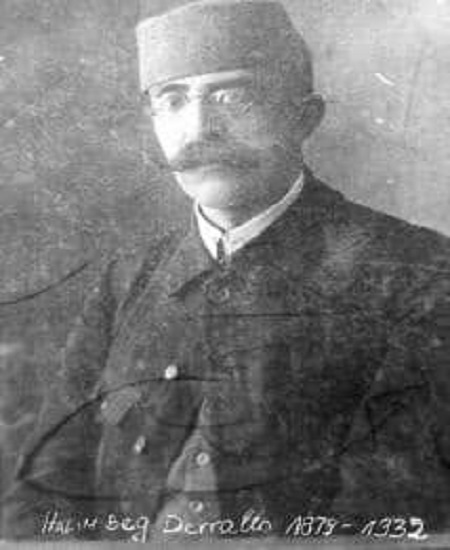
But the distinguished door of the Derallas, especially Mehmet Pasha, had taken care that his children secretly learn the language of the mother, this door also in the years that would come, would turn into a warm nest of Albanianism. While little Hyseni continued his lessons in Tetova in 1919-1924, his elder brother Halimi, would distinguish himself among the regions of Albanian Macedonia. In 1921 in the first Albanian Parliament, Halimi is sent as representative of Albanian Macedonia, since it was known that this parliament is represented by all Albanian ethnic lands.
In this way, since Halimi spent most of the time in Tirana, in 1926, he takes from Tetova his little brother, Hysenin, and places him in the “Naim Frashëri” dormitory in the Albanian capital. Even in the gymnasium of Tirana, Hyseni would distinguish himself for his zeal in studies, but also for that patriotic spirit that he brought from Tetova enslaved by the Serbo-Slavs. His friends of those years remember that on every occasion that Hyseni the gymnasium student saw in Tirana the red and black flag, he would run to kiss it tearfully. Then with the completion of secondary school, Hyseni tried to continue further his higher studies.
But, an order of the Serbo-Croatian-Slovene Kingdom called him to the army and for two consecutive years, 1931-1933, Hyseni performed his military service in Sarajevo. Although enlisted in the formations of the Kingdom of Yugoslavia, Hysen Deralla would distinguish himself for his patriotic feelings. Although he spoke several languages, although he could enter a military career in Sarajevo, the son of the Derallas preferred that after completing his military service, to go again to his birthplace. Tetova was for him not only parental love with memories, but especially the wound that was bleeding and that had to be stopped. Meanwhile in Tetova, the Deralla family had been put in the target of the Serbo-Slavic police power. The patriotic activity of Halim had worried Belgrade and Sofia.
Feeling that all these troubles could fall upon the little brother, Hysenin, the elder brothers advised him to go to Tirana. The truth is that, in the ’30s, the mother state received thousands of Albanian patriots in Kosovo, Macedonia, Chameria, and Montenegro, who were persecuted by the respective governments, for their declared Albanianism. In 1940, Hyseni was appointed as foreman on the Tirana-Durrës road, extremely correct in the implementation of duties, he would be at the same time strict with the Italian entrepreneurs, who sought by all means to exploit the poor Albanian workers.
In the spring of 1942, at the time when Mustafa Kruja was leading with an iron fist the Albanian gendarmerie, Hysen Deralla is called to work precisely in these formations. Tall, silent, with an eagle’s gaze, Hysen Deralla would enjoy very quickly the sympathy of his superiors and comrades. But this period lasted only five months. When Mustafa Kruja was undertaking punitive operations against the communists, even without sparing blood, Hyseni left telling his friends: “I know what communism is and I fear for the fate of my people. But Albanian blood I do not want to shed ever, because the Serbo-Slavs have shed enough of it for us”.
At the beginning of 1943 he goes to Tetova. The truth is that the German occupation of Yugoslavia, in April 1941, had liberated the ethnic Albanians in Kosovo and Macedonia from the hated Serbo-Slavic yoke and furthermore, the Albanian government of that time had established its power in those regions. The red and black flag waved in all the regions of Albanian Macedonia and Albanian schools were opening day by day. Hysen Deralla comes into contact, in Tetova, with honest nationalists of Albanian Macedonia.
Together with Gajur and Halim, foreseeing in these brave men the great idea of liberation from the occupiers, as well as the unification of the Albanian ethnic lands, Hasan Dosti is received as a house guest, during his visit to Albanian Macedonia, by the Deralla brothers. In fact another culminating event, such as the Second Albanian League of Prizren, would resonate all the way to Skopje, Kumanovo, Tetova, Gostivar and Struga. In the middle of 1943, the raising of Albanian nationalist çetas began, which had as their first goal the preservation of tranquility and then the war against the occupier.
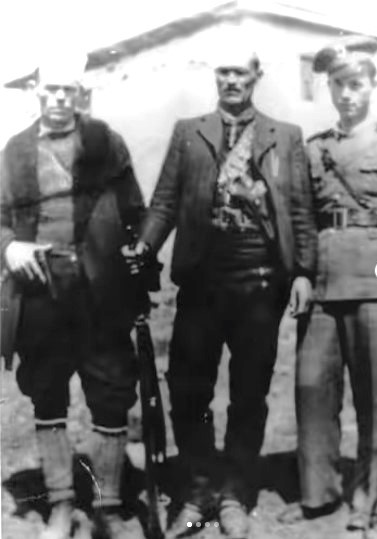
In these moments, together with the çetas of Xhem Gostivari, Bajram Dobërdolli, Musa Kranja, Hamz Rexhepi, Aqif Reçani, Murat Llabunishta, etc., the çeta of Hysen Deralla also grew day by day. There are dozens and dozens of brave fighters of Tetova and the surrounding villages, who seized arms and under the command of Hysen Deralla, organized a series of actions against the Serbo-Slavic forces.
Also, after so many years of slavery, for the first time, Tetova was filled with Albanian students, who ran through the schools, every morning, singing the national anthem of the red and black flag. Together with his brother, Gajur, Hyseni would command about 300 boys of Tetova. The battalion in question, according to the ideas of the Second Albanian League of Prizren, served within the framework of the Albanian National Defense, being in essence an initiative for the protection of the ethnic regions of Albania.
A series of battles of this battalion speak not only of the courage and bravery of the sons of Albanian Macedonia, but also of their prudence in stopping the fratricidal war. It should be emphasized that especially in 1944, there were efforts by the Albanian national-liberators to integrate the battalion into their formations, but their efforts failed with shame. The Deralla brothers rejected this cooperation and even unmasked the “brotherhood” of the Albanian national-liberators with the Serbo-Slavs.
Meanwhile, the German military command in Skopje, in January 1944, had begun recruiting Albanian youth to use them as cannon fodder in their formations against the Yugoslav army. Hysen Deralla, during this campaign, tried by every means to prevent the German initiative, inclined by the idea that after the departure of the occupiers, upon the sons of the eagle, the great burden of war against the Serbo-Slavs would fall. The patriotic action of the son of Tetova immediately catches the eye of the German authorities, who arrest him and send him to a concentration camp.
Documents prove among other things that: “Hysen Deralla, son of Mehmet and Nadire, born in 1912 in Tetova, at the end of April 1944, is arrested by the Germans for the reason that he refused to be dressed militarily in the German troops and at the same time was propagandizing that others too should not be dressed. He was sent to the concentration camp in Prishtina. He stayed there 20 days and then was sent to the internment camp named ‘Byhler Stahynbahu Bicirka’ no. 25, Vienna (Austria). (Archive of the Ministry of Internal Affairs-Tirana. Personal file of H. Deralla, document no. 184 /1).
While Hyseni himself, in the spring of 1993, in the Albanian press would express: “I tried with all my influence to stop the mobilization of the Albanian population of the Vardar zone by the Nazis, for this the first captain of Recruitment Naxhi Shkupi also helped me, knowing that the Nazis had strict commissions that did not accept the maimed in the army. However the Prefect of Tetova, Mynir Tërshana, with whom I had spoken, denounced me to the Germans, that I was the main preventer of this work. They arrested me together with my brother the first Captain, Gajur Deralla, with whom we also clashed over the issue of the ‘Luboteni’ battalion, which was called the dissident battalion, but for this problem another article should be written.
Thus together they interned us in Prishtina in the ‘Concentration Camp’. After a month they sent us to Vienna, to the camp called Biciry. There we broke stones and loaded them on our backs up to a certain point. Life in the Nazi camp was an open grave, but we did not think what would await us in the homeland after the war, in case we would survive. In May 1945 Germany capitulated and we were freed”. (Newspaper “Kosova”-Tirana, April 1993).
The spring of 1945 had come black for all the inhabitants of Albanian Macedonia, every day moreover in the villages and cities of this region, innocent boys and men were shot, allegedly they had collaborated with the Germans and the ballist forces. In February 1945, Kadri Efendi Salihu was shot without trial. His body even today is not known where it rests. On May 1, 1945, the disciple of Ethnic Albania, Xhem Gostivari, was killed by a treacherous hand and other nationalists were pursued foot by foot in the highlands of Sharri, Kaçanik, Karadak, Mavrova, etc.
A month after he had presented himself in Skopje, Hysen Deralla’s passport is taken, allegedly for verification, while in May 1946, the Slavo-Macedonian secret services arrest him and after several days send him to Tirana. And in the mother state the true calvary of the patriot of Tetova would begin, who in the years 1943-1944, although he had fought against the Slavo-Macedonians for the Albanian ethnic borders, had not collaborated with Haxhi Lleshi or other Slav communists.
Thus the hour of blind communist revenge had come upon the polylingual nationalist Hysen Deralla. But historical truth now says its own word, the Albanian world gives its own evaluations to every honest nationalist, against the communist criminals./ Memorie.al
*Bern-Switzerland