
Part Seventeen
Memorie.al / The CIA have shown the great role that the Soviet Union played in communist Albania. In several “Top Secret” documents, but declassified for years, it is shown that the USSR built several important military bases, especially in the South of the country. There, the submarines that Moscow had on the island of Sazan and the Bay of Vlorë are shown in detail, and likewise the air bases, such as that of Rinas, Kuçovë, etc. Then a panorama of political developments is given, where the dismissal of Defense Minister Beqir Balluku in the summer of 1974 from all functions in the army and party is mentioned. Likewise, a special place in the documents that the CIA has declassified are also those that speak of Albanian political emigrants in Yugoslavia, who are incorporated in the Committee of Prizren headed initially by Apostol Tanefi and under the pressures of the UDB, which recruits them with coercive measures, such as return to Albania, etc.
Continues from the previous issue
The CIA has shed light on the political situation in Albania after the death of the dictator Enver Hoxha. In a recently declassified document, it is stated that his successor Ramiz Alia decided to open Albania to the West and Europe because of the orders that the dictator had left him.
On the other hand, it is shown that all neighboring countries and beyond feared that with Hoxha’s death the situation in the Balkans would become tense. Their fear was the return of the Soviet Union, but such a thing did not happen. There it is shown how the Soviet Union lowered its rhetoric against our country and Gorbachev expressed condolences for Hoxha.
The Year 1985
Contacts with abroad and Hoxha’s successors
When the head of the Albanian Communist Party Enver Hoxha broke with the People’s Republic of China in 1978, all experts agreed that Albania would either find another communist sponsor or begin to open up to certain countries.
But Hoxha did not respond to the signals of rapprochement from the USSR, with which he had broken dramatically 17 years earlier, and began a slow process of opening trade ties with some countries of Eastern and Western Europe, as well as with Libya, Iran and Algeria.
Although Albania’s policy will most likely continue to remain the same even after Hoxha’s death, we do not exclude the possibility of re-rapprochement with Moscow and the increase of its influence there, especially in the case when the new leadership splits into factions that do not approach each other.
In recent years Tirana has exchanged diplomatic delegations with some Western European countries, such as Greece and Italy, and has intensified dialogue with Turkey and West Germany. Ties with Greece continue to improve, although tensions over the Greek minority and the technical state of war that still continues between the countries.
At the beginning of last December, Greek Foreign Minister Papoulias came to Albania for the signing of the agreement on cultural, trade and transport exchanges. While in October a high official of the Albanian Ministry of Trade led a delegation to Greece.
The two countries have recently opened two border points and have agreed on a ferry line between Albania and the island of Corfu. Also last December a trade delegation visited Rome, after a meeting between foreign ministers at the United Nations.
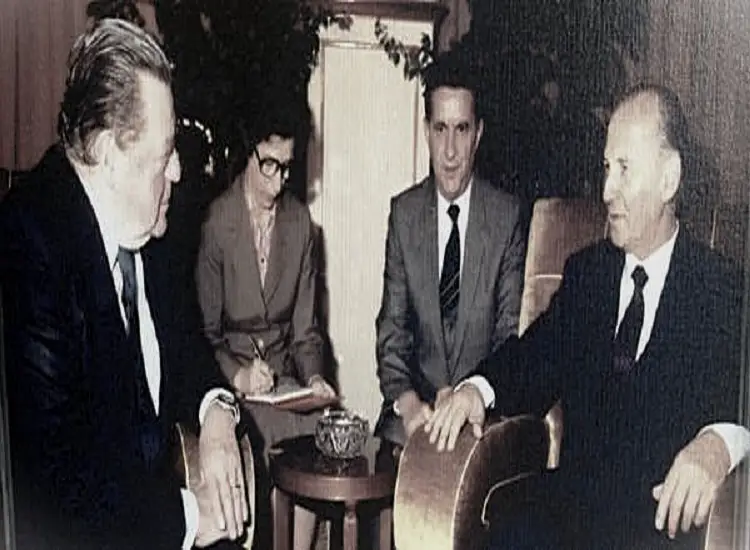
As reported, Italian companies are negotiating for the bringing of some industrial equipment to Albania. While in the summer, the Prime Minister of Bavaria, Franz Josef Strauss, came to Albania in what was described as a tourist visit. Later officials of the two countries met again in Vienna to discuss the establishment of relations.
West Germany has offered technical and economic cooperation with Albania, but before Tirana renounces claims for World War II reparations. In February the Turkish Minister of State Mustafa Tinaz Titiz came to Tirana to sign a trade protocol, revitalizing relations between the countries. Tirana has also begun a certain dialogue with the USA, Britain and France, the latter as mediator, for the issue of the return of the gold sequestered by the Nazis in Albania.
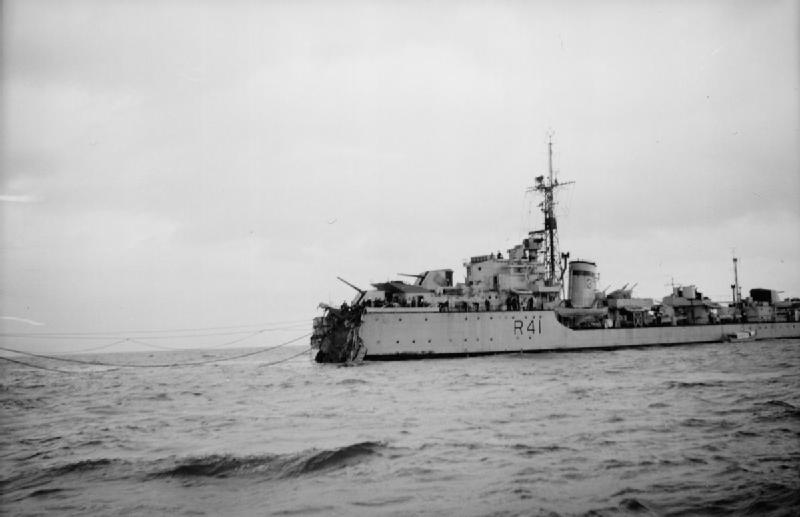
Only recently has the Albanian regime renounced claims for the return of the gold before the start of discussions on compensation for the damages of the communist regime against Western property, which consists mainly of the two British ships sunk at the end of the war by naval mines in the Corfu Channel.
Ideologies
Besides the problems with imports from the West, Tirana is also limited by its ideology of refusing credits from abroad, which would enable payments according to deliveries or in installments. This from Tirana’s conviction that Western companies cannot act outside the influence of their governments.
But nevertheless Albania has few goods that can be sold in the Western market. A modest increase has been noted in trade between the two sides in the years 1981-1983. Imports in technology have not managed to revive economic growth in Albania and the local government seems worried about this. At the end of December the party complained in the press that industry is not receiving the appropriate technology and criticized officials responsible for their work.
According to official figures, industrial production increased by only 3.3 percent in 1984, from the forecast of 8.5 percent. The plan of 1985 foresaw a lower increase, which reflects the problems with the adaptation and replacement of technologies. The Soviet Union and its allies have continuously tried to lure Albania into a re-rapprochement and now with Hoxha’s death their openings may intensify.
In their public statements the USSR tries to flatter Albania, as was the speech of General Secretary Gorbachev in the summer and the condolence messages of the Soviet party and some other satellites for Hoxha’s death.
During the last two years at the head of the seduction offensive have been Bulgaria and East Germany, toward which Tirana seems to be allowing a certain careful opening. In April 1984 Tirana and Bulgaria signed a treaty for the increase of bilateral trade, after the fall of about 19 percent during the years 1982-1983.
Tirana publicly refused the USSR’s condolence messages for Hoxha’s death and also has not publicly acknowledged the messages from other Eastern European countries, so its policies are not expected to have drastic changes in the post-Hoxha regime.
The new leader Alia will most likely begin work on the consolidation of his power, which may bring a power struggle based on ideological differences, personal interests and wars between clans.
From the little information we have it appears that the differences in foreign policy will be reflected between those who seek the opening and ties with foreign countries to overcome economic difficulties, and those who favor further isolation in defense of traditional radical policies. At least for the moment, the changes of ideologies have not given visible signs, but Albanian leaders have preferred independence from great powers to secure their personal power.
Perhaps they understand that openings toward Moscow will provoke possible intervention from Belgrade, therefore the new technocrats in power favor a certain tendency of Alia for orientation toward the West. Nevertheless we do not exclude the possibility that Moscow will regain its influence in Albania, especially in the case when the war between power factions becomes harsher, and the radicals turn to the Soviets for help.
July 1975
Refusal of Soviet openings
Tirana has forcefully reiterated its indifference to Soviet interest in diplomatic re-rapprochement. In an authoritarian editorial of the daily “Zëri i Popullit,” it not only expressed its indifference to the USSR but also warned any member of the leadership who might be in favor of improving relations.
In its comments filled with political fire, Tirana said that the seductions or pressures of the Soviet Union and its satellites would not change the anti-Soviet stance. The article claimed that the Albanian people were determined to make “every sacrifice, as we have done in the past, to preserve freedom and independence,” including reliance on their own forces for the increase of economic development.
The time of publication of this comment is interesting, since it comes during Moscow’s attempts for normalization of relations and signals for internal challenges to Hoxha’s leadership. The article warns pro-Soviet colleagues not to nourish hopes for cooperation with Moscow or otherwise face the consequences. The article says that the suggested policies of foreign credit will not cure the economic problems.
Former Defense Minister Beqir Balluku left his post in July 1974 after he favored such stances. The comment was issued on the eve of the Helsinki summit and gives reasoning for Tirana’s absence in the European security talks. Albania has previously described these talks as a “comic demonstration of the superpowers” and used the occasion to scorn the secret diplomacy of countries that “auction off” national interests.
November 1978
Intelligence report
Key points:
Since the public admission of the closure of Chinese assistance in July, Albania has begun a foreign policy of loneliness, abstaining toward rapprochement with its two main ideological enemies, China and the USSR. It has not shown signs of softening hostility toward the USA either. But Tirana has increased the efforts begun last year for the expansion of economic ties with some certain countries, both from the East and from the West.
Until now Albania has shown that it cannot find a sponsor that can give the support previously given by China. Albania faces a significant decline in its economic growth, if it does not open up to foreign credit, for which the government must remove the constitutional prohibition on borrowing from abroad.
Consequences of the break with China
Albania, as a small country with few resources, will always be dependent on trade or foreign assistance for economic development. During the two decades of alliance with China, Tirana relied almost entirely on China for economic, technological and military assistance; therefore the consequences of the separation will be severe and have already begun to appear.
We have not seen evidence that Hoxha’s regime has sought new strategies for sources of assistance, but it seems to have decided to continue, at least for the moment, the policy of increasing gradual ties with other countries. It is not likely that this approach will bring the Albanians the support and industrial supplies needed to avoid disruptions in industrial production or economic decline.
Even if the country has economic difficulties, there is no likelihood of popular unrest as long as the basic consumer needs are fulfilled. Hoxha maintains one of the most repressive regimes in the world and although some Albanians have doubts about his policies of self-sufficiency, there is no evidence of serious challenges to his authority.
Hoxha has publicly justified his current policies in a speech where he made the distinction between “different social regimes” that show themselves progressive toward Albania, and those that do not do such a thing. He expressed the will to preserve relations with the former, but emphasized that Albania nevertheless will not deny political or ideological differences with these regimes.
Hoxha used the occasion also to reiterate Albania’s hostility with the USA, the USSR and China, pledging that Tirana will continue the war against American imperialism and the socialist imperialism of China and the USSR, which excludes the possibility of rapprochement between them for the near future.
Despite Albania’s public refusals, Moscow and its Warsaw Pact allies continue their low-level efforts to lure the Albanians. Bulgaria, which is at the head of the seduction offensive, has recently published several articles where Albania is described in a positive light. Official Sofia has let Tirana understand that it wants good relations and cooperation.
The USSR is ahead of its allies in Eastern Europe for the luring of Albania, but is aware that Tirana will not accept the approach of ties with it as long as Hoxha remains in power. The Albanian leader has not given any signal that he will soften the suspicious stance toward the Soviets and Eastern Europeans.
But nevertheless Moscow may consider as progress the bringing of Albania into the fold in the post-Hoxha era. Yugoslavia, which seeks at any cost that Albania not rejoin the Soviet orbit, has expressed the will to improve bilateral ties, which have been received without open objections by Tirana, although until now there have been no considerable developments and in the short term none are expected.
Ties with other countries
Some of Tirana’s most ambitious attempts for the development of trade ties and perhaps for financial or technical aid have been directed toward India, Algeria and Japan. A visit to India by a low-level delegation in August sparked speculations that Tirana seeks to replace China with India.
Indian media wrote that Albania seeks from India assistance for the completion of a long list of projects abandoned by China and foresaw the possibility of the opening of Tirana’s diplomatic mission in Delhi. / Memorie.al
Continues in the next issue