By Eden Babani
Memorie.al / I don’t remember the exact year. I think it must have been the time when cooperative members were not allowed to keep in their private yard more than two lambs, one female and one male, or two kids (goatlings), also one female and one male. Cooperative members were obliged that, when they grew up, to hand over the females to the respective cooperative flocks, while the males they could slaughter and eat. They had to hand over only the head, after having eaten the meat. This was proof that they would not breed livestock further in their private yard.
So true was this politico-ideological narrative of the time, that as propaganda to influence the psychology of children, the loudspeakers of Radio Tirana boomed day and night with a song performed by a little girl with a beautiful voice, perfectly in tune with the music.
I quote a few of the song’s verses:
“Little lamb, why so pensive, baa, baa you make / why do you look at me so sadly, baa, baa, baa… / Father has promised me, baa, baa, baa / to take me to the cooperative… baa, baa, baa… / I will become the village shepherdess, tring-tring-tring / and graze the whole flock on the hillside, tring-tring-tring…”.
In Lispatrosë, at the annual celebration for Kajo Karafili, “Hero of the People”
In Lispatrosë, a mountain village of the United Agricultural Cooperative of Helmas, Kavajë, the annual celebration was to be held in commemoration of Kajo Karafili, “Hero of the People”, who had been killed from afar by a Nazi sniper during the Second World War. All the pupils and teachers of the area’s schools had to be present in Lispatrosë. So did our eight-year school, of Kryezi.
To celebrate the festival and raise its curtain, the Party Committee of the district had sent one of its instructors. The little village square was decorated with flags and all sorts of colorful ribbons. The loudspeakers placed high and low boomed with revolutionary songs and applause. It was said that they could be heard all the way to Pezë, on one side, and to Kavajë and Golem, on the other.
In the midst of all this, a teacher from one school over there came out unexpectedly and carelessly with a group of pupils to sing a song together. Apparently, this small “artistic” group was trying to echo the politico-ideological narrative of the time, but not like the “baa, baa, baa…” song of Radio Tirana. Instead of singing, the teacher and the pupils recited verses invented by who knows whom.
I quote: “Teacher: Hopa!… / Pupils: Hopa! Hopa! Hopa!… / Teacher: The cow has asked us… / Pupils: Hopa! Hopa! Hopa!… / Teacher: she will give us a beautiful calf / Pupils: Hopa! Hopa! Hopa! / Teacher: We will take it to the cooperative. / Pupils: Hopa! Hopa! Hopa!…”.
Every time they shouted “Hopa”, they would jump upward and spread their arms, as if they were about to fly. Before the “hopa-hopa-hopas” had even faded, another teacher came out, who began by introducing himself, even though everyone knew him:
– And now, – he said – from Sami, teacher of the four-grade collective school of Lispatrosë, you will hear the song “Oh beloved, may God judge you”! Muli, the principal of our school, turned black as coal…! So did us, the other teachers. On the contrary, the delegate of the District Party Committee got up and embraced the singer.
The late Sami had graduated from the Madrasa of Tirana. He had a tenor voice and sang very beautifully. During the Kingdom era, Radio Tirana’s programs opened with the National Anthem. After that, Sami would chant parts of the Quran for Muslims, while a priest from Korçë, if I’m not mistaken, would preach parts of the Gospel for the Orthodox and Catholics.
Caracas – Venezuela…
It must have been the school year 1961–1962. I was twenty-twenty-nine years old then, having just finished higher education because my right to study had come very late. The reason was the execution in 1948 of my grandfather, Mehmet Babani, as an “enemy of the people”. The right to study was granted to me for Mathematics – Physics. But lo and behold!… Even after this, the conditions were not yet over for me.
Hasan Duma, Vice-Rector and Secretary of the Party Committee of the University, after reading my biographical data, insisted on my exclusion, despite the defense put up for me by Professor Petraq (Pepi) Pilika and Professor Osman Kraja, given that as a student I had participated in all the colloquia and had passed all the exams with satisfactory results. Nevertheless, Hasan Duma achieved his goal, although he himself suffered afterwards. Even worse than me. You reap what you sow, as they say, whether it applies to me or to him. Anyway…!
After a back-and-forth from the University, Department of Mathematics-Physics, to the Two-Year Pedagogical Institute, Department of Albanian Language and Literature – History, as someone disliked by the regime, I was appointed to the seven-year school of Dhëmblan, very far from Skela e Vlorës, where my family lived.
Far indeed, even very far from my family, but upon setting foot in the main center of the region, I befriended the village and my pupils. I loved them and they loved me, so much so that, inspired by them, I wrote the poem titled “Poem for Myself and for others”, now published in several of my books, including “A Smile in Two Times – Poetry”.
Through an autobiographical meditation, I have tried to describe my early years as a teacher in villages, but also in towns across Albania. “Could the school not be opened to the village?” This was the essence of the dilemma I was experiencing.
But no!… “Orpheus here had swept me away / on his light wings and carried me / right next to a ragged boy / with blinded eyes who harshly scolded me: / You will not open my blinded eyes, and perhaps you’ll keep one eye for yourself… / Open them, for I have already given one away, / so you may live with three eyes in the cities…”.
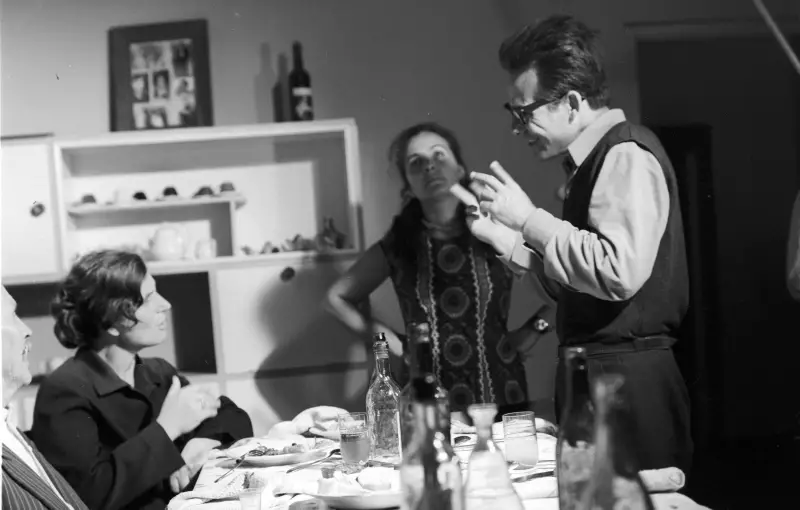
A dinner was taking place in Matohasanaj, part of the ethnographic region of Lopës, Tepelenë. The region included Dhëmblan as its main center, Matohasanaj, Sinanaj, Dorëz, and Lab-Martallos. Just as in Dhëmblan, the seven-year or primary school existed elsewhere too, for instance, in Sinanaj, but not in Matohasanaj, which was looked upon with suspicion by the regime because, as it was believed, it was a Balli Kombëtar (anti-communist) village. The lunch was held at the house of the late Servet.
On what occasion, I don’t remember. Servet was a teacher at our school in Dhëmblan. He had to come every morning from Matohasanaj, an hour or so away, even in bad weather, slipping through mud, climbing up and down precipices and rocky scree. Otherwise, his salary would be cut, if not removed entirely from education as a descendant of a Ballist family.
Thus it went, until they drafted him into the army. A year after him, they drafted me too, right at the peak age. I was enlisted from the military branch of Tepelenë. A separate story, this one too. Students who finished university did a so-called six-month military internship, and that was all, after which they received some sort of officer rank, I believe. Until then, I had avoided the army.
My father’s colleagues at the Military Branch of Vlorë, who checked the health condition of recruits before they were conscripted, had deferred my military service year after year with medical reports, as physically unfit. In Tepelenë, this didn’t work. No one knew my father there. Besides, there they called it Tepelenë, not Vlorë. I was enlisted two or three months before I was definitively discharged from the army, because I was passing the peak age.
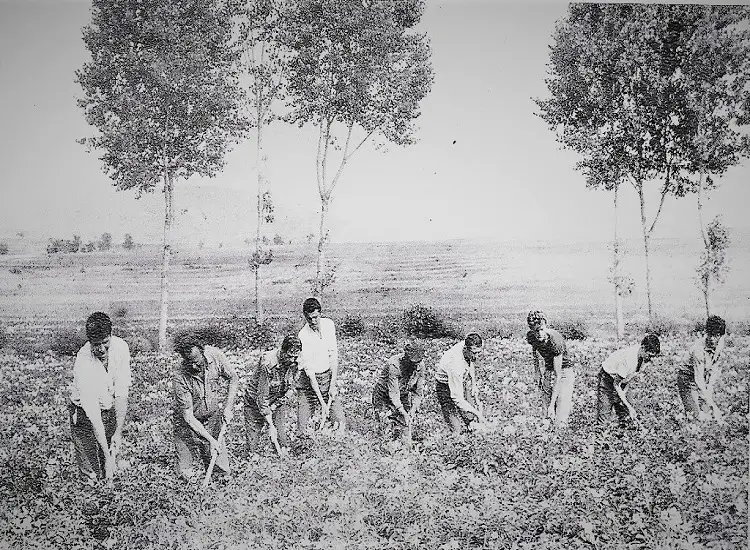
Servet, my colleague and friend from Matohasanaj, I found at the Labor Battalion in Vorë, where the Brick Factory was being built. Needless to say, neither he nor I could perform our military service with a rifle. We would do it with a pickaxe and a shovel. With opingas (traditional shoes) and boots, not with shoes.
The dinner, as I said above, was held at Servet’s house or at one of his relatives’ homes, I don’t remember exactly. But I do remember the refrain of a Lab folk song improvised on the spot. Not quite like the song *”Little lamb, why so pensive, baa, baa, baa…”*, but adapted to the narrative of the politico-ideological situation of the moment.
There were two large floor-level tables (sofra), around which guests were packed, taking up the song. As soon as those at the left table finished, those at the right took over. One group gave time to the other to swallow a glass of koçimare (wild pear) rakia. Whoo-oo… the rakia of the koçimare, because the forest over there is full and overflowing with wild pears.
Appetizers?… Don’t even mention them!… Some onion or leek skin, more rarely an olive or two, and that were it. Even those were on pieces of newspaper. Plates were out of the question. In the midst of this, suddenly and unexpectedly, someone glanced at the piece of paper with the appetizers, pointed with his finger to his friend at what was written on it, and started the song:
“Caracas…”
The second one picked it up:
“Oooh… Cara-a-cas…”
The first continued:
“Caracas – Venezuela”
The second:
“Oooh, Venezuela… oooh…”
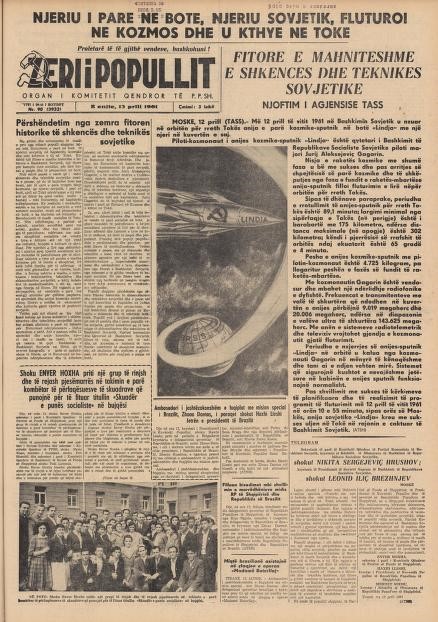
Just that much. It’s unknown how long this “Caracas – Venezuela” would have continued, had not the other floor-level table taken up the song, saving its counterpart from embarrassment. To this day, no one knows what connection the newspapers “Zëri i Popullit” and “Bashkimi” had with Caracas and Venezuela. Some earthquake like the recent one? Who asked for such details back then?!…
Why, then?! I would say that, as a Latin American state considered perhaps to be against capitalism, especially against the USA, our eternal enemy across the Atlantic, the dailies Zëri i Popullit or Bashkimi must have picked up some news in line with the politico-ideological platform of the time. / Memorie.al