
By Bashkim Trenova
Part Nineteen
– NAZBOL SHEVISM – LITERATURE AND ARTS –
FOREWORD
Memorie.al / Historians, political philosophers, intellectuals of different schools or different positions, have devoted thousands and thousands of pages, entire volumes, studies and articles to the comparison between Nazism and Communism. Generally, their publications and studies focus on the police control of society by these dictatorships, on the role of the dictatorial state hierarchy and the head of state as suppressors of free thought, on the omnipresence of official propaganda in society, on mass massacres and the network of concentration camps, on the activity of the police, the NKVD in the USSR (later the KGB) and the Gestapo in the Third Reich. In his book “Le Passé d’une illusion” (The Past of an Illusion), François Furet notes that Nazism and Communism share the same opposition to liberal democracy and what they call “capitalist bourgeoisie”. Both ideologies claim to be socialist and use the image of socialism. Communist countries called themselves “socialist”. “Nazism” is an abbreviation of National Socialism.
Continued from the previous issue
Chapter III
Petersi escapes an attempted poisoning by the Intelligence Service, withstands the hostility and constant persecution by the British, but he must also face the director of the Colonial Department in the Imperial Office of Foreign Affairs, who turns out to be… Jewish. On the same path is “Der Fuchs von Glenarvon” (The Fox of Glenarvon), produced by Max W. Kimmich in 1940. The film tells the life of Gloria Grandison, an Irish patriot who supports the fight against the English enemy. The action takes place in 1884, somewhere in north-west Galway, Ireland. “Mein Leben für Irland” (“My Life for Ireland”) is another film produced also by Max W. Kimmich, in 1941, dedicated to Ireland and the Irish resistance, again against the English enemy.
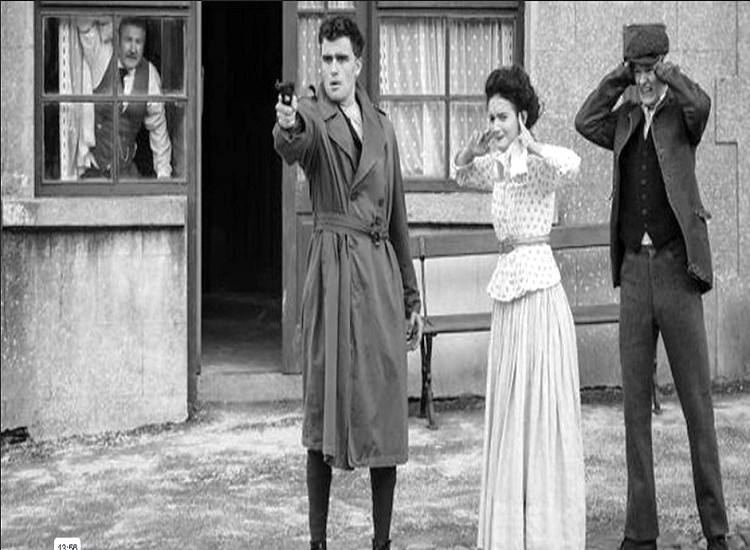
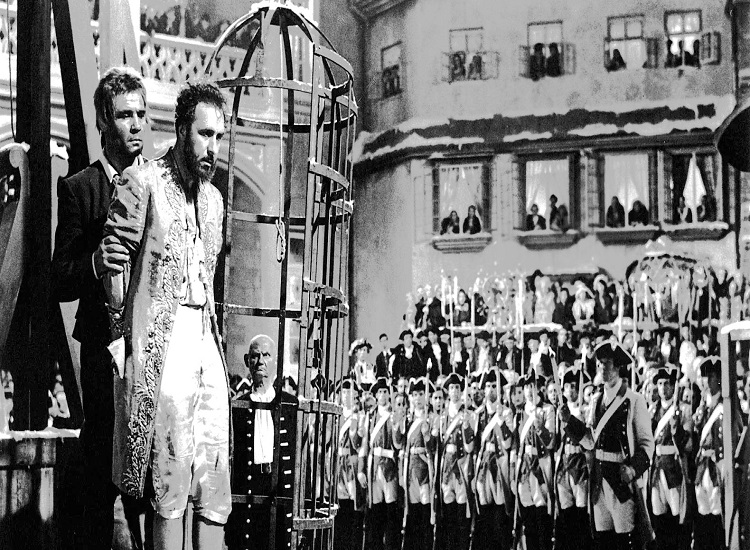
The film shows how in 1903, in Dublin, during an attack against British policemen, the leader of the Irish fighters, Michael O’Brien, is captured and sentenced to death by hanging. His pregnant fiancée, Maeve Fleming, goes to visit him in prison. They get married in prison. Michael O’Brien places around Maeve’s neck a silver cross with the inscription “My Life for Ireland”, which the best Irish fighters must always wear. Even in this film, the intrigues and backstage machinations of the Intelligence Service are not missing.
In 1943, German cinema, through Herbert Selpin and Werner Klingler, produced another anti-British film, “Titanic”. This propaganda film, made according to Goebbels’ instructions, undertakes to depict the sinking of the British ship Titanic, which struck an iceberg in 1912. The film exploits a tragedy to condemn the British owners of the ship as guilty, through the character Joseph Bruce Ismay. According to the filmmakers, he does not hesitate to make the ship travel at full speed across the Atlantic Ocean, paying no attention to safety measures and present dangers. In “Titanic”, the main factor that caused the sinking of the famous ship is British avarice. In the film, the German officer Petersen opposes the British and saves the ship’s owner, so that he may face justice for his crimes.
There are also many German films of the time against the USA. Let us focus on only one of them: “Rund um die Freiheitsstatue” (“All around the Statue of Liberty”). This film was produced in 1940 by Deutsche Wochenschau and bears the signature of Fritz Hippler, director of the cinematographic sector in the Ministry of Propaganda. The filmmakers claim that all its footage reflects American reality and unmasks the enemy’s false speeches about a “free” country. “Rund um die Freiheitsstatue” presents the USA as a land of injustice, poverty, unemployment, oppression, an uncultured, animalistic place (with Negro dances). To all this is added a commentary that makes President Roosevelt and the “Jewish plutocracy” responsible for the war.
The film aims that this whole wild picture of American life be subjected to public punishment in Germany, to alienate German public opinion from the USA. Historically, the USA held an isolationist stance during the first years of the war. Until December 7, 1941, they were not directly involved in the conflict, but since the outbreak of World War II in Europe, the USA materially supported Great Britain. The pursuit of this policy puts them in the crosshairs of Nazi propaganda and, in this context, of contemporary German cinema as part of it.
The seizure of power by the Hitlerites in 1933 plunged domestic cinema into a genuine crisis. Over a thousand people working in cinema were forced to leave the country. A large number of artists – directors, screenwriters and film producers – abandoned Germany to continue their careers abroad. Such well-known figures as directors Fritz Lang, William Dieterle, Max Ophüls, Detlef Sierck, Lothar Mendes, Billy Wilder, Kurt Bernhardt, Henry Kosterlitz, Ludwig Berger, Georg Wilhelm Pabst, Kurt and Robert Siodmak, Richard Oswald, Robert Wiene, Joe May, Henrik Galeen; actors Conrad Veidt, Fritz Kortner, Curt Bois and Peter Lorre; actresses Brigitte Helm, Elisabeth Bergner; chief cameramen Karl Freund and Eugen Schüfftan – all did so.
The racist, anti-Semitic law of June 6, 1936, forbade Germans who were not of “pure origin” from working in the film industry. Consequently, well-known figures of German cinema such as Kurt Bernhardt, Robert Siodmak and Max Ophüls were forced to emigrate. Some artists, like Kurt Gerron, who could not leave, were killed in concentration camps. Within just a few months, German cinema was emptied of its greatest representatives. German cinema lost much of its potential. The first public screening of a film in Russia took place on May 4, 1896, in St. Petersburg, at the “L’Aquarium” theatre, by emissaries of the Lumière brothers. They would open the first cinema hall in Russia two days later, in the same city.
Film is very popular, attracting a wide public of various ages, professions, social strata and origins. The Soviets would quickly understand its weight and would make it one of the most important arts after the Revolution. Anatoly Lunacharsky, People’s Commissar for Public Education in 1917, writes in his memoirs, among other things: “Vladimir Ilyich told me that we would try to do something to increase the means for the cinema sector. He stressed the necessity of establishing some proportion between entertainment film and scientific film. Vladimir Ilyich told me that we must engage in the production of new films, spread communist ideas and reflect Soviet activity. ‘You must develop and support a healthy cinema among the masses, in the cities and, even more, in the countryside,’ he told me. ‘You must absolutely remember that of all the arts, the most important for us is cinema.’”
The Bolshevik leader, besides general instructions, sees it necessary to also dictate the concrete activity of Soviet cinema. On April 9, 1921, Vladimir Lenin would address the People’s Commissariat for Education with the words: “The cinematography section is to be tasked with producing, within May, 12 films, under the direction of the General Directorate of Turbine, on the extraction of turbine for Russia, Ukraine, the Urals, Belarus and Siberia.” The decree of August 27, 1919, bearing Lenin’s signature, which nationalised film production and distribution, also marks the “official” birth of Soviet cinema. This decree would place Soviet cinema in a completely unique situation in the world: unique with regard to the role officially assigned to cinema and the means placed at its service, but also with regard to the almost total control exercised over it by political power.
Soviet cinema served the Soviet regime in a particular way, mythologising it and even distorting historical facts. With Stalin’s rise to power, its role as an instrument of Bolshevik propaganda would be further strengthened. For years and decades, it would become the most important art among all arts. In 1924, Stalin declared: “Cinema is the most fruitful means of agitation among the masses. Our only problem is to know how to keep this instrument well in hand.” A large number of decisions of the Communist Party of the USSR and the Soviet government of the time stressed the necessity of expanding the network of cinema halls. From 7,142 halls in service in 1927, in 1930 they became 15,869, and in 1932 there were 27,600.
Most of them were mobile: a projection apparatus, a small screen, a few 16 mm copies, all transported by a truck. At the end of 1940, in Russia alone, there were 17,500 cinema halls, including mobile ones. In Ukraine there were 6,000 halls, a little over 1,000 in Kazakhstan, 600 in Uzbekistan, 400 in Azerbaijan, 350 in Georgia, 200 in Kyrgyzstan and almost 200 in Armenia. During that year, while the country had a population of 194 million inhabitants, 900 million admissions to Soviet cinema halls were recorded.
From the first battles of the Civil War, communist leaders understood the importance of cinema for their propaganda and developed a cinematographic sector for the army as well: the famous “cine-trains” or “agit-trains” that moved behind the front lines with all the necessary material for the production and screening of documentaries, for the purpose of “educating the masses”. There is a problem here that does not make things easier for the Soviets. To educate the masses, those entrusted with this task had to be educated first.
For the Bolshevik leaders, the artist in general – and therefore the artists, the creators of feature films, those who must serve this “education” – are part of the devil, demonic beings, inspired by evil, inclined toward satanic activity. The Party was faced with the task of putting the “devil” at its service, to “educate” him, and if he would not obey, to condemn him, curse him, cast him into hell. One of the Party’s favourite weapons to accomplish this task was the KGB. It was present as an institution in the intellectual and artistic circles of the USSR, often without any disguise whatsoever.
In every film studio there were two KGB employees who secured a network of collaborators. According to some sources, which should be taken with reservation, filmmaker Sergei Yutkevich was “close” to them, or their “privileged advisor” on cinema problems. In Sov-Export-Film, the body in charge of distributing Soviet film abroad, KGB officers made up half the staff. They controlled all foreign contacts. Andrei Konchalovsky, an expert in this field, wrote about the “Foreign Commission” of the Writers’ Union, calling it its “Chekist sector”, i.e., a sector of the political police, the predecessor of the KGB. The “Foreign Commission” of cinema acts in the same way. This Commission, Valery Golovskoy would point out in 1982, is headed by Nadezhda Volchenko, “an extremely macabre personality, long associated with the KGB”, while her deputy is “a colourless man, Neserovsky, a non-uniformed KGB collaborator”.
After an international conference in Switzerland, in which a Soviet delegation also participates, Volchenko, as every member of the delegation must do, forwards her report to the Central Committee and the KGB: “This letter was an open denunciation: who said what and what he said, who talked to whom, who went out, etc.” Gilles Jacob, former president of the Cannes festival, humorously recalls a certain Shkalikov, who worked in KGB structures in the 1970s: “I suspect he didn’t care about cinema. He was given two hours to leave Paris, at the request of the French authorities.”
The communist revolution of 1917 forced almost the entire Russian film industry to leave the country. Drankov first went to Ukraine, then to Istanbul and then to the USA. Vera Karalli immigrated to France in 1918. Vera Kholodnaya would go to Crimea, then controlled by the Mensheviks. In 1920, Vladislav Starevich would immigrate to France. In 1929, the actress Vera Baranovskaya would leave Russia, first settling in Czechoslovakia, then in Germany and France.
Under general pressure, many cinematographers, directors and other producers were forced to leave the land of the Soviets. So did Jozef Ermoliev, Ivan Mozzhukhin, Yakov Protazanov, Ladislas Starevich, Alexander Volkov, Nathalie Lissenko, Alexander Khanzhonkov, etc. Later, Andrei Tarkovsky with his wife Larisa would immigrate to Italy. Otar Iosseliani, regularly censored, would also immigrate to France. Many others who remained in the country met a tragic fate. Zoya Alekseevna Fyodorova, known as a star of Russian cinema, accused of being a member of a criminal group that would kill Stalin, was imprisoned, sentenced to death, then “pardoned” and sent to the Gulag where, according to the relevant decision, she would have to spend 25 years of her life.
After the Gulag, she was killed, in all likelihood, by KGB men. Another artist, director Sergei Parajanov, was sentenced several times by Soviet courts on ordinary charges, among the most absurd. His films were banned for a decade. In addition to years in prison cells, he was also sent to labour camps, despite his vision problems and heart condition. For cinema, including all its components, during the years 1930-1953 alone, about 100 victims are counted. The persecution of Soviet filmmakers continued even after this period. We might mention the film “Интервенция” (“Intervention”) by Gennady Poloka, produced in 1968 and banned by Soviet authorities until 1987 as a film that mocked the Civil War. Many Soviet filmmakers were forced to continue leaving their homeland even after the Stalinist period.
It is noticeable that Soviet cinema is extremely homogeneous with regard to the subjects it treats. A special and primary place is devoted to the building of the personality cult of Bolshevik leaders, Lenin and Stalin. It also treats great historical figures and events of pre-Revolutionary Russia, past wars, the Tsarist regime, events related to the October Revolution, the Civil War, World War II, the new socialist life in city and countryside, i.e., socialist industrialisation and the collectivisation of agriculture, and the enemies of the people who sabotage their new, happy and joyous life.
In the Soviet system, it is the Party that controls and exercises its will even in the field of cinema. It is the Party that gives orders regarding what, where and how should be filmed, where and to what extent the emphasis should be placed. A censorship system, active and omnipresent, jealously watches over the ideological compliance or non-compliance of every film. It is known that the screening of any film on the cinema screen was preceded by the brief notice: “This film was made according to the order of the State Committee for Radio Broadcasting and Television under the Council of Ministers of the USSR.” This note was, so to speak, the state seal that made it possible to cross the border. A special committee (Repertkom) watched over scripts, stage and cinema, and drew up the list of banned works.
The censorship apparatus in cinema was strengthened more and more in the mid-1920s, during which numerous ideological mechanisms charged with planning cinematographic production were created. The year 1922 is also the year of the creation of Goskino, which closed the process of film production and distribution into a state monopoly. During the late 1920s, as a result of “bad ideological and political quality”, 16% of the films produced in the country were banned. The film “Октябрь” (“October”) by Sergei Eisenstein and Grigori Alexandrov, produced for the 10th anniversary of the October Revolution, was “clipped”. By Stalin’s order, the footage showing Leon Trotsky was removed from the film.
Another film by Eisenstein, “Бежин луг” (“Bezhin Meadow”), made in 1937, suffered an even worse fate. For the most part it was destroyed before its completion, and then officially banned. The director was accused of “dangerous formalist activity”, for failing to present the “realist-socialist portrait of the class struggle”. The only copy of this film was destroyed during Nazi bombings. Art, including cinema, is valued and allowed by the Bolsheviks only by interpreting aesthetics in the service of ideological criteria. “Of 129 scripts officially commissioned by Soyuzkino in 1933, only 13 were accepted.
Starting from 1938, each script had to be submitted to the Central Directorate of Cinema in Moscow. Only if accepted by it, the script would be sent to studios where filming could begin. There are numerous scripts that had to be rewritten and re-examined several times in Moscow before, sometimes, being finally banned.”Memorie.al