By Bashkim Trenova
Part Twelve
NAZIBOLSHEVISM – LITERATURE AND THE ARTS
FOREWORD
Memorie.al / Historians, political philosophers, intellectuals from various schools or different positions, have dedicated thousands upon thousands of pages, entire volumes, studies, and articles to the comparison between Nazism and Communism. Generally, in their publications and studies, the focus is on the police control of society by these dictatorships, on the role of the dictatorial state hierarchy and the head of state as suppressors of free thought, on the omnipresent place of official propaganda in society, on the mass massacres and the network of concentration camps, on the activity of the police, the NKVD in the USSR (later the KGB) and the Gestapo in the Third Reich. In his book “Le Passé d’une illusion” (The Past of an Illusion), François Furet notes that Nazism and Communism share the same opposition to liberal democracy and to what they call “capitalist bourgeoisie.” Both ideologies claim to be socialist and use the image of socialism. Communist countries called themselves “socialist.” “Nazism” is an abbreviation of National Socialism.
Continued from the previous issue
Chapter II – MUSIC
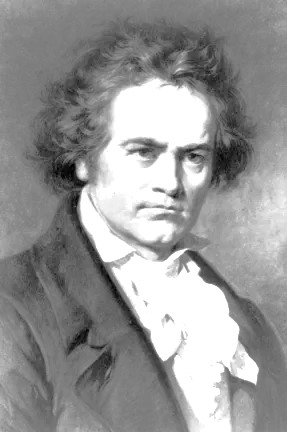
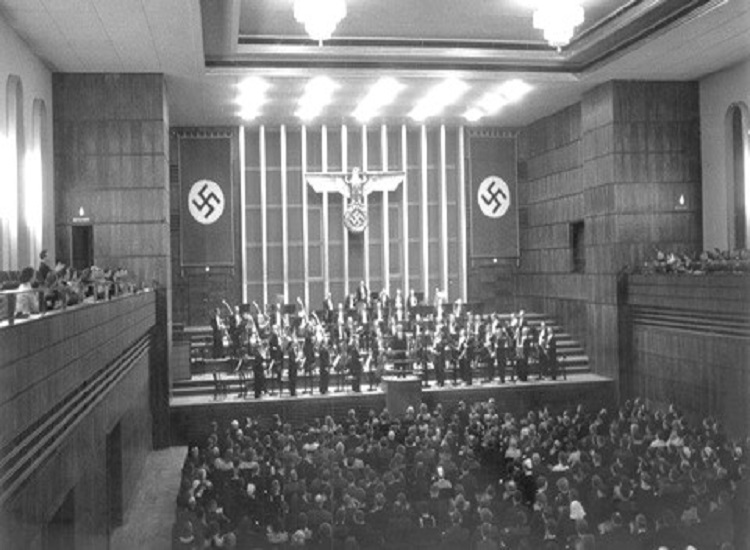
Beethoven’s works most frequently played during the Third Reich are Symphonies No. 3, 5, 7, 9, as well as the opera Fidelio. Symphony No. 3, also named the “Eroica Symphony” (Heroic Symphony), was interpreted by Nazi propaganda as the embodiment of heroism in war, of sacrifices, resurrection, and victory. Hitler himself was presented by it as the hero of the “Heroic Symphony.” Likewise, Symphony No. 5 was interpreted as the symphony of a people’s fate, finding its Führer, Hitler, as the symbol of the German people. Symphony No. 7 became known at the time as the “symbol of National Socialism’s victory.”
Nazi ideologues and theorists of music or art, such as the musician Kronaweter, speaking about Beethoven’s 9th Symphony, emphasize: “Whoever has understood the meaning of the symphony will be a better soldier afterward… because… to understand counterpoint means to know that everywhere in the world everything is regulated through struggle.”
The Hitlerites do not miss the opportunity to manipulate the fact that Symphony No. 9 was composed by Beethoven while he had lost his hearing. They compare Beethoven’s condition to that of Germany, and his work to that of Hitler. Thus, according to them, one must believe that just like Beethoven, the German people could overcome their pain and find an important place in the international arena. Just as Beethoven alone could compose a masterful masterpiece, Hitler alone would be able to rebuild Germany’s former power. Hitler himself declared: “Millions of people are captivated by Symphony No. 9, but it was composed by a single man.”
The Hitlerites similarly manipulated the opera ‘Fidelio,’ which was fundamentally against tyranny and for political freedoms. This opera was performed in 1938 on the anniversary of Hitler’s birthday, with Nazi propaganda equating him with its hero, ‘Fidelio,’ a fighter against tyranny. In the process of “Aryanizing” German music, a number of works were subjected to a kind of processing or adaptation. Mozart’s Requiem, for example, in its Nazified version, no longer contains words of Hebrew origin. They were deleted. The librettos of operas translated by some Jew were retranslated. This happened with the operas of Mozart and Handel.
Mozart’s collaboration with Jewish librettists, as well as the references to Judaism in Handel’s oratorios, could not be accepted by the Nazis. The same can be said for Franz Schubert’s and Robert Schumann’s use of poems by Heinrich Heine, who was also Jewish. ‘Ein Sommernachtstraum’ (A Midsummer Night’s Dream) by the “Jew” Mendelssohn was erased from the repertoire and promptly replaced with the version worked on by Pfitzner and Strauss. Some works by Bach and Beethoven were also subjected to “cleansing.”
Almost immediately after the Nazis seized power, concerts of contemporary music, as well as the conception or staging of modernist and expressionist operas, were banned. As early as 1933, they banned ‘Aufstieg und Fall der Stadt Mahagonny’ (Rise and Fall of the City of Mahagonny), an opera in three acts composed by Kurt Weill with a libretto by Bertolt Brecht, because it challenged the traditional forms of classical opera. Hitler himself wrote in 1931: “The texts of Bertolt Brecht and the music of Weill can never be considered German art.”
The music of Alban Berg, Hans Eisler, Paul Hindemith, Arnold Schoenberg, Anton von Webern, Kurt Weill, and other once-famous composers was banned. The same fate befell the music of composers Giacomo Meyerbeer, Jacques Offenbach, the music of George Gershwin and Irving Berlin, Mahler, and Bartók. For Nazi racist ideology, Darwin’s law of evolution and natural selection, the laws governing the organic world, are also valid in the field of music and the arts in general. According to its adherents, this law proves that even in music, degenerate, weaker, less accomplished forms naturally disappear through differentiation and the struggle for existence.
According to the Hitlerites: “everything that lives in the world follows one and only one law… everything that contains beauty and greatness develops naturally with force and in an ever-increasing diversity, constantly developing, in the future, what is most beautiful, best, and most accomplished.” In this view, the saxophone was defined as the “song of a castrated negro,” spreading powerless nostalgia and melancholy, while jazz, associated with it, was presented as a threat to the virility of the German man. According to the music theorists and Nazi ideologists, jazz, the saxophone with their strange harmonies, with their sound effects foreign to German music, are, ultimately, a planned conspiracy to demoralize the warriors of German culture. Heinrich Himmler, the head of the SS, stigmatized jazz enthusiasts, known in Germany as the “Swingjugend” (Swing Youth), as a real threat to the fate of the German people.
He recommends “taking drastic measures” against them as the only salvation. Only these measures, again according to him, “will eradicate the dangerous spread of this Anglo-phile movement at the hour when Germany is fighting for its existence.” The Swingjugend, German youths, sometimes even 14-year-olds from bourgeois families, are known not only as representatives of a musical movement condemned by the Nazis, but also as challengers and mockers of National Socialist propaganda. They turned the well-known Nazi salute ‘Sieg Heil’ into ‘Swing Heil’, or the greeting Heil Hitler into Heil Hotler, which referred to the hot club, i.e., ‘jazz clubs’.
With the start of the war by Hitler’s Germany, the persecutions against the Swingjugend became even more brutal. On August 18, 1941, 300 Swing kids were arrested or placed under surveillance. Their leaders ended up in concentration camps. In January 1942, Himmler ordered that “this evil be completely eradicated.” After ordering the closure of the last Swingjugend clubs, he also ordered: “All leaders, whether male or female… must be sent to a concentration camp. The youths must first be beaten there, then educated in the strictest manner and forced to work.”
Besides the repressive measures against jazz or swing music, the Nazis supported the idea that Germany has a special connection with “great music.” Swing and jazz represented for them a “degenerate music… superficial, stripped of any kind of creativity and originality, because it has no roots.” The target is especially Jewish music or music labelled as Bolshevized. This music, according to them, is perverse and destructive of German musical values and wealth. It is music linked to “undesirable modernism” and which, again according to them, has no fatherland.
Almost immediately after Hitler came to power, Nazi partisans of the “Kampfbund für deutsche Kultur” (Militant League for German Culture) began disrupting concerts organized by Jewish artists. Subsequently, on July 26, 1935, the cultural organization NSKG (“National-Sozialistische Kulturgemeinde” – National Socialist Cultural Community), led by Alfred Rosenberg, issued an internal document titled: “List of Music-Bolshevists and Personalities Considered as Such.” This document targeted 55 personalities active in various fields of German musical life, such as composers, conductors, soloists, singers, music critics, and professors. This list was accompanied by the note: “According to a word of the Führer, representatives of regression cannot be standard-bearers of the future.”
The Nazi policy of terror against music, composers, performers, and singers who, in one way or another, refused to march in step with the official rhythm, or who did not belong to the “pure” Aryan race for various reasons, did not provoke any strong protest in Germany. Wilhelm Furtwängler, the principal conductor of the Berlin Philharmonic Orchestra, addressed an open letter to Goebbels, expressing his views on the independence of art, its qualitative evaluation, and against anti-Jewish discriminatory measures. “…But when these blows are directed against true artists, then this is not in the interest of our cultural life,” writes Wilhelm Furtwängler, among other things, in his letter.
Endangered, many composers were forced to leave Germany. Among them are Stefan Wolpe, Paul Hindemith, Erich Wolfgang Korngold, Ernst Krenek, Wladimir Vogel, Hanns Eisler, Arnold Schoenberg, and Alban Berg. Others, like Karl Amadeus Hartmann, chose “internal emigration,” i.e., they remained in the country, continuing to secretly compose works that would be performed outside Germany. Still others chose the path of active collaboration with Nazism, or were declared Nazis.
Musicians branded as “non-Aryans” and who could not emigrate in time ended up in concentration camps. Most of them, like Alois Hába, Viktor Ullmann, Hans Krása, Pavel Haas, Alma Rosé, Erwin Schulhoff, lost their lives in these camps. Cabaret artist Fritz Grünbaum was arrested at the border and sent to Buchenwald, then to Dachau, where he died in 1941. The famous Austrian librettist Fritz Löhner-Beda, who had collaborated with Franz Lehár on several operas, was also interned in Dachau and Buchenwald and later sent to Auschwitz, where he died in 1942. Ralf Erwin, author of successful songs in Silesia, who had left Germany in 1933 and taken refuge in France, was captured by the Nazis in 1940 and died on May 15, 1943, in the Beaune-La-Rolande concentration camp near Paris. According to various sources, between 5,000 and 10,000 musicians were persecuted by the Nazis.
The Nazis assigned a monstrous role to music even in the concentration camps. It served their “extermination factory” and was a tool of torture. From the first concentration camps in 1933 to the mass extermination camps of Birkenau, Sobibor, Treblinka, Majdanek, music mingled its notes with the smoke from the crematorium ovens. A dozen melodies, mostly military marches, were repeated every day, in the morning, noon, and evening, at the worst moments of the internees’ lives in these camps, to destroy them as human beings before taking their lives.
They were forced, beaten to sing loudly while working, for example, pulling a cart full of stones. Every block in the Nazi camps had its own loudspeakers, to “re-educate” the prisoners, but also to deprive them of sleep. In Majdanek, loudspeakers blasted music at an extremely high volume during mass executions by gunfire. On November 3, 1943, in this camp, the waltzes of Johann Strauss were broadcast continuously over the loudspeakers to drown out the cries of the 18,000 Jews killed on that day.
In some camps, there were even real orchestras, formed by prisoners, who were forced to play symphonies and operas to entertain the SS officers and guards, but also played during the punishment or execution of prisoners. The musicians wore a special uniform. In Dachau, for example, Hans Loritz, the first commandant of this infamous camp, ordered the musicians to dress in the clothes of soldiers from the anti-Nazi allied powers who had fallen in battle. The perversity of the Hitlerites in the concentration camps was immense. Some of them, who supposedly wept when hearing Wagner or Schumann, accompanied their inhuman, deadly experiments on prisoners with music. Such were the “doctors” Johann Paul Kremer and Josef Mengele.
The SS often forced Jews to sing liturgical songs shortly before executing them. The orchestras of the condemned also had to play during the hangings that took place in the concentration camps. When the Nazis managed to capture a prisoner who had attempted to escape, they often forced the captured person, at the moment of erecting the gallows, to sing: “Es geht alles vorüber, es geht alles vorbei” (‘everything is over’). According to many testimonies from the Sonneburg camp, Communists had to sing The Internationale while digging their own graves.
In conclusion, from this brief overview of musical life in Nazi Germany, it can be said that here too, the same phenomenon is observed as in all spheres of art and culture. The lack of creative freedom, the persecutions, imprisonments, concentration camps, emigration, made it impossible for any great, renowned composer to emerge, one who could withstand time and take a place alongside the other previous grand, world-class figures in music. Germany, as is well known, had not a few such figures in the centuries and years before the Nazis came to power. Lenin and, later, Stalin presented themselves as admirers of Beethoven, Wagner, Verdi, Chopin, Bizet, of the famous pre-revolutionary Russian composers: Tchaikovsky, Rimsky-Korsakov, Prokofiev…! Beethoven with his “Eroica” was united by them with the revolutionary ideas of the Communist Party. He was valued as an indisputable figure of the “revolutionary heritage.”
Lenin spoke of Beethoven, calling him his favourite composer. Stalin, as the future emperor, could not ignore the fact that Beethoven had not only been a contemporary of the French Revolution but, moreover, for a time, a strong admirer of Bonaparte. It is interesting to recall that on the occasion of the tenth anniversary of the October Revolution in 1927, besides the celebrations related to this event, the 100th anniversary of Beethoven’s death was also commemorated, him being characterized as a revolutionary, popular hero.
In his honour, a series of concerts were organized, anthologies of his life and works were published, which spoke of Beethoven’s central place in Soviet music. Narkompros (The People’s Commissariat for Education) even established a committee on the occasion of the 100th anniversary of the composer’s death. This committee organized an official week in honour of Beethoven and, on this occasion, distributed free tickets to factory committees, the Komsomol, and musical institutions. Since Beethoven’s music echoes a collective feeling, it was valued as being close to the spirit of the Bolshevik revolution as well.
For pragmatic reasons, the Bolsheviks also used the great figures of Russian history, ordering the composition of operas, cantatas, etc., dedicated to Alexander Nevsky and his battles against the ‘Teutonic Knights’, the Battle of Kulikovo, or the unifying action of Ivan the Terrible. Music, when the Kremlin required it, by order and diktat, completely ignored the codes or principles that were always trumpeted and practiced, on other occasions, with the savagery and severity of an inquisition. The Bolsheviks “forget” the “principled”, class-based stance that, according to them, should be reflected in every note.
They also exploit music simply as an opportunity to reawaken the foundational myths of Slavic identity. The regime demanded that artists tackle this task with vigour, whether through patriotic songs, the creation of the Soviet anthem, or through classical music, such as the war symphonies of Shostakovich, Prokofiev, and Khachaturian. The Bolsheviks have treated great historical figures, as well as great world or Russian composers, as a kind of cheque from the past, to be spent by them as its legitimate heirs.
The Bolshevik leaders, neither more nor less, simply politicize and trade music, sanctify or curse composers and musical works of the past and present, adhering to only one criterion: how and to what extent everything serves them. Norms and principles are used by the Bolsheviks even in music, as a kind of “holy water” to wash away their hellish sins, to show hell to their real or imagined opponents. This kind of Dantean “concert” would accompany all the years of their stay in power.
At the end of World War I, after the Bolsheviks came to power in Russia, the country was plunged into Civil War. Lenin, at the head of power, eliminated his political opponents, equating the party and communist ideas with the state. The Bolsheviks, masters of the political, ideological, and spiritual life of their 150 million compatriots, to cement their positions and ambitions, to perpetuate their rule, also treated music as an instrument, as a mechanism that would only live if it served the Kremlin, if it marched to the threatening military rhythm of the Soviets. From the moment they usurped power, the Bolsheviks demanded and forced musicians to place themselves under the iron grip of official ideology. They made it clear that their existence, contrary to any democratic value, depended solely on accepting or not this reality, on aligning with the regime, on being fanatical partisans of the new tyranny on every pentagram, every note, and every performance.
Soviet Russia did not have a Maxim Gorky of music. For the Bolsheviks in power, due to the abstract nature of its language, music was suspect and undefined. In Lenin’s view, art has a class character and its priority is the education of the masses. He valued music as a means for uniting heterogeneous masses. Anatoly Lunacharsky, at the head of Narkompros (the People’s Commissariat for Education), to “educate” the people also through music, reformed music teaching institutions. The Bolshevik composer Arseny Avraamov declared Sebastian Bach “a great criminal before history, who held back the logical progress of sound perception for two centuries, deforming the hearing of millions of people.”
Arseny Avraamov also called for the burning of all existing pianos, which, according to him, represent the most typical instrument of the Western bourgeoisie. For the Bolsheviks, music, like all other arts of the new Soviet state, was declared a creativity of the fraternal working masses and was to serve them and only them. Musical education, according to them, had to be done through the working-class choirs, through the participation of the people in musical spectacles, exalting the revolution. For this, it needed to be under the “benevolent” supervision of the Party’s Central Committee and under the tutelage of the state apparatus, which in fact would prove catastrophic for music, its creators, and its performers.
During the 1920s, music found itself in an untrodden, experimental field. Factories and workers took centre stage in Russian music, which was to reflect technological progress in industry and, in general, the progress of science in the country, the centuries-old struggle of the proletariat against slavery at work. Thus, performances in open spaces, outdoors, were also born. This type of spectacle was meant to convey the will to turn art, in its multi-artistic dimensions, into something comprehensible and accessible to the people. The people themselves were called upon to actively participate in these spectacles. In 1918, for example, on the occasion of the first anniversary of the October Revolution, the city of Petrograd was transformed, over several weeks, into a vast stage. All performances given on November 7-8 were free. For the first time, workers could enter the city’s grand theatres.
In 1920, the most impressive event was the spectacle ‘Взятие Зимнего дворца’ (‘The Storming of the Winter Palace’) with 8,000 participants in front of 40,000 spectators, gathered to celebrate with revolutionary songs performed by the choir, the birth of the new Soviet society, to propagate the myth of the revolution. On this occasion, various orchestras were also mobilized, including symphony orchestras, fanfares, Russian folk and traditional orchestras, as well as several choirs. / Memorie.al