

By Mr. Sc. Nikollë LOKA
Part Four
Memorie.al / The ancestors of the Ghica family left Zërec of Përmet and settled in Constantinople in search of a better life. They engaged in trade and managed to enter the “Phanar” district, where the wealthy Christians of the Empire resided. They continued the profession of merchant; even George Ghica, the founder of the dynasty, was practicing this profession when he met the Grand Vizier of Albanian origin, Mehmed Pasha Köprülü, who helped him climb the social ladder and opened the doors of power.
The Ghica family, perhaps during George’s time, moved from Constantinople and settled in Romanian territories, which benefited from the status of “Dar al-sulh” – the land of reconciliation. This allowed these territories to have their own political, administrative, and military structures, granting them full internal self-governance, while they were obliged to harmonize their foreign policy with the Ottoman state, according to the principle that the Danubian principalities would be “the friend of the friend and the enemy of the enemy” of the Ottoman Empire.
Continued from the last issue…
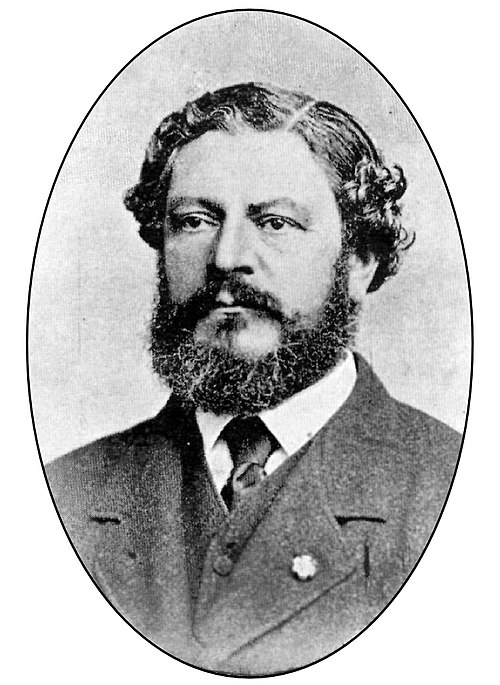
Pantazi Ghica was born on March 15, 1831. He was the twelfth of fifteen children of Prince Dimitrie Ghica and Maria Campineanu, who descended from the noble Campineanu family. Ion, Pantazi, Themistokle, and Maria were the only four children who survived; the others passed away.
Like his brothers and sisters, Pantazi began his studies at Saint Sava College in Bucharest. Later, he went to Paris and stayed there with his mother. Pantazi became a politician and jurist, and was also recognized as a poet, writer, playwright, literary critic, essayist, comedian, satirist, and more. He began his political career as a participant in the Wallachian Revolution of 1848 and was a member of the radical group led by Rosetti. Although he was twice involved in the administration of Buzau County, Pantazi spent most of his time in exile or in Bucharest.
After 1875, Pantazi Ghica became one of the leaders of the Liberal Party. Although generally viewed as an average writer, he was noted for his close relationships with writers such as Nicolae Filimon, Vasile Alecsandri, Dimitrie Bolintineanu, Alexandru Odobescu, and Alexandru Macedonski, as well as for his long-standing polemic with the conservative literary association “Junimea.”
Ghica’s works and political convictions were often criticized by Junimist intellectuals such as Titu Maiorescu, Mihai Eminescu, and Ion Luca Caragiale. He was one of those liberal politicians referred to in Eminescu’s poem “Scrisoara III” (Third Letter).
Around 1850, Pantazi fell in love with Camila de Fernex. Their wedding ceremony took place in the Greek Orthodox Church of Marseille. The Ghica brothers returned to Bucharest separately. Their return home coincided with the outbreak of the Crimean War. Pantazi Ghica joined the Ottoman army and served as a yuzbashi (captain) in the Cossack troops. Decorated and highly regarded, he returned to Bucharest. With the Treaty of Paris, Wallachia was allowed to have a new administration.
Prosecutor, Lawyer, and Journalist
In the years 1856–1858, Pantazi became a prosecutor for Dambovita County before moving into private practice as a lawyer. He became involved in politics and emerged as one of the most prominent liberal activists, associated with the more radical wing led by Rosetti. This occurred during the time of the union of Wallachia and Moldavia under the rule of Prince Alexander John Cuza.
Following the election of Prince Cuza, Ghica entered the civil service, becoming an inspector in the Ministry of Justice and later a Department Director in the Ministry of Foreign Affairs. He returned to his legal profession and, in 1861, became the legal representative for individuals arrested during the anti-unionist riots in Craiova.
A year later, he was appointed legal representative at the Ministry of Education. In 1859, together with Dimitrie Bolintineanu, he published the magazine Dambovita, but its articles soon caused a scandal, and Pantazi was arrested for a lack of ethics in his publication. He shared a cell with his colleague Orasanu, a staunch opponent of King Carol’s rule. Pantazi became friends with writer Alexander Odobescu and later, in 1861, collaborated with his literary magazine, Revista Romana. During these years, Pantazi Ghica also published two satirical magazines, Pacala and Scranciobul.
In 1863, Pantazi went to Moldavia, where he initially visited his cousin, Cleopatra Ghica, who was married into the Russian Trubetskoy family. There, he also participated in the activities of Moldavian writer Iacob Negruzzi, whom he had introduced to Rosetti’s circle. Starting in 1870, Ghica published several articles in Rosetti’s magazine, Romanul. During this period, he began publishing his literary pieces in Revista Contimporana.
In 1866, the ruler Cuza was replaced by Carol of Hohenzollern. Pantazi Ghica had played a secondary role in the efforts to overthrow Cuza as a local commander of the Civic Guard. He was given the post of Prefect of Buzau County. The appointment was welcomed by Vasile Alecsandri, who had maintained a long correspondence with both Ghica brothers. His tenure in office was short due to King Carol’s antipathy toward him. He returned to Bucharest and purchased a villa on Cometei Street. In the capital, he acted as Alecsandri’s representative in a legal conflict with peasants who had encroached on his properties.
His Final Years: Pantazi Ghica’s villa in Bucharest became a meeting place for many literary personalities of the time. Ghica was closely associated with the symbolist poet Alexandru Macedonski, who lived nearby. Pantazi became a deputy and later a senator, representing the Liberals and, toward the end of his life, the National Liberals. Pantazi Ghica died at his home on Cometei Street on July 17, 1882. He was buried in the family cemetery in Ghergani. He was survived by his daughter, Camila Ghica, who died in 1908 at the age of eighty.
Albert Ghica
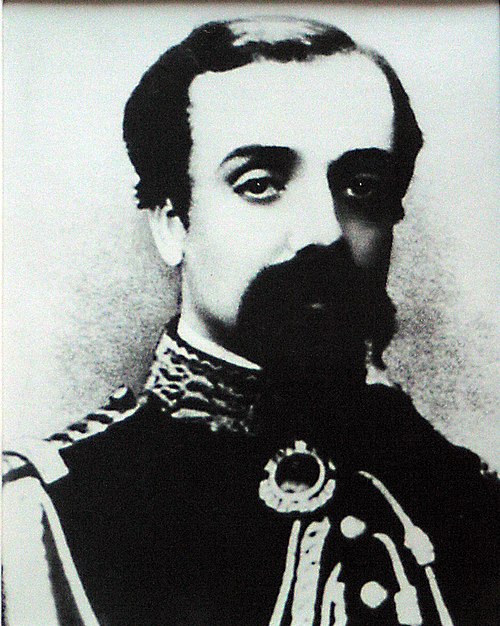
Albert Ghica is the member of the Ghica lineage who was extensively involved in the Albanian cause. Under his leadership, a nationwide congress of Albanians was held in Bucharest. He collaborated with Albanian patriotic circles in exile and with patriots living and active within Albania. In November 1902, he formed an Albanian committee in Paris and established contact with prominent Albanians living across Europe, America, and Egypt.
The political program of the Albanian Committee of Paris initially envisioned good relations between Albanians and the Ottoman Empire, but after Ghica’s visit to Istanbul, he became convinced that good relations with the Sublime Porte were not in the interest of Albanians. Albert Ghica was a very energetic man with ambitions to engage in Albanian politics.
To secure support, he traveled extensively throughout Europe, meeting many people. Toward the end of 1904, he went to England, and in early 1905, to Italy and Montenegro. He was among the first to declare his ambitions to become the King of independent Albania. Based on his claims as a leader of the nation, in 1909, he sought autonomy for Albania. In 1911, he reappeared on the political stage with a declaration addressed to the Great Powers, informing them of the Albanian uprising and publishing a draft constitution for an autonomous Albania. After the declaration of independence, he officially appeared as one of the contenders for the Albanian royal throne.
Vladimir Ghica
Vladimir Ghica was born on December 25, 1873. He was a diplomat and essayist, and after converting from Orthodoxy to Catholicism, he became a priest. He served in Transylvania, home to two million Catholics organized into seven dioceses. He eventually became the head of the Episcopal Conference of Romania. After the establishment of the communist regime in Romania, he was arrested and died in prison from torture on May 17, 1954. In his honor, the Center for Catholic Studies in Romania bears his name.
Dimitrie J. Ghica
Dimitrie J. Ghica was born in 1875 in Bucharest. He served as a minister from 1919 to 1922.
Matila Costiesco Ghica
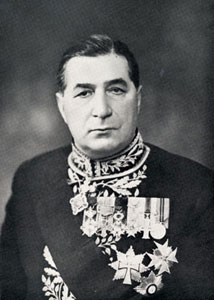
Matila Ghica was born on September 13, 1881, in Iasi, Romania, and belonged to the noble Ghica family through his mother. His parents were Matila Costiescu and Maria Ghica. He was the great-grandson of Grigore Alexandru Ghica, the last prince of Moldavia.
He initially studied at the Jesuit college in Jersey, then at the French Naval Academy in Brest, the Higher School of Electricity in Paris, and finally at the Faculty of Law at the Free University of Brussels, where he obtained his doctorate. He joined the diplomatic service in 1910 and served in Romanian embassies across European capitals such as Rome, Berlin, London, Madrid, Paris, Vienna, and Stockholm.
He became Romania’s ambassador to Sweden and the United Kingdom. In 1918, he married Eileen O’Conor, daughter of Sir Nicholas Roderick O’Conor, former UK ambassador to the Ottoman Empire and Russia. Matila possessed a versatile background, serving as a naval officer, diplomat, writer, mathematician, aesthetician, and historian.
He was introduced to French and English literary circles by Paul Morand and Prince Antoine Bibesco. He became a friend of Marcel Proust and the poet Léon-Paul Fargue. As a frequent visitor to the literary salon of Natalie Clifford Barney, he met most of the American writers who had emigrated to Europe. Matila’s primary interest was always the synthesis of mathematics and poetry.
After the end of World War II and the establishment of the communist regime in Romania, Matila Ghica left the country and worked as a professor of aesthetics in the United States, at the University of Southern California and Mary Washington College in Virginia. Although a passionate scholar, Matila also showed interest in politics. His memoirs, published in 1961, end with a message of faith in human nature. Prince Matila Ghica died in London on July 14, 1965, two years after the death of his wife, and was buried in Gunnersbury Cemetery in London.
Works of Matila Ghica
- Esthétique des proportions (Aesthetics of Proportions, 1927)
- Le Nombre d’or (The Golden Number, 1931)
- Rain of Stars (1936)—the only novel he wrote.
- Essai sur le rythme (Essay on Rhythm, 1938), with a preface by his friend Paul Valéry.
- Tour of the Philosophical Horizon (1946)
- The Magic of the Verb (1949)
- A Documentary Chronology of Romanian History from Prehistoric Periods to the Present Day (1941)
- The Geometry of Art and Life (1946)
- A Handbook of Practical Geometry (1952)
- Philosophy and Mysticism of Numbers (1952)
- Matila Ghica: Memoirs (1961)