

Part One
Memorie.al / In 1956, clashes began within the Communist Party led by Enver Hoxha. According to a declassified CIA document, many members expressed reservations about the party’s policies. They demanded accountability from Beqir Balluku, who urgently telephoned Mehmet Shehu and Enver Hoxha, who were in Shkodër and Vlorë. On the other hand, it is shown how Tropoja turned into a strong center of espionage.
October 1949
The Balkan situation
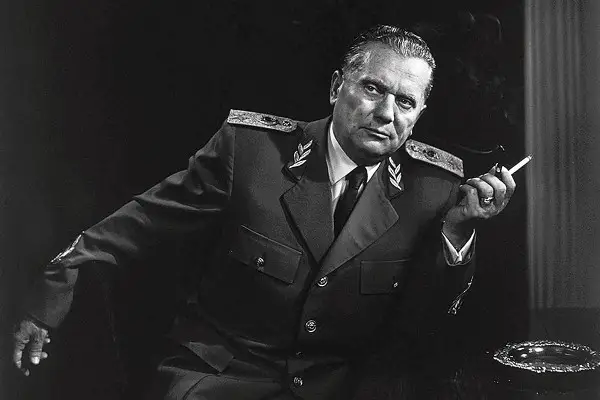
The Soviet war of nerves against Tito has already brought about the annulment of the friendship agreement with Yugoslavia and is showing the consequences of Tito’s desertion from the structure of Soviet communism. Tito’s successful challenge is turning into a focal point for dissident communist groups and could become a means of uniting an anti-Stalinist front. The question certainly is whether world communism will be directed politically by the USSR, or by an international party apparatus.
Tito has cast doubts on the leadership capability of the USSR, presenting his style of leadership as more benevolent. This point of tension in Yugoslav-USSR relations has brought a change in the situation in the Balkans. The Soviet Union may generate anti-Yugoslav policies in many directions, such as from Hungary, Bulgaria, Romania and Albania. But this capacity may be hindered by a certain rapprochement between Yugoslavia and Greece as well as by the uncertainty of the Albanian position. But the USSR may act for this by exploiting antagonistic nationalisms, which may focus on Macedonia.
Several months ago, when the taking of control by Greek communist guerrillas began, signs were noticed of the beginning of Soviet unrest in Macedonia, or and of the incitement of nationalism of Albanians in Kosovo and other minorities. The Greek guerrillas are already reduced to only 2,500 in Greece and their withdrawal from neighboring countries such as Albania and Bulgaria shows that there will be no organized operations. Already the guerrillas no longer have the capacities to negotiate with the Greek government. The latter already have confidence in their strength and had requested the pursuit of the communists beyond the Albanian border, but this would have brought old territorial revenges and was stopped by the Americans and the British.
Already the Greek government is pledged not to act against Albania but has requested from the UN the investigation of any new infiltration of guerrillas from Albania and Bulgaria. During these developments, both Greece and Yugoslavia, prompted by the USA, have improved their positions by reducing the USSR’s capabilities to achieve something in Greece. Therefore Moscow is also diverting attention from the guerrilla effort in Greece, perhaps to organize it this time toward Yugoslavia.
The re-focusing of efforts to incite the old Slav-Macedonian aspirations would serve a double purpose. On the one hand it would try to harm Tito and the Yugoslav federation, with which the Slav-Macedonians have joined, and on the other hand the guerrilla-trained units in Macedonia could also threaten Greece if the need arises.
21 August 1950
The situation of resistance in Albania
From one of our missions in Albania, which is in close contact with the resistance movement, we have received the information elaborated in the following paragraphs. According to our mission, many members of the Albanian resistance believe that they can no longer endure the sufferings they are undergoing and have decided to escape toward Yugoslavia, at the first opportunity. They would prefer to go to Greece, if it were not for the long distance from northern Albania to the Greek border. Despite the efforts made to convince them to stay in Albania, it is clear that they cannot stay another winter in the mountains, as life is so difficult that it is driving them toward madness.
Tropoja, center of espionage
The leader of this mission has sought to know whether the Yugoslav political activists in Albania (previously reported to you) are known by us and whether they represent the Allies’ effort. They also asked whether anti-communist activists from Albania would be well received in Yugoslavia. Regarding Yugoslav support to the allies, it was asked what was Yugoslavia’s policy regarding Korea.
The above message informs us that Tropoja is the center of Albanian and Yugoslav espionage, with Yugoslav and Albanian agents constantly crossing the border. The Yugoslav agents are described as having all previously been members of Albanian resistance groups. On 10 August 1950, our mission in the country sends a contact to investigate the invitation to meet an unidentified person who wished to supply the mission with Yugoslav weapons and ammunition.
The movements of the Yugoslavs
Among the populations of Northern Albania there is a great conviction that the Yugoslavs are planning an armed movement in Albania, with the aim of raising the morale of the mountain resistance groups. Some quantities of weapons are reported to have been distributed every day by the Yugoslavs, which have also been accepted by Albanian nationalists, to whom they had also approached before, but who refused waiting for approval from our mission. The leader of the mission fears that such a generosity on the part of the Yugoslavs will have the effect of gaining the sympathy of many persons who have suffered greatly working for us. In conclusion, the leader of the mission said that his convincing work would not be sufficient; therefore he needed urgent instructions on the manner of action he should follow.
March 1957
The polemics among the members of the Central Committee
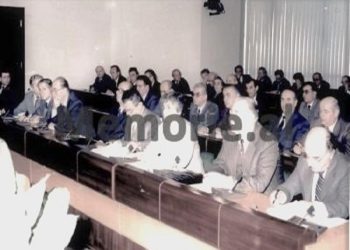
At a meeting of the party’s Central Committee in Tirana in the spring of 1956, the delegates of Tirana expressed harsh criticisms against the Central Committee and against the policies of the Communist Party. The meeting had a preparatory nature for the party congress that was held in May 1956. At the meeting the government was represented by the Minister of Defense Beqir Balluku, since Enver Hoxha was in Vlorë on vacation and Mehmet Shehu was in Shkodër. Balluku was asked by the delegates to give explanations regarding the control and censorship of the press.
But he was incapable of giving an answer and felt that such questions had consequences. Therefore he telephoned Enver Hoxha and Mehmet Shehu and told them to return immediately to Tirana. The two leaders came to the meeting and tried to calm the blood of the representatives. This was done mainly by Enver Hoxha through numerous promises for the future. A day later, at the central committee meeting, Hoxha and Shehu attacked some representatives calling them traitors and reactionaries, which brought the dismissal of two generals, Hulusi Spahiu and Tahir Kadare.
Several others were transferred to areas far from the capital. The members of the party’s central committee were further sent as delegates to various areas of the country to calm the population. Mehmet Shehu was sent to Vlorë where he spoke at the meeting held in the city’s cinema, and raised the delay in the realization of the government’s plans.
The morale of the people
Dissatisfaction and anger prevail throughout Albania because of the severe economic situation. People hope that war will break out, as the only way to remove the communist regime, since the severe security measures make the starting of an internal uprising almost impossible. Although everyone knows the terrible consequences of a war, they no longer fear it, because it is the only way to bring a change toward the improvement of living conditions. Listening to foreign radio broadcasts is forbidden, those who own radios listen to the Albanian and Greek broadcasts of the “Voice of America”, the BBC and Radio-Athens.
The collectivization campaign
The government aims to complete the collectivization of agriculture by 1958 and is taking all measures. Peasants who live in the city are being asked to return to the village, to implement the agricultural projects. In general all the government’s efforts are being focused on the improvement of agriculture and agricultural production. In the area of Vlorë 4 cooperatives have been organized which have about 25-30,000 sheep. Its director is Hasan Muço. The cooperative also has 40 beehives, which produce about 200 kg of honey per year.
July 1957
The situation in Albania
At the meeting of the party’s Central Committee in Tirana in the spring of 1956, criticisms were made against some party members, and as a result some of the delegates were accused as traitors and reactionaries. General Hulusi Spahiu and Tahir Kadare were dismissed. In October 1956, an infantry military unit of Vlorë was moved and its troops were distributed to other units in Gjirokastër, Korçë, Përmet and Shkodër. In the barracks of Vlorë remain about 150 people. The purpose of the movements is believed to have been the reinforcement of the Greek and Yugoslav borders.
An artillery military group is placed about 1000 m. south of Vlorë. Its commander is Vasil Xhelo from Himara. From the beginning of February 1957 until the beginning of March, mobilization exercises of reservists and light training have been developed. The infantry barracks of Vlorë are placed on the eastern side of the road toward the Port, 500 m. from the latter and 1500 meters from the city center. Vlora has a section of the Internal Branch, which is directed by the chief of Security, Petrit Hakani and his deputy, Skënder Paisi from Vlora.
The Naval Fleet of Vlorë has 2-3 fast boats that patrol the bay of Vlorë and the island of Sazan. Its air defense consists of 4-8 artillery guns of 20 mm. calibers placed on the hill above the city in Kuzbaba, while four 37 mm. cannons are placed in the artillery barracks of Vlorë. Near the aviation field there are also four other cannons of the same size.
Education
Vlora has a gymnasium, which has been given the name of the hero Ali Demi. In Poliçan there is a 4-year elementary school and a 3-year school called Unike. The students of the elementary school learn Greek and few hours are devoted to Albanian. On the contrary, in the program of the Unike School, Albanian is mainly learned and few hours are devoted to Greek.
Belief
Vlora has two Orthodox churches and three priests and church services are held on Sundays and feast days. Mainly the elderly participate in the Sunday services while on Orthodox feast days the churches are filled with people. Even on religious feast days communists come to church to draw the attention of the people with political discussions. In general religious feelings remain strong despite the communist oppression and measures. Many families that own radios listen to church services. In Vlorë there is also a Catholic church and a priest. Few people go to this church since most of the Christians are not Catholic.
In Vlorë there are four mosques but only three of them are used as churches, one has been turned into an archaeological museum. There are also some small mosques but few people go to them. The civil hospital of Vlorë is located in the northeast of the city and consists of five buildings, respectively for the treatment of infectious diseases, surgery, children’s diseases, women’s, etc. the hospital has six doctors and about 150 beds. The city also has a maternity house. Insured citizens are treated free of charge in the hospital.
March 1975
The Albanian editorial condemns the Soviet army
The Albanian anti-Soviet campaign must have reached new heights, as Tirana is accusing Moscow of transforming the Soviet army into an “aggressive, putschist, fascist” force. The editorial was published in the party’s daily and was titled “The Soviet army, army of occupation and oppression of peoples”. The following quotations are the typical tone of the article: “The Soviet army is now in the hands of the bourgeoisie and serves the consolidation and domination of imperialist aims.
The revisionists have transformed it from a revolutionary army as it was created by Lenin and Stalin 57 years ago, into an army of counter-revolution and of the dictatorship of the bourgeoisie … it has now become an aggressive army of occupation and oppression of peoples”. This barbaric aggression of the Soviet army against the Czechoslovak people, is the first demonstration of the aggressive, chauvinist and fascist policy, as well as a signal of the beginning of the offensive against the freedom and independence of peoples.
“With the aim of the complete enslavement of the revisionist countries of Eastern Europe both politically and militarily, the neo-tsarist leaders of the Kremlin and their generals have sought the increase of military maneuvers”, it was said there. Further it was declared: “The Soviet army is silently reinforcing the military occupation of Poland, Hungary, East Germany, Bulgaria and Mongolia, where it possesses a special status, which only an aggressive occupying army can have”. Tirana has no need for special provocations for explosions like these, since for Hoxha’s regime these things arise naturally.
But the Albanians certainly react to any signal of the growth of Soviet interest in the Balkans, especially in Yugoslavia, to which Hoxha has recently promised help in repelling any possible Soviet attack. Now that Yugoslavia has raised the second issue in six months against the satellite countries, Tirana can make even sharper accusations against the Kremlin. Meanwhile between Belgrade and Tirana discussions are continuing for the construction of the railway line, which would be Albania’s first connection with Europe.
The Belgrade-Bari line represents an old dream of the Serbs and Montenegrins and has been under construction for a decade. It is expected to be completed in 1976 but has encountered difficulties due to the difficult terrain. Its extension also to the Albanian border is relatively simple and most of the problems are only political, such as may be the convincing of xenophobic Albanians about the economic advantages of connection with the outside world. The government believes that this opening may expose the country to the “corrupting influences” of the foreign world.
China, which seeks to reduce Soviet influence in the region, is ready to finance the project, not only with the construction of the Albanian part of the railway, but is reported to have offered a credit of 75 million dollars to Belgrade, to finance also its part. The Chinese apparently believe that this will increase their influence in the Adriatic area, where they think the Soviets seek the establishment of naval bases. China may consider the step as an opportunity for the improvement of Yugoslav military transport in the area. / Memorie.al
Continues in the next issue