By UVIL ZAJMI
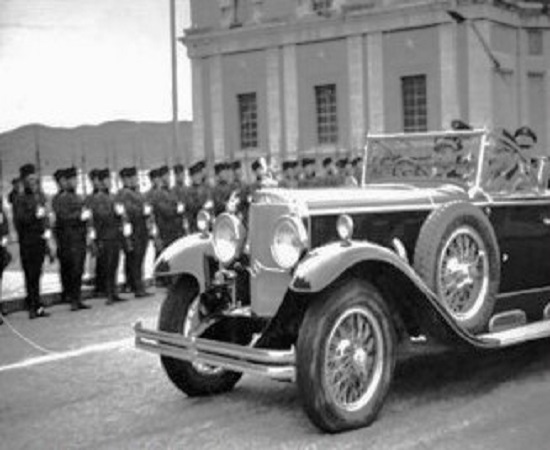
Memorie.al/ Although the road network in Albania, especially after the First World War, was problematic, both urban public transport within the city and intercity transport functioned with an organization that was normal for the time, including even air transport. In the South, movement took place on military roads opened by the Italian army, while during the years of the Kingdom; we see greater expansion and more functional movement, with regulations and the opening of new roads. In fact, the first highway, Tirana–Durrës, along the Erzen River, was even in the project phase, but it was never realized. Until the end of the 1930s, and also during the Italian occupation, transport was organized by several companies: “SATA”, with modern Italian buses of the time, the “Fiat 626” and “RNL 626”; “SAUD Adriatik”; “CIDA”, the Albanian automobile society for the Tirana–Durrës route; “SAKAS” for inner-city urban routes; “VERMOSHI” for Tirana–Shkodër; the “Kosova” agency of Zija Beqaj for the Tirana–Korçë–Struga–Prizren line; as well as the two Italian agencies “TRUÇHI” and “SAN MARCO”.
Meanwhile, “Kadesha” was the ticket sales agency, and Cen Basha had the travelers’ company that ensured daily Tirana–Vlorë and vice versa, with cars that were his own property, just as there was the one with daily buses from Tirana to Durrës, or from the airport (today the “Our Lady of Good Counsel” University) to “Rruga e Elbasanit”, where buses of well-known brands were used, among them “Diamond”.
FROM TIRANA TO ALL OF ALBANIA, THE HISTORICAL AGENCY OF THE CAPITAL
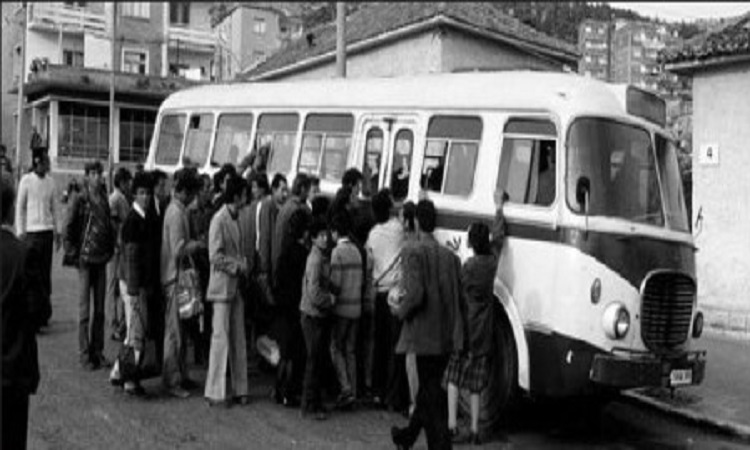
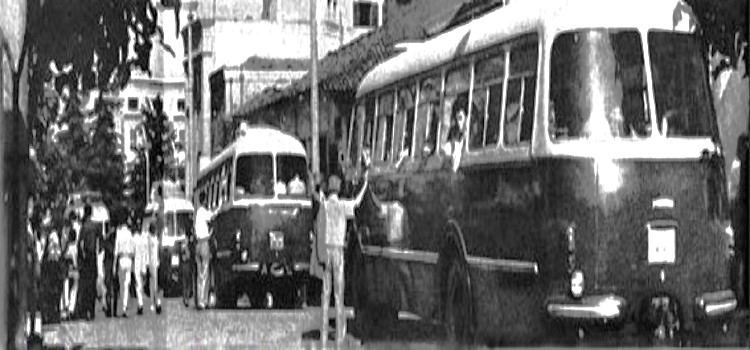
The Passenger Transport Agency in Tirana has been and remains unique for the very history of travel in Albania. For many years, from that one-story building near the Clock Tower, adjacent to “Vollga” (later “Drini”), every morning around 7:00 AM, the buses of all lines would set off, along with the travelers, their luggage, and the family members who came to see them off – but also to welcome them when the buses arrived back in Tirana at midday.
The flow was heavy at the beginning or end of the school year for students, as well as during various holidays, especially the end-of-year ones, when the number of travelers increased because everyone wanted to return to their families. With only a few buses offering 48 or 54 seats, running once a day, it was nearly impossible to meet the demand.
It took a long time to secure a ticket – you had to stand in line from midnight at the doors and the two counters of the Agency, which were divided by an iron bar in the middle: one counter for the North and the other for the South. The ticket office operated from 08:00 to 13:00 and from 16:00 to 19:00, and the most famous ticket seller was Fatimja, an energetic woman who handled the North, working there in winter and summer in that environment without proper conditions, heated only by a wood- or coal-burning stove. Alongside her was Naze Gërbi, for the buses heading to the South.
This building has remained unchanged to this day, well preserving its former structure. In Shkodër, the agency – as the stopping and arrival point for buses – was at the beginning of the road to Rus; in Korçë, near the market; in Gjirokastër, at the Tourism office; in Vlorë, at the old Tourism office; in Kukës, at the city exit at the Morinë – Bicaj intersection; in Peshkopi, at the square after the bridge and before entering the city; and so on. Even in these agencies, securing a ticket was difficult, just as in Tirana, especially during peak rush times. The price of an inter-urban ticket was: 1 lek per kilometer.
A DAY’S JOURNEY WITHOUT BUDGING
Those were journeys on difficult, exhausting, and dangerous roads, with extended hours and no comfort – an eternity to reach your destination when you had to cross passes like Qafa e Buallit, Llogara, Qafë-Thanë, Kërrabë, and so on, even more so in winter. And for a breakdown or a tire change, it would take hours, because everything was handled by the drivers themselves, often even with the help of the passengers. When the lines were direct, such as Tirana–Shkodër, you would necessarily pass through Milot, Zog’s Bridge, stop for a coffee in Zejmen, then continue along the road of Gjadër – before it became a military zone – until it was diverted via Torovica, often accompanied by a quick stop in cases where someone got off to go to the Torovica prison.
Likewise, on the direct lines from Tirana to Kukës, Pukë, Bajram Curri, and Peshkopi, the first stop was made at “Marie’s Cafe” in Milot, known for its coffee with finjë (traditional froth). Then came the stop at Qafë e Malit, and at the curves of Shpal, to drop off family members going to the Spaç prison. (There were cases where the bus would be followed by the traffic police, to see which person got off – both to take note and to warn the driver not to pick up people who intended to get off there.) Likewise, from Tirana to the southeast – Pogradec, Korçë – as well as to the South on long distances to Sarandë, Gjirokastër, and Përmet, there was a stop at Uji i Ftohtë in Tepelenë, after having passed the grueling curves of Ballsh.
TRAIN-BUS, INTERCHANGEABLY
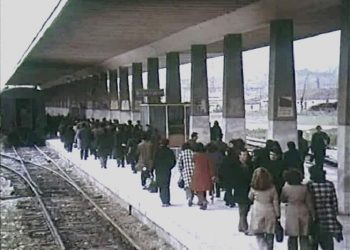
With the operation of the dual train-bus system – mainly when the train arrived at the Laç station, then in Milot and Mjedë (and vice versa) – buses would pick up passengers at the train station to continue toward the North and Northeast. Or there was the Tirana–Librazhd line, then on to Guri i Kuq, and from there by bus (twice a day) toward Pogradec, to arrive at midnight in Korçë. Even the Tirana–Ballsh train line (inaugurated in March 1975) was an intensive route with heavy traffic, and in Ballsh a great commotion would arise as people tried to continue by bus to the South.
The same scheme applied with the train to Lushnje or Fier, and then by bus to Berat, Kuçovë, Vlorë, Himarë, etc. Even when buses began departing from train stations, tickets still had to be secured from the Tirana agency or from the city where you started your journey, since only a small contingent of tickets was available for sale at the stations themselves. To buy a ticket, passengers would jump off the train before it had even fully stopped and run toward the counters. This created a chaotic scramble that in many cases required police intervention.
DRIVERS, HUMANE AND POPULAR FIGURES
On the other hand, you often had to plead with the driver to take you. For this reason, drivers played a major role and were very popular figures in their cities, and they have their own humane share in this history of travel: with the “Vibert” bus on the Tirana–Laç–Shkodër line, Mustafa Toska – or “Faja” as he was called—was one of the generous drivers; or Zija Kërçova, the veteran of the Tirana – Peshkopi route; Petrit Laknori, the driver with the “Korosa” on the Kukës line.
To take passengers without tickets, they had devised a plank that served as a seat between two benches, they would seat people on the hood, on the middle seats that the Shkodër buses had, and also let them stand for hours. It was enough just to get moving. Even the traffic police had grown accustomed to these “inventions” of the drivers.
FROM THE KING’S BRIDGE…
The most famous of all remains the Bridge over the Mat River, or “Zog’s Bridge,” which connected Albania with its northern part. Construction began in 1925 according to the project of Engineer Back, executed by Ervin Schnitter of the Italian company “Mazorana & Co,” and was carried out by the Albanian engineer Gjovalin Gjadri, who had graduated in Vienna. It was inaugurated on May 26, 1926. With six large concrete arches, each 54 meters long, this bridge, running north–south, was over 300 meters long and had a single lane, so buses and vehicles had to wait at the entrances at both ends, taking their turn until one side cleared.
There were cases when suddenly the police would organize passport checks, stop the buses in the middle of the bridge, thereby cutting off any chance of escape for “suspected” individuals. Until the parallel bridge was built, Zog’s Bridge bore the entire road load of vehicles of various tonnages that had to cross the Mat River, resisting time, natural changes, and everything else.
…TO THE POLICE CHECKPOINT AT BAHÇALLËK
The Bahçallëk Bridge, over the Drin River before entering Shkodër – inaugurated on February 4, 1914 – remains the first and only metal bridge. Every vehicle that crossed it would undergo a “passport check” by the police. At its head, on the city side, there was a police cabin, and as soon as vehicles – mainly buses – crossed the bridge, they were obliged to stop. A policeman would board and, one by one, check and verify the passports of every passenger; whenever he had suspicions, he would even ask them where they were going.
It was a ritual reserved only for when you went to Shkodër, and it was done to “uncover” suspicious persons trying to flee. Likewise, the bridge over the Drin in Lezhë, the Mifoli Bridge over the Vjosa, the one that takes you to Përmet and back, etc., have all been very important, but on these bridges, police passport checks were organized only on sporadic occasions.
URBAN TRANSPORT IN TIRANA: BUSES, TAXIS, AND HORSE-DRAWN CARRIAGES
Urban transport in Tirana – as well as in the main cities of Albania – in the pre-liberation years operated on small segments from the center to the periphery and back, while after the war it saw great expansion, especially in Tirana. Initially, the routes were: Bankë – Textile Combine “Stalin”; Bankë – Kinostudio; and Bankë – Laprakë.
Years later, the direct line Kinostudio–Kombinat was introduced, while the other two remained unchanged. With the construction of the apartment block at “Varri i Bamit” and the creation of the Artistic Enterprise “Migjeni,” the Bankë–Porcelan line began, followed by Bankë–Tractor Factory and Bankë–Rruga Ura, since a large part of the capital’s population worked at these giant industrial sites -even in three shifts—and their daily commute had to be ensured. The Maternitet–Tirana e Re line and the Great Ring line were also set up.
Service started at 5:00 AM, initially with only a few buses, the number of which increased as the flow of people going to work and school grew, while on Sundays their number was reduced. The line to Kinostudio had the heaviest traffic, since people would get off at the Hospital. After 10:00 PM, bus movement began to be restricted and their frequency was reduced to every half hour. The very last one was at 12:25 AM after midnight.
FROM “VIBERTI” TO “SKODA,” “KOROSA,” AND THE ACCORDION BUSES
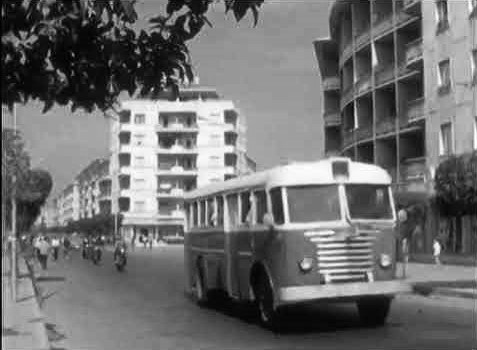
Based on the initials “SATA” (Società Automobilistica Tecnologie Avanzate, or Societa Albanese Transporti Automobilistiche) of the Fiat Company – “…Erdhi Sata…” (“Here comes Sata”) – the capital’s residents knew the “Viberti” buses by this name, which were rumored to have been given as war reparations from Italy. Cherry-red in color, with the steering wheel on the right-hand side, they were among the main vehicles for Tirana’s urban service for many years.
Also distinctive were the buses with trailers – an additional attachment that came from the East, equipped with two long benches and an electric cable by which the trailer conductor communicated with the driver during stops at stations. Later, buses and vehicles from Eastern production flooded in, mainly Romanian, Czech, and Polish, exchanged through “Clearing” (a form of trade) – such as “Ikarus,” “Korosa,” and “Skoda” – while the “Saviem” buses appeared in the 1980s and came from France for the Tirana e Re line.
Then came the accordion-style buses (articulated buses), a product of the NSHRAK factory in Shkodër, which were used all over Albania, mainly for urban lines. The drivers, and especially the bus conductors, were well-known figures, since they were always assigned to the same line. An urban ticket cost three lekë, and on the buses one could read slogans such as: “No tips accepted”; “Tipping is a foreign bourgeois custom”; or “Do not talk to the driver.” With the appearance of “Iliria” radios, drivers would place one next to the steering wheel to listen to music or the program “From One Match to the Next.”
THE FAMOUS STATIONS OF THE CAPITAL
For the Kinostudio line, buses departed next to the Bankë building, while for Kombinat they left from across the way, near “Kursal,” where there was also a bus dispatcher. For Laprakë, the bus stops changed several times, with stops at the “Agim” pastry shop (no longer in existence today), then at “Flora,” while for the Tractor Factory and Porcelan, the stop was at the Clock Tower or the Unknown Soldier monument.
Along the boulevard, the Tirana e Re line operated, which started from the Train Station, with its main stop at Skënderbeu Square and the University Bookstore, while the Great Ring line had no fixed start or end point. The famous stops in Tirana were: the stop at the “Mihal Duri” Facility, “21 Dhjetori,” the “Enver” Factory, the Food Combine, “Misto Mame,” while on the other side: Selvija, the Medrese, the Hospital, the United School, and Rruga Ura. The Laprakë line had the Party School, while the “Traktori” Factory line had “Ali Demi” and the Polygraphic Institute.
TAXIS AND THE FREQUENTED HORSE-DRAWN CARRIAGES
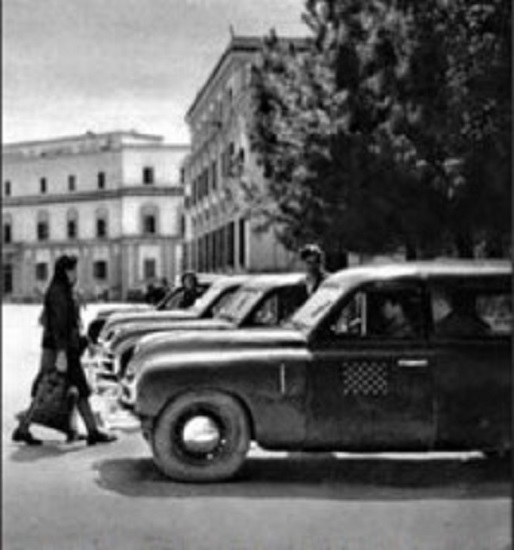
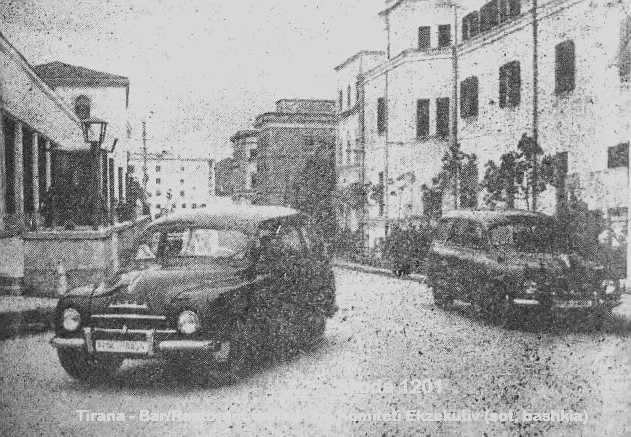
Taxi service, both urban and inter-urban, was widely used not only in the pre-war years with the vehicles of the time, but also after liberation. As for brands, besides the leftover Italian ones, there were those from Eastern countries: German “Ifa”s, “Moskvič,” “Pobeda,” “Warszawa,” “Skoda” (with manual gear shift), and later Polish “Fiat” models, etc. In Tirana, their traditional base was the spot opposite the Puppet Theater. Fares were 3 lekë per kilometer. Maria was a well-known figure in the capital, just as Afërdita Shqau was in Elbasan, as the only female taxi drivers.
Likewise, horse-drawn carriages, widely frequented mainly in Tirana and a few elite cities before and after the 1940s, were preferred not only by well-known families, personalities of the time, and public figures, but also by the general population. With a decorated carriage, a removable cover, well-dressed coachmen—even sporting a top hat on holidays—the carriage was used for pleasure rides, at family events, and so on. They also had their own stations: near the “International” Hotel, at the Train Station, and at the “Kongresi i Përmetit” School on “Rruga e Dibrës.”
A carriage ride cost up to 10 lekë. The carriages were phased out in the mid-1960s–70s, being considered a luxury incompatible with the socialist system then under construction. Only taxis were allowed, and urban and inter-urban transport and service were carried out with state-owned vehicles and organized by the state. The Delegations Park was established and operated for a long time, housing the vehicles used to receive foreign delegations and dignitaries. This continued until 1990, after which everything changed…! / Memorie.al