By Isuf Bajrami
“Çams love their country with enthusiasm. When they speak of it, they place it above other countries. Their gaze always turns to the mountains of Epirus.”
POUQUEVILLE, in “Voyage”, Vol. I, Ch. 29
– The decision for the displacement of the Cham population to Asia –
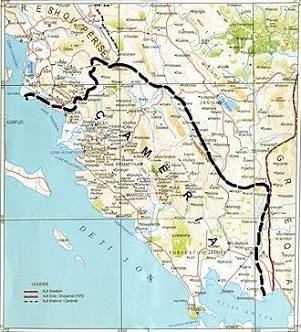
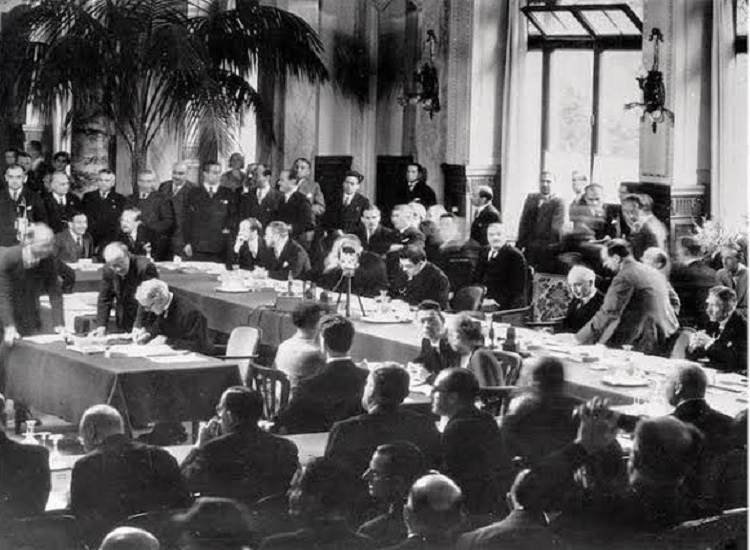
Memorie.al / On January 23, 1923, the Treaty of Lausanne was signed. In its final article, the exchange of the Turkish population in Greece with the Greek population in Turkey was stipulated. This commitment was confirmed several times by the Greek government. But in an unlawful manner, many violent efforts were made by the Greek government and the local administration to include Muslim Albanians of Albanian nationality in the exchange and send them to Asia Minor. It had already become clear to everyone that an entire strategy had been planned for the expropriation and colonization of Albanian properties with Greek refugees who had arrived from Asia Minor.
In support of this idea, the Greek Ministry of Agriculture, on October 1, 1922, by means of a Circular, ordered the general administration of Epirus that “…the families of refugees be settled on the properties of Muslim Albanians,” (AYE/A/5 (9). (Governor General of Epirus, Greek Ministry of Foreign Affairs, Ioannina, March 2, 1923). At the same time, by order, the displacement of the Chams from their homes and lands began. Here is how Krapsites writes:
On January 23, 1923, the Treaty of Lausanne was signed. In its final article, the exchange of the Turkish population in Greece with the Greek population in Turkey was stipulated. This commitment was confirmed several times by the Greek government. But in an unlawful manner, many violent efforts were made by the Greek government and the local administration to include Muslim Albanians of Albanian nationality in the exchange and send them to Asia Minor. It had already become clear to everyone that an entire strategy had been planned for the expropriation and colonization of Albanian properties with Greek refugees who had arrived from Asia Minor.
In support of this idea, the Greek Ministry of Agriculture, on October 1, 1922, by means of a Circular, ordered the general administration of Epirus that “…the families of refugees be settled on the properties of Muslim Albanians,” (AYE/A/5 (9). (Governor General of Epirus, Greek Ministry of Foreign Affairs, Ioannina, March 2, 1923). At the same time, by order, the displacement of the Chams from their homes and lands began. Here is how Krapsites writes:
“The Greek government had planned to settle in the region of Chameria, on the properties of Albanians, 18,000 Greek refugees who had arrived from Asia Minor. Meanwhile, contingents of Greek colonists had begun to settle in the villages of Gardhiq, Dhragomi, Karbunarë, Vole, Niste, Arpicë, etc. Thus, for example, in the village of Arpicë, out of the 300 houses that the village had, 250 had been occupied by the refugees, while the Albanians were forced to accommodate 3-4 families in one house. (Vas. Krapsites, “Oi Mousolmanoi tsamides tis Thesprotias”, Athens, 1986, p. 33).
Also in the Muslim villages of Shkalla (Filat), such as in Picar, Muzhakë, Sollopi, Pjadhul and Sklav, the houses and properties of the Muslims were forcibly seized by the Greek refugees. On February 15, 1923, another decree was issued regarding the settlement of landless Christians, according to which public lands and those owned by Muslim Albanians would be distributed to settle the refugees.
The expropriation law was based on the Greek Constitution of 1911 and entered into force before 1923. This law was nothing other than an official robbery and was sufficient to leave the Albanians without bread and to force them to leave Chameria, (“Oi Mousolmanoi tsamides tis Thesprotias”, Athens, 1986, p. 33)…
Violence against the Cham population
In the scenario of Greek violence, the most affected was the Cham population of Muslim faith. Here is how it is documented in the AQSH [Central State Archive]: “…Before the Commission arrived in Chameria (at the beginning of 1924), Greek bands led by the Cretan Jani Mandi, Kollovci, Nikolla Qamo, Harilla and Vasil Mastora, exerted pressure on the Muslim population to declare to the Commission that they were Turks and wanted to be exchanged, (AQSH, Fund 251, year 1923, “Documents for Chameria”, doc. 183, p. 285).
When the Mixed Commission arrived in Preveza, the officials of the Greek local administration used every format so that the representatives of Chameria would not contact the members of the Mixed Commission, in order to present the demands on behalf of the Cham population. The Greek government, in order to realize its plans, launched a wave of arrests and the isolation of the representatives of Chameria. Here is how this fact is reflected in the AQSH: “The first blow against Albanian patriots began in the main centers of Chameria: in Filat, Margëlliç, Gumenicë, Paramithi and Parga.
In the prisons of Ioannina and in the internment camps, the most honest people of Chameria languished, such as Musa Demi, the Mufti of Filat, Mehmet Zeqirjai, Haki Musai, Mazar Dino from Paramithia, Ymer Çapari from Luarat, Jasin Sadiku from Margëlliç, Ymer Merishi, etc…. On June 2, 1924, a certain Llucaqis tortured the inhabitants of the villages of Filat, so much so that the women and children were traumatized by the screams of the victims. The same newspaper published a correspondence with the women and children, (AQSH, ibid.).
The expulsion of the Chams in figures
Greek refugees in Cham lands. According to the archives, in 1925 and at the beginning of 1926, out of 3,419 Muslim houses in Chameria, Greek refugees were settled in 1943 in Muslim houses and in not a single Christian house. The occupation of dwellings, olive groves, vineyards, productive lands, and pastures by the Greek refugees took its final form and brought severe consequences to the economy of the Cham minority.
With the coming to power of General Pangalos, who considered neighboring Albania a possible ally against the Slavic danger, serious steps were taken toward the normalization of relations with the neighboring country. Among them, we can mention the decision to disband the Northern Epirote organizations that operated against Albania. Always in connection with the problem of the Muslim Chams, he ordered the prohibition of the further settlement of Greek refugees on their lands and proclaimed a general amnesty for all Chams imprisoned and interned by the Greek government.
Of particular importance was the decision of Pangalos’s Greek government to allow the opening of Albanian schools in the villages of Chameria. The Albanian government welcomed the Pangalos government for the breath of fresh air it gave to Albanian-Greek relations, which had long been frozen. For his part, Pangalos, in an interview given to the Albanian correspondent in Athens, on February 14, 1926, emphasized: “Athens is determined to punish any wrongdoing in Greece against the Albanian minority by some irresponsible hotheads.”
Taking the Muslim Chams in Greece under protection, Pangalos expressed the belief that the Albanian government would also maintain the same stance toward the Greek minorities in Albania. “By Greek minorities in Albania,” emphasized Pangalos in his press statement, “we understand the Greek-speakers in Southern Albania and by no means the Albanian Orthodox, who by race and nationality are masters in their own homes. We are against that erroneous theory,” he continues, “of calling every Orthodox person a Greek,” (AYE, 1926-1927-1928, B/68/6. Governor General of Epirus to the Greek Ministry of Foreign Affairs, No. 41 (secret), Ioannina, December 7, 1926).
But the overthrow of Pangalos in the summer of 1926 spoiled the climate. With the coming to power of General Kondilis, the Cham issue would become a major problem for the Greek government. Athens launched another new crusade to force the Muslims to leave for Turkey. Thus, 280 Cham families from Gardhiqi, Dhragomia, Kurtesi and from Paramithia had sought to leave their hearths and settle in Turkey. The true reasons for the departure of the Albanian Cham population: “They, in order to survive, are forced to take the road of emigration,” (Greek Archives, newspaper “Kiriks”, Ioannina, June 12, 1921)…
The criminal Metaxas adds reprisals against the Chams
Evidence of the time, but also archive documents, confirm that the government of the dictator Metaxas, in 1936, with the nationalist policy it pursued, further added discriminatory measures for the Chams. He placed all of Chameria under full surveillance. The dictator’s government, thinking that the center of Chameria, Filat, was located beyond the Kalamas River, near the Albanian-Greek border, gave priority to Gumenica as the center of Chameria. Thus, Chameria became a district and Gumenica its center.
The Metaxas government made these administrative changes because it did not see the Chams as trustworthy citizens of the Hellenic state. Sound Greek opinion noted with despair that the revenge taken by Metaxas, known for his fascist ideas against the Albanian Cham minority, would have tragic consequences, not only for the Muslim Chams but for all of Greece. In these circumstances, well-known political personalities appeared on the Greek political scene, such as the deputies of Ioannina, Jorgios Sp. Sakas and Kristo Vasili, who exposed the diabolical plans of Metaxas and his cabinet, regarding the hostile attitudes and discriminatory behavior maintained toward the Albanian minority.
The two Greek deputies were against the restriction of the rights of the Albanian minority, against its discrimination and the unjust distrust maintained toward it by the government and the administration of Epirus. The two gentleman deputies from Ioannina had had numerous occasions of contact with the Chams and had come to know well their high qualities.
This made them and many other Greeks hold toward the Muslim Albanians in Greece a stance absolutely contrary to that of the Greek government, which had sown in every Albanian family insecurity, hunger and misery, as deputy Jorgios Sp. Sakas expressed it: “Hunger and misery have covered the population of Chameria.
Those quiet subjects raise their voices in vain in all directions.” And further, deputy Sakas clarifies the true cause of this misery: “…The reason is: some time ago, the Greek government implemented the Agrarian Reform Law, expropriating their lands. Their lands were expropriated and they were left empty-handed, facing hunger. They have the right to protest,” (Greek Archive, newspaper “Kravji”, Ioannina, July 18, 1936).
Mr. Sakas, convinced that there is no means at hand to influence the change of that bitter reality, has nothing else left but to address the Greek government with a touching plea: “…In the name of the hungry people, in the name of justice and human humanitarianism, I beg the head of the government to help these compatriots, our brothers with whom we are separated only by religion, but are united by the same customs, the same past and the same history.” He concludes the article by reminding the Greek rulers that, “we must not forget that they too have rights in the Greek state,” (Greek Archive, newspaper “Kravji”, Ioannina, ibid.).
The extremely aggravated situation toward the Albanian minority in Greece continued until the eve of the Italo-Greek War. Athens had received signals from Rome that an armed conflict would be inevitable. The Italian fascist government, under the pretext that the Albanian minority in Greece had lost all its political and economic rights, threatened Greece to make improvements, otherwise it would take upon itself the protection of its rights, (Documenti Diplomatici Italiani “DDI”, Nova Serie, V.5, Doc. 429, p. 411).
End of 1940, the massive bloodshed of the Cham population
But, as would be proven later, the issue of the Albanian minority in Greece was only a pretext of Rome. The real cause was its expansion: after the occupation of Albania, on April 7, 1939, it sought to extend its occupation toward Greece. The resistance and active participation in the war against the Greek occupiers at the end of 1940 for the Cham population would not change the Hellenic scenario for the seizure of the lands and the forced displacement. / Memorie.al