




From DASHNOR KALOÇI
Part Eleven
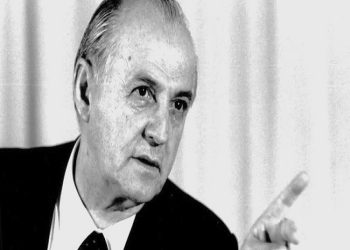
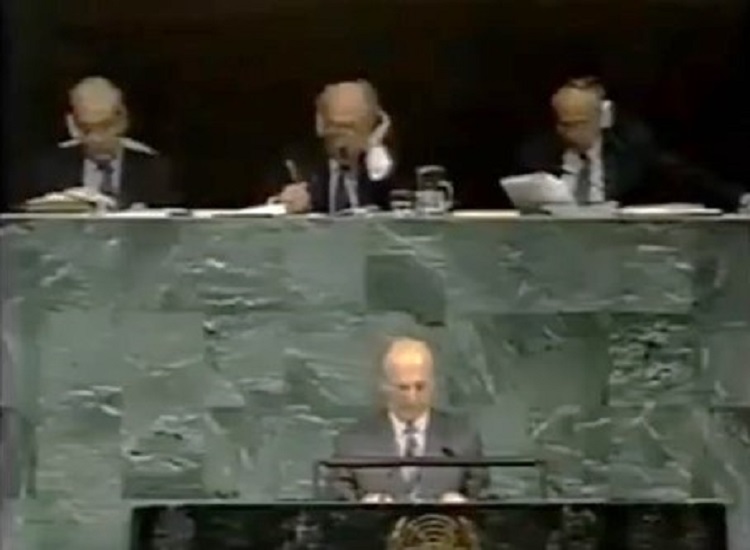
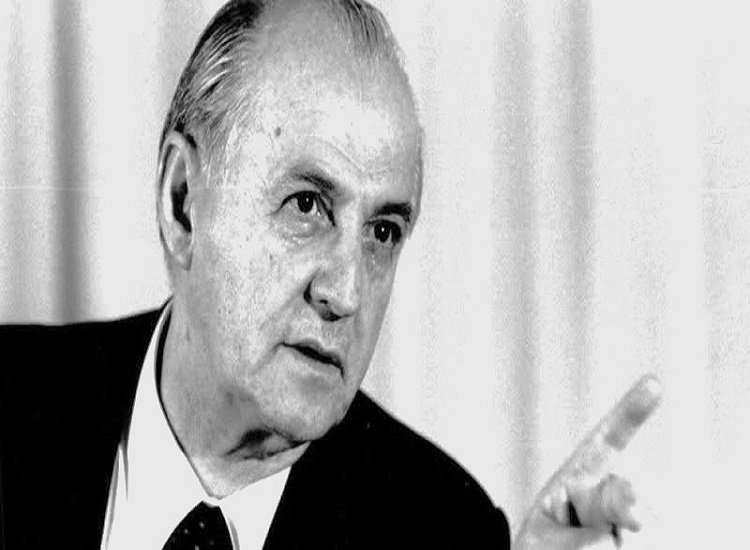
Memorie.al / A full 36 years ago, in the last week of September 1990, the head of communist Albania at that time, Ramiz Alia, who held the functions of chairman of the Presidium of the People’s Assembly, First Secretary of the Central Committee of the PLA (Party of Labour of Albania) and also Commander-in-Chief of the Armed Forces of the People’s Socialist Republic of Albania, at the head of a large delegation, set off to participate in the meeting of the United Nations General Assembly in New York. Ramiz Alia’s participation in the 45th session of the UN had a great echo at the time, not only within the country, but also in the international arena, since it was the first time that one of the main leaders of communist Albania took part in the proceedings of the UN Assembly, something which had not happened since 1961, when official Tirana was represented in that high forum of world politics and diplomacy by the prime minister of that time, Mehmet Shehu.
Even though 36 years have passed since that time, even today it continues to remain shrouded in mystery, since with the exception of some testimony of the members of that delegation (the memoirs of Reiz Mailes, or Lisen Bashkurti), as well as very few archival documents published in the press, nothing else is known about the visit of the head of the Albanian state of that time, Ramiz Alia, to the 45th session of the United Nations in New York, which held its proceedings for about three consecutive weeks, until the middle of October 1990.
Such as, for example: When did the preparation and drafting of the relevant protocol for the participation of the Albanian delegation in that high forum of world politics begin, who were the other members of the delegation who accompanied Ramiz Alia on that long journey across the Atlantic and what functions did they hold; of how many persons the support staff that accompanied the Albanian delegation consisted and who were they?! When did the preparation begin and what did the program of visits and meetings of Ramiz Alia contain during the entire period that they would stay in the USA? Was that entire program realized according to the relevant protocol and who were the heads of foreign delegations that Ramiz Alia met during all the days of the stay in the USA, and what did he discuss with them? Who were the Albanians of the “old emigration,” with whom the head of communist Albania met during that visit, what was discussed in those meetings and were there incidents with the “reactionary Albanian emigration,” who had fled from Albania after 1945? Who organized the reception that Ramiz Alia gave for compatriots in Boston, who were some of the exponents of the Albanian emigration who assisted there and how did that meeting go?
What was the itinerary of the journey of the Albanian delegation from Tirana toward the USA, why were they divided into several groups and the reasons for the one-night stay in Switzerland? Why was Arben Alia, the son of the head of state, Ramiz Alia, also part of the Albanian delegation and how was his participation in the composition of the delegation in question “justified”? How many and which were the gifts that the Albanian delegation headed by Ramiz Alia took with it and to whom were they given in Switzerland and the USA? Why was Hotel “Plaza” (the hotel owned by the current president of the USA, Donald Trump) designated for the accommodation of Ramiz Alia and some other members of that delegation? How much did all that visit cost financially, why were other funds added during the period that the delegation was in the USA and how were those expenses justified?
Why did the staff of Albanian diplomats serving in the UN Mission take care to give Ramiz Alia also an exact floor plan of the hall where the 45th session of the UN would be held, specifying even the place where the main representative of the delegation of the Federal Republic of Yugoslavia would sit?! Who were the two bodyguards (the doctor and the driver) who accompanied Ramiz Alia during that entire visit and how was it possible for them to travel on the plane with armament and ammunition with them? Who were the members of the filming group of Albanian Radio-Television that accompanied the delegation and what tasks were given to them? Regarding these etc., the archival documents extracted from the Central State Archive (the fund of the former Central Committee of the PLA) acquaint us, which are published for the first time and with the relevant facsimiles by Memorie.al
Continued from the previous issue
ARCHIVAL DOCUMENT WITH THE MINUTES OF THE MEETING OF THE HEAD OF THE ALBANIAN STATE, RAMIZ ALIA, WITH THE PRIME MINISTER OF FINLAND, HARRI HOLKERI, ON 29 SEPTEMBER 1990, AT HOTEL “PLAZA”
THERE EXIST ALL POSSIBILITIES THAT THE RELATIONS BETWEEN OUR TWO COUNTRIES BE EXPANDED EVEN MORE
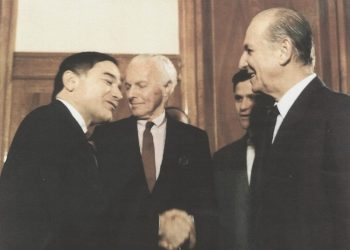
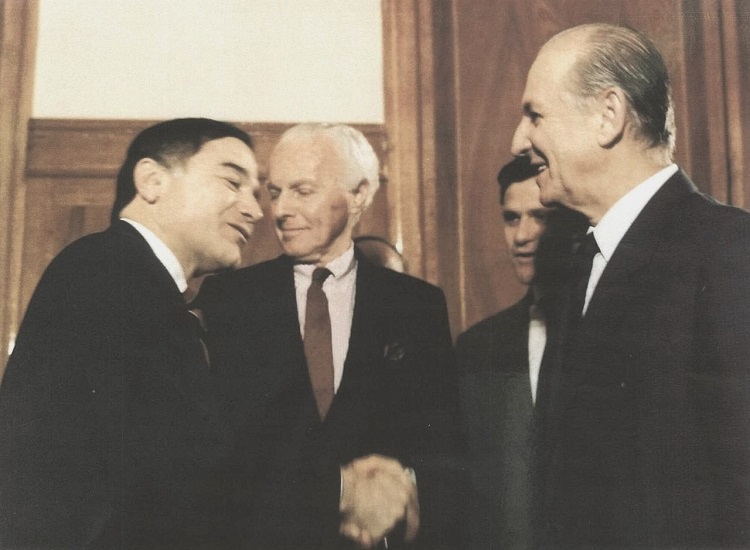
The Chairman of the Presidium of the People’s Assembly, comrade Ramiz Alia, met on 29.9.1990 at hotel “Plaza” in New York with the Prime Minister of Finland, Harri Holkeri. Between them the following conversation took place:
Comrade Ramiz Alia: I am very glad to meet you. We note with pleasure that between Albania and Finland there are friendly relations. There exist all possibilities that, regardless of the distance, these relations be expanded even more in various fields such as economic, political and social. We have special respect for the Finnish people and for your independent policy.
Harri Holkeri: Many thanks for the quite warm words addressed to my people. I fully agree with you. I would like to warmly congratulate you for the very good speech you delivered yesterday at the Assembly. I say this not only from my impressions, but I saw it also from the applause in the hall, as well as from the overall positive reactions of the press.
We follow with attention your policy of openness, which is welcomed by all. The relations between Finland and Albania are very good. The Finnish parliamentary delegation that was a short time ago in Albania and that was received by your parliament remained very satisfied. It left your country with the best impressions. I was informed extensively about this visit.
We wish to carry our relations even further forward. In this framework the Secretary of Foreign Affairs, based on the invitation that has been made by the Albanian side, will gladly come for a visit to Albania.
Comrade Ramiz Alia: Albania was in the past very poor. The people suffered for bread. Illiteracy, diseases were very widespread. The Albanian lived 38 years in 1945, whereas today he lives 72. In my speech I also spoke about the CSCE. At first we asked to be observers, because we needed time to study the numerous documents, but also to adapt our laws to some requirements of the Helsinki Act.
We made a governmental declaration, that already the conditions have been created for the full participation of Albania in the CSCE process. In this direction we have also officially informed the USA as the organizing (host) country of the present meeting of the Foreign Ministers of the CSCE, Finland as the depositary country of the Helsinki Act, as well as the French government as the host country of the High-Level Meeting. We believe that we will enjoy the support of the Finnish government.
Harri Holkeri: We have received your notification and we have notified all the participating countries. In principle the position of the Finnish government is positive, but, as you know, Mr. President, the CSCE process continues on the basis of consensus. So, a decision must be taken on this basis.
Yesterday when I spoke in New York, at the New York Association for Foreign Policy, I said that the number of countries in the CSCE is not fixed. Excuse me, I wanted to make a joke, but now the number of countries is 35, but after the reunification of the two Germanys, the number is reduced to 34, so we need one more to make it 35, and that is Albania.
Comrade Ramiz Alia: We rely on your opinion. We know the principle of consensus and to achieve the realization of this principle we appreciate your position. The Helsinki process is an important activity in which Albania must not be deprived. Albania in its path, which some call that of openness, but it is of the further democratization of life, would contribute best to this process.
The setting of conditions toward Albania influences negatively, therefore in this direction we count on your support. In the case of our participation we declare that not only will we sign the Helsinki Act, but we commit ourselves also to its implementation.
Harri Holkeri: This is important, Mr. President.
Comrade Ramiz Alia: As regards bilateral relations they should be seen according to reciprocal interests. Naturally positive steps have been taken in the political field and others. Even in the future we think that bigger steps will be taken. But we think to look better at trade relations. It is very good that the Albanian people and the Finnish people get to know each other better.
Harri Holkeri: Mr. President, I fully agree with you. We too have such a desire. Your population is a little smaller than that of Finland, but both of us are small countries. We too, like you, have always endeavored to preserve our national language and culture. And this thing both sides have done with very great efforts. As far as I know, the Albanian language is a special language.
Comrade Ramiz Alia: The Albanian language is unique, it has no sister. Albanian culture too is very ancient. Here then we have an important point of contact for getting to know each other.
Harri Holkeri: I fully agree with you. We have great possibilities to work together. Things are moving in Europe. Here not only the unification of Germany happened, but also the changes in Eastern Europe were visible. What is happening in the Soviet Union is not very clear, I can even say it is something dark.
We in Finland try to have contacts with the Soviet Union, which I can say is sometimes even difficult. As far as I know you have problems with your neighbors. May I ask you openly, what is your opinion about Yugoslavia?
Comrade Ramiz Alia: As you too have problems for example, with the Soviet Union, which you have as a neighbor, we too endeavor to have good relations with our neighbors. You asked me about Yugoslavia. In our opinion, the situation there is difficult. I am not speaking simply about the political field, but there is a constitutional crisis in this country.
You know how the Yugoslav federation was formed. There are six republics and two autonomous provinces there, which were such, because yesterday Serbia proclaimed the new Constitution and totally eliminated the autonomy of Kosovo, where more than 2 million Albanians live. As is known, about 3 million Albanians live in Yugoslavia, because alongside those who live in Kosovo, there are also in other parts of Yugoslavia. In Macedonia, for example, there are more than 600 thousand Albanians, in Montenegro more than 100 thousand.
So it is a large entity, to which all rights are now being removed. In Yugoslavia there are not simply great contradictions between Serbs and Albanians, but also between Serbia and Croatia, Serbia and Slovenia, Serbia and Macedonia and even also between Serbia and Bosnia-Herzegovina.
The problem is posed as to who will dominate. The Serbs are not satisfied, but they always try to establish hegemony in all of Yugoslavia. If in Slovenia and in Croatia there is a tendency for a kind of independence, on the part of Serbia there is the tendency of hegemonism.
If we look also at the processes in Yugoslavia, in Croatia and in Slovenia, there seems to be democracy, but Serbia maintains unitarism, which goes in contradiction with all the processes in Europe. Serbia’s policy toward the Albanians is a reflection of hegemonism as a whole in Yugoslavia. No democratic right is recognized for the Albanians.
The Albanian television was closed, the press in the Albanian language was annulled, things went so far that even the Albanian deputies of the Albanian Assembly, that is of the parliament, are arrested. This undoubtedly is an extremely difficult situation, truly difficult, because it was not enough only with these anti-democratic measures, but they were accompanied also with the use of violence and force.
In Kosovo and near the borders with Albania military forces have been gathered, up to 15 thousand soldiers with weapons. So, at the border in such cases favorable situations are not created.
Harri Holkeri: I asked you about Yugoslavia also in connection with its internal developments. It is already a fact that Yugoslavia is a big problem. There is no doubt that different nationalities try to create their own republics and autonomous provinces.
As is known the Hungarians in Transylvania and Vojvodina, the minorities in the Soviet Union, the Baltic republics are not calm, they are trying for independence. The situations are not calm also in some other countries. So the whole continent is in turmoil.
Comrade Ramiz Alia: The perspective too, especially in the countries of Eastern Europe, is dark. Alongside other numerous problems there are also economic problems, which, without doubt, influence relations with various countries.
Harri Holkeri: Finland is trying to have the best possible contacts with the EFTA countries, so that in Europe there be the closest possible cooperation between the EFTA countries and the European Committee. This is a main task. We will try that the coming year to undertake also other important steps in this direction.
Comrade Ramiz Alia: I understand why you are working in this direction, whereas we are engaged in the Balkan field. On 24 October of this year the meeting of the ministers of Foreign Affairs will be held in Tirana, where it will be discussed in the spirit of cooperation, with the aim that the relations between the Balkan countries move forward.
There is no doubt that the Balkans has problems, especially the national ones are great, but this does not mean that these problems should not be confronted. For every problem, however great it may be, the right ways for solution can be found. Therefore our policy has been, is and will always be for good neighborly relations. As you know, the Balkan zone is vulnerable.
Harri Holkeri: My government fully agrees with what you said, Mr. President. I will notify the minister of Foreign Affairs of my country, who will participate next Monday in the meeting in the framework of the CSCE.
I wish, and I am sure, that the relations between our two countries will be expanded further. I wish you successes in the development of your country! I thank you very much, Mr. President, for this friendly meeting.
Comrade Ramiz Alia: I too on my part thank you very much and I wish you and the Finnish people all the best! / Memorie.al
(Taken by stenography)
Continued in the next issue