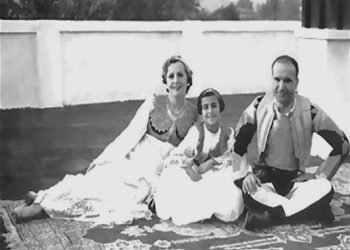
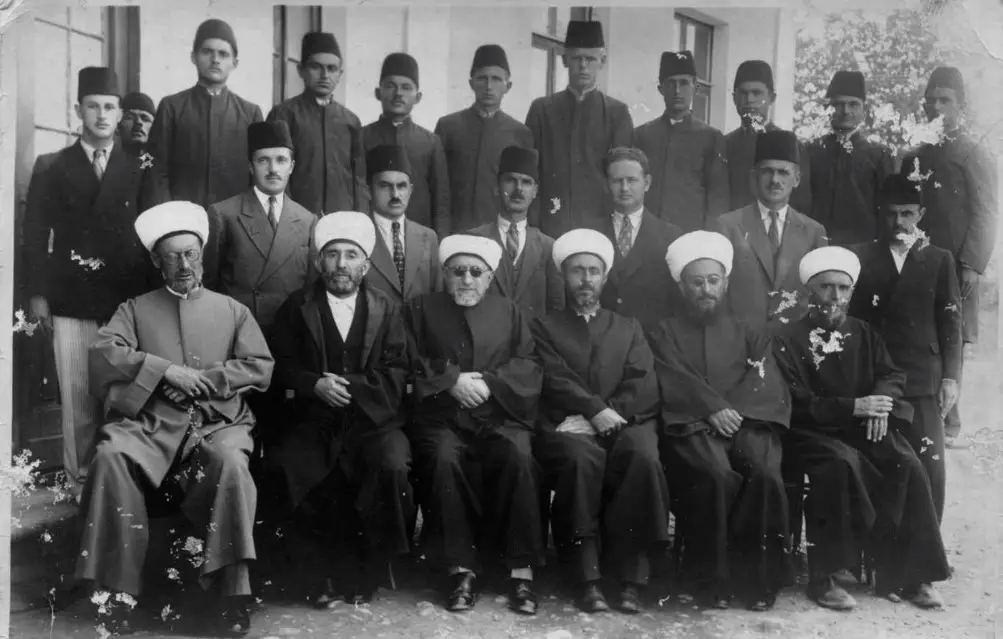
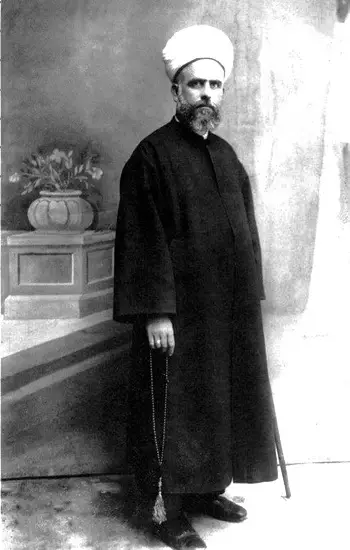
Memorie.al / The Muslim leader Mustafa Jusuf Varoshi was born in 1898 in Durrës. He received his moral, religious and patriotic education from his father, who was a respected Myderiz in the city of Durrës. Having a clear view of intellectual values also in the service of the religious issue, he carefully dealt with the education of his only son, enrolling Mustafa at the Tirana Madrasa, with the aim of giving him a complete education later religious. The young man soon became distinguished for his all-round preparation in religious studies and thanks to his natural gift for the acquisition of foreign languages, he laid the foundations for growing up as an intellectual with wide knowledge, as he would become known in the circles intellectual, inside and outside the country. After graduating from the Tirana Madrasah, he continued his higher studies in Saudi Arabia, where, after being equipped with a wide religious and secular culture, he returned to his homeland.
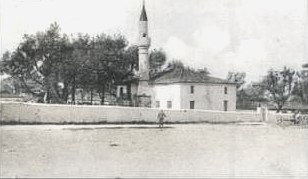
In 1924, at the age of 27, he was appointed imam in the Varosh mosque in Durrës, quickly becoming known as a persuasive and gracious preacher. With the appearance of a handsome and healthy man, with natural intelligence, with intellectual and theological preparation, he imposed himself with a sharp logic and with the sentences of religious teaching, which he fused so beautifully and combined with the advice of morality and patriotism.
He was engraved in the minds of the citizens of Durrës, where his figure grew bigger and bigger from year to year. In his sermons, the moral values that a person should have, the basis for being a good religious, a good family member, a citizen and a free patriot, respectively for every religious faith, always stood out.
In one of the memories about the honorable figure of Mustafa Varoshi, we read: “He was an honorable cleric for all the citizens of Durrës. Beloved, respected by everyone, regardless of religious affiliation, sociable with everyone, Muslims, Orthodox and Catholics. He did not differentiate between the rich and the poor, for the troubles and hardships of the people.
He also had an outward appearance that seemed to radiate nobility. The hour of his sermon in the mosque made an impression, where, with a full and sweet voice, he made vases (lectures), gave advice of a moral character and with an eloquence to be envied, moved on to advice about patriotism. The belief stood out in him that a moral and virtuous man, regardless of his religion, should think and strive for his country”.
In 1942, he together with Muhammad Xhumri; he goes to Bologna where he also held a meeting with the religious consul of the city, who was surprised by the great lay-religious culture of this cleric, the eight languages he possessed and the democratic tendencies that characterized him. Perhaps this was also the reason for the invitation given to him by the Vatican, where in the meeting with the high religious hierarchy, he left great impressions. (This is evidenced by the fact that in February 1991, Vatican Radio mentioned Mustafa Efendi Varosh, not only as a democrat and victim of the communist dictatorship, but also as a cleric with great capacity).
In 1943, he was called to Tirana by Shijak and appointed Mufti of the city of Durrës. He was a religious leader and a very active citizen. His words came from the depth of the heart and the clarity of the mind, being a “balm” for healing the wounds of suffering people, with the aim of achieving social peace, fraternal and religious understanding. He did not separate his word from his deed, being himself an example of religious tolerance, as a necessary element of rapprochement between the religious communities that existed so harmoniously in our city.
The elderly keep alive in their memory those walks they took in the streets of the city, or the visits exchanged by the three honorable clergymen of Durrës: Mufti Mustafa Efendi Varoshi, Pope Erazem Jorgo and Father Jul Bonati.
Mustafa Efendi Varoshi was not only a contemporary of lawyer Hysen Myshketa, a well-known personality, intellectual, nationalist and democrat, but also his close friend and companion, with the same views.
And while Myshketa wrote that: Efendi Mustafa Varoshi openly and fervently preached the same thoughts, he tried to penetrate especially into the souls of young people and set a perfect example not only in association with Orthodox and Catholic clergy, but also with direct effort for the organization of Muslim youth in Durrës, to prepare a moral and worthy generation for the family, society and homeland.
It was precisely this initiative of the youth of Durrës that made possible the organization of Mevlud Sherif in Tirana, in April 1944. In his speech of greeting, the young Mufti said: “I pray to God that for the sake of Muhammad (pbuh), to grant the Albanian nation peace, union, fraternity, solidarity, a happy moral and material life, without religious differences”.
Mustafa Varoshi did not close himself within the walls of the mosque and deal only with religious rite affairs; on the contrary, he led a lively civic life, trying to alleviate people’s problems. It was a conciliatory element, where there were fights and quarrels; it was very helpful to help the needy materially.
The moral-religious education undoubtedly led him towards a complete humanism, so much so that he supported the initiative of the lawyer Myshketa, for the creation of a Charity Committee, with the help of the merchants from Durrës, to provide support to poor families, to organize a canteen popular for free and to build houses for the housing of needy families.
Mufti Mustafa Varoshi, being fair, was also brave. He would be among the drafters of the petition addressed to the communist government of Enver Hoxha, for the family of Ali Saraçi and his two friends; collected the signatures of the citizens of Durrës from different walks of life, asking the communist government for their forgiveness, and when the petition was not taken into account and the three young men were shot, the Mufti spoke in the mosque, condemning; “the ugly act of taking the decision by the military court and the punishment of the innocent”.
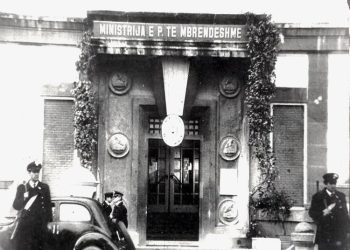
The dictatorial communist regime, not only did not forget that petition, but responded immediately, with the arrest and imprisonment of its drafters, including: Hamdi Kazazi, Ali Cara, Ismail Rama, Ymer Menaholli, etc. But towards the Mufti, he was initially “cautious” and began to prepare the blow, with the article of the newspaper “Bashkimi”, entitled “Under the mask of mercy”, where he made this threat: “This decision is a warning to all those who are tried or, they will try to defend the crimes of the enemies of the people”.
Recognizing the authority he enjoyed among the people, not only in Durrës, but in a wide area of central Albania, Enver Hoxha called Mustafa Varosh to Tirana and tried cunningly to put him at the service of the low goals of the dictatorship. Such a proposal completely contradicted the education, concepts and human spirit of that man, who was devoted to other high goals, therefore Mustafa Efendi Varoshi rejected it with contempt, aware of the consequences that they were waiting for him.
And it didn’t take long. In September 1947, he was arrested and locked up in the basement dungeon of the Internal Affairs Branch of the city of Durrës. They made up all kinds of accusations, even being an agent of the Germans! And why?! When his family had moved to Shijak, like many other families, where they respected him a lot, Mustafa Varoshi had dared to go to the German command and knowing the language, thanks to his wisdom and reasoning, he had prayed not to jump the bridge of Shijak in the wind.
The honest cleric would never have thought that because of the foreign language he possessed and, for an honest prayer in defense of the interests of a city, he would be accused and punished as an “enemy of the people”.
After brutal tortures that disfigured his graceful appearance, the court of the Enverist communist dictatorship sentenced him to 20 years of political imprisonment. Here is what Mustafa Xhumri, a former prisoner together with the Mufti, writes: “The figure of this cleric offended all of us, who suffered wildly in the dungeons of this prison, and it seemed inhumane to us that his imprisonment and, later, the other cleric’s from our city of the Catholic religion, that Vinçenc Prendushi, who as far as I remember, had a long-standing friendship between them and a respect to be admired.
Both of them had no other motive for their conversations, other than love for the country. I wanted to cry when I saw for the first time among us, in the prison yard, the venerable Mufti who was brought from the torture cell. He was unable to stand. I can say that he, through all those tortures, remained stoic and did not betray his pure, religious and civic ideal. The severe torture, life in the dungeon and the diabetes disease, which aggravated him even more, led him to death.”
Wisdom, justice, humanity, stoicism to face suffering and misfortunes, he had all within his being, on sound moral, civic, religious and intellectual grounds, in match with those who took his life, who were the personification of his of evil, of ignorance, of terror, of bloody dictatorship, of meanness, of wickedness in action.
Dictatorship, no matter how ferocious it is, is not a mistress of subjugating people’s souls, free thought, even where it calls itself all-powerful, in its prison cells. This is what happened with the figure of Mustafa Varoshi. He died, but his ideal and his memory lived on.
He who had preached all his life about religious tolerance for religious fraternity, for religious respect as a fellow countryman, died amid torture, with the venerable Catholic priest, both transmitters of God’s knowledge of human love, both were sacrificed as pure icons. Mustafa Varoshi, died in prison at the age of 51, on March 7, 1948.
His death was a great loss not only for the Islamic religion, but also for the entire city of Durrës, which expressed its attitude with the challenge it made to the country’s communist authorities; without permission, leaving aside the fear at the height of the dictatorship, the people of the city, left their work and came out to participate in the burial ceremony, which was carried out magnificently. Memorie.al