


By DASHNOR KALOÇI
Part One
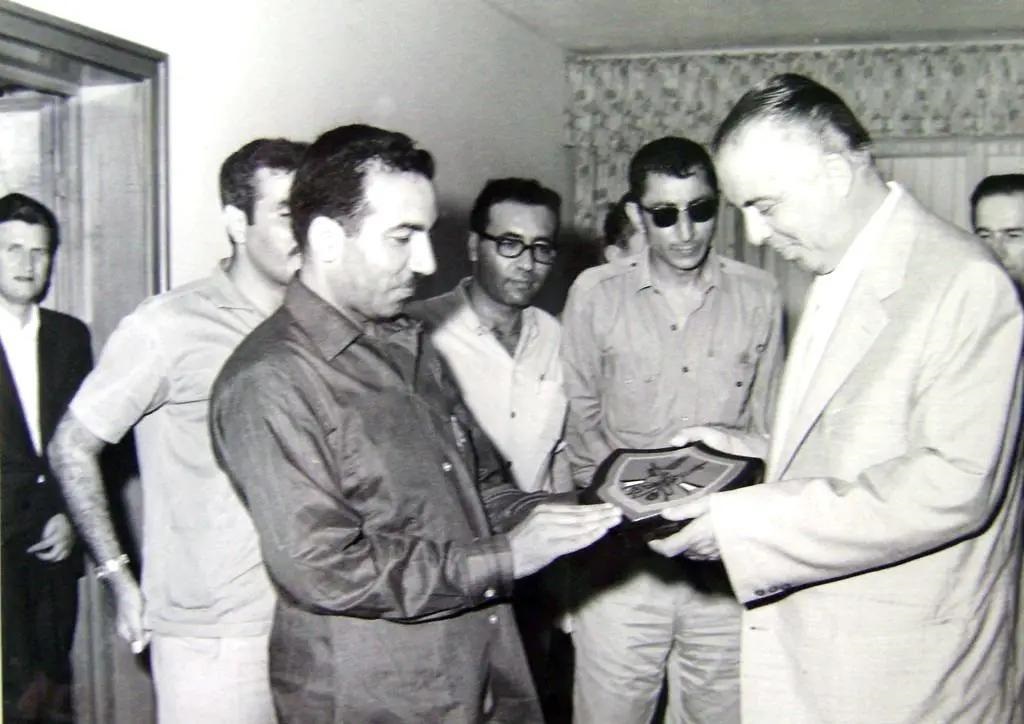
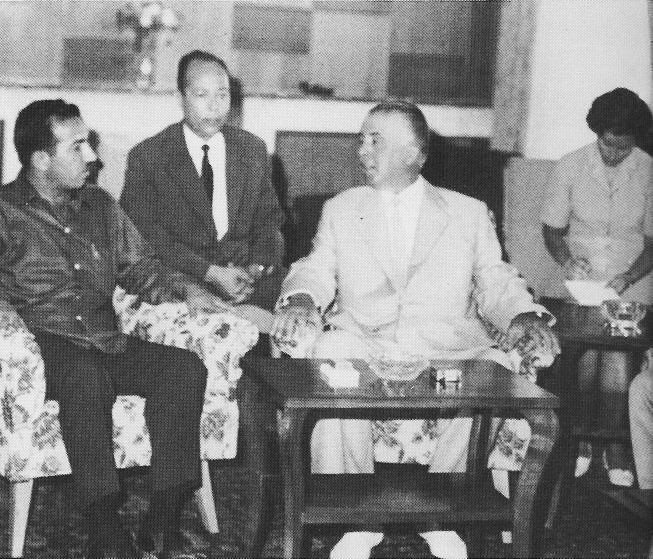
Memorie.al / Toward the end of July 1970, in Enver Hoxha’s communist Albania, a high-level delegation of the Palestine National Liberation Movement – better known as “Al Fatah” – arrived for an official visit. It was headed by Khalid Al Wazir, Yasser Arafat’s right-hand man (vice-chairman and co-founder of “Al Fatah”), known by the pseudonym “Abu Jihad,” who in that organization’s hierarchy had also been elected as a member of the general leadership of the forces of “AL-ALIFA.” The visit of the high-level Al Fatah delegation to Albania had been organized for some time in secret by the Albanian embassy in Cairo, at the request of Yasser Arafat, the main head of the Palestinian Movement. Only two or three days after their arrival in Albania, on August 1, they were received by the Albanian Prime Minister himself, Mehmet Shehu, at the government villa on the Hill of Durrës (the former Villa of King Zog), where after lengthy talks he also hosted a lunch in their honor. Along with Prime Minister Mehmet Shehu, that secret meeting was also attended by the Minister of People’s Defense and Deputy Prime Minister Beqir Balluku, Foreign Minister Nesti Nase, the Vice-President of the Presidium of the People’s Assembly Xhafer Spahiu, the Director of the Political Directorate of the Army Hito Çako, the Chairman of the Committee of Veterans of the Anti-Fascist War of the Albanian People Shefqet Peçi, etc.
Three days later (on August 3, 1970), the high-level Palestinian delegation was received by the main leader of communist Albania himself, Enver Hoxha, at the government villa in the Uji i Ftohtë area on the coast of Vlora, attended also by Hysni Kapo, Minister Beqir Balluku, the First Secretary of the Party Committee of Vlora Petro Dode, Deputy Minister of People’s Defense Rrahman Parllaku, the General Secretary of the Organization of the Democratic Front of Albania Ramadan Xhangolli, etc. The reception given at that time to the main heads of the Palestine National Liberation Movement (later called the Palestine Liberation Organization) was in the wake of the aid that official Tirana had been giving for years to Arab countries and mainly to Palestine in their armed conflict with the state of Israel, which intensified greatly especially after 1967, when the war between them began.
The Arab-Israeli conflict of 1967, otherwise known as the “Six-Day War,” began on June 5, 1967, when Israel carried out a preemptive air strike against Egypt. The conflict in question had its origins in the mid-1960s, when Palestinian guerrilla groups supported by Syria carried out continuous attacks across the Israeli border, which were followed by military retaliation from Israel. Tensions were further increased by Syrian efforts to divert water sources in the Golan Heights, which threatened Israel’s main water supply.
In the Arab-Israeli war, which at the time had a great echo, since indirectly the United States of America and the Soviet Union of that time were also involved, Enver Hoxha’s communist Albania also played a modest role. From that time onward, in addition to financial or material aid (fabrics, food, medicines, and medical equipment) that it gave to Arab countries, it also received and trained in Albania various groups of Palestinians (at the Zall-Herr unit), mainly for guerrilla warfare and the placement of explosives in various facilities.
As noted above, these things have long been well known; in this article we are publishing archival documents with the minutes of the meeting of Prime Minister Mehmet Shehu with the high-level Palestinian delegation headed by Khalid Al Wazir (whom Israeli Mossad killed in Tunisia in 1988), where among other things a special place was also taken by the issue of Che Guevara, for whom the Albanian prime minister had many reservations, even advising the Palestinian friends not to rely at any moment on his words and ideas. Regarding these and other matters, the documents in question inform us, which have been taken from the Central State Archive (the fund of the former Central Committee of the PPSh [Party of Labour of Albania]), which are published for the first time with the corresponding photos and facsimiles by Memorie.al.
MINUTES OF THE MEETING OF PRIME MINISTER MEHMET SHEHU WITH THE HIGH-LEVEL PALESTINIAN DELEGATION OF “AL FATAH,” HEADED BY KHALID AL WAZIR, KNOWN BY THE PSEUDONYM “ABU JIHAD,” YASSER ARAFAT’S RIGHT-HAND MAN
CONVERSATION
HELD ON AUGUST 1, 1970, IN DURRËS, AT THE RECEPTION GIVEN BY THE CHAIRMAN OF THE COUNCIL OF MINISTERS MEHMET SHEHU TO THE DELEGATION OF THE PALESTINE NATIONAL LIBERATION MOVEMENT (AL-FATAH), HEADED BY THE MEMBER OF THE GENERAL LEADERSHIP OF THE FORCES OF AL-ALIFA, ABU JIHAD.
Note: Printed in 3 copies: 1 for the archive of the apparatus of the Council of Ministers, 1 for the archive of the Ministry of Foreign Affairs, and 1 for the personal archive.
Attending the reception were the Deputy Secretary of the Council of Ministers and Minister of People’s Defense Beqir Balluku, the Deputy Secretary of the Council of Ministers Adil Çarçani, the Minister of Foreign Affairs Nesti Nase, the Minister and Vice-President of the National Committee of Veterans of the War of the Albanian People Shefqet Peçi, the Chief of the Political Directorate of the People’s Army Hito Çako, and the Secretary of the General Council of the Democratic Front of Albania Ramadan Xhangolli.
After the customary greetings, the following conversation took place:
MEHMET SHEHU: We are very glad that you have come to our country, to Albania, and we welcome you.
ABU JIHAD:Thank you. For all the members of the delegation of the Palestine National Liberation Movement, it is a great honor that we were given the opportunity to come to your heroic country, which has become a base of revolution for all people who fight for freedom. So Albania as such, there is no doubt, is a support for our people’s war and for all other peoples who fight. Even before we came here, we knew that Albania is a base of revolution, but with our arrival this became more concrete. This belief and these feelings toward your country will not be erased from our mind and heart. When we return, we will tell our comrades about our impressions of your heroic country and people. During the visits we made in your Homeland, we saw with our own eyes how the Albanian people, who have fought with heroism for the liberation of the country, are now again working with heroism for the good of socialism.
MEHMET SHEHU: Thank you for the visit you are making to our country, as well as for the warm words you said. You said that Albania is a base of revolution. This is true, but Albania is not the only base of revolution. You too are a base of revolution; it is another matter that you have not yet liberated your country. Precisely because we are such, that is why we love each other. Our people and Party have a great sympathy for the war that the people of Palestine are waging. Our Party and our leader, Comrade Enver Hoxha, have taught us to follow with attention the war of your heroic people, and we follow it with special interest.
Your war is truly heroic, and we can say that it is developing in more difficult conditions than those of our National Liberation War, for the reason that the international situation today, compared to that which existed at the time when we waged our partisan war, is more complicated, as well as for the fact that we fought on our own terrain, in “our own house,” whereas you fight on foreign terrain, because a part of your population has been forced to emigrate and is outside the borders of its own homeland.
Naturally these complicate the situation, but although the situation is difficult, your people fight and are waging a truly heroic war, a just revolutionary war. Precisely because it is such a war, all reactionary, imperialist, chauvinist, and social-imperialist forces have set upon it to strangle it. Our Party, Government, and people support the war of your people.
We too have waged a national liberation war, and you have expressed the desire both before and now, with the visit you are making to our country, to learn from the experience of our war. It is our duty to give to our friends and comrades what we know, but I think that whatever the case, for you the greatest and best experience is the experience of your own war, for the reason that how one should fight, for example, at the Jordan River, you can never learn, neither from the experience of Albania, nor from that of China, nor from anyone else. Isn’t that so, Comrade Beqir?
BEQIR BALLUKU: That is so, Comrade Mehmet.
MEHMET SHEHU: Likewise, how one should fight on Mount Tomor, neither the experience of the war of the Chinese people, nor that of the Palestinian people, nor any other war can teach us. We must take from outside the good, revolutionary, and consistent experience, seek it wherever it is – in China, Vietnam, and everywhere – but in the final analysis it is the correct political line in the given conditions, the consciousness of the people, unity, political clarity, and combat readiness that decide the fate of the war.
We are ready to give you our experience, but I think that it is more in your interest to learn from that of our National Liberation War than from the organization of defense we have today, for the reason that today we are in another epoch, and our present-day operational, tactical, and strategic military art is in a phase and in completely different conditions from those in which you find yourselves.
With us, with the Albanian people and with the Party of Labour, you will everywhere and always have a determined and loyal friend. We may have shortcomings, but our people have a quality which life and history have proven, and which we consider one of our main qualities – that of telling a friend that he is a friend and an enemy that he is an enemy, regardless of how strong the enemy appears and how small the friend.
We are declared Marxist-Leninists, whereas you have not declared yourselves as such, but regardless of this, we are comrades-in-arms and, as such, I can tell you that our National Liberation War was difficult and we had to make many sacrifices to establish people’s power, but we had to overcome even greater difficulties to keep that power.
The war after liberation was a hundred times more difficult than the one we waged to establish people’s power. Our history proved once again in practice what Lenin said – that it is easier to overthrow the bourgeoisie and establish the dictatorship of the proletariat than to hold power after taking it. We have passed through many dangers during the National Liberation War and after liberation, up to the present day.
You too are passing through very great dangers, so allow me to tell you some of the greatest ones we have passed through. In 1943, the reactionary forces of the country attempted and achieved a certain success, by deceiving some representatives of the Central Committee of our Party into dissolving all our national liberation forces with the reactionary forces and forming a joint power. In other words, to share power with the bourgeoisie.
The member of the Central Committee of our Party who had been delegated for talks with the representatives of the bourgeois organizations accepted this plot, even accepted and signed an agreement on this matter with the reactionaries. If our Party had accepted this plot, you would not be in Albania today, because we would not be in power; Albania would be like today’s Greece of the colonels.
Another great danger we passed through in 1944, at the time when our forces were in the general offensive against the German forces, to liberate the whole country. At this time, the British Mediterranean forces, General Alexander, insistently requested that their forces land in the south of Albania, under the pretext of pursuing the German forces and joining with the Albanian forces.
Comrade Enver Hoxha, who at that time was Commander-in-Chief of our National Liberation Army, told them that we did not accept and did not need such help, that we would liberate Albania ourselves, and in fact we did liberate it ourselves. Nevertheless, the British landed some of their forces in Saranda. We gave them an ultimatum that within 24 hours they would either withdraw their forces, or otherwise we would fight simultaneously against the Germans and the British and would destroy them. After this ultimatum, the British withdrew not within 24 hours, but within 23 hours.
If we had accepted their forces landing in Albania, our country would be as Greece is today, the “Albania of the reactionary colonels.” Likewise, after liberation, we passed through another great danger. Since during the National Liberation War we had very close relations with the Yugoslav Communist Party. At that time we did not know Tito well and we had very close cooperation; we started from sincere positions. After liberation, Yugoslavia attempted to assimilate Albania.
They are trying to assimilate your country already, without it even being liberated yet, and not by one force but by many, whereas with us, at that time, it was one force – the Titoist force. This stance of the Yugoslavs created a very critical situation in our country after liberation. The Yugoslav revisionists had managed to penetrate, introducing their elements even into the Political Bureau of the Central Committee of our Party; they had taken places and positions in the Party organs, in the Army, and in power.
When Tito saw that the situation was ripe for swallowing Albania, he requested to send his divisions to Albania, under the pretext of coming to Albania’s aid, supposedly because it would be attacked by Greece. But the Central Committee of our Party, Comrade Enver Hoxha, immediately refused the arrival of the Yugoslav army in Albania; we grouped our forces on the Yugoslav border, arrested all their agents, shot or imprisoned them, and thus saved the Homeland once again from death.
Had we accepted Tito’s tutelage, Albania would have in time become the 7th Republic of Yugoslavia. We sincerely respected Tito as a friend, but when we saw that he had evil intentions toward Albania, when we saw that he was an enemy, we kicked him; we turned the rifle around and put it to his chest. In the international conflict we are going through today, you may have heard that if Yugoslavia and Romania are threatened from outside, from the Soviet Union or other countries, we will support their war.
This is true, it is not a lie, but the Party of Labour of Albania and Tito’s Party will never reconcile; as much as fire can reconcile with water, that much can we too reconcile with Tito. I will mention another example to you – I am not speaking of the imperialists’ plots, but of our former friends. With the Soviet Union we had extremely close and intimate relations. We were closely linked with it since Stalin was alive, in Molotov’s time, indeed even in Khrushchev’s.
All of these, including Brezhnev, Kosygin, Polyansky, Suslov, and others, were once our close friends. We know all the nuances of the Soviet leadership. As you know, after Stalin’s death, Khrushchev came to power. This happened in September 1953, whereas Stalin died in March 1953. The truth is that we expected Molotov to be put in place and we did not like it and were surprised that Khrushchev was put at the head, but this was their affair; they chose him themselves and we applauded.
After Stalin’s death, we noticed that the Soviet leadership began to behave differently toward us; it began to take a hostile stance against us, its friends, whereas toward enemies, like Yugoslavia and America, a different stance began, the Soviet leadership began to draw closer to them. A pronounced tendency began toward enmity with Albania and China, with the national liberation movements, against the peoples of Latin America, of Africa, and all the peoples of the world.
We clashed with Khrushchev as early as the beginning of June 1955. This matter has not been made public, but I tell it to you as friends and comrades that we are. At that time Khrushchev was to go to Yugoslavia. The Central Committee of the Party of Labour of Albania sent a letter signed by Comrade Enver Hoxha, which is in the archives of Moscow, in which we expressed that we were against Khrushchev’s going to Yugoslavia and against the rehabilitation of Tito.
From the doubts we had toward the new Soviet leadership, we reached the conclusion that their actions were not merely opportunist but hostile, and that they were enemies of the Soviet people, of the Albanian people, and of the peoples of the whole world. In 1956, in Moscow, the 20th Congress of the Communist Party of the Soviet Union was held, which we approved only formally, for in fact we did not agree. In June 1960, at the Bucharest meeting, and in November of the same year, at the meeting of the 81 communist and workers’ parties held in Moscow, we came out openly against the Soviet leadership.
Recently the speech that Comrade Enver Hoxha delivered against Khrushchev at the Moscow meeting has been published. Only our Party and the Communist Party of China rose against the Soviet leadership; all the other parties – Romanian, Bulgarian, Polish, German, Hungarian, Czech, etc. – without exception attacked us. The communists of Iraq, of Syria, of Libya, of Turkey, and all without exception condemned us. But we were not frightened; we told them that we were on the right road, whereas all of them, from Khrushchev to Khalid Bagdash of Syria and his comrades, were base, and that we would win; therefore, let them hold on, let them attack Albania.
If we had accepted the theses of the 20th Congress of the Communist Party of the Soviet Union, Durrës and Vlora today would be naval bases of the Soviet military-naval fleet; today’s leadership would have been liquidated, Albania would have been turned into a satellite of the Soviet social-imperialists, just as Bulgaria is today; in that case, here today the collaborators of your enemies would be in power, here the revisionists and reactionaries would rule, Albania ruled by revisionists would work against the Palestinian people, would join with the “Rogers Plan,” there would be no Arabic-language radio broadcast here, and if you were to come for a visit to Albania, they would not speak to you as we are speaking to you today, but in another language; they would urge you to accept the “Rogers Plan.”
The enemies call us “mad,” they say to us: “you don’t understand and they have given us plenty of other titles. They say that the Albanians have opposed Yugoslavia and the Soviet Union, are against the Americans, against the Soviet-American agreements, fight with all the reactionaries and revisionists in the world. The question arises: how is it possible that we pursue such a policy? How can a small state like Albania exist, with a population of about 2,000,000 inhabitants, in the heart of imperialist and revisionist Europe?
We tell you sincerely, as friends and comrades that we are, that there is no force in the world that can defeat the Party of Labour of Albania and the Albanian people. We are two million inhabitants, dwelling in about 28,000 km². This theater of war, Albania, has a certain capacity to hold a certain number of military forces of possible enemies. We are prepared to withstand and annihilate even the maximum number of armed enemy forces that the territory of our theater of war can hold. / Memorie.al
Continues in the next issue