

By Sven Aurén
Translated by Adil N. Bicaku
Part Five
Memorie.al/ publishes a report by the well‑known Swedish journalist Sven Aurén, originally printed in the Stockholm newspaper Svenska Dagbladet, concerning his four visits to Albania, starting from the years 1935‑38 when he came for King Zog’s wedding and ending in September 1968, when he visited communist Albania for the last time.
Continued from the previous issue
TOURIST IN ALBANIA
Thinking back on the series of previous articles, it may seem incomprehensible that I persistently urge my friends and acquaintances to take a tourist trip to Albania, if possible through one of those small group tours that leave, albeit rarely and irregularly, with very few participants, from Paris to Tirana. First of all, of course, I recommend such an expedition to students, to refresh their minds if they are worried about so‑called ‘Maoism’. In Albania they can make interesting studies of what Chinese communism looks like when practised on a European people. But also for those who have no need for an antidote to revolutionary romanticism, this is a very interesting journey, allowing contact with a small, forgotten, strange country, yet a country of magnificent beauty, not far from the heavily trafficked roads.
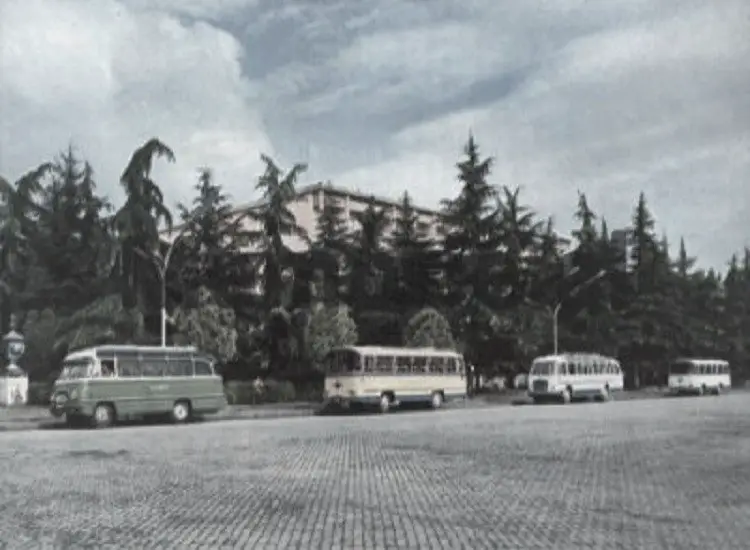
Besides, a trip to Albania is less arduous than before. When I travelled by car before the war, there were few petrol stations and you had to be careful not to miss them. Now there is indeed no petrol station at all – which is unique in Europe – but since the tourist is not allowed to move individually, that doesn’t matter. You are obliged to go in a group and by the bus that “Albturist” places at your disposal. This bus is refuelled at designated state locations, where the driver presents an official document. You would think the country was at war.
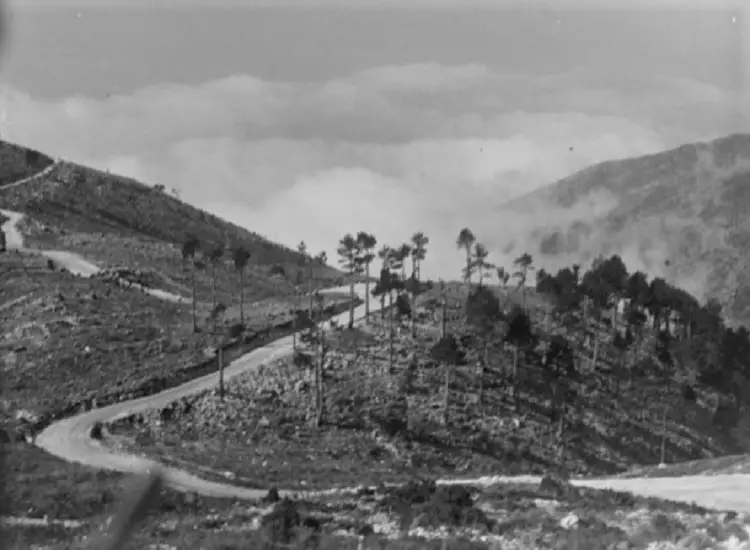
As for the roads, they have become better. Albania produces enough asphalt, which is even exported – in Paris there are roads paved with Albanian asphalt – but in the 1930s there was little left for domestic use. The roads and thoroughfares boasted all those potholes, bumps and sags typical of the Balkans, and the car shook like a jackhammer. With the exception of the coastal road between Vlorë and Saranda, the main roads are now well maintained and asphalted. But whoever takes the road from Vlorë to Saranda needs to have his nerves under control.
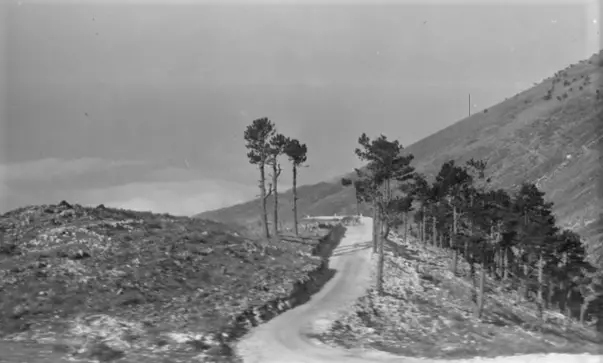
The road goes through a jagged mountain range on a primitive serpentine built by the Austrians during the First World War and unchanged since then. It is as narrow as a village lane, with hairpin turns, odd protruding corners, above dizzying precipices – it is a mystery how drivers manage heavy vehicles on these vibrations without crashing into the sea?! Now and then you meet large Lorries of Russian make, which of course makes it even more dangerous.
They back up and manoeuvre to the millimetre. To forget the jolting in your stomach and avoid looking down into the abyss, you look for eagles. The eagle is the proud bird of Albania, which you find again on its red flag. Sometimes a magnificent specimen sits there, perfectly still as if suspended by a thread from the clouds above. When you look down again, the lorry has passed, the passengers applaud their skilled driver, and a gentleman from Paris exclaims in a strange voice: “We made it this time too!”
But this kind of experience is limited, as I said, to the ten miles between the two southern coastal towns. In general, of course, travelling around Albania is a journey over massive mountains and along serpentines, because that is the nature of the country. But on good roads with walls at the bends, you don’t feel worried. The journey is easier because there is little traffic. You often drive alone like a king for tens and tens of kilometres. In the villages I never saw a car; the rare examples I could see were in the towns.
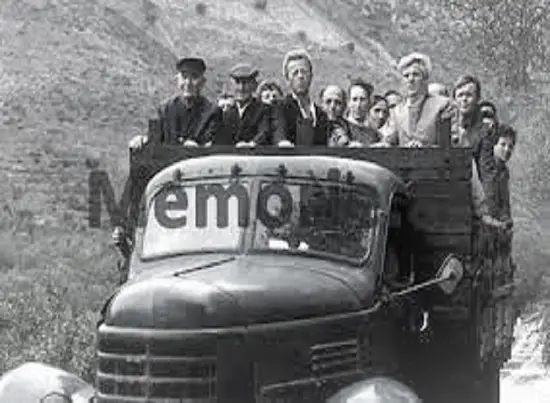
Road traffic outside the towns is carried out by laden mules, the occasional bus, and above all Lorries, which are often used to transport people. From time to time you meet large Lorries packed with men and women standing, squeezed against the bodywork. On top of the driver’s cabin a red flag flutters. They are work brigades from the roads or from the cooperatives. In Albania there is no longer any private land. Not a single square metre. Therefore you never see anyone working alone – which makes a terrible impression on a Western European! They always work in groups. The comparison may be unfair, but it does not help – one’s mind turns to prisoners and convicts doing forced labour.
Although travelling in Albania entails a series of difficulties, the tourist is compensated by abundant impressions of natural beauty. The landscape is splendid. The daring Lord Byron, who travelled through this country at the beginning of the last century, was extraordinarily impressed by its furious, adventurous character.
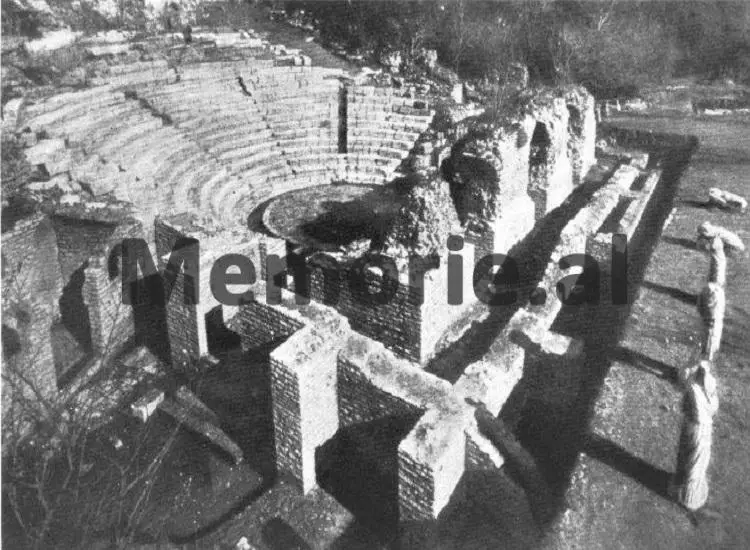
One experiences a tremendous grandeur. The mountain ranges are fantastic, the panoramas dizzying. The gorges look like deep wells guarded by giants – the cliffs themselves. And one believes one understands why the Albanians have been able to preserve their characteristic features even though they have almost always lived under foreign rule: a mountainous country like this can never be completely conquered. One is also rewarded after that anxious drive from Vlorë to Saranda. A new road takes you to Butrint, the Buthrotum of antiquity, which Virgil mentions in the *Aeneid* and where Racine chose it as the setting for his play Andromaque.
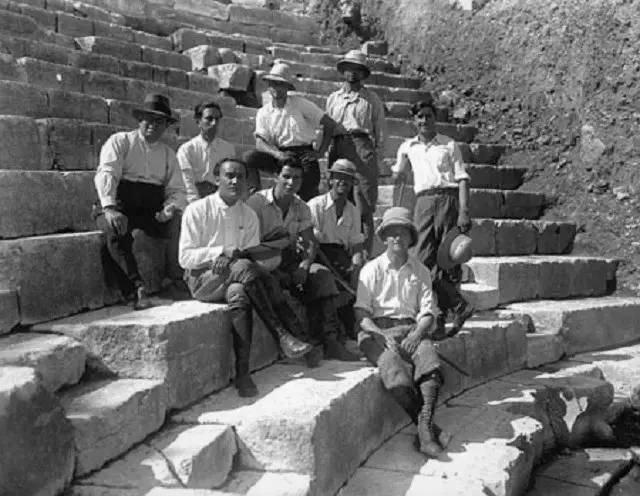
Hundreds of years before Christ, this city was one of the most famous centres of trade and culture in Epirus. Gradually it became a Roman colony, and then fell under Byzantine rule, then under Venice, and then the Turks took it. In the 1700s the city was abandoned and later turned into a jungle that covered everything. Between the two world wars, the Italian archaeologist Ugolini devoted ten years to Butrint to rediscover it, and did not interrupt his large‑scale excavations until 1939. It was hard work: he had great difficulty coping with the bushes and dense vegetation; the marshy ground required complicated drainage; and malaria was a constant threat. When the Second World War broke out, only a small part had been uncovered.
As you walk around this rediscovered city, the thought immediately strikes you: if all this that has been uncovered is only a small part, then what more remains to be discovered! From a cultural‑historical point of view as well, Albania’s aggressive isolation is a tragedy. What is needed is an investment in archaeology on a completely different scale, which the Albanians themselves cannot make. For now, I admire a magnificent amphitheatre of white marble from the fourth century BC, a temple of Asclepius, a Byzantine baptistery with sculpted columns on lovely mosaic floors, a very well‑preserved Roman bath…!
Those uncovered fragments lay as very small spaces in this hot, humid jungle, where we walk forward on paths and see strange hills that testify to walls and houses beneath the dense vegetation. In an old fortress above the city, which Ugolini enlarged and furnished as a dwelling, they have also opened a museum with the discovered objects: beautiful portrait sculptures, weapons, household utensils and decorative items. The Italian experts explain that this is only a small foretaste of Butrint’s possibilities.
A young Albanian archaeologist, who studied in Moscow and works as a guide here, says he agrees. But he will not explain anything about future excavation plans. Instead, he emphasises what Albania calls “Ugolini’s great crime”. Among many sculptures, the Italian scholar found an exceptionally beautiful head – it is not certain whether it depicts a boy or a girl. It is made with a craftsmanship reminiscent of Praxiteles. At the end of the 1930s, he sent it to Rome, and it was rumoured that Zog had given it to Italy as a sign of thanks for the excavations.
“He stole our most beautiful sculpture,” say today’s Albanian masters. Their bitterness is understandable. The country has two precious treasures: the head from Butrint and Skanderbeg’s helmet. Neither is in Albania. The head is in a museum in Rome, the helmet in a museum in Vienna.
Anyone travelling in Albania need not worry about food. In this respect there is progress compared to before, when restaurants did not even meet the minimum hygiene requirements.
It is hard to say where they learned – perhaps the Italians were their teachers? – But Albanian chefs now possess astonishing professional skills. Everywhere I went on this journey, they served very well‑cooked dishes, much better than many Western European places could offer in similar simple establishments. Albanian cuisine, among other things, boasts a particular favourite: in the local language it is called (kos) – an extraordinary yoghurt that even the Bulgarians cannot match.
It is prepared according to traditional methods; if the waiters are to be believed, there must be areas where the yoghurt is started with a little from the old batch to make the new one, continuing since ancient times. In Kruja, the fortress city from which Skanderbeg fought the Turks so successfully 450 years ago, they must have historical yoghurt – that is, one can trace its lineage through generations all the way back to the days of the National Hero. Whether false or true, the fact remains that thanks to yoghurt we can speak of an Albanian gastronomy, and besides, the food standard is surprisingly good.
As for hotels, there is a convincing improvement. When I left Tirana in the 1930s, other towns had only Balkan inns: frightening staircases and bad rooms where even the sheets looked historical – in the sense that they too seemed to date from Skanderbeg’s time, unwashed ever since. One armed oneself with the patience of a saint. The worst were the cockroaches, which at that time were a special torment in Albanian hotels. Add the sanitary side. Everything was a matter of patience that could plunge even the most seasoned tourist into a state of deep gloom.
Here, both one thing and the other have happened. Quite a few new hotels have been built. Given the previous situation, they can be considered acceptable. They never have lifts, of course, because lifts have to be imported. It also happens that eight visitors share a single bathroom, and the cleanliness is regrettable. But the rooms are clean. As for cockroaches, perhaps they have emigrated to some other People’s Democracy, or they were drugged before we arrived – it was said later that the rooms had been disinfected shortly before our arrival, but none of the travellers had any trouble of that kind.
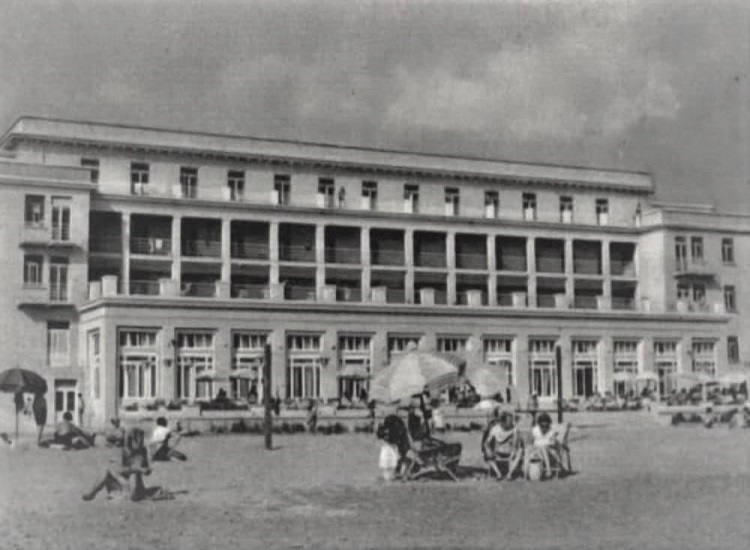
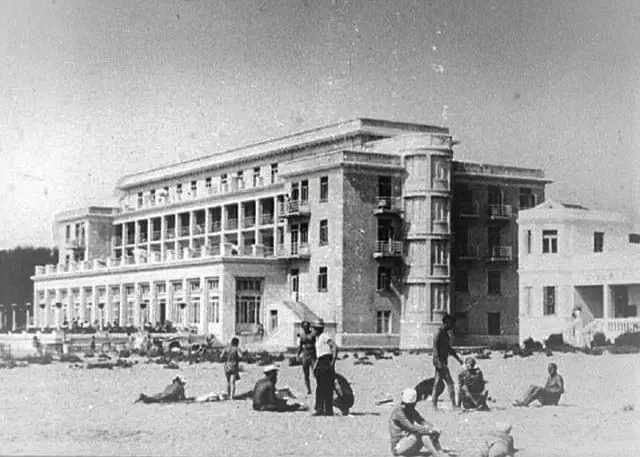
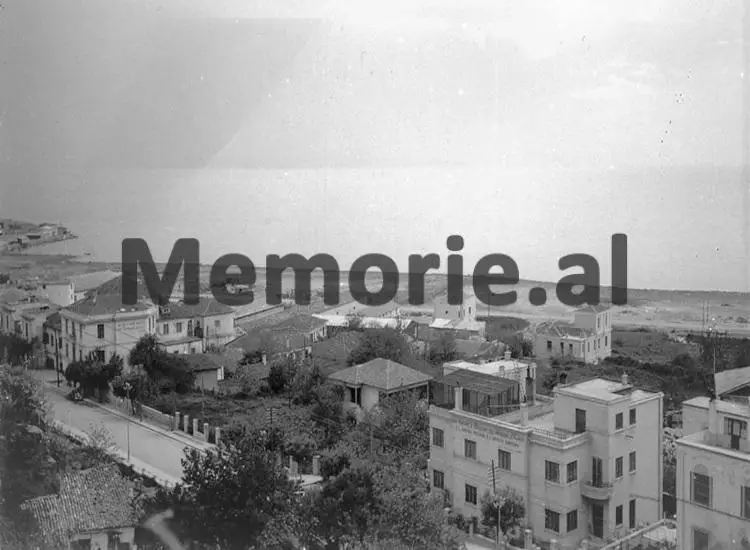
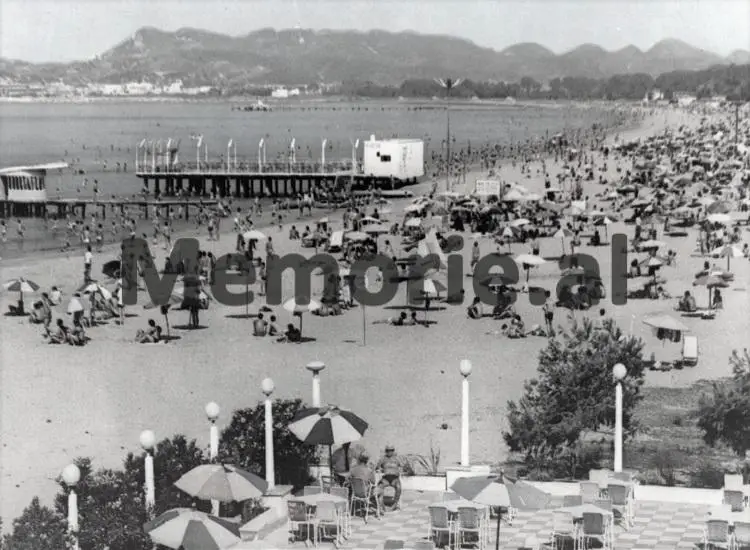
One cannot speak of hotels without adding a few words about the “Adriatik” hotel in Durrës – not only because it is the pride of “Albturist”, but also because the atmosphere and circumstances reflect all of Albania. Durrës is an important coastal town which, before the state closed the window and lowered the curtain, had heavy maritime traffic with Dubrovnik, Bari, Venice and other Adriatic ports.
Now the ships come from China. But Durrës is also a gift from Enver Hoxha to the people: a wide beach where, along five kilometres of coastline, diligent officials and workers receive a few weeks’ holiday as a reward. In the middle of the coastline, the “Adriatik” has raised its impressive walls. The rooms are excellent, even though the building does not benefit from running water in the true sense – water must be brought by tanker and pumped up to fill a roof reservoir – it offers great luxury given Albanian circumstances. The bar is very large and solemn, like an old‑fashioned dance hall, and the dining room likewise. Waiters in white jackets and waitresses with hair in buns, without a smile but with great efficiency, serve the capitalists and revisionists.
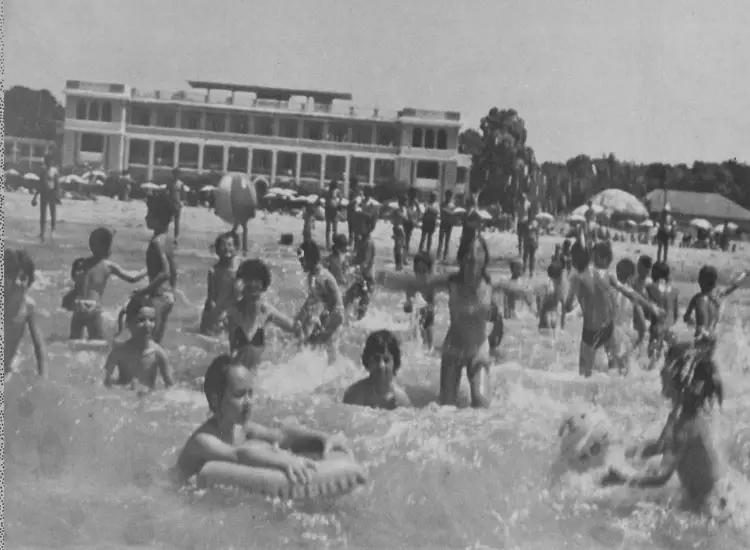
The “Adriatik” is in fact reserved for foreigners – that is, a small number of tourists from Western Europe, occasionally a trade delegation from Yugoslavia and Romania (two particularly suspect nations from the Albanian point of view), as well as members of the diplomatic corps who come from Tirana for a few days in an attempt to forget the deadly boredom of the capital. From the hotel entrance to the water’s edge is a narrow, forbidden area reserved for guests only, where you see colourful bathing suits, elegant sun umbrellas and colourful rubber mattresses. On both sides of this reserve, you find the Albanian beach public. From time to time they surge in such numbers as to remind one of the Ganges.
It is a pathetic public: the beach without swimwear for sale, without cameras or transistor radios, they have no sun umbrellas but tie sheets to four sticks, and their swimsuits are home‑sewn. This is a shameful segregation. You feel as if you are in a cartoon from *Pravda*, where the capitalist sits in the reserved area under a beautiful sun umbrella and tries to pick up Italian news stations on a transistor radio. A little further on, the beach is blocked by police guarding a group of villas that the masters of power use for their weekends.
Like all communist states, Albania is a class society. Out in the sea, Chinese transport ships wait for berths at the quay, and when darkness falls they turn on their lights and look very decorative. Meanwhile, the management of the “Adriatik” begins the perpetual preparation of evening entertainment. They show propaganda films on the large terrace. Yesterday we were delighted by excavators attacking a future construction site and Lorries transporting gravel, while a commentator in French spoke of the energy and will of Albanian progress. Tonight, it is announced, a new building will be erected before our eyes. /Memorie.al
Albania, September 1968
Sven Aurén