
By Luan Rexha
Part One
-Memoirs of a Seasoned Journalist –
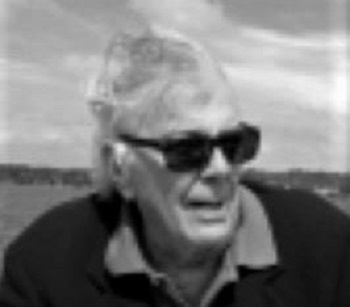
Memorie.al / Luan Rexha are a well-known journalist on the staff of the newspapers “Giornale di Sicilia” and “Ansa” in Italy. Despite his Italian upbringing, his heart holds a deep longing for Albania. The book presented to the reader contains a collection of articles reflecting the communist period in Albania in 1967. As the author himself states, he was the first Western journalist granted a visa to visit Albania and provide a panorama of the country, specifically regarding the relations between Enver Hoxha’s Communist Albania and the People’s Republic of China led by Mao Zedong.
In these articles, autobiographical elements abound, further enriching the framework of events. These also appear in his well-known novel, “Death Has Blue Eyes,” under the guise of the journalist Michele Sermonti, the main character. The author left Albania in his mother’s arms when he was only ten months old to start a new life in Sicily. It was only in 1967 that he was given the opportunity to return to Tirana to meet his grandmother and relatives whom he had never seen before.
His career is multifaceted: starting as a journalist for “Giornale di Sicilia,” he covered Sicily during the Mafia era, the earthquake of 1967, and the Albanian experience. Simultaneously, his contribution extends to the theater as an author of several plays and musicals, as well as to cinematography. This allowed him to be in contact with people of letters and arts. These circles were left-leaning, yet the influence of Italian communism on him – which was essentially Western and could not be reconciled with the totalitarianism of “real socialism” – is evident. This is what he had to confront during his stay in Albania.
He describes the reality of an indoctrinated country where the media was censored. In fact, he observes that Albania had jumped from feudalism to communism without experiencing bourgeois development. A special place is given to the analysis of how communism was perceived by the Chinese and the Albanians. Before his eyes, the reality of daily life unfolds. He admires the work of the people who, despite it being “voluntary,” built railways and infrastructure through hardship and sacrifice. Even in his relations with those around him, the author had to face the regime’s slogans, which did not correspond to the truth, as in the case of the “fletë-rrufe” (lightning sheets/public criticism posters).
Additionally, one thing that impressed the author was the morning physical education – the ridiculous manner of forming lines and movements in harmony with the leaders. Luan could not reconcile with the rigid stance of Albanian communism toward religious freedom, places of worship, and beliefs, expressed through their closure and the impossibility of practicing faith. Thus, the picture of Albania is described in vivid colors by an author who, for a period of several years, shared his life with his compatriots in Albania.
Giornale di Sicilia, March 11, 1967
Albania: China, 90 km Away
Even in Tirana, following the example of Beijing’s “Red Guards,” youth organization groups behave with severity, yet Enver Hoxha still manages to control them. Luan Rexha is the first journalist to receive a visa to enter Albania after the start of the “Cultural Revolution,” which, in the wake of Maoism, has had shocking effects even in this small Balkan country.
We are publishing the first article as part of a series by Luan Rexha on the life and characteristics of the enigmatic Chinese bastion in the Adriatic.
Tirana, February 28
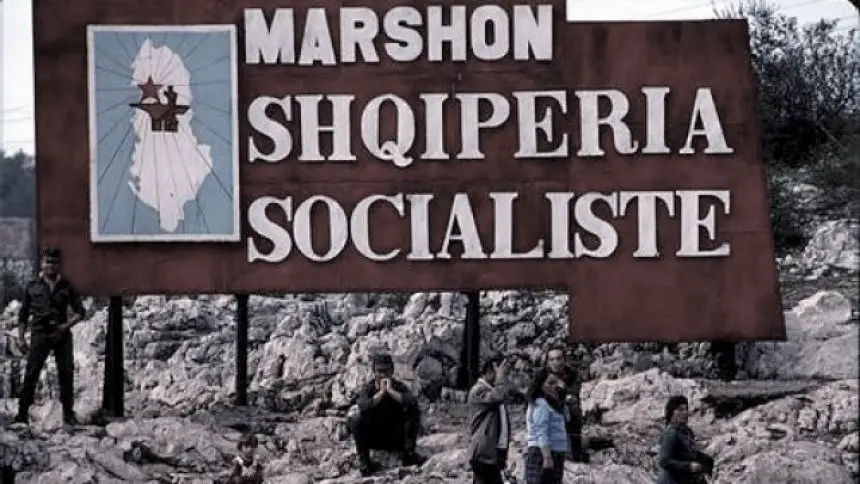
At Rinas Airport near Tirana, the day of my arrival was sunny. There was only one runway. In the hangar, in search of some reaction, and everywhere else, were five-pointed red stars. In the area in front of the building housing the customs and the bar stood the Chinese political staff in Tirana (numerous in counts) and other Albanian officials.
They had come to welcome the new Pakistani ambassador, a country whose hatred toward India was pushing it into Beijing’s arms. After a few moments, a feeling crawled over my skin that I had landed in another world, perhaps further away than the Moon.
Beyond a wall, a giant portrait of Enver Hoxha – the man of the anti-fascist resistance, the professor-general-colonel who “taught” the Nazis what it means when terror is not imposed but suffered – fixed his eternal eyes on me, like those of Eastern peoples. Meanwhile, an official from the “political office” confiscated all the newspapers I had bought at Fiumicino Airport.
A bit further, around a set table, Chinese and Albanians awaited together with the honors of the house for the distinguished guest who had descended from a “Viscount” type airplane. Mutual congratulations for a fruitful cooperation and the ritual toast with raki followed. They offered me some as well. It is a 22-degree raki. It burns. I hear that among them, the ideological allies, they speak in Russian to understand one another: it is the “post-mortem” revenge of the traitors of Moscow’s socialism.
Another raki. Outside, there is a group of “Red Guards” who have come to bring greetings from the Labor Youth Union of Albania: boys and girls all armed. I have entered the heart of the revolution, a revolution right at our doorstep. After seven days, I am waiting for another plane, so that I may try to describe it.
The baggage check process takes a long time. It is the books and cameras that make the police suspicious. “I am here for tourism,” I explain, but they are not convinced.
Someone has come forward to meet me. A man I know well and who shares the same last name, but whom I have never seen. First the war, and then communism: a long-awaited meeting after twenty-eight years. His arrival allowed me to cross the “dead end” of customs. Let’s go. They gave me a circulation permit: every day I must present it in Tirana at an office where a stamp is placed on the seven boxes it contains.
They do not trust me. For the communist regime in power, I am a Westerner, an enemy, an imperialist-capitalist. The past does not matter: a few meters of impressive film are worth more than the eleven members of my family who were killed by the Germans during the War, fighting for the same ideals in which the Comrade General Secretary of the Party of Labor (Enver Hoxha) believes.
Another raki. This time the glasses clink with sympathy: it is a private matter in the eyes of the Party. “Shëndet” – “Salute,” and hands tremble, but it is understandable.
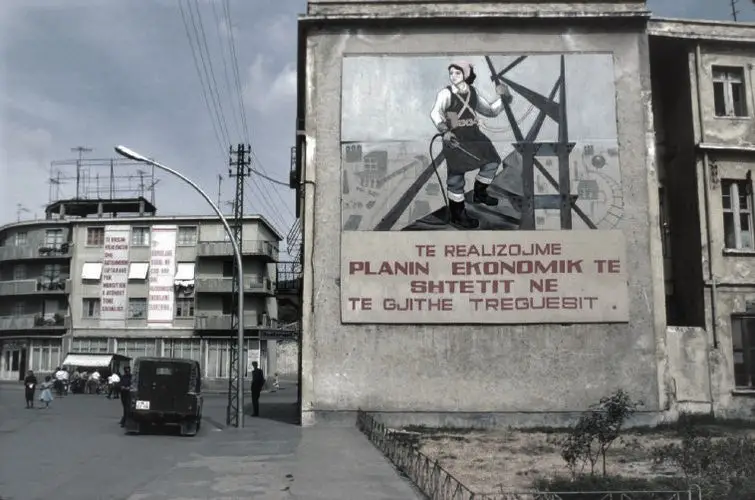
We took our places in a “Skoda” full of problems. The speedometer rises constantly as we struggle to leave tractors and trucks behind. We pass through a village rich with vineyards and trees. On both sides of the road, brightly colored signs sing praises to Marxism-Leninism, alongside a line of peasants in blue overalls.
I observe them closely. Among them are many girls, some very young, who do not have the appearance of those who have always worked the land. “They are members of the Youth Union organization,” explains the man who gave the guarantee for me at the airport – “the wings of the cultural revolution.”
Here in Albania, 90 km away from the Italian shores, the groups of Enver Hoxha’s communist youth organization “have placed a bet with history.” They must make up for a delay of several centuries, and they are not yet sixteen years old. The party asks everything of them: the word “impossible” has been erased from the dictionary.
The law of survival dictates it. Surrounded by hostile states that have never hidden their intentions for territorial expansion and in irreconcilable politico-ideological polemics with the “revisionists” of Moscow, the Albanians have only one friend: Mao Tse-tung, the great leader and helmsman of the People’s Republic of China.
A “relationship” made difficult by the different cultural context, a problematic alliance due to the lack of territorial continuity, yet one that moves beyond any Soviet prediction and overcomes the shallow Western illusion that China is far away.
For Hoxha, Beijing’s new path was an opportunity to ask the peasant and working masses of his country for a colossal collective effort to advance on the road to economic independence. Why? Perhaps out of fear that the powerful Asian supporter might emerge defeated from the open battle against the “soft” bureaucratic layer.
Chinese aid (millions of dollars for oil resource exploration, ultra-modern machinery for setting up hydroelectric plants, and the development of heavy industry) could be cut off at any moment. A China that would deny its prophet that would say no to the permanent revolution by setting aside the utopia of equality in the drawer of impossible things would constitute a mortal danger for Hoxha and his regime.
A restoration of friendly relations between Beijing and the Soviet Union, in fact, would bring “proofs” of good will from the rebels who might begin to reason. Today, beyond any doubt, one of these “concrete proofs” that the Kremlin would certainly demand is the Chinese withdrawal from their propaganda and military bases in Europe.
This means, in short: saying goodbye to Albania and the strategic ports of Durrës and Vlora. The communist fanatics of Tirana would thus find themselves completely isolated, as happened in 1961 when the head of the Kremlin, Nikita Khrushchev, to punish Enver Hoxha’s blind faith in Stalinism, severed diplomatic (and especially economic) relations with the smallest of his satellites.
In that case, Albania reacted harshly to the Russian sanctions. It was a “mouse’s roar,” and for the first time since the painful events in Hungary, someone in the communist world had the courage to publicly oppose the unlimited power of Moscow.
In that distant December, the break managed to survive thanks to the immediate “interest” of Beijing. Conversely, in the event of a future Sino-Soviet reconciliation, Albania would not know which “Saint” to turn to in order to carry out its five-year plan. Only to the West, though the Marxist-Leninist orthodoxy of the current regime makes such a hypothesis quite impossible.
With the uncertainty of tomorrow, Hoxha tells the masses: “When we have completed our industrial structure, we will carry out the second war of national liberation to the end”; and to the high party bureaucrats: “Do not stifle internal criticism just to preserve your personal privileges. If something is not working, it must be changed, whatever the cost, but it is important that this is done as soon as possible.”
Mao and Hoxha share only their hostility toward the imperial-capitalist-revisionists. If the former believes in thought, the latter relies on action. The first is a son of Confucius, and the second of Sorel. The Chinese Proletarian Cultural Revolution is lavish, reckless of risks, and entertaining, while the Albanian one is cold, calculated, and against violence.
If the Beijing philosopher has chosen the free path of contradictions, calculating their immediate consequences but with the belief that advantages will arrive in the future, the Albanian leader gives the “youth members” a controlled autonomy – just enough to be taken from those living “at the top” – to avoid the possibility of the revolution shaking an administrative structure that is still fragile, thus halting the very economic development they laboriously wish to incite.
This is the man for whom, today, two million people prepare to face great sacrifices and respond with a willful effort to the countless difficulties that following the “dogma” creates for them. And they smile, saluting with closed fists the giant portraits of the Comrade Secretary (Enver Hoxha) from the trucks that take them to the mountainous regions, far from any fear, where they must snatch new workable lands from the Balkan Alps.
They wear red scarves around their necks; although in Albania everything is red, and they sometimes confuse the errands their mothers give them at home with the slogans of the Central Committee of the PPSH. In Rrogozhina, one hundred and fifty volunteers are building a segment of the railway line. They are all very young and have responded to the Party’s call, bringing with them a blanket and schoolbooks.
It was essential that a double-track line connect Rrogozhina with the industrial center of Fier, but according to the five-year plan, no funds had been allocated for this work, and so the youth organization members were put into action, like the “Red Guards” in China!
The youth runs forward: “Glory to the Party that has given us a new railway,” “We thank the Party that leads us in this new life.” It is a song that “Radio Tirana” broadcasts every day at two o’clock, when they have an hour’s break for lunch. They are obliged, willingly or not – but mostly by their own will – to stay ten hours with a pickaxe in hand during a winter that has nothing to do with the Mediterranean climate, and they are the ones who give thanks. This hymn, then, was composed by the students of an eight-year school in Shkodra; for us Westerners, who are in fact “consumers” or have such tendencies, this sounds like it comes from Mars.
This is what I was talking about during the thirty kilometers that separate the airport from Tirana. The man sitting next to me, who knows the prisons of half of Europe, tried to explain to me the Cultural Revolution, militant Marxism-Leninism, and the hopes and concerns of the new Albania – certainly from his perspective, which coincides with that of an old Party theorist. “Now it is your turn to cast your eyes and try to understand the problems, and especially not to judge with bitterness: our people have suffered much.”
He has a gaze full of sweetness, but one that has surrendered to fate. Our meeting will never be complete. We can understand each other as long as one particular word does not come up in our conversation – the word liberty.
“Your power is economic, while our strength is moral. You live with the fear of tomorrow, while we do not. What is the use of always earning more if your needs increase in geometric progression with your income? You will never stop our (your) dissatisfaction. Withdrawing into yourselves condemns you to a constant sadness and loneliness. You suffer in a golden hell; do you not ask yourselves why? You cannot have a clear conscience when you live in a system based on the exploitation of man, and this feeling of guilt, even if you do not confess it, pushes toward the preparation for war.”
The man speaking to me is a high official of the Albanian government. It is the first official meeting with one of the men of the regime. They wanted me to face an “ideological” questionnaire. The gears of the organization had been set in motion.
“Our strength is moral.”
His harsh and modest stance is in contradiction with the idea we in Italy have created – not without reason – about power. The mysterious element in his formation impresses you immediately, as does the ill-fitting suit that made him look grotesque, like a man of no consequence who knows his business, and the striking absence of doubt. I tried to evaluate him, to focus on him. Was he a cunning propagandist? A visionary? A wretch who must follow the directives of the leaders to avoid ending up in some agricultural province? No, simply a Marxist-Leninist, loyal to the communist temple that makes no concessions./Memorie.al
Translated and prepared by: Alvin Saraçi