By ANTON PAPLEKA
Part One
Memorie.al / Official publications to date show that Albanian historiography has not reflected with scientific objectivity the resistance of the population of Nikaj-Mërtur against the military expedition commanded by General Shefqet Turgut Pasha in 1910. In the text “History of Albania,” for secondary schools, Tirana, 1973, this event is written about in a general and cursory manner: “After the fall of the Kosovo uprising, the Turkish army corps, under the command of Shefqet Turgut Pasha, crossed in July into the vilayet of Shkodra to carry out there as well the disarmament of the population and the recruitment of soldiers.”
Unfortunately, this lack of objectivity has continued even after the establishment of the democratic system. In the text “History of the Albanian People,” for secondary schools, Tirana 1994, where it speaks of the 1910 uprising, it is written: “After the fall of the uprising in Kosovo, the Young Turk government, which aimed to strike the entire National Movement, ordered its troops to continue the operation in the other provinces. During this march through Northern and Central Albania, martial law was declared everywhere, persecutions and arrests were made, military courts were set up, and Albanian clubs and newspapers were closed.”
Driven by the dismissive stance of official historiography, other instances or individuals have also attempted to belittle or completely disregard the historical fact that the Ottoman army interrupted its march towards Shkodra, through the mountains of Dukagjin, and was forced to change its itinerary.
I am inclined to think that those who have maintained such attitudes either did not know the facts and documents related to this period well enough, or were motivated by regional and religious hatred, to overshadow the resistance of the region of Nikaj-Mërtur, to which history gave the opportunity to unfold its great spiritual and warrior values.
The aims of Shefqet Turgut Pasha’s military expedition were not limited simply to subjugation, to disarming the population, and to collecting nizams (conscripts).
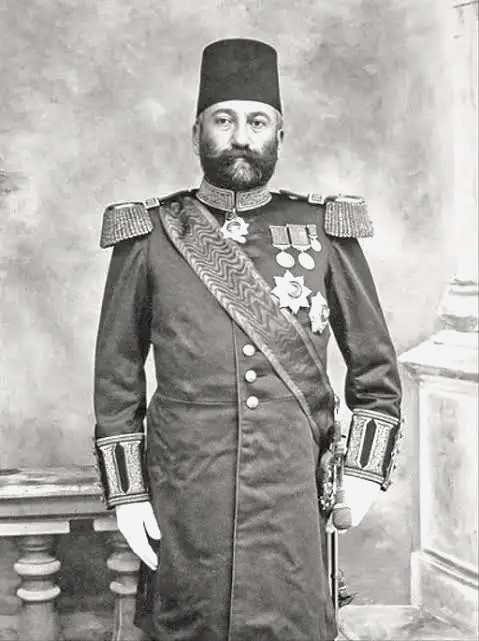
In his book “Travels Through the Balkans,” the albanologist Franz Nopcsa, who met with the Ottoman general, writes: “As he clearly emphasized to me, his program was to turn Northern Albania into a desert and then to populate this desert with Muslim emigrants coming from Bosnia. He particularly emphasized this specific detail—Bosnian emigrants, not from Anatolia.”
The ambition of this senior officer of the Ottoman Empire to subjugate the Albanians also comes to light in the folk songs that speak of this period: “All seven kings are holding council: / This Albania has escaped our hands, / All of Albania has escaped our hands. / They send a message to the Pasha: / If you give her to me for three years, / When I give her back, I’ll give her back raging. / I will take her land, I will take her livestock, / I will collect all her weapons, / I will take her nizams for three years.”
Although the army commanded by Shefqet Turgut Pasha numbered over forty thousand men and was equipped with the most modern weapons produced by European factories at that time, the Albanians did not hesitate to stand before it to cut off the path of this apocalyptic monster that would trample their lands.
Bloody fighting took place especially in the Kaçanik Gorge: “A new sultan mounted his post, / And sent the army to Albania, To gather men and gather children. / When he wanted to enter Kaçanik, / Kaçanik was drenched in blood, / He did not let it pass without being stabbed with knives! / They stabbed with knives for seven hours, / The horse drowned swimming in blood.”
After defeating the resistance of the Kosovo fighters, Shefqet Turgut Pasha’s army continued its march towards Northern Albania. To ensure the highest degree of manoeuvrability, he divided his troops into two parts: one he sent towards the Qafa e Morinës (Morina Pass), and the other towards Bytyç. The first to confront the military column that passed through Qafa e Morinës were the fighters of Gash, led by Halil Brahimi.
The Ottoman army was also met with resistance in Krasniqe. To pass through this region with as little damage as possible, the Ottoman general used all means to win over its leader, Shaban Binaku, who, after the proclamation of the Hyrjet (the 1908 Young Turk Revolution), had trampled on the photograph of Sultan Hamit, saying that from then on he himself would be the king of that land.
Convinced that after passing through Gash and Krasniqe the Ottoman army would march towards their region, the inhabitants of Nikaj-Mërtur gathered in a council and decided to set up an ambush on the main path leading to their lands, at Qafa e Kolçit (Kolçi Pass). They did not heed the large number of Turgut Pasha’s soldiers, starting from the principle that highlanders do not use counting for people, but for livestock.
A chronicler, a contemporary of these events, writes: “At Qafa e Kolçit, the men of Nikaj and Mërtur stood bravely, but the means they had were scarce, the weapons used were old and so few in number, that they could in no way match the large and strict army of the Turk, which lacked nothing, but had every means of warfare in abundance, even the newest mauzers, cannons, and machine guns.”
To weaken and humiliate the highlanders armed with outdated rifles, Shefqet Turgut Pasha gave the order for the cannons to be loaded with explosive shells that emitted a blinding flame. These shells, previously unknown, had a great psychological and combat impact. The dust and rock fragments prevented the highlanders not only from taking aim but also from inserting cartridges into their rifle chambers.
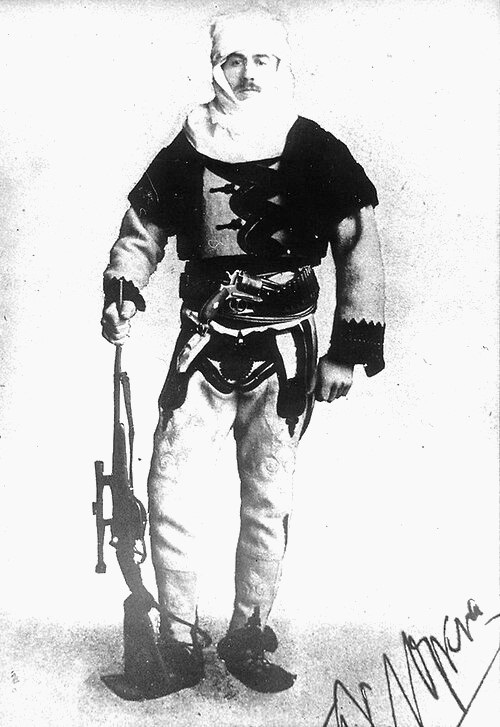
In those battles, where it was difficult to distinguish the ordinary fighter from the experienced leader, stood out Sokol Basha, the flag-bearer (bajraktar) of Nikaj; Shytan Brahimi, head of Nikaj; Gjelosh Rama of Currajt e Epër, Dedë Trimi, head of Mërtur; Tunxh Miftari, Sadik Gjergji, first house of Palç, and Prelë Tuli, the Trimi (Hero) of Salcë…!
The military superiority of the enemy forced the fighters of Nikaj-Mërtur to withdraw from Qafa e Kolçit. The Ottoman army passed through this bloody pass, which reeked of gunpowder, and surged into the depths of the region. The military command was established at Gurra e Hasan Gashit (Hasan Gash’s Spring), a strategic point from which the entire valley could be seen as if in the palm of the hand. Commanded by a captain, the army’s vanguard crossed the Great River, the Small River, and arrived at Gjonpepaj, at the church of Nikaj.
This church was saved from desecration only thanks to the intervention of an Ottoman officer of Albanian origin: “Here it must be known to the Bey of Kosovo (Ali Bey, A.P.) whether the priest survived without being imprisoned and the church without being violated. An Albanian, no matter what religion he is, is Albanian, and he does not forget his blood, nor does he humiliate his brother in front of a foreigner.”
The highlanders who had weapons were scattered throughout the mountains. They fired occasionally at the tents of the occupying army. The military command summoned the flag-bearer Sokol Basha together with the leaders of Nikaj, whom it ordered to surrender their weapons, register their family members, livestock, and property, and send men from fifteen to sixty years of age to serve as soldiers, without regard for family needs or any health deficiencies.
The tax for sheep and goats would be five grosh per head, while for pigs it would be ten grosh per head. If these demands were not met, the Ottoman officers threatened to execute the leaders by firing squad and arrest the common highlanders.
Faced with these threats, the leaders of Nikaj-Mërtur were forced to accept the demands of the Ottoman army command, just as their neighbours in Gash and Krasniqe had done. The only ones who refused to meet with Shefqet Turgut Pasha’s envoys were the leaders and inhabitants of the villages of Palç, Salcë, and Brisë, which lay to the west of the region, on the border with Dukagjin.
When the Ottoman army officers sent word to the three unsubdued villages to surrender their weapons, otherwise their houses would be set on fire within twenty-four hours, their leaders and inhabitants replied as follows: “If Istanbul wants the weapons, let it come itself and take them. Salca does not keep, nor has it ever kept, weapons to surrender them, but to fight with them. Therefore, here on the spot and not elsewhere, we will give the Pasha these iron pieces smeared with pork fat.”
To punish the disobedient villages, the Ottoman army gathered at Tëtherme (the hot springs) of Nikaj, in the meadows where livestock grazed. The foreign soldiers plundered livestock, dairy products, and damaged the crops. Anyone who resisted was arrested and beaten with a stick.
Hearing about the injustices the Ottomans were committing in the subdued villages, Prelë Tuli urged the inhabitants of the three undisarmed villages not to fall into the hands of Shefqet Turgut Pasha and to stand firm until the last cartridge. Regarding the role of the Trimi of Salcë as the organizer of the resistance, Pal Duka–Gjini writes: “The fiery word of the mountain man, his fiery eye and steel heart, his struggles with the elders and the hypnotism of the hope that Prela had placed in them, electrified Salca and Mërtur. They decided to die to the last man.”
The determination of the highlanders to defend their freedom and dignity has been immortalized by a faithful chronicler, as is the folk song created at that time: “The hill of Palç appears black, / A hundred houses have set up ambushes, / That Prelë Tuli has led us, / They have come out before the army, / They are sending word to Turgut Pasha: / This gorge is hard to get through, / Turn back the army when you receive the reply, / Because we cannot give up the arms of our arm, / Not without dying with honour, / Our father left them to us as a trust!”
Aware of the danger that the resistance posed against the large army of Shefqet Turgut Pasha—this resistance has been compared to the heroism of the three hundred Spartans led by King Leonidas at the Thermopylae Gorge—the highlanders’ leader, Prelë Tuli, tried to secure the help of the inhabitants living beyond the region of Nikaj-Mërtur: “Prelë Tuli rises to his feet / Who will take my message to Toplana / To save me, all the people, / All the people to save me, / Because Turgut has surrounded me…” Besides Toplana, Prelë Tuli also sought help from the great tribes of Dukagjin.
Led by Prelë Tuli, Man Avdia, and Deli Tahiri, the fighters of the villages of Palç, Salcë, and Brisë took positions at Guri Murg (Murg Rock), a steep rock, which they used as a natural fortification. For seven consecutive days, they repelled the Ottoman assaults, killing many of them: “Guri Murg, a white stone, / Shells are going past it in rows, / But they did not let the Pasha pass, / Before he turned back whence he came!”
In these battles, not only the skill of Prelë Tuli as a military tactician stood out, but also his personal bravery, as he killed a bimbashi (major) of the Ottoman army. In the words put in his mouth by the folk poet, the deep hatred of the highlanders towards the Asian empire that had separated them from Europe and left them in deep backwardness comes to the fore: “That Prelë Tuli shouted: / -Stop, major, for your hour has come! / He caught the bimbashi well. / The rifle cracked, the mountain resounded, / The nizams are falling down the slope…”
When they ran out of cartridges, the fighters of Palç, Salcë, and Brisë were forced to abandon their positions at Guri Murg and withdraw deeper, setting up a new line of fire on some impassable rocks near Brisë.
To vent their fury and avenge the losses they had suffered, the Ottomans destroyed the houses of Palç and Salcë, blowing them up with dynamite. In addition, they cut down trees with axes, trampled the green corn and grazed it with horses. They used the church of Palç as a barracks. Not even the vestments and sacred vessels of religious service escaped their desecration.
To force the unsubdued highlanders to leave the steep rocks where they stood with weapons in hand, the Ottoman officers gave the order to bombard the houses of the village of Brisë, the valleys, and the mountain peaks on the Dukagjin side: “This Thatë Mountain is wailing, / Men are killed, women are killed, / Three villages are in flames!”
Instead of being terrified by these bombardments, Prelë Tuli and his fellow fighters wrapped the shells in wet sheepskin cloaks (gunas) to prevent them from exploding and to take the gunpowder they needed for fighting. They continued the resistance resolutely, supported by two powerful allies: the Drin River, which flowed to the right of their positions and the two thousand fighters of the Dukagjin tribes who protected their backs and left flank. Memorie.al