Part Three
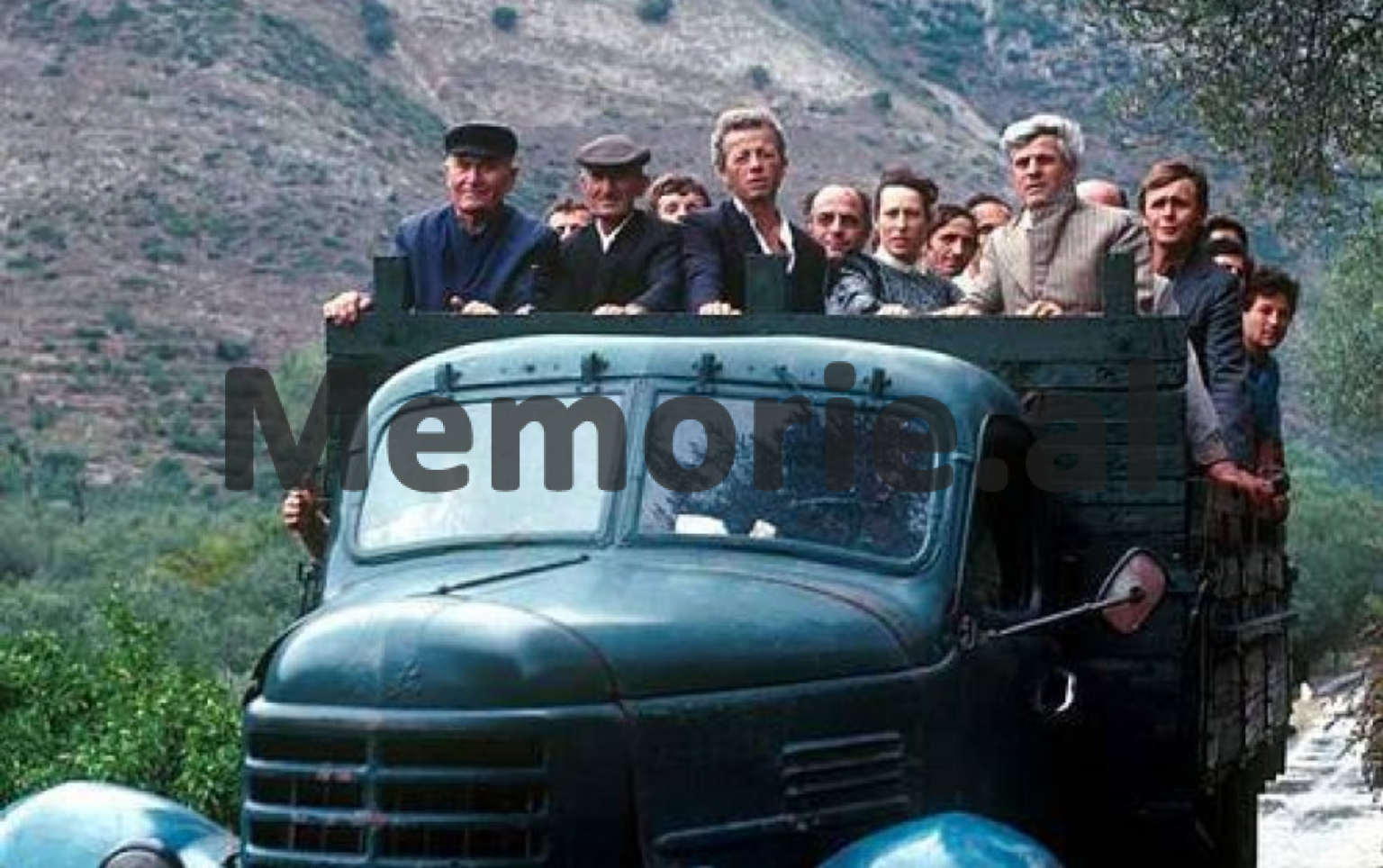
Memorie.al / A shoeshine costs 1 dollar in Tirana, but that is the last thing Albanians worry about. Many of them do not shine their shoes at all. In fact, most walk barefoot and others wear wooden clogs. The industrialization of the 20th century has only barely touched this country surrounded by mountains, which was once the Kingdom of Illyria and now proudly bears the name People’s Republic of Albania – the Land of Eagles. How little industrialization has affected the country becomes immediately clear when the driver of a “Warszawa” car (a Polish model of the Soviet “Pobeda” version), after we have spent 8 hours climbing up and down mountains, abruptly stops the car at the edge of an abyss. The up-and-down journey on mountain roads has put the hydraulic brake system out of order. “I’ll use water until I find some wine,” says the driver, putting on a philosopher’s mask.
Continued from the previous issue
“NEW YORK TIMES” IN 1957: “THE US MUST SAVE ALBANIA FROM IGNORANCE”!
In 1957, the American correspondent believed that the country was ready to open up to the West and that the West should not turn its back. The first American correspondent to set foot in post-World War II Albania managed to see light at the end of the tunnel.
He believed that the regime would tolerate some kind of relationship with the West, just enough to awaken Albania’s youth, who at that time had contact only with Moscow. According to him, Albania’s only hope was for the USA and other countries to lift the diplomatic blockade and enable the country’s communication with the West.
This is perhaps the time that also marks a kind of softening of the dictatorship in Albania, although this did not last very long and perhaps the opening that the correspondent hoped for never happened, perhaps because, as Salisbury predicts, “the clique in power would not allow anything to jeopardize its power held by violence and deceit.”
The American journalist: “All of ‘Socialist Realism’’
Whatever suggestion for a bit of pleasure and exaltation is mocked by Albanian youth. There may be such things in Poland, but not in Albania. When I quoted the Soviet author Vladimir Dudintsev and his highly controversial novel titled “Not by Bread Alone”, a group of Albanian writers looked at me with hostility and mocked me. “We don’t have any Dudintsevs here,” said one of them, emphasizing the words.
“We have no opposition. We are all of Socialist Realism.” Often the young people who had studied in Moscow and worked on farms in Cërrik, Elbasan, and Vlorë would drop their hostile appearance when I started speaking to them in Russian. No one greeted you here; nowhere did you find the warm hospitality you would receive in the Soviet Union. There were no lavish dinners, lunches, or toasts of friendship, nor a shower of questions about New York, Hollywood, or at least about the condition of Black people.
The only person who asked about the United States of America asked about the workers. When I told that man that in the USA workers are experiencing a notable improvement in well-being, he pursed his lips and said no more. On the other hand, the young man who served as our guide and came from the Ministry of Foreign Affairs had considerable difficulty persuading factory managers to open their doors to a correspondent from the United States of America.
Often they were rude and suspicious and would start making phone calls to the Central Committee in Tirana. In many factories that had previously appeared in Albanian documentary films, we were not allowed to take pictures, even though the guide insisted that such a thing had been permitted by the Ministry of Foreign Affairs.
CONTROL OF A REPORT ABOUT A REVOLT
For me, most of this sensitivity was similar to the reaction of a mollusk when its shell opens for the first time. I can cite another incident here. A news agency from the United States had telegraphed the Albanian Ministry of Foreign Affairs to verify news published in a Greek daily that there had been a revolt in Elbasan. I was called and asked to verify the news myself by going to Elbasan and asking people on the street.
They themselves stopped a man and asked him. His reaction was more than surprise. He said that during the four years he had lived there, there had been no disturbance. Prime Minister Mehmet Shehu himself got very heated about this dark report, even mocking it during a public speech. This summer, a handful of British tourists visited the country. They managed to photograph a good number of aspects of everyday Albanian life, but this again aroused a deep sense of offense.
These are just a fraction of the anger and bad impressions produced by the West’s stance towards Albania so far. The young people here have no choice but to keep their eyes on Moscow. They have no free path to go to New York, London, or Paris, even if such a heretical idea manages to enter their heads.
If the current opportunity is assessed positively, if, disregarding the bad behavior of Albanian officials and their innate hostility, the opportunity is opened for a program of diplomatic relations, cultural exchanges, and trade exchanges, an unexpected success could be achieved.
Albanian youth, like young people all over the world, are energetic and impatient, impressionable and fresh. They want a better life for themselves and their country, and so far only Moscow has thrown those crumbs of light towards the future.
THE “NEW YORK TIMES” EDITORIAL ON THE REPORTS OF HARRISON E. SALISBURY, VISITOR TO ALBANIA
“New York Times” correspondent Harrison E. Salisbury completes today in these pages a series of articles that give us, for the first time, on-the-ground information about Albania, information that is also brought for the first time by an American correspondent in a decade.
From his account, it is clear that even after 12 years under the communist regime, Albania is still the most backward and primitive country in Europe. In fact, in some aspects, it is even more backward than it was years ago when it had free contact with Western culture.
Our correspondent noted that Albania today is practically a province of the Soviet Union. The positive side of this dependence is that the Soviet Union has brought Albania some industrialization, albeit limited, a considerable increase in the number of people who can read and write, and a new native intelligentsia educated in Soviet schools.
But on the other hand, there are many negative things: old institutions have been harshly attacked, people have grotesquely been given an abnormal view of the world, and the persecutions and injustices of Stalinist totalitarianism have become a daily routine.
In short, we must say that the Albanians are paying dearly for those few benefits they have from communist control. Mr. Salisbury reports that opportunities still exist for the West and the USA to put an end to the barriers that have separated Albania from the West in the past. If Albanians are given more opportunities to contact the West, the harmful effects of the ignorance in which they live will be minimized.
This is certainly an element that should be considered before deciding on any policy. On the other hand, it must be borne in mind that the clique that currently runs the country has no intention of allowing contacts to grow as large as to jeopardize this clique and their power of terror and deceit. Memorie.al