
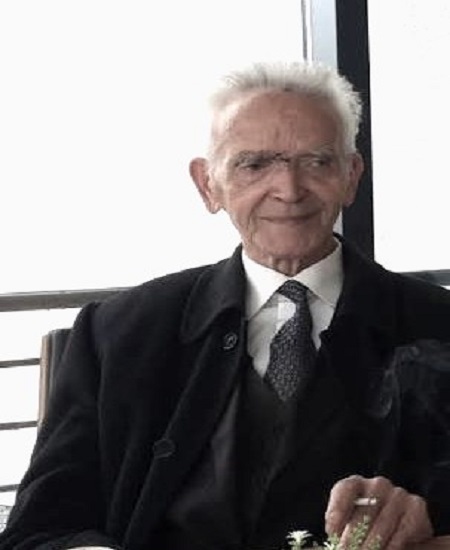
By Arif Ejupi
Part Two
– Reflections on the work of author Ymer Adem Llugaliu, who refused to sell his conscience –
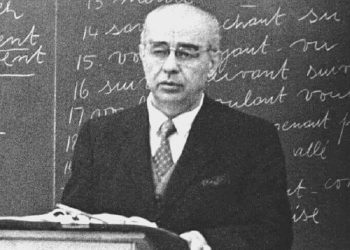
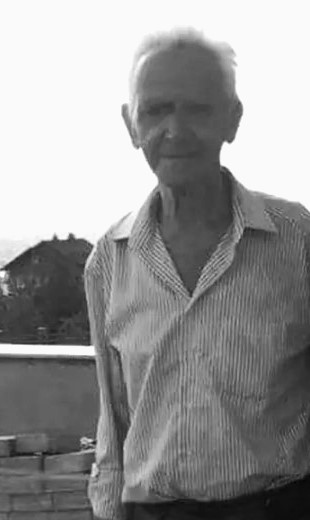
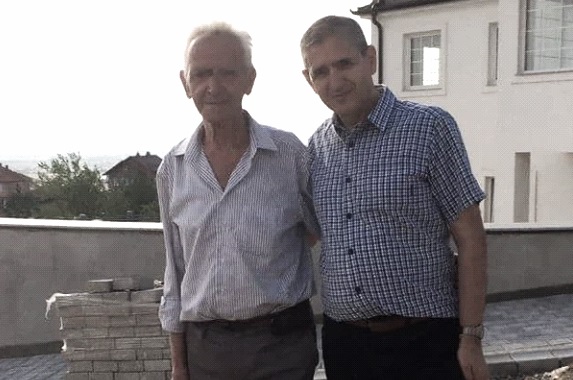
Memorie.al / In the history of twentieth-century Albanian literature, there exists a category of creators whose works cannot be fully understood without knowing the tragedy of their lives. They were not simply persecuted poets, writers, or intellectuals. They were people who found themselves facing an existential choice: to accept subjugation in order to secure a quieter life or to preserve freedom of thought by accepting the severe consequences of opposition. This category of creators includes Ymer Adem Llugaliu (1936–2022), teacher, poet, scholar of the Albanian language, polyglot, and intellectual with broad cultural formation. He was born in Surkish of Podujevo, to parents Adem and Arzija.
Continued from the previous issue
Diogenes and the search for the true human being
The philosophical peak of the poetry appears in two lines:
“Where to find the man,
where is Diogenes”!
This call is linked to the figure of Diogenes of Sinope, the ancient Greek philosopher with whom the philosophical tradition associates the tale of searching for the honest man with a lit lantern. But in Llugaliu’s work, the question takes on a much broader meaning. The poet does not ask where people are. He asks where the true human being is. That is, where is the one who does not sell his conscience?
Where is the man who does not betray his friend?
Where is the intellectual who does not remain silent before injustice? Where is the individual who preserves his dignity even when faced with prison, poverty, or threats? The call addressed to Diogenes is essentially a demand for the return of morality to social life. At this point, Llugaliu’s poetry gains universal dimensions. Because the search for the honest man is not related only to Albania of the seventies. It remains a concern of every society where interest, fear, and personal gain risk replacing conscience.
Shackles and galleries – the geography of violence
In these lines:
“Let the courageous measure themselves
against the weight of shackles,
against the cold of cells,
against the dampness of galleries.”
The poetry moves away from philosophical abstraction and enters the concrete reality of imprisonment. Shackles, cells, and galleries are no longer merely literary figures. They represent the experience of prisons and forced labor. Considering the author’s imprisonment in Spaç and Ballsh, these lines take on a special evidentiary force.
Spaç, known for its severe conditions of imprisonment and forced labor in the mines, was one of the places where political oppression took physical form. In this environment, courage was not measured by public declarations or decorations.
It was measured by the ability to endure pain, isolation, and attempts to break the individual psychologically. The poet uses three sensory dimensions: The weight of shackles. The coldness of cells. The dampness of galleries.
Weight, coldness, and dampness create an almost bodily experience of imprisonment. The reader does not know suffering only through thought. He feels it through the senses. This is one of the most important artistic achievements of the poetry. Historical suffering is transformed into poetic experience.
The frozen conscience – the central metaphor of the work
The lines most directly connected to the title are:
“From our heartsa free conscience is as far
as the August sun
from the frozen Antarctica.”
This is one of the most powerful metaphors in the entire poem. The poet constructs a contrast between two natural realities. The August sun represents warmth, life, light, and energy. Antarctica represents cold, distance, and an environment where survival requires extraordinary conditions.
By placing these two worlds against each other, Llugaliu creates a powerful figure of the lack of freedom of conscience. It is not merely about a society where people cannot speak freely. It is about a society where fear has penetrated so deeply that man risks losing his natural relationship with truth.
Here an essential distinction must be made. A frozen conscience is not necessarily a dead conscience. Ice can cover life, but it does not exclude the possibility of its revival. This opens an important interpretive perspective.
The very fact that the poet writes this poem proves that his conscience is not frozen. He manages to identify the moral freezing of society precisely because within himself he preserves the ability to distinguish well from evil.
Therefore the title contains a great paradox. The poet speaks of the frozen conscience, but creates a work that proves that human conscience can resist freezing.
The clowns, the servile, and the hounds – the satire of submission
In the concluding part, the poet uses harsh satirical language:
“Let the clowns applaud
for the ‘liberating’ murderers
slaps to the streets,
echo of shattered hearts.”
The irony is built on the contrast between the words murderer and liberator. The murderer and the liberator are two morally opposite figures. By joining them, the poet questions how political propaganda can change the meaning of words. He suggests that a power can present violence as heroism and submission as loyalty. Here Llugaliu enters one of the most important themes of anti-totalitarian literature: the manipulation of language.
Further we read:
“Let the monkeys grin,
let the servile bow,
let the hounds bark,
let the hunters satisfy themselves
with the blood of reptiles.”
This is a scene filled with grotesque figures. The monkeys symbolize imitation without independent thought. The servile represent conscious submission for gain. The hounds create the figure of pursuit and persecution. The hunters are linked to the exercise of force over those who have been turned into objects of pursuit.
This figurative world does not aim to describe animals. It aims to reveal the deformation of human behavior. At the same time, the repetition of the phrase “Let” gives the poem a powerful accusatory rhythm.
The poet seems to leave the scene to those who have adapted to power, but this concession is only ironic. Because the last word does not belong to them.
The eagle flying above the saçmes – the symbolic triumph of freedom
The poem ends with the lines:
“The saçmes of the rifle
cannot reach the heights
of the eagle’s flight.”
This is the highest symbolic point of the work. On one side we have the rifle and the saçmes, instruments of physical violence. On the other side we have the eagle, symbol of height, freedom, and pride. The confrontation is seemingly unequal. The saçmes can wound and kill. But the poet asserts that there exists a height they cannot reach. This height is spiritual freedom. It is dignity. It is the ideal.
It is the conscience that refuses submission. The eagle also has a clear national significance. For an intellectual born in Kosovo, who had chosen to live in Albania and had dedicated his life to the Albanian language and culture, this figure takes on a special weight. It can be read as a symbol of a spiritual homeland greater than political borders and longer-lived than temporary powers.
In this way, the poet does not close the work with despair. He closes it with a powerful assertion of the moral superiority of freedom over violence. At the end of the poem, the prisoner is not presented as a defeated man. On the contrary, while his body may be limited, his thought and conscience remain capable of flying.
The Gheg dialect as identity and cultural resistance
A fundamental aspect of the poem “FROZEN CONSCIENCE” is the language in which it is written. Ymer Llugaliu was an intellectual professionally formed in the Albanian language and literature. He knew the grammatical structures, the historical development, and the dialectal wealth of the language. Therefore the use of Gheg cannot be interpreted as a consequence of a lack of linguistic formation.
On the contrary, it represents a conscious creative choice. In the context of the language policies of communist Albania, where the standardization of Albanian was accompanied by the limitation of the institutional space of literary Gheg, this choice also takes on a cultural meaning.
However, to understand Llugaliu’s position correctly, one must distinguish the need for a common standard language from the denial of the values of dialectal traditions. A standard language can serve as an instrument of national communication without excluding creativity in Gheg or Tosk.
The problem arises when a linguistic variant is treated as invalid for literature and culture. In this context, Llugaliu’s Gheg becomes part of his artistic and spiritual identity.
The forms:
dasht (loved), nxansit (students), tyne (their), kam ngarkue (I have loaded), ardhmenis (of the future), nji (one), asht (is), naltsite (the heights), are not obstacles that should be removed from the poetry. They are part of its aesthetic structure. Through them the author’s voice is heard. His connection with his birthplace, with the linguistic tradition, and with cultural memory is heard.
In this sense, standardizing the poetry would risk changing its rhythm, sound, and stylistic individuality. For an author who had lived so deeply the conflict between freedom and compulsion, respecting the original language is also an obligation to the authenticity of the work.
Llugaliu’s Gheg should not be seen as an unfinished form of standard Albanian, but as a literary tool with its own tradition, beauty, and expressive possibilities. Publishing silence as moral refusal. One of the most significant aspects of Ymer Llugaliu’s biography is his relationship with publishing. He had begun to write and publish from early youth.
So, he was not an author who discovered creativity after the fall of the dictatorship. On the contrary, he had an early literary experience and a complete intellectual formation. However, according to biographical testimonies about his life, during the communist regime in Albania, he did not publish a single line of poetry. This silence has a special importance. It was not necessarily a lack of creativity.
It was, according to the account of his position, a refusal to put his talent in the service of glorifying a political system that he considered oppressive toward citizens, especially toward the poor and dispossessed strata. Here one must distinguish between silence imposed by censorship and silence chosen as a moral stance.
In Llugaliu’s life these two circumstances may have acted simultaneously. On the one hand, political persecution limited the real possibilities of publishing. On the other hand, his position toward ideologically oriented creativity represented the refusal to use poetry as an instrument of praising power. This is a position of deep ethical significance.
Because the writer does not face only the question of what he should write. He also faces the question of what he should not write against his own conscience. In this sense, even silence can become a form of expression. An author who refuses to write what he does not believe protects his relationship with truth.
Prison literature and the survival of memory
Poems created under conditions of political persecution have a special position in the history of literature. They can be simultaneously artistic works and testimonies of a historical experience. This also applies to Ymer Llugaliu’s creativity. But the poem “FROZEN CONSCIENCE” should not be limited only to the category of historical document.
Its value does not lie simply in the fact that the author was a political prisoner. What makes the work important is the way personal experience is transformed into poetic structure. At the beginning we have the teacher’s love for his students. Then disappointment appears. The critique of the moral deformation of society follows. Then comes the concrete experience of imprisonment. At the end appears the symbol of the eagle flying above the possibilities of violence. This inner movement represents a passage from personal memory toward the universal affirmation of freedom.
The work is not merely a narrative of suffering. It is an attempt to give suffering a moral and philosophical meaning. In this aspect, Llugaliu can be studied in relation to the tradition of Albanian prison literature and intellectual resistance, alongside authors who experienced censorship, persecution, and political imprisonment. Such a comparison does not aim to equate the creators, but to identify the experiences and themes that connect them: freedom, conscience, dignity, loneliness, and the individual’s relationship with power.
From communist prisons to democratic movements
Ymer Llugaliu’s personal history does not end with imprisonment. After his release and the political changes in Albania in the early nineties, he became involved in activities and movements for democracy and freedom. This involvement constitutes a continuity of the worldview expressed in his poetry. The man who had written about free conscience now sought to contribute also to public life. In 1993, he published the poetry collection “The Lion of Prishtina.”
He then continued with other publications in the fields of literature, history, linguistics, and journalism. His interest in the phonetics, morphology, and syntax of Albanian proves that, despite interruptions and sufferings, he had not abandoned his early passion for the study of language.
The creativity that had remained unpublished for years gradually began to find its way to the reader. In this process, the publication of poems written during the years of persecution also had an important historical function. It returned to society a voice that for a long time had been deprived of the possibility of free public communication.
A testimony of human courage: the burial of Musine Kokalari
An episode of particular importance in the life of Ymer Adem Llugaliu is his participation in the burial of the writer and dissident Musine Kokalari, in Rrëshen, in August 1983. Kokalari passed away on August 13, 1983; the burial ceremony took place the following day, August 14. At a time when fear and social isolation weighed heavily on people persecuted by the regime, Llugaliu’s presence at this funeral constituted a gesture of solidarity and human dignity.
This fact is documented in the testimony of Agim Haruni, a participant in the burial, who explicitly mentions Ymer Llugaliu among those present, together with Gjergji Gjergo and a small group of people close to Musine. This episode of Llugaliu’s life proves that solidarity with the persecuted did not remain for him merely a conviction, but was also expressed through concrete action.
(Sources for this episode: the testimony of Agim Haruni, published by Ndue Dedaj in Memorie.al and republished in Gazeta Shqip; an interview with a participant in the burial, published in Dosja.al; Arif Ejupi, “In memory of the dissident, scholar, and polyglot Ymer Adem Llugaliu,” published in VOAL)./ Memorie.al
Continued in the next issue