

By DASHNOR KALOÇI
Part Five
Memorie.al / Even though he was the main leader of communist Albania for 40 consecutive years, governing his country with an iron hand from 1945 until he died on April 11, ’85, and even after his death – until the collapse of the communist regime in early 1991- a complete official biography of Enver Hoxha was never published, although he himself left behind a series of works totaling around 80 volumes. In fact, even after the 1990s and up to today, a biography of the former communist dictator Enver Hoxha has still not been published that is based on archival documents shedding light on the early origins of his family, with its genealogical tree, as well as a life story of him, from the day he was born until the day he died…! This apparently is also due to the fact that throughout his life there were many shadows, indeed many dark stains, which meant that he himself never gave approval for the publication of a biography of him in a separate book, even though such biographies have in fact existed. In fact, three of them, by different authors, are found even today in Enver Hoxha’s personal fond at the Central State Archive in Tirana.
The first official biography of Enver Hoxha became public in 1946, within the framework of the “popularization” of his figure, as “the main leader and first secretary of the Communist Party of Albania, commander-in-chief of the National Liberation Army with the rank of colonel-general, chairman of the presidium of the Democratic Front of Albania, prime minister of the Albanian government, minister of People’s Defense and minister of Foreign Affairs.” As can be seen in the relevant facsimiles attached to this article, this biography – which is a small booklet of 58 pages, published at the “Rinia” Printing House (formerly the “Gutenberg” printing house) – on the first page (after the dark maroon cover and the photo of Enver Hoxha in the military uniform of a general with medals on his chest), has written in capital letters: “ENVER HOXHA, A SHORT BIOGRAPHY.” That first official biography of Enver Hoxha was prepared for publication by the employees of the Agit-Prop sector (Agitation and Propaganda) within the apparatus of the Central Committee of the PPSh [Party of Labor of Albania], but in reality its compiler and author was the first captain, Ndreçi Plasari, whose name does not appear in the book in question, but is found written in his own handwriting on the first page of the typed material sent to press.
The book, or more precisely the brochure “ENVER HOXHA, A SHORT BIOGRAPHY,” begins with a description of the city of Gjirokastra where Enver was born on October 16, 1908, and continues with several paragraphs on the history of the Hoxha family (which occupies only the first two pages), while the entire remaining part is devoted to his (Enver’s) role during the period of the “Anti-Fascist National Liberation War” with some of its main events (the founding of the PKSh [Communist Party of Albania], the Peza Conference, the Labinot Meeting and the creation of the General Staff of the National Liberation Army on July 10, 1943, the Mukja Agreement, the Përmet Congress, etc.), concluding with January 11, 1946, with the event of the proclamation of the Republic. Even today it is not known with precision why that brochure with the first official biography of Enver Hoxha (in which a life story of him for the period of Zog’s Monarchy is almost entirely missing), which glorifies his figure and role (or that of the Hoxha family), from the period of childhood up to the time it was published, was immediately withdrawn from circulation (it is said after two or three months) and was never again used even for reference, in books, albums, or other works dedicated to his figure.
Because from that time onward, Enver Hoxha began eliminating his close collaborators (members of the Politburo, ministers, deputies, etc.), by imprisoning, interning or executing them, and the book in question with his biography could no longer circulate with the names of “enemies of the people.” The second biography of Enver Hoxha was written in 1950 (15.VI.1950) and its author is Misto Treska, a close and highly trusted man of Enver Hoxha since the period of the French Lyceum of Korça and the Communist Group of that city of which he was a member, who during the War period was political commissar of the partisan Battalion “Reshit Çollaku” and after 1944 was promoted to major, being appointed as prosecutor and member of the judging panel in the Special Trial of 1945, which sentenced to death former prime minister Maliq Bushati and the members of the Regency, Lef Nosi and Father Anton Harapi.
Just like the biography written by Ndreçi Plasari in 1946, that of Misto Treska too – which has 238 pages of handwriting and the same title (“Enver Hoxha, a short biography”) – glorifies beyond measure the figure and role of Enver Hoxha in all the time periods treated there. Perhaps this was also the main reason why that biography written by Misto Treska about Enver Hoxha was not only never published, but was not even typed on a typewriter, like the 1946 biography of Ndreç Plasari, or the other one written later. Likewise, it is not known with precision whether this “service” that Misto Treska did for the main leader of Albania, Enver Hoxha (with whom he was acquainted even from the period of studies in France), influenced his later career, where he served as a jurist, translator, book author, diplomat, ambassador of Albania to France, Belgium, etc., as well as chairman of the Committee for Friendly and Cultural Relations with the Outside World, where he retired in 1981.
The same goes for Professor Ndreçi Plasari, a historian and researcher who during the communist regime held important academic and political posts, being for a long time also deputy director of the Institute of Marxist-Leninist Studies in Tirana, directed by Nexhmije Hoxha. In those duties, Professor Plasari served until 1982, when he was struck by the Party, accused as “a man of Mehmet Shehu, who had been sent by him to the British archives to inflate his (Mehmet’s) cult and had hidden the documents proving that Mehmet Shehu had been an agent of the Intelligence Service”! The third biography of Enver Hoxha was written in 1969 and its author is Aqif Selfo, a close friend of Enver’s childhood and youth and his neighbor in the city of Gjirokastra and, later, at the French Lyceum of Korça, where they studied together and Selfo also served for some time as a dormitory supervisor at that lyceum. On the first page of that biography, it is written: “Memories from the life of the Hoxha family, its origin and a life story of comrade Enver Hoxha, for the period 1908-1930 and 1931-1939, 6.1.1969, by Aqif Selfo.”
That biography, or more precisely a life story, as its author himself titled it (it has 124 pages of handwriting, while 82 pages typed), just like those of Ndreçi Plasari and Misto Treska, from beginning to end glorifies the figure and role of Enver Hoxha, indeed with distortions and falsifications of historical events and facts. (For example, on p. 46 of his memoirs, Aqif Selfo among other things writes that: “Enver set off for Belgium, settled in Brussels and began the duty of secretary of the Consulate. He stayed here partly in 1934, all of 1935 and partly in 1936. Alongside the duty of secretary of the Albanian Consulate in Brussels, Enver continued his studies at the faculty of law and took the exams of the second year.” While in another archival document found also in Enver Hoxha’s personal fond, the Albanian diplomat Nos Qosja who served in our embassy in Paris, among other things writes: “During my visit to Belgium with comrade Harrilla Kola, we went to the University of Brussels (Faculty of Law) and asked and established: Comrade Enver is registered in the Faculty of Law for the academic year 1934-1935. In the archive of that faculty, there exists a card with these data;
HOXHA Enver
Academic year 1934-1935
Date of birth; 3 October 1908 (Gjirokastra)
Register number; 2821
His address; “Legation d’Albania 155 Rue de la Loi, Brussels”.
The card is white, it does not appear that he took any exam.”
Paris, 22 February 1969 Nos Qosja
From what is stated also in the archival document in question (which is contemporaneous with the period when Enver’s biography by Aqif Selfo was written), it results that Enver Hoxha did not take any exam at the Faculty of Law of Brussels, which refutes what Aqif Selfo writes, that “Enver took the exams of the second year”! Perhaps this was also the main reason why those “Memories” were never published as a book, since in the period they were written, many of Enver’s and Selfo’s comrades and peers were still alive (in political prisons or free), whether from the period of their childhood in the city of Gjirokastra, that of the Lyceum of Korça, or even studies in France. But even though those “Memories” never saw the light of publication, in all likelihood they served their author Aqif Selfo as a shield for a quiet life (he worked as a teacher in Tirana at the “Qemal Stafa” gymnasium until he retired), unlike his two cousins, Riza and Syrja Selfo, whom Enver arrested and shot, even though they and the entire Selfo family had helped him with money during the War period, 1939-1944.
On the basis of these three biographies, in 1978 a book was published, or more precisely a brochure-type publication titled: “Enver Hoxha, beloved leader of the Albanian people”- (Material for conversations, on the occasion of the 70th anniversary of his birth), where on the first page after the cover, it is written: “Prepared by the sector of Marxist-Leninist education, at the C.C. of the PPSh. – In aid of agitators and propagandists.” The book in question was published by the “8-Nëntori” Publishing House at the “Mihal Duri” Printing House in Tirana. The fact that these three biographies of Enver Hoxha are found in his personal fond, indeed even with interventions and corrections by other persons – if they were not made at his order – in all likelihood were written with Enver’s approval. In any case these remain within the framework of hypotheses where there is room for longer investigation, but in this article we are publishing first the biography of Enver Hoxha, which was written by Aqif Selfo, which is being published for the first time and with the relevant facsimiles in several issues, by Memorie.al.
Continued from the previous issue
ARCHIVAL DOCUMENT EXTRACTED FROM THE PERSONAL FOND OF ENVER HOXHA FOUND IN THE CENTRAL STATE ARCHIVE, WITH THE MEMORIES WRITTEN BY AQIF SELFO, ON THE ORIGIN OF THE HOXHA FAMILY AND A LIFE STORY OF ENVER HOXHA
Memories from the life of the Hoxha family, its origin, and the life story of comrade Enver Hoxha for the period 1908–1930 and 1931 – 1939
By Aqif Selfo
6.1.1969
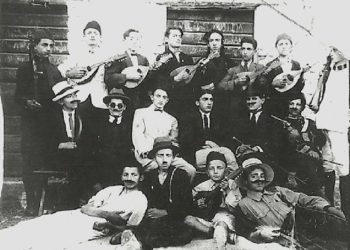
The boyish enthusiasm of the members of the society, most of whom were under the age of 15, gave an impetus never seen before to cultural activity in Gjirokastra. Within a short time the comedy “Lojnat e studentit” [The Student’s Games] was prepared. This play was shown to the public on August 24, 1924 in the hall of the lyceum. The next day this same comedy was shown also for women. The comedy “Imazhi” [The Image] had great success. But what made an impression and great joy was its showing for women: for the first time the women of Gjirokastra saw a theatrical piece prepared and acted by their boys. Among the actors was also Enver; in this play he played the role of the coachman (in the National Liberation Museum of the former District of Gjirokastra, there is the photograph of the participants of this show; in the photograph Enver is found on the right in the foreground). The first revenues of the shows were used for renting a premise where the society’s headquarters was established, for furnishing the premises with the necessary furniture and for creating a rich library, for that time, with Albanian books and magazines as well as with books in foreign languages.
But the main purpose of the society was to collect money for the erection of the statue of Çerçis Topulli. A distinguishing feature of all the members of the society was the great mobilization for carrying out their tasks: for the best preparation of the orchestra (mandolinata) and especially of the theatrical pieces. The players of the theatrical group not only prepared themselves in their roles and took part regularly in rehearsals but also worked tirelessly in setting up the stage and equipping it as the case might be. Because of the many tasks they often did not even go to their homes to eat lunch or dinner but took with them whatever they had and ate there. Often they stayed late at night or stayed up until dawn in the hall of the lyceum where the stage was being prepared, taking only a wink of sleep. Among them were distinguished Enver Hoxha, Selami Xhaxhiu, Reshat Toto, Elmas Konjari, Fane Rodi, Nuri Drrasa, etc. An unstinting help in these theatrical preparations was also given by Dine Qadhimi, who, although he was of frail health and with small income (he practiced the profession of photographer), left his work and was always near the theatrical group. He was the director of the society.
Through his great and selfless work he won the love and respect of everyone. Another distinguishing feature was also their maturity. The general meetings were held with the greatest seriousness. At these meetings various issues were discussed such as the good running of the society, its financial situation, discipline, order, etc. The discussions of the members were lively, numerous and just. At one of the general meetings, during the time of preparing the first theatrical show, something unexpected for the overwhelming majority of the members came up. At this meeting a small group of members made some remarks against the leadership of the society. The leadership of the society (the leadership consisted of the chairman of the society Aqif Selfo, the vice-chairman Naxhi Totozani and the secretary Elmas Konjari), had taken some measures for the good running of the work such as prohibiting members who did not belong to a given group from entering the rooms where the mandolinata rehearsals were held, the rehearsals of the theatrical piece being prepared for showing, or the meetings that the separate work groups held to discuss the cultural activity of the group, etc.
These measures, for this small group, were called strict and unjust. At this general meeting, after the agenda ended, one of the members of this small group asked for permission to speak. Permission was given immediately. He demanded that the measures taken by the leadership of the society were unfounded, violated the freedom of the members and hindered the good running of the society. He demanded the removal of these measures at once and the replacement of the society’s leadership with a new leadership. This proposal caused a great astonishment and concern among the majority of the members, but at once the situation was clarified. The leadership for its part showed the reasons and the good purpose of these measures. But the great participation of the society’s members in the discussion of this issue gave the meeting a great liveliness. One of the most striking and just discussions was Enver’s discussion. Enver characterized these remarks as trifles, harmful and which had as their purpose not the forward march of the society but its weakening and destruction. In his discussion he pointed out that the achievements attained in a short time were not only the great and unstinting work of all members without exception but also the fruit of the measures taken for the good running of the work; the opposite would lead the society into a chaotic state and toward its complete destruction.
The just stance of Enver and of the other members of the society toward this issue convinced all members without exception, including that small group, to give up the trifles and to multiply their forces for the good running of the society. Thus, after this meeting, the society emerged more compact: the first show and the other subsequent cultural activities achieved visible successes. So the summer holidays of 1924 were closed for the members of the society and for the society with great successes in all cultural activities. After the holidays a part of the society’s members left Gjirokastra to continue their studies in the country’s secondary schools, while the other part, students of the lyceum of Gjirokastra, also began their studies for the school year 1924-1925 in their school. In this period the society was directed by the students of the lyceum of Gjirokastra themselves: Elmas Konjari, Enver Hoxha, etc. But this period, the end of 1924, both for the whole country and for the “Student Society” was charged with very grave events: the preparation and establishment of Zog’s dictatorship.
The students of the lyceum of Gjirokastra, like all the students of the secondary schools and of the youth of Albania, in those days of December 1924, with the 16-year-old boy Enver Hoxha, burst into demonstrations and demanded weapons to fight against the return of Zog. [There follows a passage that in the original repeats the earlier text about the show for women, the coachman role, the revenues, the statue of Çerçis Topulli, the theatrical group’s work, Dine Qadhimi, the maturity of the members, the general meeting, the small group’s remarks, Enver’s discussion, and the closing of the 1924 summer holidays – repeated verbatim in the source file. It is translated identically above.]
The students of the lyceum of Gjirokastra, like all the students of the secondary schools and of the youth of Albania, in those days of December 1924, with the 16-year-old boy Enver Hoxha, burst into demonstrations and demanded weapons to fight against the return of Zog. Regarding this matter, a teacher who taught at the lyceum of Gjirokastra recounts: “One evening before December 24, I and some of my colleagues, coming out of the house of the lyceum director V. Kutan, invited by him to spend some moments together, headed toward the marketplace to go to our homes. Meanwhile we heard some cheers but as we approached the center the cheers became stronger and clearer. Finally we found ourselves before a large crowd of young people; they were the lyceum students who had burst into a powerful anti-Zog demonstration. At the head of the demonstration was Enver Hoxha. The students, having seen us, approached us and Enver told us that we are demanding weapons to fight against the fugitives led by Myfit bey Libohova who had gathered on Greek soil with the help of the Greek reaction beyond Kakavija.
We for our part told the students that you are small, so you will not go, but we will go. They strongly opposed this opinion but finally were convinced. Then we, seeing the example of these young people, after arming ourselves with some weapons we could find, went toward Kakavija.” But the events rolled on with lightning speed: on December 24, 1924 Zog’s bashibozuks entered Tirana and his reactionary dictatorship was established throughout Albania. The establishment of the reactionary dictatorship was a great misfortune for the entire Albanian people, hence also for all the youth of the country. Nevertheless the young people, especially the school students, expressed their hatred toward Zog’s regime in various forms. One of these forms was sabotage or the lack of enthusiasm at the new holidays, especially on the day of the proclamation of the Republic. At this holiday the students went out, or rather were taken out in an organized way school by school, to participate, but no liveliness appeared on their faces: they were there in body but not in heart. In this period the celebration of the November 28 holiday stood out. In the celebration of November 28 the liveliness and enthusiasm included everyone: old, young, school students, etc. This stance was maintained by the young people of all schools and by the people throughout Zog’s regime. Zog’s regime, in the first days of its life, laid at the foundation of its policy repressive measures against the people and liquidating measures for everything progressive. / Memorie.al
Continued in the next issue