
From Sejdi Peka
Memorie.al – In this rewriting of history, shedding light on the role of the intellectual Xhafer Deva in protecting Jews in Albania during World War II, as well as in organizing the resistance of the Albanian people for the protection of Kosovo’s ethnic borders under the direction of the “Second League of Prizren,” takes on a particular importance. When the then-Albanian Prime Minister put forward the idea of rewriting history and freeing it from ideological treatment, some officials from the chairs of Marxist-Leninist history in Tirana and Pristina reacted negatively. Now, after so many years, the Prime Minister’s idea has gradually faded, until it appears forgotten. Even the efforts of historians such as Dr. Beqir Meta and Dr. Muharrem Dezhdiu to treat history after pluralism were attacked in the most primitive manner by the historian-politicians of the former communist left.
Against the falsification of our national history, especially that of World War II and its aftermath, at least we, the former political persecutees of Albania, cannot remain silent and accept that our national history be written even in our days by sick historians infected with communist ideology. In this piece, I am undertaking, in the light of facts and truth, to illuminate the role of the intellectual Xhafer Deva in protecting Jews in Albania during World War II, as well as organizing Albanian resistance in Kosovo through the formation of the “Second League of Prizren,” which holds particular significance.
There is no doubt that one of the most brilliant chapters of our national history is the “Second League of Prizren.” January 26 has been declared the International Day of Commemoration in Memory of the Victims of the Holocaust. For us Albanians, this commemoration holds double significance. First, we are among those peoples who did not allow the killing of a single Jew by the German fascists on our soil, and for this we have reason to be proud. And second, on this occasion we commemorate the Holocaust of the communist dictatorship, which for 50 years exercised it against our people – both for seizing power until 1944 and for retaining it after that year until the fall of communism.
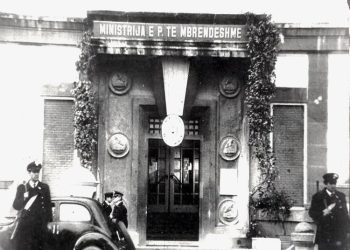
Our history – that of a small people, but “quite unfortunate,” as Abdyl Frashëri writes – is a history written in blood and suffering, and therefore it deserves to be written as it truly was. It is true that the Albanian people sheltered and protected the Jews, just as we must accept the historical truth that the Jews were also protected by the so-called “quisling” governments – according to communist historiography – in this particular case, the government of Rexhep Mitrovica. At that time, the Minister of the Interior was, again according to communist historiography, also the “quisling” Xhafer Deva – who, if we examine history, would later be, also according to communist historiography, even the “quisling” of the Americans for overthrowing communism and establishing democracy in Albania.
In 1949, immediately after the formation of the North Atlantic Treaty Organization (NATO), he would become a close collaborator of this alliance. Deva, with dedication and determination, as a man of the tradition and besa (honor code) of the land that bore him, protected the Jews with honor and dignity from the extermination intended by the Germans. On this occasion, this important fact could not be mentioned as historical truth. Against Xhafer Deva and Albanian nationalism in general, so much mud has been thrown by the communists that it is quite difficult to prepare public opinion to learn the truth of our national history, especially during the half-century period of the communist regime.
With Xhafer Deva’s name is associated the so-called massacre of February 4, 1944, which, according to communist historiography, was a cruel act of Xhafer Deva – like the St. Bartholomew’s Day massacre. But is the massacre of February 4 in Tirana true, as the communists have written it? This remains for historians to examine in the future, and everyone should be given the “due” that belongs to them, based on facts that must be looked at in the light of day, without communist-like emotions. However, according to historical facts, it appears that in their struggle to seize power and to justify their killings and massacres throughout Albania, the communists considered lies and propaganda as primary.
On social networks, a piece by an author has been published, based on the account of a veteran – an eyewitness to this event. From the very beginning of the testimony, although the historian has been a lecturer at the Chair of History of the Party of Labor of Albania and secretary of the Party Committee in Lushnja, he becomes entirely unconvincing. “That harsh winter night,” the veteran begins his account – when it is known that Tirana cannot have a harsh winter, since roses even bloom buds in winter. “Dragging them through alleys and gutters, 84 people were barbarously shot, and 500 others were arrested and interned.” The author of the piece, citing the story of a mother whose son was shot on that night of February 4, 1944, writes the words of others: “Tie the dog up, shouted Qazim Mulleti and Osman Kazazi.” Again, it is completely implausible that the Prefect of Tirana at that time would go house to house and street to street, shooting people.
But the veteran historian, from the 84 people who according to him were shot that night, although he had more than half a century at his disposal, could not gather more than 30 names – and even these are very likely to have been killed under other circumstances. Citing the newspaper Bashkimi (The Union) dated February 3, 1945, which at the time was the most reliable organ of the Albanian communists, we note that an announcement had been published: “Families, relatives, comrades, and any citizen who knows the names of the martyrs of February 4, 1944, are requested to notify the National Liberation Council of the city of Tirana within today.” As can be seen, even one year after this event, although the communists were masters of propaganda, they had not been able to complete the list of names of those killed in the “St. Bartholomew’s Night.”
The newspaper Bashkimi, in the declaration of the Central Committee of the Party of Labor of Albania on the occasion of February 4, gives only the names of four persons killed. On February 9, the same newspaper writes that Ali Visha, on this same date a year earlier, “had died from the tortures of the people’s executioners.” Meanwhile, the veteran historian, Doctor of Historical Sciences, in the list he presents of those killed on February 4, 1944, includes Ali Visha as well. It is quite senseless for the same person to have been killed on February 4 but also on February 9.
Looking at it from this perspective, and considering many other facts, while at the same time feeling great regret if there truly were victims, one thing is very true: February 4 was a fabrication of communist propaganda to discredit Xhafer Deva and, at the same time, to justify their own killings and massacres against the people in all four corners of the country.
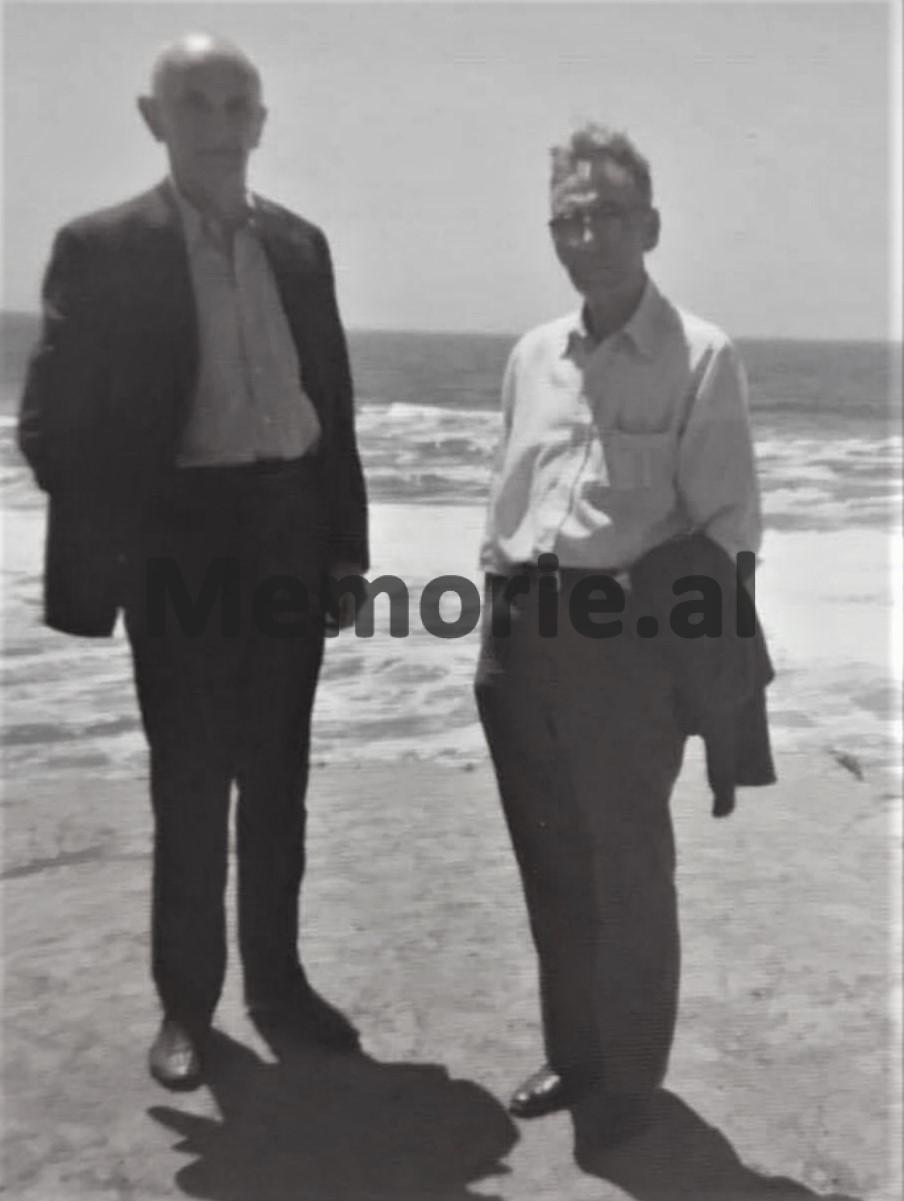
But who is Xhafer Deva, about whom Albanians have been informed only through communist propaganda – as a quisling in the service of fascism, an ignorant, murderous traitor to national interests? And for this man, who for a time made a name for himself in our national history, the truth is deliberately shrouded in darkness. Personally, I did not know Xhafer Deva.
But I had the good fortune to meet and have extensive conversations with Prof. Dr. Rexhep Krasniqi, former Minister of Education, former Vice-President of the National Assembly of Albania in 1943, Vice-President of the Second League of Prizren during 1943–1944, and Chairman of the Committee “Free Albania” in New York from 1956 to 1992. This too is a fact that Albanians should know: that the Committee “Free Albania” possessed almost the attributes of a provisional government in exile, with the moral and material support of the U.S. government.
Hundreds of thousands of Albanians persecuted by the communist regime and sheltered in camps, such as those in Italy, Yugoslavia, France, Austria, etc., came to America through the personal intervention of Krasniqi with the U.S. government. With this support, the Committee “Free Albania” worked tirelessly in the diplomatic, political, and military fields to overthrow the communist regime and establish democracy in Albania.
Now, the colossus of Albanian patriotism and nationalism, Rexhep Krasniqi, no longer lives, but I am very grateful to Mr. Idriz Lamaj, for a long time a journalist and announcer for the Albanian Service of the Voice of America, and to Mr. Hysen Biberaj, an unbending fighter for a democratic ethnic Albania, who enabled me to get to know this personality, this scholar of Albanian letters.
During a month-long stay in New York, there was hardly a day when I did not talk with Krasniqi. It is not surprising that former Prime Minister Berisha, not long ago, addressed the deputies of the Assembly asking them: “Do you know who Rexhep Krasniqi is?” and silence filled the hall. The Prime Minister answered his own question again: “You see, you do not know him?”
Rexhep Krasniqi was Xhafer Deva’s closest collaborator during World War II. Deva was the Chairman of the Second League of Prizren, and Krasniqi was its Vice-Chairman – the League that organized the people of Kosovo in an armed life-or-death struggle against the installation of the criminal Bolshevik-Serb regime in Kosovo. Later, their collaboration would continue in exile within the framework of the “Free Albania” Committee in America.
The archive of this Committee, whose activity spans more than 35 years, also sheds light on the activity of Xhafer Deva. In his writings and memoirs, Rexhep Krasniqi relates that Deva always categorically denied any massacre that might have been committed under his orders during the time he was Minister of the Interior in the government of Rexhep Mitrovica.
Education
Xhafer Deva was born in Mitrovica in 1904, into a family of urban origin from Gjakova, but which had descended very early from Deva in the has region. A well-educated man, an engineer by profession, he was a polyglot, knowing many languages such as English, German, Turkish, French, and Italian. In the book Isa Boletini, the author Skënder Luarasi, speaking of the hero of Kosovo, writes: “If for nothing other than that night when, with the brave men of Kosovo, he stopped the army of Xhavit Pasha on the hills of Levan to prevent it from entering Vlorë, defending the flag and the declaration of independence, Isa Boletini would still be a Hero of the People.”
In this sense, Xhafer Deva devoted his entire life to extraordinary struggle and effort for the liberation of Kosovo from Serbian occupation and its unification with Albania, along with all Albanian territories left outside the mother country. In the diplomatic and military fields, even in exile with the support of the U.S. government, his efforts never ceased to overthrow the communist regime and establish democracy in Albania and Kosovo.
On April 9, 1950, Xhafer Deva wrote to Rexhep Krasniqi, who at that time was in Australia: “The outbreak of a war in the Balkans, and even beyond, should not find us unprepared. We cannot perform miracles, but with a battalion, which I can create and lead, I will land in Tropojë, and from there we can break through a point to enter the Plain of Dukagjin.” (Idriz Lamaj, Xhafer Deva’s Engagement for the Inclusion of Kosovo in Washington’s Military Plan, p. 2).
And there, Lamaj writes that, “On June 26, 1950, shortly before midnight, the dropping of Xhafer Deva’s paratroopers into Albania began. They were all Kosovars and dressed in American military uniforms. They had been trained in an American military camp, with Deva present day after day on the training field.” At that time, the communists in Belgrade and Tirana were alarmed, for they knew very well who Deva was.
The newspaper Zëri i Popullit (The People’s Voice) in Tirana, and its sister paper in Belgrade, Večernje Novosti, published lengthy articles stating that “Xhafer Deva was on the move.” Drawing a parallel with what happened 49 years later in Kosovo, when the KLA broke through the border precisely at Tropojë toward Kosharë, entering the Plain of Dukagjin, demonstrates that strategy and ability of Deva as a highly capable military leader.
The government of Rexhep Mitrovica, in which Deva was Minister of the Interior, is accused by communist historiography of being a quisling government. We must look further into the strategy of this government, which aimed to exploit the political conjunctures of the time for the unification of all Albanian territories into a single state. At no time in Albania did a Nazi party exist, nor were there any organized formations of Albanian youth.
In no state building or public centre, apart from the national flag, was any foreign flag raised.” (Rexhep Krasniqi, Xhafer Deva: Life and Activity, p. 73). Ago Agaj, “the so-called pride of Vlorë,” a fellow fighter alongside Deva in the struggle for an ethnic, democratic Albania and against communism, Prefect of Mitrovica, Minister of the National Economy in the government of Rexhep Mitrovica, in his memoirs in the piece “How I Got to Know Xhafer Deva,” writes: “I write as an aged man but also as a man before God. God and the nation must not be deceived. Xhafer Deva had these consciousnesses of a Kosovar, and he threw himself into battle without a second thought, more than anyone else, to protect his people. He was the man, the most outstanding Albanian of his generation.” (Ibid, pp. 1 and 116).
It is indeed deeply regrettable that all those who spent their whole lives fighting for an ethnic, democratic Albania and against the installation of the communist plague in Kosovo and Albania are not honored but, on the contrary, are ignored. This shows that our society and politics in Albania are deeply infected by the remnants of the communist regime. We must rise from this quagmire as soon as possible, so that we may set out on the difficult path of democracy and unite with other civilized nations. National treason has never been and will never be on the side of nationalists. The nationalists were resolute in their idea – an ethnic, democratic Albania, united with all its territories unjustly left outside the mother country by the London Conference of 1913. Albania and the national cause were betrayed by Enver Hoxha and the communists, who served their criminal work against the Albanian people.
“Here it is proven that the stance toward Kosovo is Enver Hoxha’s greatest betrayal, which sent Albanians to shed their blood in order to secure for the Yugoslav communists the rule over Kosovo.” (See Tajar Zavalani, History of Albania, Part Two, pp. 278/79, London 1966). The Second League of Prizren, led by Deva and other most prominent intellectuals of Kosovo, will remain among the most brilliant chapters of our national history. At this time, the people of Kosovo, who were fighting a life-or-death struggle against the Serb-Montenegrin brigades in defense of their ethnic borders, were in the autumn of 1944 also treacherously attacked by the Albanian partisan brigades of Enver Hoxha. The military forces of the Second League of Prizren were now caught between Scylla and Charybdis.
Even Shaban Polluzha, with the brave men of legendary Drenica, had been surrounded – on one side by the Serb-Montenegrin brigades of Tito, and on the other by the Albanian partisan brigades of Enver Hoxha. Communist savagery had no limits. More than 44 villages were reduced to ashes. The number of killed and innocent victims shot by the communists in Kosovo and other regions in Macedonia and Montenegro reaches 47,000–50,000 Albanians.
From the long list of hundreds of thousands of martyrs, we will note just a few: Musa Shehi – Chairman of the Assembly of the Second League of Prizren; Prof. Kol Margjini – Vice-Chairman of the Central Committee of the League; Aqif Bluta – Vice-Chairman of the League; the sons of Isa Boletini – Asllan Boletini, Mujo Boletini, Pajazit Boletini; the grandsons of Isa Boletini – Kapllan Boletini, Skënder Boletini; Bedri Peja – Secretary of the League; Uk Sadik Berisha and Shaban Berisha – the two sons of Sadik Ram Berisha, leader of the uprising of the Plain of Dukagjin; Skënder Curri, Esat Berisha, Mulla Idriz Gilani, etc.
A special place of honor should be dedicated to the “Hasan Prishtina” battalion, composed of very young youth, which was entirely annihilated – 300 men – in the gorges of Podujevë while defending a strategic point against the Bulgarian army led by communist commissars. This bloody battle has been called by the Albanian poet “Kosovo’s Thermopylae.”
The Albanian partisan brigades surrendered to the Yugoslav communist forces that were occupying Kosovo, as did the majority of the League’s officers, such as: Col. Fuat Dibra, commander of the League’s military forces, and his staff; Col. Asllan Vela; Lt. Col. Sitki Shkupi; Captain Hajdar Plana; Captain Rasim Dajçi; Captain Gjon Dostanishta; Major N. Hoxha; Captain Mark Thani; Lieutenant Nush Dobruna; Second Lieutenant Qazim Gostivari; Ensign Reshit Kaçaniku, etc.
All these officers surrendered to the command of the partisan brigade in Prizren, which immediately handed them over to the Yugoslav communist authorities, who executed them without delay.” (Kosovo in the years 1941–1945 and Xhafer Deva, Rexhep Krasniqi, pp. 67/68). Massacres continued even after the establishment of the Serb communist regime in Kosovo. In the spring of 1945, 8,000 fighters of the Second League of Prizren and other patriots – the flower of Kosovar youth – were gathered in Prizren and in the internment camps of Kukës, Pukë, and Shkodër; by agreement with the communist government of Enver Hoxha, they were sent to Tivar (Bar) and executed.
Xhafer Deva and his name can no longer be shrouded in darkness and held hostage by the historians of the Institute of Marxist-Leninist Studies. The anti-communist political emigration in Europe and America has made due efforts with the government of Kosovo, and soon the remains of Xhafer Deva – from America – will rest in his Mitrovica, the legend of Isa Boletini, in the Albanian land for which he fought all his life with honor and dignity. / Memorie.al