

By ERALD KAPRI
Part One
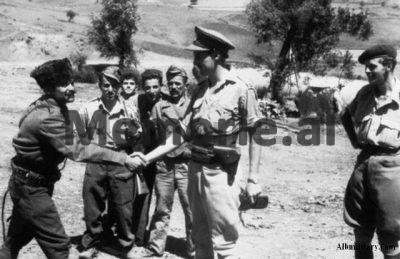
Memorie.al / Among the British officers who fought and directed war operations in Albania during the years 1943–1944, three of them were among the most active and who stayed the longest: Billy McLean, David Smiley, and Julian Amery. Initially, the first two arrived earlier in Albania, in April 1943, and formed the First Brigade. Later, they returned in the spring of 1944, to stay for several months near the headquarters of Abaz Kupi and his thousands of men. At the end of the war, the three officers drafted a memorandum of over 40 pages and presented it to the British Foreign Office, where they reported in detail on their missions.
Their memorandum is considered the most complete because they knew the terrain better than anyone else. They worked alongside both the communists and the nationalists, providing quite interesting details during their military work in Albania. In their lengthy report, they describe in detail the clash between nationalists and communists during the war, characterizing it as a genuine civil war.
Their presence near Abaz Kupi’s headquarters until September 1944 became a major problem for Enver Hoxha, who insisted on their removal, but the British officers described the military clash that began among Albanians after June 1944, when the communist brigades decided to cross the Shkumbin River and head north.
In today’s issue is the part of the report where the three British officers reported on the civil war, the last effort made by the nationalists to unite against the communists, as well as the reasons why the British did not aid them with weapons and ammunition.
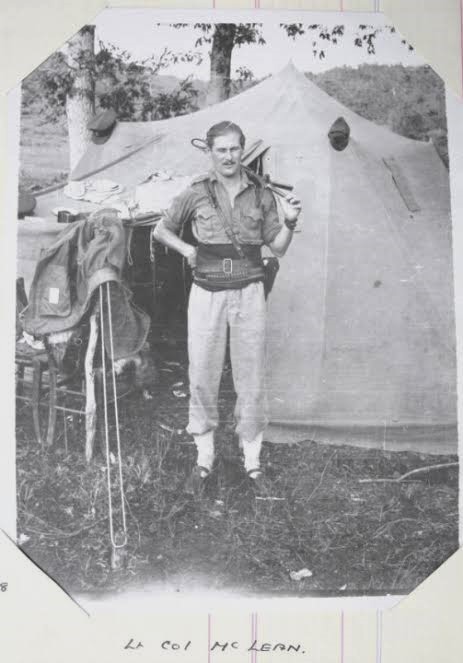
British officer Billy McLean during his stay in Albania. It is worth noting that after the war, all three officers had brilliant careers. Billy McLean would be elected as a member of the British Parliament, but would pass away prematurely in the 1960s.
David Smiley would continue his military career, being decorated many times, and would work for the Albanian cause. He trained hundreds of Albanians in Malta in the late 1940s, who were parachuted into Albania to fight against Enver Hoxha’s regime.
He would be among the first to return to Albania in 1991 and was a staunch pro-Albanian and anti-communist. He passed away in 2009. Julian Amery would marry the daughter of British Prime Minister Macmillan and would later be elected as a Member of Parliament and minister in one of the Conservative governments.
He was a committed anti-communist, who always raised the concern that Britain had not done enough for Albania, leaving it under communism. He would return to Albania in the 1990s, extremely proud that Albania had returned free and democratic. In 1994, Smiley and Amery inaugurated the cemetery of British soldiers who fell in the war, near the Lake Hills.
EXCERPT FROM THE MEMORANDUM OF THE 3 BRITISH OFFICERS: CIVIL WAR AND THE PROBLEM OF COLLABORATION WITH THE OCCUPIER
The offensive of the National Liberation Forces (National Liberation Front) against Kupi began on July 5, and from that moment, he remained in Lurë until the morning of July 7 to meet with Smith. Around the evening of July 7, he rejoined the main body of his forces near Burrel.
At that time, the National Liberation Forces had already occupied the entire Shupal valley, including Kupi’s central headquarters and half of Mat, thereby depriving him of most of the territory he had held and the source of his military potential.
This situation was serious, and after giving instructions for the defense of the western part of Mat, he hurried to break through the Qafë-Shtamë pass to go to his base in Luzë, in order to mobilize his remaining forces there for the defense of the Krujë region, which was now threatened by the National Liberation Forces near Bastar.
The NLF offensive against Dibër and Mat, which also threatened Mirdita, finally brought about the establishment of an alliance between Kupi, Gjon Markagjoni, Fiqiri Dine, and the Regency against the NLF.
It was precisely this alliance for which Mustafa Kruja, Mehdi Frashëri, and other collaborators of the Germans had worked in vain immediately after the capitulation of Italy, and now that Kupi’s military position was critical, it was the right time for a political initiative from the collaborators in Tirana.
As a result, negotiations are likely to have taken place in Luzë (July 11) between Kupi, Mustafa Kruja, Mark Gjonmarkaj (the son of Gjon Markagjoni), and representatives of Fiqiri Dine and Mehdi Frashëri.
No accusation of collaboration with the enemy was raised against Kupi during the period before the Luzë meeting, and there is no doubt that after September 6 he was in open conflict with the Germans. Consequently, it is precisely the period between July 11 and September 6 that is referred to regarding all these changes.
It is true that the danger of social revolution threatened by the NLF created a community of interest between Kupi and the collaborationist elements, and it is possible that the contacts that had always existed between them—just as had in fact existed between the collaborators and the NLF—had a less informative character.
It is also true that after the Luzë meeting, and likely as a result of it, Kupi secured 30,000 rounds of ammunition and on one occasion 20 trucks for transporting civilians, during which he rushed with his forces through Qafë-Shtamë, to somewhat relieve the situation in the Mat region.
In the following six weeks, he distributed bread rations to his troops, obtaining them from bakers in Tirana, for which his organization is likely to have paid. Naturally, the government was prepared to encourage Kupi’s campaign against the National Liberation Front, while the Germans are thought to have been satisfied with the fact that the NLF’s efforts were directed more against the Zogists than against German targets.
It is also likely that Kupi was aware of Fiqiri Dine’s decision to form a government with Zogist or Balli Kombëtar sympathizers, with the aim of using the state machinery against the NLF, while Fiqiri Dine later accepted the letter to secure cash and weapons from the Germans.
Such documents that fell into German hands give the impression that the letter considered Kupi a British agent, and generally, both in the military and political spheres, we were never able to understand that any collaboration with the occupiers on Kupi’s part would have been illogical.
He knew very well that his political position, apart from being based on local territorial influence, derived entirely from his good command of English and the fact that he represented King Zog, who was in England.
By collaborating with the Germans, whose defeat was in any case certain by that period, he would have immediately lost his reputation and would have been nothing more than one of the many collaborators of the occupier and an illiterate in this regard.” / Memorie.al