By Chris Deliso*
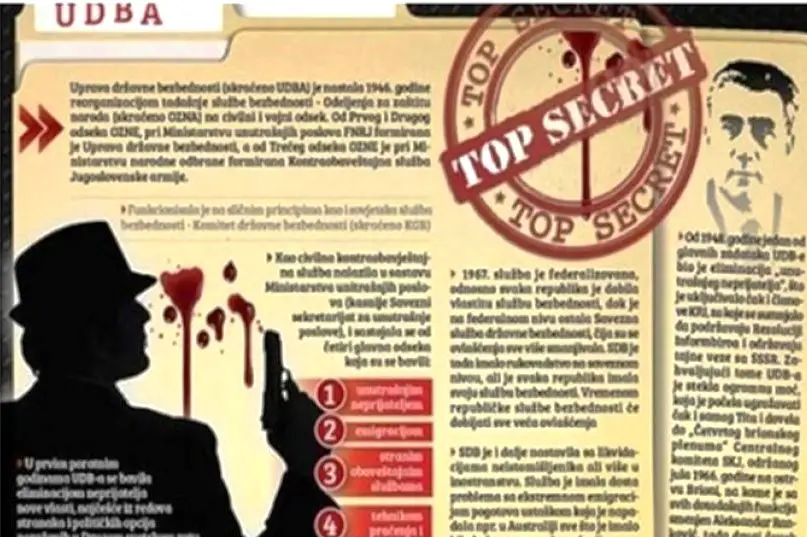
Memorie.al / The UDBA is perhaps the least known spy agency of the Cold War. It remains influential, despite the disintegration of the country it was formed to protect. The CIA, the KGB, Mossad, and MI6 are familiar names of secret services – inevitably opaque though they may be – that played major roles in the Cold War. Yet among the spy agencies that emerged from the ruins of World War II, the UDBA of the former Yugoslavia is hardly known at all. Formally dissolved after the country’s violent breakup in 1991, its legacy lives on in the form of deviated spies, business tycoons, politicians, and people of the next generation with family ties to the former communist regime.
The UDBA (“Uprava Drzavne Bezbednosti” or in Albanian, the “State Security Administration”) still has a well-known reputation in the Balkans. Political rivals accuse their opponents of having ties to the former agency, while “lustration commissions” in the former Yugoslav republics – Slovenia, Croatia, Bosnia-Herzegovina, Serbia, Montenegro, Macedonia, and Kosovo – have compiled voluminous lists of suspected informants, code names, and secret missions.
The purpose of these commissions was not to arrest people, but to identify informants so that they could be denied future employment. However, efforts to sever old ties and relationships in the former Yugoslavia have never had the same success as the efforts made in the countries of the Warsaw Pact.
Two reasons lie behind this. The first is due to the shrewd approach of Josip Broz Tito, leader of the Yugoslav partisan movement during World War II and founder of communist Yugoslavia in 1945. Seeking a balance between East and West, Tito built a “softer” communism than that established in other Eastern Bloc states. Although criticism of the regime was punishable, its citizens enjoyed greater employment opportunities and could travel anywhere with the Yugoslav passport.
The second is that, unlike the relatively peaceful independence processes of post-Soviet states, Yugoslavia descended into civil war during the 1990s, in which UDBA networks cooperated with each other, as well as with various foreign intelligence agencies, in the field of military intelligence and the increasingly corrupt business practices facilitated by war, international sanctions, and closed borders.
Now that the Balkans are peaceful, the UDBA’s violent excesses have for the most part been forgotten, allowing its clandestine elements to transform themselves into “respected” members of society, as professors, politicians, and businessmen.
How did the UDBA expand?
By 1945, Tito’s partisans had defeated not only the German and Bulgarian occupiers, who had invaded the Kingdom of Yugoslavia in April 1941, but also internal rivals, such as the nationalist Chetnik movement and the Ustaše. The country that Tito inherited – having expanded the borders of the former royal Yugoslavia – was largely agrarian, poor, and devastated by war.
Aside from the possibility of emigration, social advancement depended on joining the Communist Party, the army, or the UDBA. This phenomenon accelerated dissident emigration and created communist and UDBA dynasties that have managed to retain influence today. Tito had cemented his authority by 1946, reaching ad-hoc agreements with foreign leaders – a balancing act between West and East that would also include contacts with the developing world.
Yugoslavia became a founding member of the “Non-Aligned Movement” – a group of nations independent of any major power bloc – founded in its capital, Belgrade, in 1961. Through this relationship, Tito would expand his political ideology, business contracts, and intelligence capacities in all directions. However, internal and external threats remained.
As a consequence of Tito’s break with Stalin in 1948 – a time when civil war was raging in Greece, just south of the Yugoslav Republic of Macedonia – Bulgaria and Hungary appeared predatory. The difficult issue of Macedonia had caused conflicts for nearly 70 years, during the slow retreat of the Ottoman Empire from the Balkans. In 1934, a man from the Macedonian VMRO, aided by Croatian nationalists, had assassinated King Alexander of Serbia in Paris.
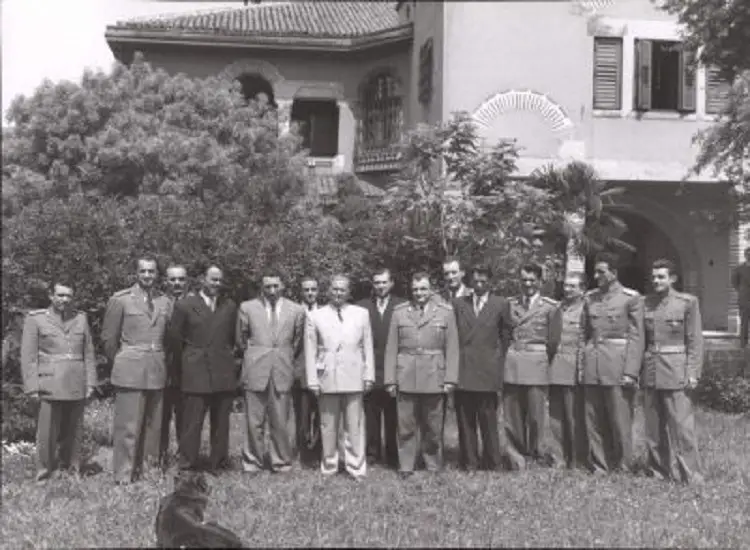
For Tito (who would also be targeted for assassination by Stalin in later years), creating a ruthless and efficient secret service was vital. The Yugoslav dictator found his man in Aleksandar Ranković, a Serbian partisan veteran whose wife and mother had been killed by the Gestapo. For more than two decades, until his dramatic fall in 1966 (due to suspected involvement in a plot against Tito), Ranković was the third most powerful man in Yugoslavia.
In 1944, he founded the OZNA (“Odeljenje za Zaštitu Naroda,” the “Department of National Security”), which in 1946 was transformed into the UDBA. The UDBA’s operations were shaped by perceived internal and external threats. Under Ranković, it maintained secret mountain depots of munitions, protected railway traffic, spied on foreign diplomats, wiretapped telephones, opened mail, and interrogated supposed internal enemies, from politicians to peasants who resisted collectivization.
Basic training at the UDBA’s official spy schools (headquartered in Belgrade) lasted two years and included physical training, language courses, military and diplomatic intelligence, and criminal investigations.
Black Operations
While he consolidated internal stability, Tito also traveled carefully abroad. Numerous rivals had emigrated or escaped after the war (including many Ustaše members, rescued by Croatian Catholic priests in Italy along Nazi “ratlines” to Argentina). The UDBA would be tasked with spying on such Yugoslav émigrés.
The UDBA’s black operations were affected after liberal protests in the West similarly erupted in the late 1960s in Yugoslavia. By 1974, the country had a new constitution, presented as an effort to appease restive nationalists by decentralizing power. The UDBA’s response to dissidence in the diaspora materialized in some of the bloodiest and most brutal assassinations – perhaps the greatest during the Cold War. Their methods were simple, efficient, and organized along ethnic lines.
Typically, the “task” would be delegated to the republican-level UDBA leadership of the target in question, using officials of the same ethnic background. After infiltrating the relevant diaspora circle, UDBA agents would encourage paranoia, infighting, and confusion through disinformation and rumors. This inevitably created local tensions, giving the Yugoslav authorities “plausible denial.”
After the assassination – usually carried out by the regime using small arms or a knife – the event could simply be explained as the result of rivalries within closed ethnic communities. The use of agents with criminal backgrounds further helped conceal any Yugoslav government involvement. Thus, local police often avoided investigating such cases, whether they occurred in Britain, West Germany, the United States, Canada, Australia, or South America.
However, the relatively lax approach to UDBA operations was not only a byproduct of ignorance, but also of different Western political perceptions of ‘soft communist’ Yugoslavia versus the Soviet Union’s ‘Eastern Bloc.’
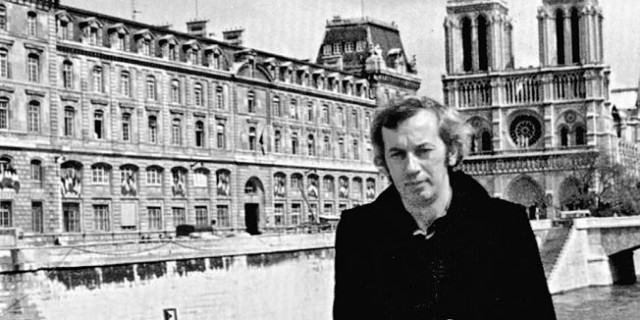
Thus, while the KGB-assisted infamous assassination of Bulgarian dissident Georgi Markov in London in September 1978 prompted a detailed investigation and extensive news coverage, few recall the assassination of Croatian dissident Bruno Bušić in Paris a month later. The lack of enthusiasm for official investigations, even when the UDBA was suspected, reflected the West’s perception that Tito was a useful ally against the Soviets.
Professional Actions
Many UDBA operations exceeded the limits of morality, such as the 1972 assassination of Croatian terrorist Stjepan Ševo in Italy and the murder of Serbian extremist Dragiša Kašiković in Chicago – killings that left innocent bystanders dead, including children. Other missions were notably more justifiable, as in the case of the 1969 assassination of former Ustaše commander Vjekoslav Luburić in Spain.
Luburić had overseen the Jasenovac concentration camp in Croatia during World War II, where hundreds of thousands of Serbs and Jews were killed. The UDBA considered its slow and patient penetration of Luburić’s émigré entourage to be a highly professional operation. During the 1990s, Yugoslavia descended into a series of bloody wars along ethnic and religious lines. The disbanded UDBA personnel steered the security structures of their nascent states, cooperating with their former colleagues across newly formed borders.
In a time of irregular warfare and international sanctions, there was considerable demand for those who knew the hidden locations of old weapons depots or who could arrange smuggling routes for oil and other essential goods through little-known border crossings. So, essentially, the UDBA became a decentralized criminal entity – a secret society hidden in plain sight.
Even today, among the populations of the former Yugoslavia, one can find former assassins drawing pensions, “nationalist” politicians with communist roots, businessmen of dubious wealth, and former agents acting as mercenaries for foreign powers. With wealth accrued from decades of privilege and, sometimes, criminal activities, the extended UDBA families are likely to continue thriving well into the future.
“Successor” States
The West’s lack of interest in the UDBA’s legacy was primarily due to the overriding imperative of regional stability after World War II. This required a tolerance of people who entered the security and political establishments of Yugoslavia’s successor states.
Despite occasional calls for investigations or local media exposés about former UDBA informants, too much time has already passed. The moment for “purging” former communist elements has long since passed. For better or worse, Yugoslavia’s infamous secret service seems destined to remain an enigma, even as its activities continue to resonate.
Chris Deliso is Director of Balkanalysis.com and author of Migration, Terrorism and the Future of a Divided Europe: a Continent Transformed (Praeger Publishers, 2017)
Prepared by: Armin Tirana