
Memorie.al / During the years of communist rule in Albania, the Communist Party led the country under the mask of the Democratic Front of Albania, which was the successor of the National Liberation Front, born in 1942 at the Peza Conference. In all elections for the People’s Assembly, the Communist Party of Albania (after 1948, the Party of Labour) presented itself as the leader of the anti-fascist coalition called the Democratic Front, at the head of which, after 1945 until 1989, was placed the First Secretary of the PPSH. Since the Front was a “big name,” or rather, a great disguise for the CP Albania, its history remains more a hidden history, treated according to the will of the party that ruled the country for over 50 years.
What was the Peza meeting of 1942 really?
The starting point of the National Liberation Front is considered to be the Peza meeting, commonly also called the Peza Conference. As in other cases, the Party of Labour falsified the entire history of the creation and other developments regarding this organization. The truth begins in the first months of 1942 and has as its first character, the brother of Myslim Peza, Shyqyri. The latter, in February 1942, accepted the fascist compromise, according to which, in Peza, the only force that would act to maintain order would be an armed group under his (Shyqyri’s) orders.
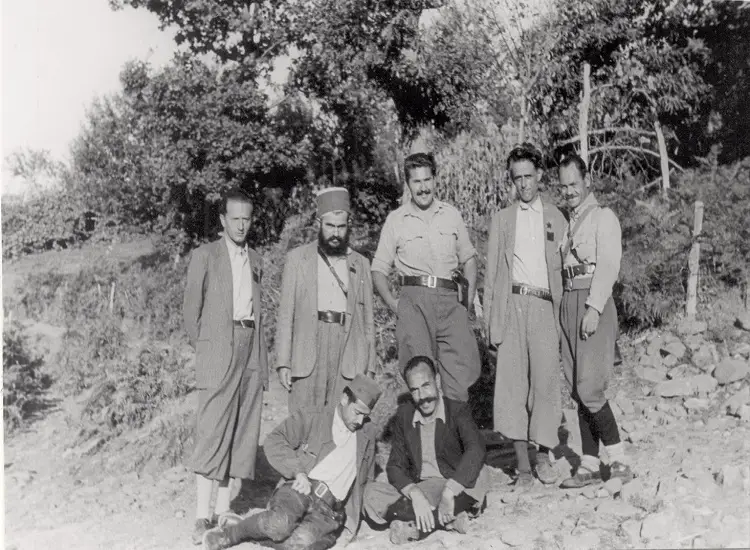
Myslim did not accept this compromise, but in fact, he benefited considerably from it (see Koço Tashko’s letter addressed to the Comintern in autumn 1942, in “Antinational Policy of Enver Hoxha, the Second Plenum of Berat,” Tirana 1995, pages 191-192). In this secure environment, the Peza Conference was held. Main participants in it were Abaz Kupi, Myslim Peza, Haxhi Lleshi, Mustafa Xhani, Ndoc Çoba, Ramazan Jarani, Halim Begeja, Ismail Petrela, Skënder Muço, Azis Çami, and Skënder Jegeni, while from the CP Albania participated: Ymer Dishnica, Mustafa Gjinishi, Koço Tashko, Enver Hoxha, Nako Spiru, and Nexhmije Xhuglini (later Hoxha). The chairman of the conference was elected Ndoc Çoba and secretary, Mustafa Gjinishi.
In the conference, the organization of forces in a common war against the occupier was discussed, an organization that was later named the National Liberation Front. Those present entered into debates regarding communist symbols, such as the red star, etc., which were not accepted by the non-communists.
A resolution was approved, in which it was stated that representatives of all nationalist tendencies, the CP Albania, the Communist Youth, the Nationalist Youth, and the Popular Women’s Youth, approved the respective declaration, which supported the coalition against the Axis, heavily accused Mustafa Kruja, and supported the struggle of those bands that had fought up to that moment, while on the other hand emphasizing the issue of national liberation councils. (“Antinational Policy of Enver Hoxha…”, pages 174-179).
The conference elected the General National Council, composed of Kamber Qafmolla (chairman), Mustafa Gjinishi (secretary), Ndoc Çoba, Myslim Peza, Abaz Kupi, Enver Hoxha, Ymer Dishnica (members). After the marginalization of Kamber Qafmolla, Omer Nishani began to be known as the leader of the Front. In this capacity, the latter also chaired the Front’s delegation at the Mukje meeting, while the National Front (Balli Kombëtar) was led by Mit’hat Frashëri.
The Transformation of the Front into a Facade of the Communist Party
After the rupture of the Mukje agreement in August 1943, in September 1943, the CP Albania definitively settled accounts with those it considered political opponents. Yugoslav communist emissaries played a major role, even after the Mukje agreement. The Second National Liberation Conference, held on September 4-9, 1943, in Labinot of Elbasan (the first being the one held in Peza on September 16, 1942), dealt mainly with the issue of power and separately, that of people’s councils, about which it was said that they were “the only power of the people in Albania.”
Likewise, a primary goal of the conference was the denunciation of the Mukje agreement, which seriously damaged Slavic interests in Albania. The main role here was played by Miladin Popović and Dušan Mugoša. Consequently, the Yugoslav model was copied and action was taken according to it.
On November 26, 1942, Tito had organized in Bihać, Bosnia, the First Meeting of the Anti-Fascist National Liberation Council (AVNOJ), where he decided on the creation of the Yugoslav National Liberation Army. Here, for the first time, it was foreseen what the third Yugoslavia would be like. Following the example of this meeting, the meeting in question was held in Labinot.
The Labinot Conference elected the General National Liberation Council, composed of 62 members (from the previous 7) and this had a presidency composed of 16 members. The presidency, which was placed in the role of an illegal presidency, consisted of these persons: Omer Nishani, Mustafa Xhani, Myslim Peza, Enver Hoxha, Kostë Boshnjaku, Ymer Dishnica, Ollga Plumbi, Liri Gega, Haxhi Lleshi, Fetah Ekmeçiu, Medar Shtylla, Nako Spiru, Sejfulla Malëshova, Ramadan Çitaku, Abaz Kupi, and Spiro Moisiu (Enver Hoxha “When the Foundations of the New Albania Were Laid,” Tirana 1984, page 329). After this conference, the civil war began. The Secretariat of the National Liberation Front consisted of Omer Nishani (president), Koçi Xoxe, Sejfulla Malëshova, Medar Shtylla (vice-presidents), Nako Spiru (secretary), Shefqet Beja (general secretary) (according to “Bashkimi,” August 7, 1945).
Reorganization of the Front after the war; Omer Nishani gives way to Enver Hoxha
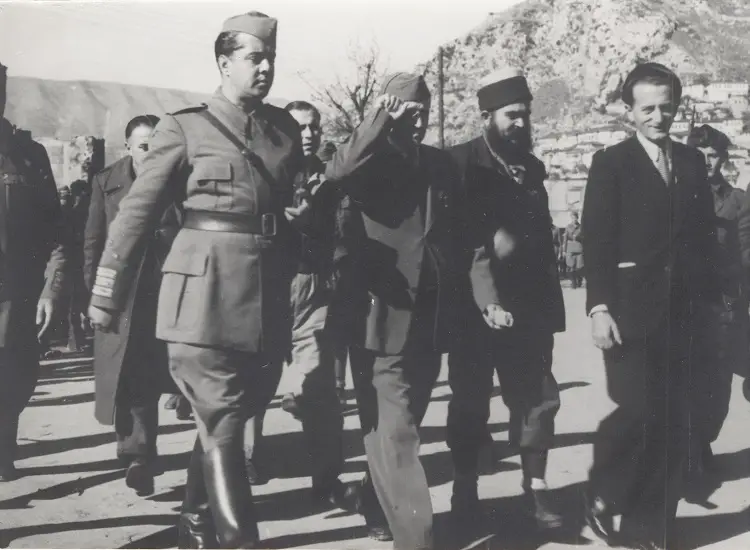
After the war, the role of the Front was the best mask for the CP Albania, which did not dare to come out openly as the leading force. On August 5, 1945, the first congress of the Front was held, where it was declared that the organization would continue to be an anti-fascist force. Present was the Yugoslav minister in Tirana, Velimir Stojnić. On the same day, the congress of the National Liberation Front of Yugoslavia also began; moreover, Koçi Xoxe proposed that a telegram be sent to them, which was accepted with pleasure and applause from those present (“Bashkimi” August 7, 1945), while Tito’s full speech at this congress was published (“Bashkimi” August 8, 1945). A day later, the chairman of the National Liberation Front, Omer Nishani, proposed that the future president of the Front should be Enver Hoxha (“Bashkimi” August 9, 1945).
This proposal was accompanied by shouts from the delegates, so much so that at one moment, they lifted Enver Hoxha onto their shoulders. After this, Nishani cheered for Enver Hoxha, the Front, the CP Albania, the Anti-Fascist Youth, the Anti-Fascist Woman, the Trade Unions, and the Albanian people. Revealing the future plan as well, Nishani said: in “conformity with the will expressed by everyone”: “Long live the Albanian Democratic Republic!” According to this, it became clear that the elections that would be held would be completely futile, because the form of the regime had already been decided.
On August 10, 1946, the newspaper “Bashkimi” appeared with the logo “organ of the Democratic Front,” as the organization’s new name would be from then on. After this date, a 7-point program was presented, which concerned the realization of the unity of all the people, the defense of independence and sovereignty, support for the new people’s power, the political organization of the Albanian people, broad economic and social reforms, and Balkan and wider cooperation, to strengthen the anti-fascist line.
In the Secretariat of the Front were elected:
Gen. Col. Enver Hoxha – President
Gen. Lt. Koçi Xoxe – Vice President
Medar Shtylla – Vice President
Shefqet Beja – Vice President
Sejfulla Malëshova – General Secretary
Behar Shtylla – Secretary
Fadil Paçrami – Member
Kolë Kuqali – Member
Selaudin Toto – Member
Of these, at various times, the following were declared traitors: Koçi Xoxe, Shefqet Beja, Sejfulla Malëshova, Selaudin Toto, Kolë Kuqali, and Fadil Paçrami. Only Enver Hoxha and Medar Shtylla remained “loyal.” Moreover, 4 of the “traitors” were sentenced to death.
In the Executive Committee, in addition to the secretariat members, the following were also elected:
– Gen. Maj. Bedri Spahiu
– Ymer Dishnica
– Nako Spiru
– Manol Konomi
– Col. Kristo Themelko
– Naxhije Dume
– Pandi Kristo
– Dom Luigj Pici
– Siri Shapllo
– Gjergj Kokoshi
– Abdyl Këllezi
It is a unique case that all of these were declared traitors, providing the most typical example of the years of the communist regime. In the resolution of the Front at the meeting in question, there was also talk of the Constituent Assembly, and the recognition of the communist government of Albania by the Yugoslav one was appreciated. On April 9, 1946, at the second meeting of the General Council of the Front, the statute and regulations of the Front were approved.
Because the first deviations and removals had begun, the Secretariat of the latter was reformulated, according to this composition: Enver Hoxha – President, Koçi Xoxe – Vice President, Medar Shtylla – Vice President, Hysni Kapo – General Secretary, Tuk Jakova, Gogo Nushi, Gaqo Tashko, Liri Belishova. Among these, others were declared “traitors,” including Tuk Jakova and Liri Belishova.
Meanwhile, the Executive Committee (which also included the secretariat members) was reformulated as follows: Nako Spiru, Pandi Kristo, Kristo Themelko, Naxhije Dume, Bedri Spahiu, Fadil Paçrami, Abdyl Këllezi, Ymer Dishnica, Manol Konomi, Kadri Baboçi, Nexhmije Hoxha, Haxhi Lleshi, Kiço Ngjela (“Bashkimi” September 25, 1946).
The keynote speech at the meeting in question was delivered by Koçi Xoxe. In the statute approved on this occasion, it was stated that the National Liberation Front was “a mass political organization, which gathers within itself all democratic and anti-fascist organizations and elements,” which had been born and had “led the masses of the Albanian people in the National Liberation War and is today the main force for preserving the victories of the National Liberation War and for building the new Albania.”
The General Council was the leading body, which elected the Executive Committee, and the latter elected the secretariat. The Congress was held every two years, and all citizens were members of the Front. In this meeting of the Front, the following were expelled from its ranks: Hysni Peja, Dom Luigj Pici, Kolë Rodhe, Suat Asllani, and Dan Kaloshi, who were accused of having worked against the Front (“Bashkimi” April 8-10, 1945).
Nexhmije Hoxha, the Penultimate Chairwoman of the Front
Enver Hoxha continued to be the chairman of the Democratic Front until 1985, when he died. His successor, not without reason, but symbolically and meaningfully, passed this function to Nexhmije Hoxha. On the eve of major democratic changes, Nexhmije Hoxha resigned for “reasons of age” and this duty was taken over by the “young” nearly 70-year-old Adil Çarçani, who also closed the nearly 50-year history of what was called the Democratic Front of Albania. / Memorie.al