By Shaqir Vukaj
Part One
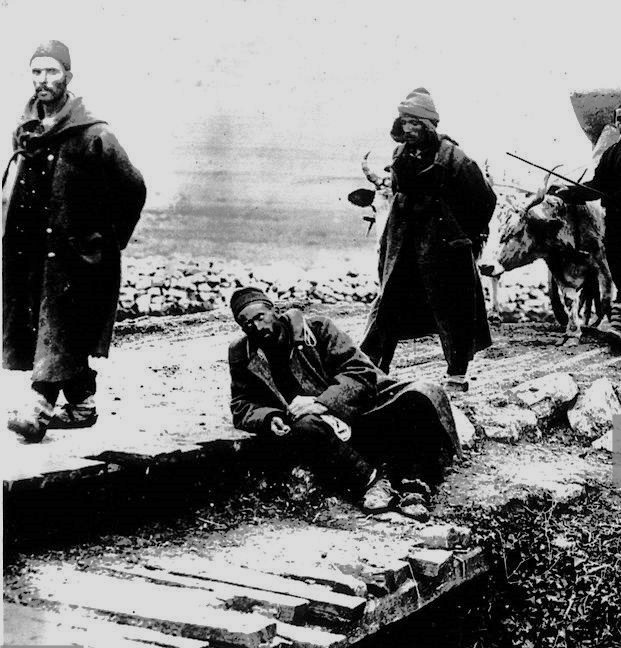
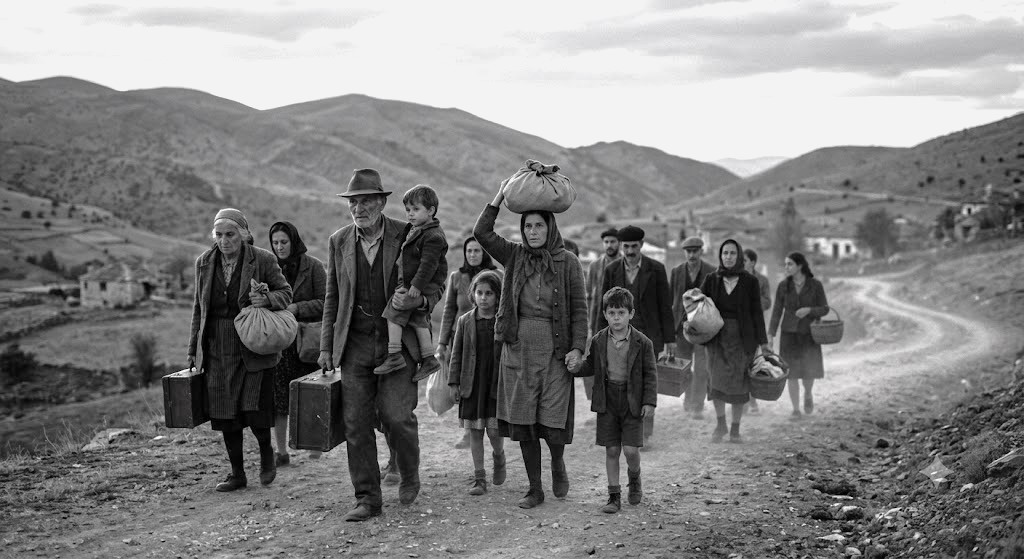
Memorie.al / Among the many Balkan problems, inherited from the past and unresolved to this day, is that of the Slavic-Macedonian emigrants or refugees driven out of Aegean Macedonia. The problem of the emigrants who left Aegean Macedonia is an old one and is connected, in the first place, with the division of Macedonia as a result of the Balkan Wars. According to the Treaty of Bucharest of 1913, the historical-geographical space of Macedonia, inhabited by various peoples and nations, was divided between Greece (51 percent of the territory – Aegean Macedonia), Serbia (38 percent – Vardar Macedonia), and Bulgaria (11 percent – Pirin Macedonia).
The number of Slavic Macedonians who left Aegean Macedonia is large, but in this writing, the focus is on the Macedonian political emigration (according to Skopje), Bulgarian (according to Sofia), Greco-Slav or Slavo-Greek (according to Athens) from Aegean Macedonia, who left (or were driven out) after the Civil War of 1946–1949 in Greece, much like the case of our Chams…!
As a result of the Balkan Wars, the disintegration of the Ottoman Empire, and, most importantly, the unfair decisions of the Conference of London, Greece was among the Balkan countries that expanded the most. Thus, referring to official documents, it appears that from 1900 to 1913 (after the decisions of the Conference of London), the territory of Greece almost doubled. In this way, from about 60 thousand square kilometers, it went to about 120 thousand square kilometers and, with the subsequent border changes in 1922; its territory reached about 131 thousand square kilometers.
Yet, from these same documents, it appears that the population growth up to 1907 was normal for the conditions of that time, compared also to the natural increase of population in the other Balkan countries. The major increase in the population of the Greek state and its near-doubling occurred in the years 1912–1913, precisely when its territory doubled. But the increase continued also in the following years, mainly as a result of the exchange of populations with Bulgaria and especially with Turkey, reaching, in 1928, 2.4 times more than in 1907.
Referring to the figures of the 1928 census, it appears that at this time only 38 percent of the population were Greeks (according to the 1907 census), while 55 percent were inhabitants of the added territories, as well as Greeks returned from other countries, so that the ethnic composition of Greece had completely changed, and particularly that of Aegean Macedonia. We note that during the population exchange with Turkey, a large part of the Muslims sent to Turkey were Albanians. According to many European scholars, in all the censuses conducted in Greece, the Arvanites and the Orthodox Albanians of Chameria were registered by official Athens as Greeks…!
The Slavs of Greece have lived for centuries in that part of the multi-ethnic Balkan space called Macedonia, which was included within the Greek territory after the disintegration of the Ottoman Empire and the Balkan Wars of 1912–1913, and which is known by various names: Aegean Macedonia, Greek Macedonia, White Sea Macedonia, and not infrequently as Southern Macedonia.
According to the statistics of the League of Nations, in this part of Macedonia, which constituted 51 percent of the territory of all of Macedonia and about 25.9 percent of the territory of present-day Greece, at the moment of its incorporation into Greece in 1913, there lived 43 percent Greeks, 39 percent Turks (this number includes Muslim Albanians), 10 percent Slavs, 8 percent Jews, etc. According to data provided by Sofia, in that period, there lived there 330 thousand Bulgarians, 314 thousand Turks (within this figure are included Muslim Albanians), 237 thousand Greeks, 44 thousand Vlachs, 66 thousand Jews, 15 thousand Albanians, etc.
The Slavic-Macedonians lived in certain regions, in a compact manner. In this part of Macedonia were born the creators of the Slavic alphabet, the brothers Cyril and Methodius, the founder of the Bulgarian Social-Democratic Party, Dimitar Blagoev, prominent figures such as Gotse Delchev, Hristo Smirnenski, the Prime Minister of Bulgaria in the 1950s, Anton Yugov, and many other well-known figures of Vardar Macedonia or Bulgaria.
Immediately after the union of Aegean Macedonia with Greece, Athens began to pursue a discriminatory policy towards the non-Greek autochthonous populations that had been included within the Greek territory, with the aim of their elimination or alienation, a policy that the government of Athens began very early on and has followed consistently to this day. Immediately after the Balkan Wars, as early as 1913, official Athens began the gradual removal of the Slavic population from Aegean Macedonia or its Hellenization.
Eleftherios Venizelos, in his program, had set as a task the assimilation and denationalization of the non-Greek populations, in order to create the “harmonious unity,” as he put it, with the other Greek territories…! For the Slavs of Aegean Macedonia, this policy, among other things, began to be concretized immediately, using all sorts of methods and pretexts. Alongside violence and other forms for its implementation, in 1919, with the agreement between Greece and Bulgaria for the “voluntary” exchange of populations, according to which tens of thousands of Slavs went from Greece to Bulgaria in exchange for the Greek population living in Bulgaria who returned to Greece (according to Sofia’s data, during this period about 90 thousand people went from Aegean Macedonia to Bulgaria).
The Treaty of Lausanne of 1923, between Greece and Turkey, for the reciprocal exchange of populations, brought a new wave of displacements. In implementation of this agreement, about 600–700 thousand Greeks went from Turkey to Greece, who was settled mainly in Aegean Macedonia, causing the population of Aegean Macedonia to reach nearly 1.5 million inhabitants and, most importantly, changing the ethnic ratio in favor of the Greek population over the non-Greek populations.
As a result of the denationalization policies, the population exchanges with Bulgaria and especially with Turkey, and the settlement of all the returned Greeks in Aegean Macedonia, it was achieved that by 1926, according to the data of the League of Nations, the Greek population in Aegean Macedonia not only increased significantly, but, most importantly, the number of Greeks grew, becoming dominant compared to the inhabitants of other nationalities (Slavo-Macedonians, Turks, Albanians, Jews, etc.) of this region.
Given that non-Greek populations and minorities had been included within the borders of the Greek state, in August 1920, the Entente powers signed in Sèvres the “Agreement for the Protection of Non-Greek Minorities in Greece,” which obliged Greece to respect “the interests of inhabitants who differ from the majority of the population in language, nationality, and religion.” Since official Athens did not recognize the autochthonous Slavs of Aegean Macedonia as Macedonians, but as Bulgarian Slavs, in 1924, through a protocol signed between the Greek and Bulgarian Foreign Ministers, the Greek Government officially acknowledged the existence of the Bulgarian-Slav minority in Greece and committed to recognizing its rights and freedoms, although, influenced by other factors, the Greek Parliament did not ratify this agreement.
Nevertheless, in implementation of the aforementioned agreement, for instruction in the mother tongue in schools, that same year the first primer was drafted and printed in the Slavo-Macedonian language, with Latin letters (Abecedari – as it was called then), but which, within the framework of the assimilation policy, was soon withdrawn from circulation…! In continuation of the assimilation policy, in November 1926, the law on the change of “foreign” names and the naming of villages, towns, etc. only in Greek, as well as the Hellenization of Slavic names, was approved.
During the Metaxas dictatorship (1936–1941), with a special Decree, the use of the Macedonian language was prohibited. Since the Slavo-Macedonians spoke only their own language, the government took measures to “teach” them to speak Greek. The elderly were forced to attend night schools, while children were forced not only to attend Greek schools but also to call themselves Greeks… It seems unbelievable, but this Decree was implemented until late, and only in 1980 was the use of the Macedonian language allowed, considered a Slavic dialect, but not officially recognized.
Alongside many facts, documents, and published materials regarding the assimilation policy towards the Macedonian Slavs in Aegean Macedonia, pursued by official Athens, the book “Fields of Wheat, Hills of Blood” by the Greek author Anastasia Karakasidou, Professor at Wellesley College in the USA, published in 1997 in the USA, speaks very clearly. Through many facts and documents, it convincingly demonstrates the denationalizing and assimilation policy pursued by Athens. This book is so revealing about Athens’ policy that, at the time, the Greek Ministry of Foreign Affairs made every effort to prevent its publication…!
During World War II, Macedonia was redivided once again. Bulgaria, as an ally of Nazi Germany, occupied a part of Vardar Macedonia and a part of Aegean Macedonia (a small part of this Macedonia, with an Albanian population, was given to Italy within the framework of the creation of Ethnic Albania). The Germans “kept” the other part of Aegean Macedonia for themselves, so that it was divided into three parts.
From the very beginning of World War II, the Slavs of Aegean Macedonia were involved in the anti-fascist resistance, also creating special partisan units. This war was experienced by them as a struggle for the final solution of the Macedonian problem. According to data from Skopje and Sofia, alongside the Greek partisan army, the Macedonian partisans of Aegean Macedonia constituted a considerable force in the war against the occupier.
During the Greek Civil War (1946–1949), the Macedonians of Greece massively supported the Democratic Army of Greece, and in the region of Western and Central Macedonia, the National Liberation Front (a politico-military organization) of the Slavic Macedonians was created, which during this period was very active. It had become well-known and its influence had increased throughout Aegean Macedonia. Certainly, Yugoslavia and Bulgaria played their roles, because despite the problems they had between themselves regarding the Macedonian issue, their leaders continued their work for the creation of a Balkan Federation or Confederation, where, according to them, Macedonia would be transformed from an “apple of discord” into an “apple of reconciliation” and where it was projected that Aegean Macedonia would also be included in this Federation or Confederation…!
The leadership of the Communist Party of Greece initially welcomed the organization and struggle of this Front, but within the Greek population (and even within the ranks of the Communist Party of Greece) there were different opinions and stances. The main issue was that slogans began to spread that this Front aimed at dividing the country and seceding Aegean Macedonia from Greece and uniting it with Yugoslavia. This forced the leadership of the Greek Communist Party to abandon and no longer support it, even to publicly declare that there was no connection between the Communist Party of Greece and the National Liberation Front.
…Referring to history, it appears that the Macedonian issue is old, but it has been particularly exacerbated with the creation of the independent Balkan states and their open emergence with territorial claims against one another. Alongside the Albanian lands, towards which Serbia, Montenegro, Greece, and even Bulgaria had claims, the struggle over the division of Macedonia was extremely fierce. To neutralize and regulate the problems related to the division of Macedonia, among other things, the idea had been put forward and the variant of forming a Balkan federal entity based on the historical-geographical territory of Macedonia was being worked on. The Macedonian federal variant aimed to neutralize the claims of Bulgaria, Greece, and Serbia towards the multi-ethnic space called Macedonia and which was considered the “apple of discord” of the Balkans.
Regardless of the ways of organizing this Federation or Confederation, before World War II, and especially after it, the leaders of the Yugoslav and Bulgarian Communist Parties, and after the war, of the governments of Yugoslavia and Bulgaria, were very active in realizing this idea. The leaders of the two parties and the two countries met several times, despite the problems and disagreements regarding the method of its creation. Attention is drawn to the fact that even the leadership of the Communist Party of Greece had initially expressed itself in favor of uniting Aegean Macedonia with the Balkan Federation. We emphasize that among the ideas and plans that were drawn up, there were those according to which, alongside Yugoslavia, Bulgaria, and Albania, even Greece (and in some cases Romania was also suggested) would compose this federation or confederation.
But Yugoslavia’s claims went so far as to have this so-called Balkan Federation or Confederation centered on Belgrade and directed from there. However, despite the work for the creation of this federation or confederation, before the war had even ended, Tito and the leadership of the Yugoslav Communist Party were planning that after the war Aegean Macedonia would be included within the Yugoslav state. An interesting fact draws attention. In the meeting held with Stalin in early January 1945 in Moscow, Tito’s special representative, A. Hebrang, presented to him the claims that Yugoslavia had against its neighbors (Bulgaria, Hungary, Italy, Austria, etc.).
To Stalin’s question regarding relations with Greece, he replied that Yugoslavia expected to take Aegean Macedonia from Greece, along with Thessaloniki. Stalin’s stance was extremely cynical, even categorically against, telling him, “You are creating a situation where you will be in a hostile position with Romania, Hungary, and Greece and you are preparing to fight the whole world. There is no sense in creating such a situation.”
We note that during World War II, in a material prepared by the Ministry of Foreign Affairs of the Soviet Union, regarding the future of the Balkans after the war, it was emphasized that Aegean Macedonia would be returned to Greece. But, at the same time, Moscow demanded the protection of the Slavic population in Greece. Attention is drawn to the fact that on September 1, 1946, just as the Greek Civil War had begun, the representative of the Soviet Union at the UN had raised the issue of protecting the Slavic population there.
The Yugoslav claims for the unification of Aegean Macedonia with this Federation or Confederation – a demand also put forward by the National Liberation Front – had caused fierce opposition from many layers of the population in Greece, including the Communist Party of Greece. The stance of the Greek communists gave official Athens the opportunity to increase propaganda among the Greek people against these stances, which also brought about the further isolation of the National Liberation Front. / Memorie.al
To be continued in the next issue