

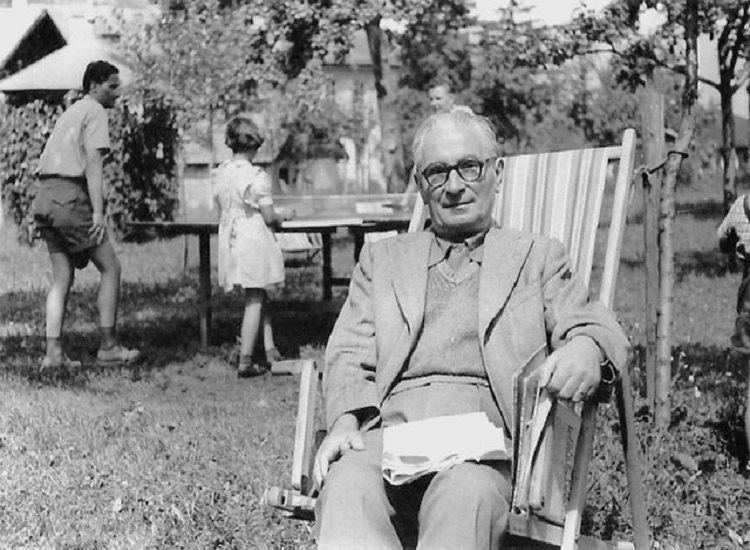
Memorie.al – At the end of March 2014, Hëna Këlcyra fulfilled one of her wishes: to bring back to Albania the remains of her father, Ali Këlcyra, and the remains of Eqrem Bej Vlora, who had lived with the Këlcyra family until the very last minute of his life. Eqrem Bej Vlora is buried in Vienna, while Ali Këlcyra is buried in Italy. The remains of Eqrem Bej Vlora were interred in Kaninë in a family ceremony under the care of the Ministry of Culture, while the remains of Ali Këlcyra were placed near the symbolic cemetery of the Këlcyra family in Këlcyrë, where Hëna has built a memorial for the members of her family who are no longer with them. In an interview she gave, Hëna recounted the final moments of Eqrem Bej Vlora in Vienna and how he died while writing his memoirs about Albania.
Please tell me about the last moments when Eqrem Bej Vlora died?
We lived together in Vienna, after my father’s death. We had spent only six months in Austria. At dinner, we called the emergency services, since Eqrem Beu was feeling unwell, and we went to the hospital, where I insisted on not leaving him alone. We entered the hospital together. The doctors wanted to run diagnostic tests on him; he spoke to me in Albanian, while with the doctor he spoke in German. The doctor told me it was the first time he had ever had a patient in such a health condition who could speak two languages perfectly at the same time. After an hour, I had the impression that he had recovered. I went to the room and asked the doctor. “Unfortunately, no. At most, he can survive until five o’clock,” he told me.
But what was the diagnosis?
Heart weakness. This had been diagnosed even earlier. Eqremi was 83 years old. Once, Eqrem Beu was supposed to undergo an intervention, but they told him his heart would be at risk if it were done. At that time, he managed to survive. The second time, he did not. One day, he had a heart problem, and this was confirmed by the top doctors in Vienna, with the support of Shaqir Kolonja, who was an Albanian doctor in Austria.
What happened at the moment when the doctor said he wouldn’t survive? Did you go home, or did you stay with him?
We stayed there. Even though they had given him only five hours to live, Eqrem Beu’s condition was normal. So we talked. He gave me instructions that the funeral expenses should be paid from the money he had. He asked me that, if it wasn’t enough, I should add my own, but not to ask his sisters in Italy, or others. But if there was any money left over from what he had, he told me to send it to his younger sister, who lived in Albania.
Did you stay with him in the hospital room?
Yes, I stayed in his room. It was a second-class room. Uncle Eqeremi kept apologizing for keeping me awake and for the trouble. Even though I told him I wasn’t upset, he said: “I can see it, because you’re pacing around the room.” When five in the morning came, he asked me what time it was. He kept asking me for the time all through that night. When I told him it was five o’clock, I realized that Eqerem Beu had heard the doctor when he said that, at most, he would survive until five o’clock. But in reality, he fell into a coma around eight o’clock that same morning. In total, he stayed in the hospital for 12 hours. After five o’clock, two of my Austrian friends came. I left him with them for 10 minutes and called my sisters, my mother in Rome, and the family to tell them about his health situation. At that time, my mother had been staying in Rome for six months, after my father’s death.
How old were you?
I was 27 years old when Uncle Eqrem died.
Did you ask him where he wanted to be buried?
He told me: “you decide.” Of course, I decided that he should be buried there. I returned to the room and waited for him to pass away.
Did he suffer much in his final moments?
No, only that he wanted to get up from the bed. In fact, they wanted to tie him down. But I told them: leave him, he wants to get up, let him get up. Then they took him.
What were his last words?
I told you, he was thanking me and apologizing for having troubled me.
Did he say anything about his family?
The only words he said to me were that the money left over from what he had in his bankbook, after the expenses I would incur for the funeral, should be sent to his sister in Albania, for her daughter.
Did Eqrem Bej Vlora leave a dying wish (amanet)?
No, he didn’t.
What was his regret?
No, I don’t know. I had been with him twice in the hospital. The first time made a bigger impression on me. I had been working in Germany for two or three months, and he wrote me a letter, telling me he wanted to have surgery, that his life was in danger, and he asked me to take the necessary steps to find him a hospital. I was surprised then: “Why would you come to Germany and not go to Italy, where you have your two sisters and my mother?” And he told me: “If I die, I want to die in your hands. But above all, I do not want to be buried on Italian soil.” He didn’t want to be buried in Italy.
But why not on Italian soil?
Neither he nor my father, Ali Këlcyra. It wasn’t a topic we opened, because we knew what the situation was like in Albania.
How did the funeral of Eqrem Bej Vlora take place?
They put him in a morgue, because a cemetery had to be found. A problem arose, because a few days before he died, Uncle Eqeremi had gone to the cinema to watch a film about Freud. The film started with Freud, a student in Vienna, who was from the old faith (Jewish), visiting the great hospital of Vienna, where these various religious communities are located. Watching the film, he told me: “What an ugly cemetery this is…?! I would never want to be buried in this place.” After his death, accompanied by a friend of mine who worked at the American embassy, we went to these offices to take the necessary steps, because Eqerem Beu did not have residency in Austria. He was a guest in my house; he had lived with me and my parents for eight years in Italy. So finding a grave was problematic. It took me a day to find one.
From the day he died, how much time passed until he was buried?
He died on March 30, and the funeral was held on April 4.
In the cemetery he didn’t want…?
The funeral took place in one of the most beautiful cemeteries in Vienna, in “Neustift Am Walde.” His brother, his brother-in-law, and my mother also came. From Italy, Mr. Boçari also came, an Albanian from Vlora who had been captured by the Germans.
How did the ceremony go?
With Muslim rites. Present were me, my mother, his brother, my mother’s brother, Mr. Boçari, and a Kosovar from Belgium, who represented Kosovo. There was my Austrian family and Mr. Shaqir Kolonja.
Meaning, there were no more than 10 people attending the funeral?
No. That’s how many of us there were. / Memorie.al