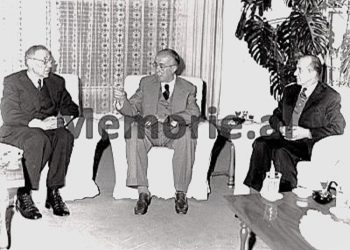


Memorie.al / Esat Myftari, former deputy of the Albanian Parliament, “Kosovar emigrant” and former political prisoner in Enver Hoxha’s prisons, in his book “Kosova and Enver Hoxha”, published some time ago, brings to light unknown events and facts emerging from the Archive of the Ministry of Foreign Affairs. This book mentions the Albanian nomenklatura of Kosovo, such as Fadil Hoxha, Ali Shukria, Veli Deva, Xhavit Nimani, Ismet Shaqiri… who had personal acquaintance or friendship with the dictator. Myftari provides a professional treatment of this part of history, using archival documents that testify to an extraordinary alignment of the Serbian secret service with the Albanian regime during the years of Enver Hoxha’s leadership. This new euphoria of meetings and communications with former Yugoslav fighters was taking a strange development and began to be considered, to speak in today’s language, as a kind of soft power to blunt the political arrogance of the Yugoslav leadership in the process of “reconciliation”.
Excerpt from the book “Kosova and Enver Hoxha” by Esat Myftari
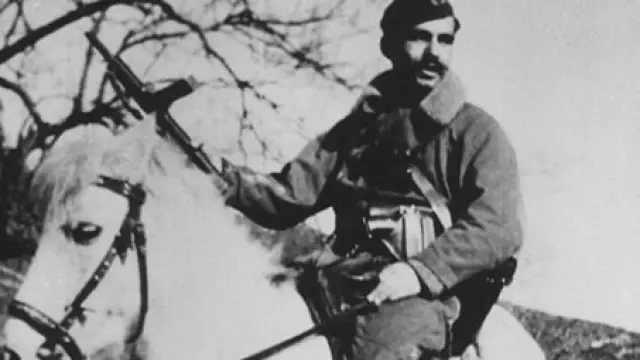
Prime Minister Mehmet Shehu, former volunteer of the International Brigades in Spain, recalled that there he had met many Yugoslav comrades, with whom he had shared not only the same ideals but also moments of friendship and human solidarity. And he was overcome with a sense of pride because one of them, Ivan Gošnjak, had managed to become Minister of Defence of the Federal People’s Republic of Yugoslavia.
Therefore, he prepared a package with a photo album from Spain and two letters addressed personally to Gošnjak. Mr. Karafili was entrusted with delivering these gifts. But he was received by Gošnjak’s first deputy and also the general secretary of the former Spanish fighters, on the pretext that the minister had no free time. As the host explained, there had been several thousand Yugoslav volunteers in Spain, and he had known Mehmet in Spain and had spent difficult days together with him in the French internment camps, right after the war.
But what surprised Mr. Karafili was the host’s claim that in Yugoslavia these volunteers, in certain party circles, were considered suspicious, as Gestapo men. Our ambassador did not know that this kind of accusation was not based on any evidence and was simply an epithet attached a priori to any communist who had had the misfortune to pass through fascist camps. For Stalin and his comrades, there was no one who could withstand the trials of such camps; therefore, those who came out alive from that hell had to be physically eliminated as dangerous, if not as traitors, or, in the best case, purged from the Party and the delicate state structures.
Slovenia had many such examples. Even in communist Albania, the group of Spanish volunteers had been marginalised from the very beginning of “people’s power”, but they were not burdened with similar accusations. It is very likely that this was due to Mehmet Shehu. This kind of rapprochement was thought to have other benefits as well. Karafili had several times received assurances from Yugoslav diplomats that the Balkan Pact, which had once caused strong reactions in the Albanian government, was gradually losing its raison d’être, as the international political climate was softening and the very spirit of Yugoslavia’s non-alignment was spreading to all continents, especially among peoples breaking away from former colonial powers and aiming for a kind of comprehensive independence.
In the judgement of the Albanian government, such a reality did not tempt it as its own positive orientation, but it brought with it the emergence of Albania from its island-like position. And that was no small thing, especially in the context of the new Moscow-Belgrade ties. Carried away by this momentum, for the November 29th holiday the Albanians proposed that an ordered article, written by the Yugoslavs themselves, be published in the newspaper Zëri i Popullit, while a similar article written by the Albanians is published in the newspaper Borba. But the Yugoslavs refused.
They considered it excessive intimacy…!
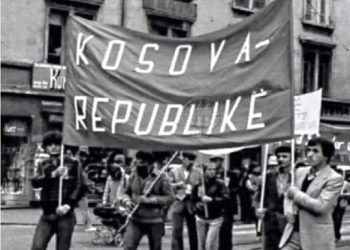
In Kosovo, there was a moment of hope that the Albania-Yugoslavia rapprochement was a good framework for also drawing closer to Kosovo. It was not like in 1946, when Enver had visited Belgrade and other parts of Yugoslavia, but without going to Kosovo. At that time, he was understood: everyone knew he had no face to go there, to a Kosovo filled with Kosovar victims at the hands of the Slavic-Orthodox communists.
The only person for whom it would have been worth going down there would have been Milladini [i.e., Milladin Popović? or a Kosovar figure?], but even that pleasure had been cut short by the “Kosovar fanatic” Haki Taha, as he was accustomed to calling him, and with this aggravating charge he had even put him into school textbooks. Therefore, he contented himself with the legend that Milladini’s mother had gone to Belgrade, had met Enver, and had whispered in his ear that the real killer of her son had not been an Albanian! A tall tale that, before that, General Rahman Perllaku had served to Enver when he returned from Kosovo as his confidant. But it soon became apparent that Enver had other interests and that the Kosovo problem was not on his agenda.
The second rupture of relations with the Yugoslavs
As stated at the beginning of this chapter, the rapprochement with Yugoslavia was not a personal initiative of official Albania. It was a corporate initiative. Therefore, the development of these relations had necessarily to pass along two tracks: one of harmonisation with the collective stance of the camp, where problems were more theoretical and political, and the other, which was bilateral, filled with national and personal events and episodes.
The Yugoslavs, convinced that they enjoyed the sympathy of the rest of the camp – the assessment prevailing that the others had taken upon themselves all the blame for its expulsion from the Cominform – were giving more and more signs that they could not endure Enver’s “procrastinating and evasive” tactic. As seen above, the formal centre of this new showdown was not only the rehabilitation of Koçi Xoxe, but now also the entirety of the PPSH’s [Albanian Party of Labour] accusations from 1948.
Therefore, they judged the time appropriate to begin a series of disorienting declarations towards the Albanian leadership, sometimes with allusions and sometimes with direct blows. For this reason, the strong statement of those days by Vidić [Dobrivoje Vidić], Secretary of the Yugoslav Secretariat for Foreign Affairs, saying that: “The normalisation of our relations has only just begun, but normalisation has not yet been achieved. Economic, cultural and other activities cannot be carried out without clarifying the period after 1948. The Soviet Union and the other people’s democracies have clarified this period and have rejected the fabricated accusations against Yugoslavia. The statements of your leaders are good and please us, but they speak about the future and do not clarify the past,” was interpreted as the beginning of a new campaign. While others, like Vlajko Begović, did not hesitate to use also diversionary means, albeit quite primitive: “…We consider Comrade Enver as the best comrade, but he is surrounded by people who hesitate regarding us, for example, Mehmet Shehu.”
In the end, when it became clear that these kinds of tricks were not igniting anything, they moved to a system of boycott and isolation of Albania, to expose it as guilty in the eyes of the people’s democracies for the failure of Albanian-Yugoslav relations to progress at the desired pace and showdown – an exchange of letters, a test of strength (author’s note) – in the “required” direction.
The modalities were so vulgar that they even violated the rules of elementary politeness. Our diplomat Lako reported with great concern that at the reception organised by the Yugoslav embassy in Bucharest, where a film and a buffet were offered, all the heads of the diplomatic missions of the camp had been invited, except him, and that this was happening to him for the first time. Meanwhile, from our embassy in Paris, a completely scandalous case was reported, where the Yugoslav diplomats, with their chief, the well-known Slovene Aleš Bebler, implemented the so-called protocol of humiliation:
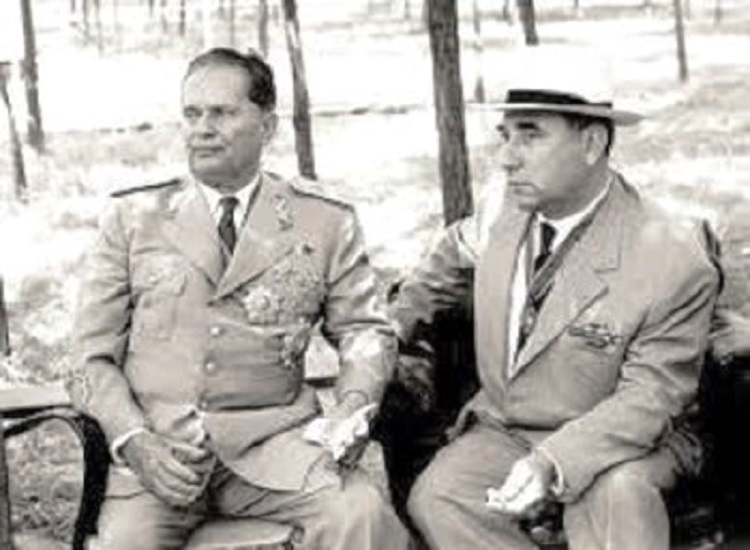
“At receptions, they greet all the friendly heads of mission, but they turn their backs on us.” But the peak of this tactic is reached at the reception Tito gave to our minister in Belgrade. As Karafili relates: “The conversation lasted 15 minutes. During the visit, Tito also had Vilfan [Vladimir Vilfan?]. The reception was cold. He served the drink and when he said goodbye he turned his head away. All the heads of missions who have left, he not only received them but also kept them for lunch or dinner.”
Only after this report was it judged that the cup had overflowed and that the Yugoslavs deserved some kind of counter-response. For the November 29th holiday, our embassies received orders to respond in case of provocations with words or deeds. By now, the rupture of relations could be felt in the air. But just as the first time, so now, the cause of the official rupture of these relations, in essence, came from outside. In both cases, to Enver’s benefit. The failure of the Hungarian “counter-revolution” and the rupture of Belgrade with Moscow had become a fait accompli. As a consequence, all the countries of the camp would inevitably follow that path.
In fact, Tito’s pressures and his unusual haste had precisely this direction of events in mind. He wanted to bring Enver to his knees before the Nagy-Khrushchev duel ended. Just as Enver was not playing the delaying tactic for nothing. He too was sufficiently aware that fortune could turn in his favour, because it had become clear that the West had left Hungary in the mud. Another trigger for deepening polemics was the escape on 16-17 May 1957 of Panajot Plaku to Yugoslavia. The Albanian government immediately requested his extradition and objected to the granting of political asylum by the Yugoslav side.
But Dobrivoje Vidić rejected the accusation that Panajot had taken secret documents with him. He declared that before Panajot’s arrival, no one had known him, and that, based on the laws in force; he could not carry out any activity against other countries or Albania. Naturally, no one believed this claim of his, but everyone knew that the Albanian government had not been “nobler” in this regard either.
Meanwhile, that the rupture was becoming truly irreversible became clear only when the polemical baton passed to the press. A special role was assigned to the Pristina newspaper Rilindja, which began with reportage articles and then published the report of Xhavit Nimani, in which it was stated: “The only country that has remained aside from the stabilisation process is Albania. There, not only have they not begun to correct the old mistakes, but they continue constantly with the old policy and the methods of the fateful year 1948.” In particular, well-known Yugoslav caricaturists were mobilised.
The satirical newspaper Jež (The Hedgehog) showed Enver Hoxha with binoculars following the Bucharest meeting from Tirana. Below, in the caption, it was written: “You have forgotten the greatest Marxist!”. Even Rilindja, treating the same theme, published another caricature with a very sharp nuance: on one side, the participants of the Bucharest conference, and on the other side, Enver Hoxha dressed in military uniform and with his boots removed, entering a mosque.
The rupture of relations was now branching into all fields of mutual communication. In diplomatic vocabulary, they moved from “comrade” to “mister”; the Yugoslavs deemed reasonable the expulsion of the second secretary of the Albanian legation in Belgrade, while on our side the foreign minister issued an order to his subordinates, stating: “The Yugoslav legation has had an incorrect attitude from the beginning. We categorically advise you that, in case of meetings with Yugoslav representatives, you should stay strictly within protocol conversation and avoid any unnecessary contact.”
Nevertheless, Mr. Karafili was not upset. In fact, he seemed to have an inner joy, because events had taken this course. Besides that, there was also the new Russian ambassador in Belgrade, Firjubin [i.e., Mikhail Firyubin], who consoled him: “Here a great campaign has been undertaken against the Soviet Union. In Belgrade,” he says, “for this purpose there were as many as 118 lectures. There has been pursuit, surveillance. Therefore, in this situation it is good not to make visits, because they are likely to concoct a provocation.”
Faced with this new Yugoslav propaganda attack and the inevitable rupture of relations, the Albanian state remembers its reserve weapon, Kosovo. The Albanian press publishes several writings about the displacement of Albanians to Turkey, also reminds of the fact that while efforts were being made to normalise relations during the years 1954-56, monstrous tortures had been used against Albanians in Kosovo in the criminal action of collecting weapons.
“Zëri i Popullit” published an article also about the London Conference, which dealt with the injustices of the Great Powers towards the Albanian nation, from which Serbia and Montenegro had benefited. But the writing was merely in the form of a historical memento. And Belgrade had known this trick of official Tirana for years, so it laughed under its nose. Moreover, in its mocking game, Belgrade brought to the forefront the Albanian leader Xhavit Nimani, who, without a shred of shame, declared publicly that in Kosovo there had been neither a weapon-collection action nor a displacement to Turkey.
As can be seen, in the turbulent years 1953-57, due to the cheap Yugoslav attacks, without any international restraint from their Eastern ideological brothers, Enver’s positions were shaken considerably. Moreover, even within the circle of his own Party, forces had been activated that had taken the courage to challenge him publicly, so he “had no time” to deal with Kosovo, despite the fact that it had been subjected to the bloody campaign of weapon collection. There are those who think that precisely for this reason Yugoslavia had increased pressures on him in order to impose his silence on Kosovo and create an alibi for itself before history.
The only Albanian factor that had raised its voice against this new Serb-Montenegrin barbarism was the “Albanian reactionary” press through its own organs Shqipëria e Lirë, Besa, etc., and its prominent leaders who landed in Turkey hoping to prevent the suffering and the new Albanian haemorrhage.
That heavy post-war atmosphere had returned, when Kosovar Albanians disappeared without any accountability and official Albania did not feel alive even in those cases when it was not a direct co-author with them. But this government had the kindness to read these organs of “reaction”, to take notes from them, because they would be needed for the propaganda after the new rupture with Yugoslavia. The same thing had happened also after the 1948 Resolution.
In its propaganda, the PPSH and the Albanian press exploited the quite exhaustive materials of people like Xhaferr Vokshi, who had come to Albania as a political emigrant and, because he had been part of the regional leadership, was fully aware of the games and crimes of the Serbs in Kosovo and had summarised them in a voluminous report deposited at the Ministry of Foreign Affairs / Memorie.al